

james
1.3K posts
今天,被讨论得最多的就是空军一号起飞前,要求所有人将中国所赠礼品交出,放置于一巨大的垃圾桶里,很多人将此视为对中国的外交羞辱,其实这次事件只因社媒发达才被广泛讨论,这是美国安保惯例,而且是在“金唇事件”上吃过大亏之后的亡羊补牢之举。
1945年,二战最后数周,一群俄罗斯少先队员在美国驻莫斯科大使官邸——史帕索馆(Spaso House)——向美国大使献上了一枚手工雕刻的美国大纹章。
这份礼物象征着战时的美苏合作,美国大使埃夫里尔·哈里曼(W Averell Harriman)也自豪地将它挂在宅邸里,一直保存到1952年。
然而,大使和他的安保团队并不知道,这枚大纹章里藏着一个秘密窃听器。美方技术人员后来将它称作“金唇”(The Thing)。它在毫不被察觉的情况下,监听了外交对话七年之久。bbc.com/zhongwen/artic…
在华府的国际间谍博物馆参观时,我见过这枚The Thing的实物。去华府时,除那些人皆要去的地方,还有两个必须要去的地方,这是其一。
中文
james retweetledi
james retweetledi

Japanese and Americans are not the only foreigners in China. She is conflating the fall of American and Japanese soft power (world wide) with China's treatment of foreigners.
China's reception of foreigners has indeed improved over the past 8 years. Gone are, for example, signs of "no more than 5 foreigners allowed at the same time on premises" from Beijing's Wudaokou establishments cca 2016.
But she wouldn't know that anyway.
Yoko Kubota@Kubota_Yoko
I left China after eight years. Here's what I experienced as a Japanese person reporting for an American outlet, at a time when a distrust of foreigners has come to permeate everyday life in China. wsj.com/world/china/im… via @WSJ
English
james retweetledi

Let me explain to you why Chinese people distrust you, with a famous Chinese song lyric: "When friends come, we welcome them with good liquor. When jackals come, we greet them with our hunting rifle."
The Wall Street Journal@WSJ
“I can’t shake the sense that something fundamental in China has changed.” Journal correspondent Yoko Kubota reflects on how a distrust of foreigners has come to permeate everyday life in China. 🔗 on.wsj.com/4n93KP3
English
james retweetledi

#Comment:
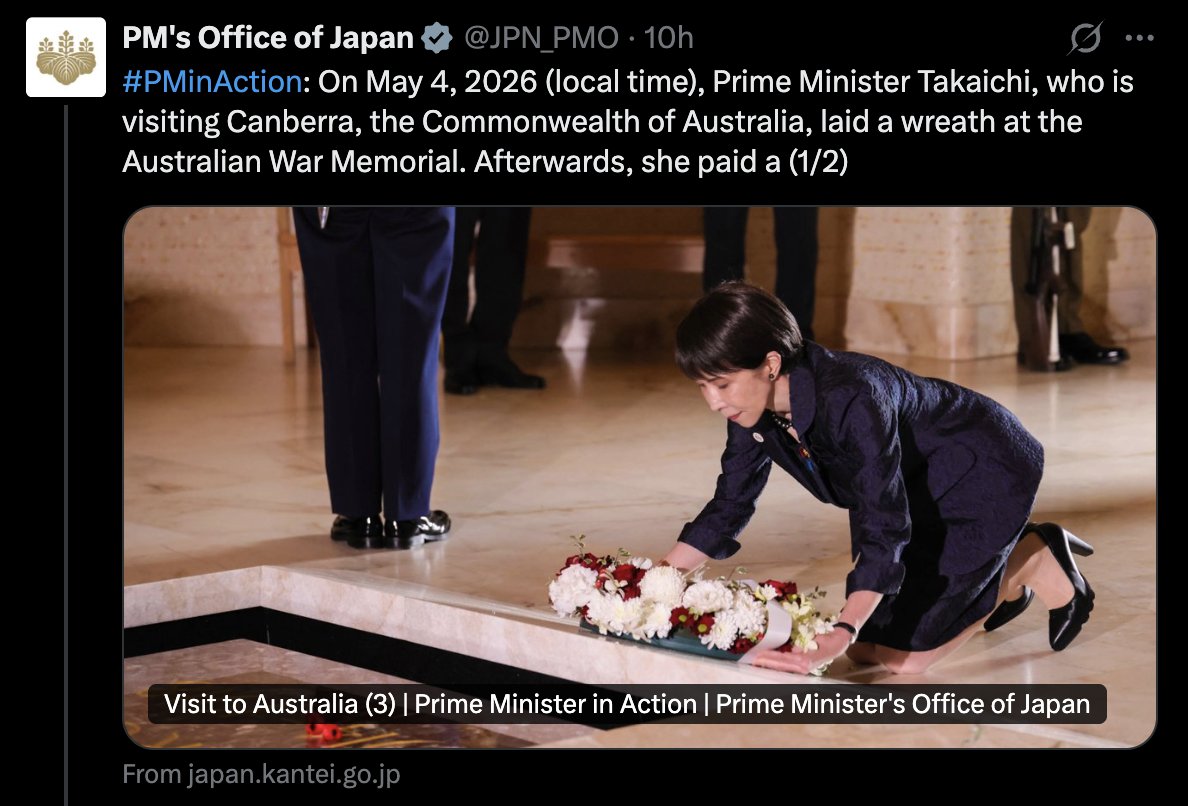
As it turns out, sitting 🇯🇵 prime ministers are perfectly capable of kneeling in the physical sense — yet they still owe the people of all Asian countries victimized by 🇯🇵 colonial rule a sincere kneeling act of atonement they have never made.
Take a closer look: Sanae Takaichi merely knelt in 🇦🇺 to arrange a wreath. Coupled with the Takaichi administration’s recent string of moves toward neo-militarism, Takaichi’s kneeling is all the more alarming to clear-eyed observers.
PM's Office of Japan@JPN_PMO
#PMinAction: On May 4, 2026 (local time), Prime Minister Takaichi, who is visiting Canberra, the Commonwealth of Australia, laid a wreath at the Australian War Memorial. Afterwards, she paid a (1/2) japan.kantei.go.jp/105/actions/20…
English
james retweetledi

It's dishonest and non-professional to conflate "distrust of a Japanese journalist who covers national security in China" with a permeating "distrust of foreigners".
In modern history, China has suffered too much from foreign spy who use "journalist" as a cover-up.
The Wall Street Journal@WSJ
“I can’t shake the sense that something fundamental in China has changed.” Journal correspondent Yoko Kubota reflects on how a distrust of foreigners has come to permeate everyday life in China. 🔗 on.wsj.com/4n93KP3
English
james retweetledi
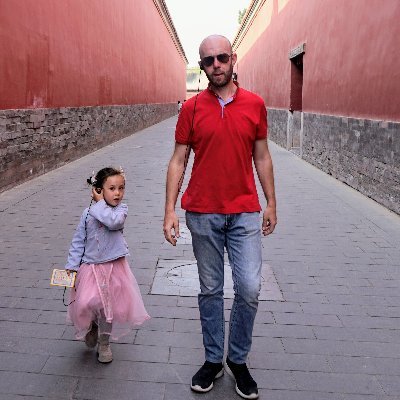
What a ridiculous assertion. China has, factually, never been so open to foreigners as it is now: they recently increased the number of nationalities that can visit entirely visa-free to 50, you just book a plane ticket and show up at the airport.
Compare this to 10 years ago and it's WAY more open.
The Wall Street Journal@WSJ
“I can’t shake the sense that something fundamental in China has changed.” Journal correspondent Yoko Kubota reflects on how a distrust of foreigners has come to permeate everyday life in China. 🔗 on.wsj.com/4n93KP3
English
james retweetledi

🇯🇵 Japanese Wall Street Journal Reporter Leaves China After 8 Years: Blames “Suspicion of Outsiders” While Ignoring Imperial Japan’s Record
WSJ’s Yoko Kubota has published her “I’m leaving China after 8 years” essay blaming rising suspicion of outsiders.
She is Japanese, a former Tokyo auto reporter who has now moved to Washington DC as the paper’s National Security Correspondent. This was a standard career rotation after serving as deputy bureau chief in Beijing, not a flight from hostility. Her own LinkedIn post described the eight years as “unforgettable” and a “privilege.” The dramatic framing serves Western readers who expect “China turning nasty” narratives.
Consider the details she highlights. The BYD driver calling a map a national secret and lecturing her on Taiwan was not random xenophobia. That reflects a Chinese citizen whose family lived through Imperial Japan’s invasion, an estimated 14 to 20 million Chinese dead, the Nanjing Massacre of 200,000 to 300,000 civilians and POWs in weeks and Unit 731’s horrific biological experiments including live vivisections and plague attacks.
Japan has never delivered the full reckoning Germany did. Yasukuni Shrine still honours war criminals, textbooks soften the record and current Tokyo policy aligns with US containment, sailing warships and framing Taiwan as a survival issue for Japan.
The anti-espionage campaign she portrays as paranoia is a defensive response in Cold War 2.0. US chip bans, export controls, talent recruitment drives, public CIA spy ads and dual-use tech operations prompted Beijing’s measures. Raids and sentences target genuine risks to sovereignty, not blanket distrust of foreigners.
School decisions on Christmas or news apps highlighting overseas incidents represent cultural self-assertion after decades of Western soft power, the same Western media that frame Chinese achievements as threats and Chinese setbacks as systemic collapse. In Chinese cities, Africans, Russians, Koreans and others continue to live, trade and study with opportunity. Occasional caution, such as the Samurai Blue fan hiding his jersey, stems from bilateral tensions rather than everyday hatred. That the fan loved Japan enough to wear the jersey but felt unsafe showing it publicly tells you something has gone wrong in the relationship and Kubota frames the symptom as the disease.
The 2024 Shenzhen incident was a tragedy. A child died. No contextualisation erases that. Chinese authorities caught, tried and executed the perpetrator, an outcome that would be called swift and decisive if it came from a Western capital, but is largely ignored in Western coverage. It was also, by every available measure, an isolated act that does not reflect how millions of foreigners live and move through China without incident.
What Kubota also doesn’t address: the source-drying-up she describes is the predictable reality for any journalist covering sensitive topics for an American newspaper in a period of active US-China confrontation. Companies and individuals limiting contact with a US national security reporter is not evidence of a closing society, it is the entirely rational self-protection of people navigating geopolitical pressure from Washington. She conflates her beat-specific professional constraints with a broader social trend and the distinction matters.
What Kubota underplays is China’s continued opening. The visa-free policy now covers dozens of countries including Japan, with millions of entries recorded in early 2026 and inbound tourism rebounding strongly. Foreign businesses remain active in large numbers. Daily life for most expatriates is stable.
This is not the end of reform and opening. It is the next phase: strategic self-reliance in energy, semiconductors and critical minerals when interdependence has been repeatedly weaponised. The CPC is not anti-foreigner. It is prioritising China’s development and security in a contested world.
Kubota experienced wariness because of her Japanese background, American newspaper affiliation and coverage of sensitive technology topics at a time of heightened tensions. That is understandable. Framing it as China fundamentally changing for the worse is another Western misreading of a civilisation that remembers its historical scars and now defends its rise on its own terms.
From the ground in China today, most people focus on building the future rather than resenting outsiders. They simply refuse to pretend history began yesterday or that sovereignty is negotiable.
Exit essays like this reveal more about the discomfort of a changing global order than about China itself. When will Western correspondents stop treating their professional access constraints as evidence of a country’s moral failure?
@Kubota_Yoko @WSJ
The Wall Street Journal@WSJ
“I can’t shake the sense that something fundamental in China has changed.” Journal correspondent Yoko Kubota reflects on how a distrust of foreigners has come to permeate everyday life in China. 🔗 on.wsj.com/4n93KP3
English

james retweetledi

The most common liberal American response to criticism of American foreign policy is to agree with the specific criticism and then immediately undermine it.
"Yes, the Iraq War was a terrible mistake."
Mistake.
"Yes, what happened in Vietnam was a tragedy."
Tragedy.
"Yes, the CIA did some very bad things during the Cold War."
Some things. Very bad. Past tense.
Watch the language.
Watch what the language does.
Watch how it processes an atrocity.
A mistake is what you make when you mispronounce a word.
A mistake implies no intent, no pattern, no structural cause, no accountability.
A mistake is something that won't happen again because now we know better.
A tragedy is what happens in Greek theater. Oedipus didn't mean to kill his father.
Tragedy implies fate, complexity, the sad inevitability of good intentions meeting harsh reality.
A tragedy is no one's fault, because fault requires agency, and tragedy requires that the agent be a victim of circumstance.
Some bad things.
Quantifying. Minimizing. Removing the specific human content from events that had specific human content.
Not: the Phoenix Program systematically tortured and assassinated somewhere between twenty and forty thousand civilians.
But: some bad things.
This is the liberal version of American innocence.
It performs more discomfort.
It is willing to go further in acknowledging that something went wrong.
But it arrives at the same destination:
No one is accountable.
No pattern is structura.
No reckoning is necessary.
And the fundamental moral standing of American power remains intact.
The conservative version says it didn't happen.
The liberal version says it happened but it was complicated.
Both versions protect the same thing.
Both versions mean you never have to change anything, because mistakes don't require structural change and tragedies don't require perpetrators.
The people who were napalmed do not have the luxury of calling it a tragedy.
They just call it what happened to them.
English
james retweetledi

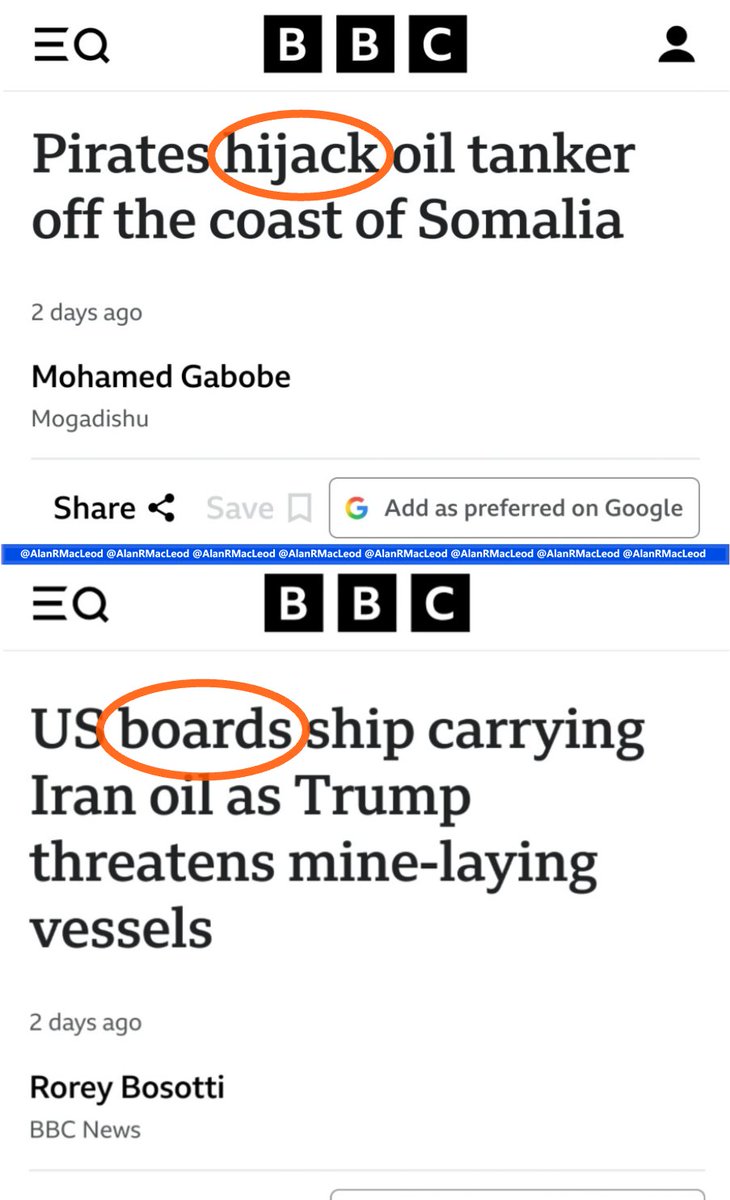
Same day, same outlet (the BBC):
Somalis "hijack" ships.
The US merely "boards" them.
This is how consent is manufactured in real time.
English
james retweetledi

nytimes.com/video/us/polit…
Quite right to report on how the U.S. is depleting stocks of vital weapons on the unnecessary war in Iran. But citing a potential war with China as one major contingency for using the weapons sidesteps the much greater need to be aware of the necessity for the United States to avoid any such war. Few news stories if any actually address whether the U.S. in fact has a vital interest in conducting a war with China. The only possible contingency would be Taiwan, which is not a truly vital U.S. interest. Where are the news stories discussing this?
English

james retweetledi

Hugh Thompson Jr. saw Americans k*lling civilians in 1968. Not enemies. Not combat. Just unarmed people being gunned down. He refused to look away. He was a helicopter pilot in Vietnam. Sent to observe, report, and stay above the fight. That morning, there was no fight—only horror unfolding below. He landed anyway. Right between soldiers and villagers. Putting his aircraft directly in the line of fire to stop it. Then he made the choice. He told his crew to aim at American troops if they kept shooting. A line most people would never cross. He pulled survivors out. Flew them to safety while bodies still lay in the ditches. While the k!LLing hadn’t fully stopped yet. He saved lives that day. But back home… He wasn’t called a hero. He was called a liar. A traitor. Someone who turned against his own. For years, the truth was buried. And so was his story. Only decades later did recognition come. Long after the damage was done. Long after the silence. He never asked for medals. He just wanted the shooting to stop. Sometimes courage isn’t fighting the enemy. Sometimes it’s standing against your own side… and refusing to be silent.
- via the Untold Past on FB

English
james retweetledi

Guess what Bonnie I was on your side until 2023. I stayed quiet in 2024. But in 2025 the idea that the US can be Taiwan’s force guarantor against China became untenable. In 2026, it’s just a joke.
I AM the emerging Taiwanese majority. I am why you are writing worried stories about Seeseepee propaganda leading Taiwanese sheep astray.
Cheng Li-wun, Holger Chen, me…we are all ex-DPP. Then at some point we got with reality. More Taiwanese will follow.
Bonnie Glaser / 葛來儀@BonnieGlaser
@AngelicaOung @jamespomfret The majority of Taiwanese appear to disagree with you.
English

@Its_ereko Japanese people do not want to see themselves in her , but reality is harsh.
English
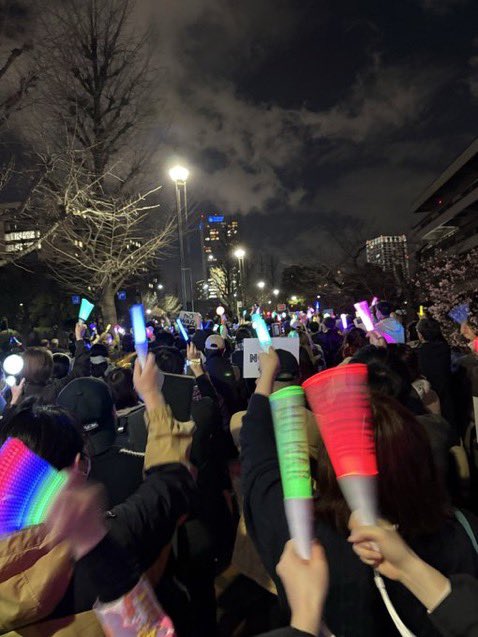
🇯🇵🇺🇸 Huge protests in Japan. After Takaichi's disgraceful visit. After Trump humiliated her. In the Oval Office.
The people are angry. The streets are full. The government is exposed.
Takaichi flew 6,000 miles to be mocked about Pearl Harbor. She stayed for dinner. She signed the deals.
Now Japan is rising. Not behind her. Against her.
The protests are huge. The silence is broken. The shame is public.
Trump insulted Japan. Takaichi smiled. The people will not forget.
English
james retweetledi
Before the DPP changed the textbooks, this is what all Taiwanese were taught: “Taiwan has since time immemorial been an inseparable part of China’s sacred territories. Both sides of the straits belong to one China. We are forever Chinese. We are forever one family.”
We’ve seen some bullshit since then but mark my words, the Taiwanese will remember their Chinese-ness again.
Tesla@NikolaTesla2010
翻開台灣教科書第一頁,前言。 眼中泛起熱淚。
English
james retweetledi
以游牧狩猎为主又长期处于战乱的欧洲,饮食上是弄熟了能吃就可以,所以到今天仍然流行烧烤与快餐,三明治
中国的农耕社会食材与调料丰富,唐宋明清等朝代中有相对和平的几百年,上层社会有条件在饮食上下功夫,才可能有炒、蒸、煮、炖、煎、炸、焖、卤、烧多种烹调做法
中国饮食文化在世界属于最前列
宋代已有完整餐馆体系、菜单、外卖、夜市
明清时期形成了系统的八大菜系
宫廷与士大夫阶层长期研究烹饪、调味和饮食礼仪
全世界的城市几乎找不到没中餐馆的,外国人去中餐馆不是解决温饱而是去享受
老季@XiaoJi0403
中餐炒菜那么好吃, 为什么欧美人不去学?
中文
james retweetledi

Shawn McCreesh is how it is done.
No groveling. No rambling setup. No pretending obvious lies deserve polite handling.
He looked Trump straight in the eye and said: “You just suggested that Iran somehow got its hands on a Tomahawk and bombed its own school. But you’re the only person in your government saying this. Even your defense secretary wouldn’t say that. Why are you the only person saying this?”
That is what a real reporter does.
Put him alongside Kaitlan Collins and you are looking at what feels like the last scraps of a genuine American press corps, people still willing to challenge power instead of decorating it. Collins has likewise become known for pressing Trump and his team with direct questions they clearly do not want to answer.
For us in Europe, where journalists are expected to roast presidents, prime ministers, and ministers when they lie, that should not be remarkable. It should be standard. But in today’s White House press room, too much of the rest looks less like journalism and more like the kind of staged, obedient press theater you associate with North Korea, where access matters more than truth, the questions are safe, the tone is submissive, and the whole spectacle exists to protect the leader from real scrutiny.
McCreesh did not play courtier. He did his job.
And that is exactly why the moment stood out.
What matters most in a press conference like this: asking the question everyone wants answered, or refusing to let power hide behind nonsense?
Stay connected,
Follow Gandalv @Microinteracti1
Molly Ploofkins@Mollyploofkins
The reporter's name is @ShawnMcCreesh. This is how it's done.
English