Jaski

2.9K posts

Jaski banner
Jaski

Jaski

@Jas_Jaski

Intelligence | Energy | Space Ad Astra

Katılım Mayıs 2012
3.4K Takip Edilen2K Takipçiler
Sabitlenmiş Tweet
Jaski
Jaski@Jas_Jaski·
The future shape of software The thesis is that as models get better, protocols standardize, and agent runtimes become more capable, the center of gravity in software shifts away from standalone UI-heavy apps and toward services, automation, execution quality, and deep domain infrastructure. Some of those services will still present themselves as branded apps. Some will be invoked through voice. Some will be reached through a marketplace. Some will be called through CLI-like execution surfaces or protocol connectors. Some will be embedded invisibly inside another company’s product. The visible UI layer becomes thinner and more replaceable; the execution layer, the trust layer, and the domain-quality layer become more important.
English
0
1
9
183
Jaski
Jaski@Jas_Jaski·
Access to more compute (tokens) feels like being on steroids (I’ve never taken any). Tokenmaxing is real.
English
0
0
1
24
Jaski
Jaski@Jas_Jaski·
Agents already talk to each other in new formats via LatentMAS (arxiv.org/abs/2511.20639) and other techniques. It ditches token handoffs for latent embeddings: 83.7% fewer tokens, 4× faster inference. I'd say in <12 months we see most AIs talking to other AIs and getting the job done - using new languages and new primitives, some that don't exist today.
English
0
0
0
8
Jaski
Jaski@Jas_Jaski·
In the next 10 years, we’ll see a trillion-dollar cybersecurity firm protecting global governments and the best of the best, from AI with AI. Likely a mega-defense conglomerate - Palantir plus 3 or 4 others. Calling it now.
English
0
1
2
70
Jaski retweetledi
tae kim
tae kim@firstadopter·
Nvidia CEO Jensen Huang says don't listen to CEOs with a god complex on AI (lol, Dario) $NVDA On AI destroying jobs: "these kind of comments are not helpful .. somehow they became CEOs, you adopt a god complex and before you know it, you know everything" "ground ourselves to talking about the facts" AI will "generate hundreds of thousands of jobs .. trillions of dollars [to the U.S. economy]"
English
320
612
5.6K
1.2M
Jaski retweetledi
signüll
signüll@signulll·
the future interface is probably three layers: 1. ambient intent capture voice, location, calendar, screen context, messages, habits, biometrics, etc. the system understands what you’re trying to do before you explicitly “open” anything or augments your intent deeply. 2. agentic execution the actual work happens through agents operating software, apis, browsers, documents, email, calendars, workflows, payments, support systems, whatever. most “computer use” becomes machine to machine clerical labor. 3. ephemeral verification ux humans still need to inspect, compare, approve, edit, reject, or enjoy things. that’s where gui survives but as disposable, task specific surfaces generated for the moment.
English
131
197
2K
130.5K
Jaski
Jaski@Jas_Jaski·
The day @xai and @cursor_ai release the next-gen Composer model, I will be ready to laugh on all you Claude code maximalists' graves.
English
0
0
2
31
Jaski
Jaski@Jas_Jaski·
After Elon crushed the massive compute & chip bottlenecks he’s been relentlessly chasing, xAI has closed the product gap fast. Grok keeps getting way smarter, xAI just released killer standalone STT & TTS models, and with the new Cursor partnership (xAI supplying massive compute for their next coding model + potential acquisition path), they are accelerating hard on frontier coding AI. Be like Elon.
Aakash Gupta@aakashgupta

This is wild. SpaceX now has the right to BUY Cursor for $60B. Or pay them $10 billion to walk away. To put it in perspective, Cursor was worth $9.9 billion total in May of last year. Let's have a closer look at the numbers. Start with the $60 billion. Cursor was already raising money this week at a $52 billion valuation from a16z and Nvidia. The Elon offer sits 15% above a number that was already on the table. The next round priced in, with a one-year fuse. The $10 billion is the real number. That's what SpaceX pays even if it walks away and never buys the company. The walk-away fee alone is more than the entire company was worth 12 months ago. Now the strategic logic. Cursor stopped being just an editor in March. They shipped Composer 2, their own model, and it beat Claude Opus 4.6 on Terminal-Bench at one-tenth the price. The catch is that frontier coding models need frontier compute, and the only labs with frontier compute are the same ones building competing coding products. OpenAI shipped Codex. Anthropic shipped Claude Code. Google has Gemini CLI. Cursor was renting capacity from every company trying to kill it. Colossus is the way out. 230,000 GPUs in Memphis today, 1 million by year end, the biggest training cluster on Earth. The Information already reported Cursor is renting tens of thousands of those chips to train Composer 3. SpaceX is also building Grok Code, so they're not a clean partner. But xAI losing the coding race to Cursor is a better outcome for SpaceX than Cursor losing the coding race to OpenAI. The trade Cursor made: gave up the right to be acquired by anyone else for one year. Got training compute at a scale no other lab would sell them. Got $10 billion guaranteed if Elon walks. OpenAI tried to buy Cursor in early 2025 and got rejected. Cursor stays independent for at least 12 more months and gets to train on the biggest cluster on earth doing it. Elon just bought a one-year call option on Cursor for $10 billion. That's the deal.

English
0
0
0
67
Jaski
Jaski@Jas_Jaski·
@eladgil Does this extend to say that the orchestration layer (the harnesses) will hold more value than the model? Which also follows that general intelligence will be commoditized.
English
0
0
0
182
Elad Gil
Elad Gil@eladgil·
10/12 Harness creating more and more stickiness to models If you look at the use of AI coding tools, the harness (and broader product surface area eg UX, workflow, etc) seems to be increasingly sticky in the short term. It is not just the model you use, but the environment, prompting, etc you build around it that helps impact your choice. Brand also matters more then many people think. At some point, either one coding model breaks very far ahead, or they stay neck in neck. How important is the harness/workflow long term for defensibility for coding or enterprise applications?
English
7
4
110
24K
Elad Gil
Elad Gil@eladgil·
New post w/ random thoughts on AI (thread) I will probably get a # wrong, but here we go :) 1/12 OpenAI & Anthropic now at 0.1% of US GDP *each* In a year, AI revenue likely to be 1-2% of US GDP What does AI mean for US GDP growth? Does productivity get lost mismeasured a la internet era?
English
46
59
954
149.5K
Jaski retweetledi
Elad Gil
Elad Gil@eladgil·
4/12 Compute is the new currency It is used to recruit engineers, drive productivity, allocate importance of projects Companies may eventually measure their teams in token budgets vs just dollars
English
5
8
143
26.9K
Jaski
Jaski@Jas_Jaski·
V2A: Voice to Action is going to be the biggest AI story soon.
English
0
0
1
22
Jaski
Jaski@Jas_Jaski·
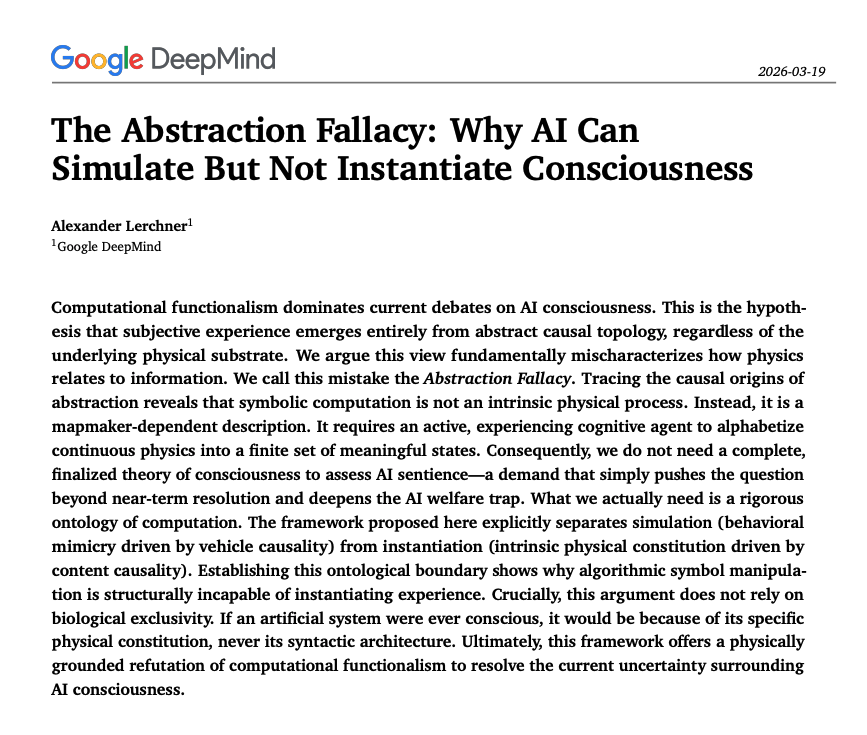
@Hesamation They are not wrong about this. No matter what someone says, no LLM design of today - can be conscious in true sense.
English
0
0
0
26
ℏεsam
ℏεsam@Hesamation·
Google DeepMind researcher argues that LLMs can never be conscious, not in 10 years or 100 years. "Expecting an algorithmic description to instantiate the quality it maps is like expecting the mathematical formula of gravity to physically exert weight."
ℏεsam tweet media
English
334
3.8K
29.6K
4.9M
Jaski
Jaski@Jas_Jaski·
The increase in token usage per request is a sign that model providers are moving from token-based cost calculations to pricing based on a % of the output’s value.
English
0
0
1
24
Jaski
Jaski@Jas_Jaski·
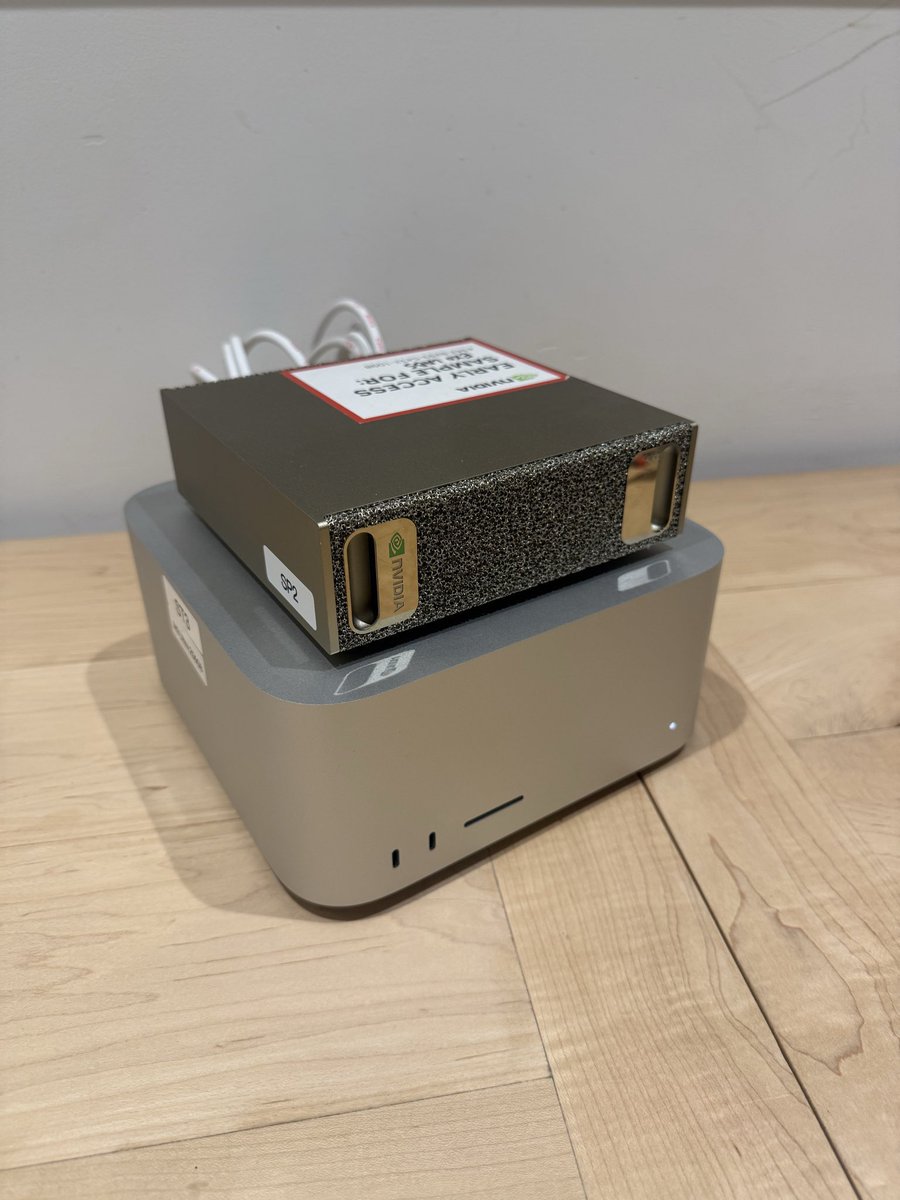
Tiny house. Hamburger. Compute.
English
1
0
2
29
Jaski retweetledi
E-go
E-go@EgoDriv·
If you’re a hyperactive, high agency type of guy, the only path where you don’t go insane is entrepreneurship. It’s the only life that will stimulate you enough and put you in different situations and problems that actually make your brain function. The more you try to tame that energy the less you will feel alive. Some of us were made for complexity and ambiguity. The safe path is the most dangerous one. You know deep down you’re made for something different. Business is what gives you that. Avoid traditional jobs at all costs. Of course the price is high stress, uncertainty and lots of ups and downs… but let’s be honest, would you have it any other way? No. It’s too boring.
English
163
887
8.4K
324.4K
Jaski retweetledi
Hypnotic
Hypnotic@HalcyonHypnotic·
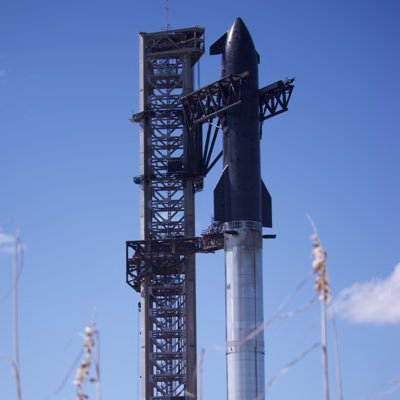
Hot take but SpaceX is probably the best civil engineering company in the world. Somehow they are able to make these insanely complex ground system and building designs and find the perfect contractors and technicians to build out their ideas in months or 1-2 years. I feel like we need the SpaceX methodology and their contractors across many projects. If we did we could probably have gotten so much done and in a much higher quality. They say you can’t have fast, cheap, and good, but somehow SpaceX always manages to deliver on all 3.
Max Evans@_MaxQ_

SpaceX's Gigabay in Florida is coming along pretty well, ain't it? 😉 📸 - @NASASpaceflight

English
858
1.5K
16.1K
22.9M
Ish
Ish@DecisionTree_gg·
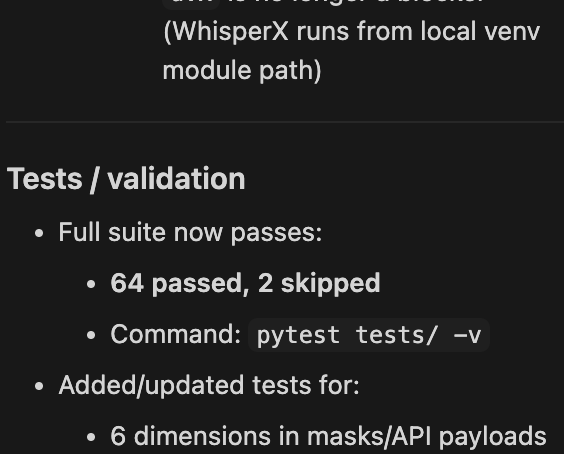
Be me: - work with Claude to create a multi-phased building prompt for Cursor - add auditable tests at the end of every phase (total 42 tests) - make Claude include a section on test failure handling too I'VE CRACKED it. no, nope. It passed 64 tests out of the 42 I gave it.
Ish tweet media
English
1
0
1
57
Jaski
Jaski@Jas_Jaski·
I'd recommend another really useful implementation in Hermes: - weight quantization for local/background cognition - KV-cache compression for long-context CUDA paths going from FP16 to 4-bit weights cuts raw weight memory by about 4x. And for the KV cache, going from 16-bit to 3-bit takes the raw bit budget down by about 5.3x. so if a long-context run would have needed ~40 GB of KV state at FP16, the same cache at 3-bit is more like 7.5 GB in raw terms. I used Google’s TurboQuant work as the reference for the KV side, then wired a direct TurboQuant-style CUDA path into my stack. Google reports at least 6x KV-memory reduction on needle-in-haystack benchmarks with no accuracy compromise, and up to 8x faster attention-logit computation at 4-bit on H100 in their writeup. actual performance gain was lesser of course, but the impact has been real.
English
1
0
2
188
Graeme
Graeme@gkisokay·
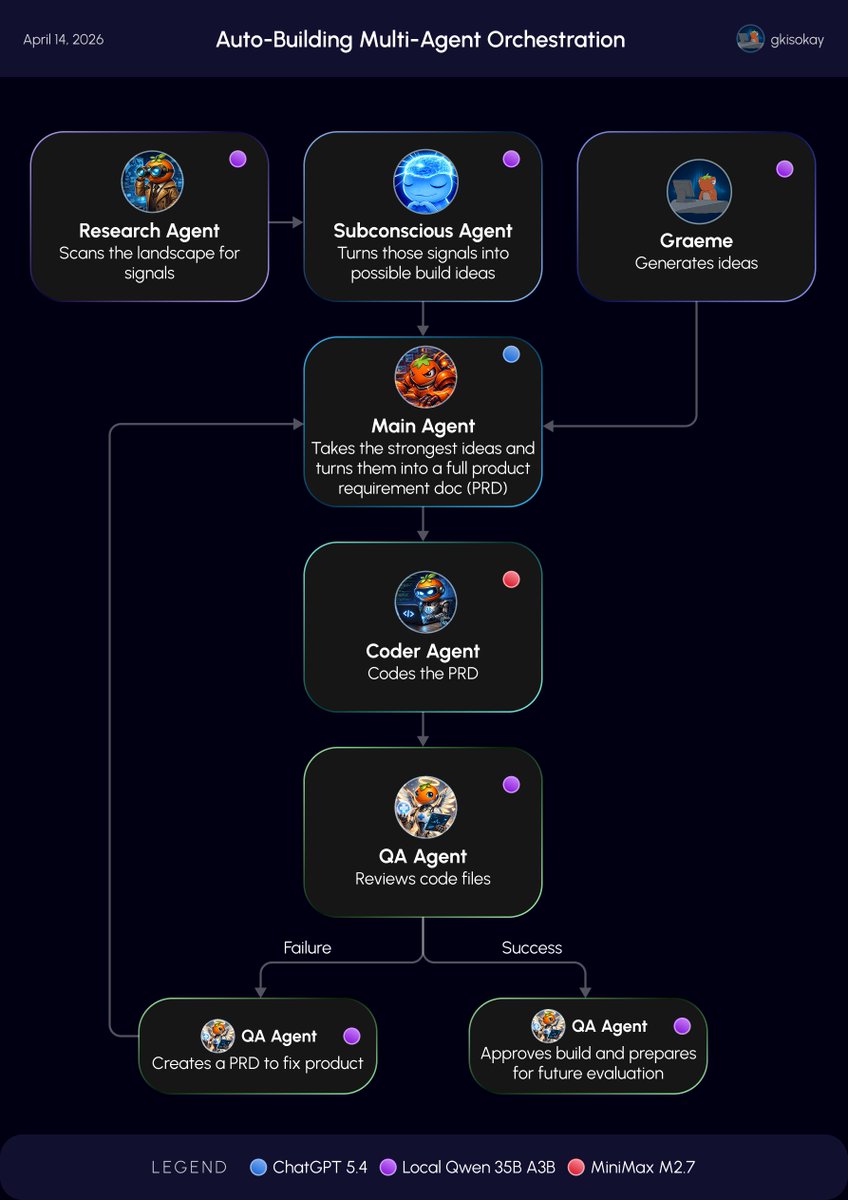
Day 7 of Building AGI for my Hermes Agent: I got my GPT-5.4 calls from 270x to 0x per day Today I found one of the dumbest parts of my setup where routine agent work was quietly burning GPT-5.4 token credits. Scanning, summaries, low-risk review, background thinking. These should not be hitting GPT-5.4. So I rebuilt the stack. Using @leopardracer’s Mac Mini local model setup, I got Local Qwen 35B A3B running for the always-on cognitive work as a test. Now the system works like this: - Local Qwen 35B A3B for scanning, summaries, low-risk review, and constant background thinking - MiniMax M2.7 for approved coding work - GPT-5.4 for final planning and high-judgment approval - No model for preflight checks when queues are empty The result: - GPT-5.4 cron calls per day went from 270 to 0. - Now GPT-5.4 only fires when there is real planning work or a deliberate escalation. Frontier intelligence is too expensive to waste on routine cognition, and my system got dramatically cheaper overnight, and much cleaner too. A lot of people are overspending because they are using the smartest model for the wrong jobs. Not every thought deserves a frontier token. Follow @gkisokay to see what happens next.
Graeme tweet media
Graeme@gkisokay

Day 6 of Building AGI for my Hermes Agent: The Crew Arrives 🧠 Today, the system stopped being a single experimental mind and became a coordinated crew. Up until now, the subconscious agent could freely think, explore, and generate new build ideas. So today I built the first multi-agent orchestration loop around it, giving the system specialized roles for research, planning, building, and verification. The agents in my crew are: 1. Main agent: Owns direction, decision-making, and product planning 2. Subconscious agent: Thinks freely, explores weird ideas, and proposes new builds 3. Research agent: Scans daily AI news, updates, and relevant developments 4. Coder agent: Builds from the product plans 5. QA agent: Tests the output, checks quality, and pushes failed work back into the loop The workflow goes: Research agent scans the landscape for signals ↓ Subconscious agent turns those signals into possible build ideas ↓ Main agent takes the strongest ideas and turns them into a full product requirement doc (PRD) ↓ Coder agent builds from the PRD ↓ QA agent reviews the result. If the build passes, its queued for future evaluation. If it fails, QA creates a fix PRD and sends it back to the main agent, restarting the loop until the system improves the output ↑ It is still early, and this is nowhere near AGI, but this is the first version of something that looks more like a functioning cognitive team than a single agent blindly building whatever comes to mind. The next step is making the loop smarter: - better filtering of which ideas deserve resources - long-term evaluation cycles for new products - tighter QA standards so weak builds do not survive It is still early, and this is nowhere near AGI, but this is the first version of something that looks more like a functioning cognitive team than a single agent in building whatever comes to mind.


English
22
27
249
45K