Jackie DiMonte

3.1K posts

Jackie DiMonte banner
Jackie DiMonte

Jackie DiMonte

@jaydimonte

🏗️🏭🚛

Katılım Aralık 2015
532 Takip Edilen2.4K Takipçiler
Sabitlenmiş Tweet
Jackie DiMonte
Jackie DiMonte@jaydimonte·
We all know about "crossing the chasm" when it comes to starting with early adopters and moving on to the majority A necessary action for any startup pursuing scale But, this framework isn't helpful for industrial startups...
Jackie DiMonte tweet media
English
3
1
12
1.8K
Jackie DiMonte
Jackie DiMonte@jaydimonte·
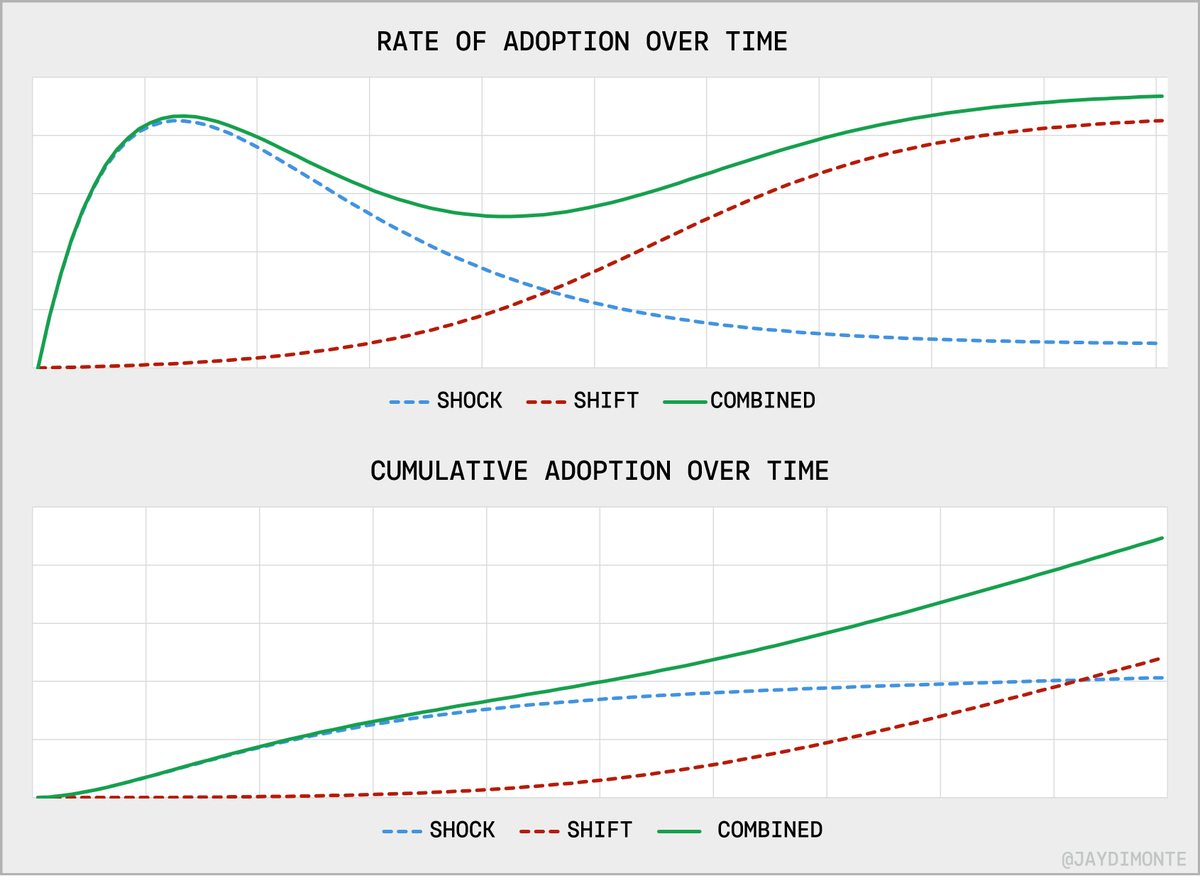
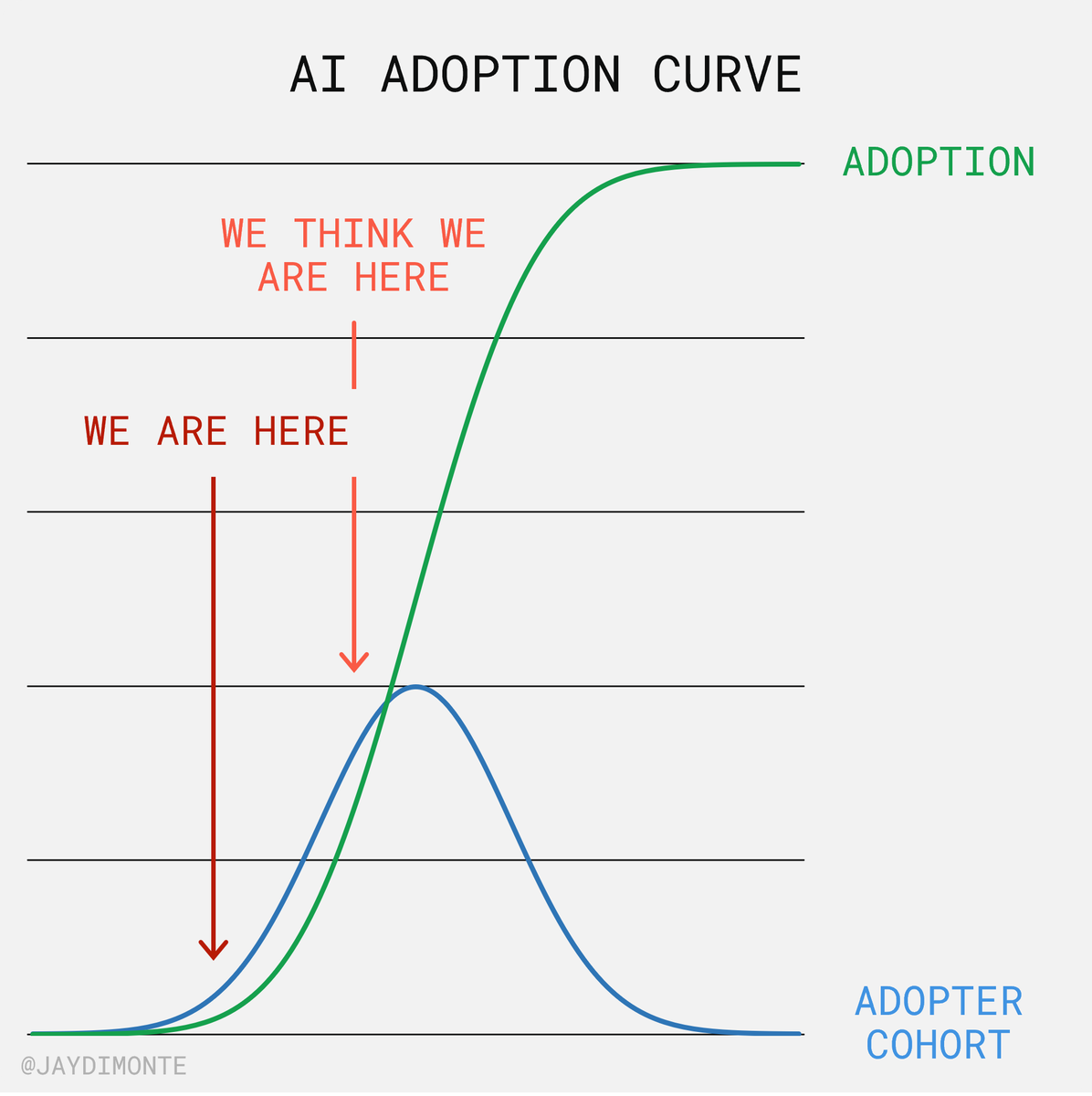
📊 45%+ of workers say they “use AI.” The real number is so much lower than that. Most people aren’t using AI the way people in tech mean it 𝘵𝘰𝘥𝘢𝘺. They’re using LLMs to edit emails, summarize documents, or replace search. Meanwhile, the pace of change is so fast that “using AI” isn’t a one-time adoption event. It requires constant learning, unlearning, and tinkering. Every new wave of AI capability resets the adoption curve. So, where we think we’ve hit the majority, it’s still the early adopters leading the charge. I’m seeing two opposing forces at work: 📉 Some people fall off the learning curve completely, adopting one use case and getting stuck there. 📈 Each advancement makes the most powerful features easier to access, pulling new users in. A lot of the anxiety about the future comes from confusing those two curves. We may think we’re "late" but I think we’re just getting started. Think of... what's the best thing you can do with AI now that you couldn't three months ago?
Jackie DiMonte tweet media
English
0
0
3
160
Cam
Cam@camdoody·
Idk who needs to hear this today, but never ever tell a founder good luck.
English
3
0
9
749
Jackie DiMonte
Jackie DiMonte@jaydimonte·
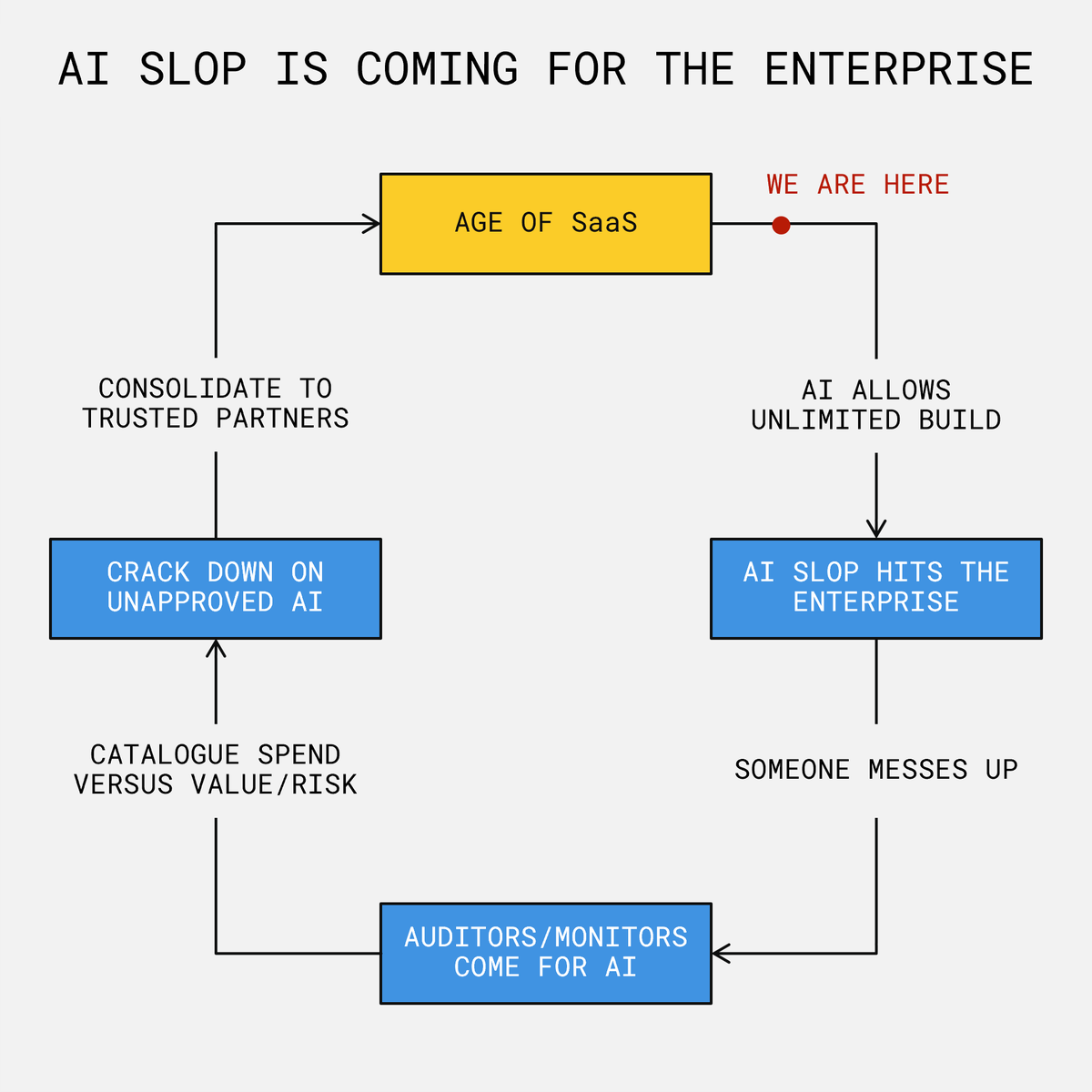
AI slop is coming for the enterprise. Today, the 𝘱𝘦𝘰𝘱𝘭𝘦 𝘣𝘶𝘪𝘭𝘥𝘪𝘯𝘨 𝘵𝘩𝘦 𝘮𝘰𝘴𝘵 𝘸𝘪𝘵𝘩 𝘈𝘐 are early adopters. The 𝘤𝘰𝘮𝘱𝘢𝘯𝘪𝘦𝘴 𝘸𝘪𝘵𝘩 𝘵𝘩𝘦 𝘮𝘰𝘴𝘵 𝘱𝘦𝘰𝘱𝘭𝘦 building with AI are early-adopter companies. That won't last. As these tools improve, more people will use them across more companies. It won't just be the tech-natives. It'll be everyone. 🙅‍♀️ It'll be Pam from procurement who builds her own agent… that promptly rejects a PO from a new vendor for critical parts. 🙋‍♂️ It'll be Max from marketing who spins up a web app… that burns through $100K of compute when his branded meme generator goes viral overnight. Now multiply that across every employee, every department. Think about how many mistakes we've already seen very capable people make with the release of clawdbot. Then scale that to the rest of the enterprise. We're not yet in the age of "everyone builds." But when we get there, the real question won't be how. It'll be for how long. Then it's back to permissioning, security, and… SaaS again. It's one of the reasons behind why Grid is focused on net new operating systems and outsourced services [🔗@jaydimonte/p-159090810" target="_blank" rel="nofollow noopener">substack.com/@jaydimonte/p-…]. Everything in between feels somewhat cyclical at the enterprise.
Jackie DiMonte tweet media
English
5
0
9
233
Jackie DiMonte
Jackie DiMonte@jaydimonte·
@volkertdesign Yea, more tongue in cheek. From what I’ve heard it’s too hard to get through IT
English
1
0
1
13
Nick Volkert
Nick Volkert@volkertdesign·
@jaydimonte Technically, yes? I've also heard practically no one uses it though. But I'm sure it's at a lot of people's fingertips because of how Microsoft is pushed on everyone.
English
1
0
0
15
Jackie DiMonte
Jackie DiMonte@jaydimonte·
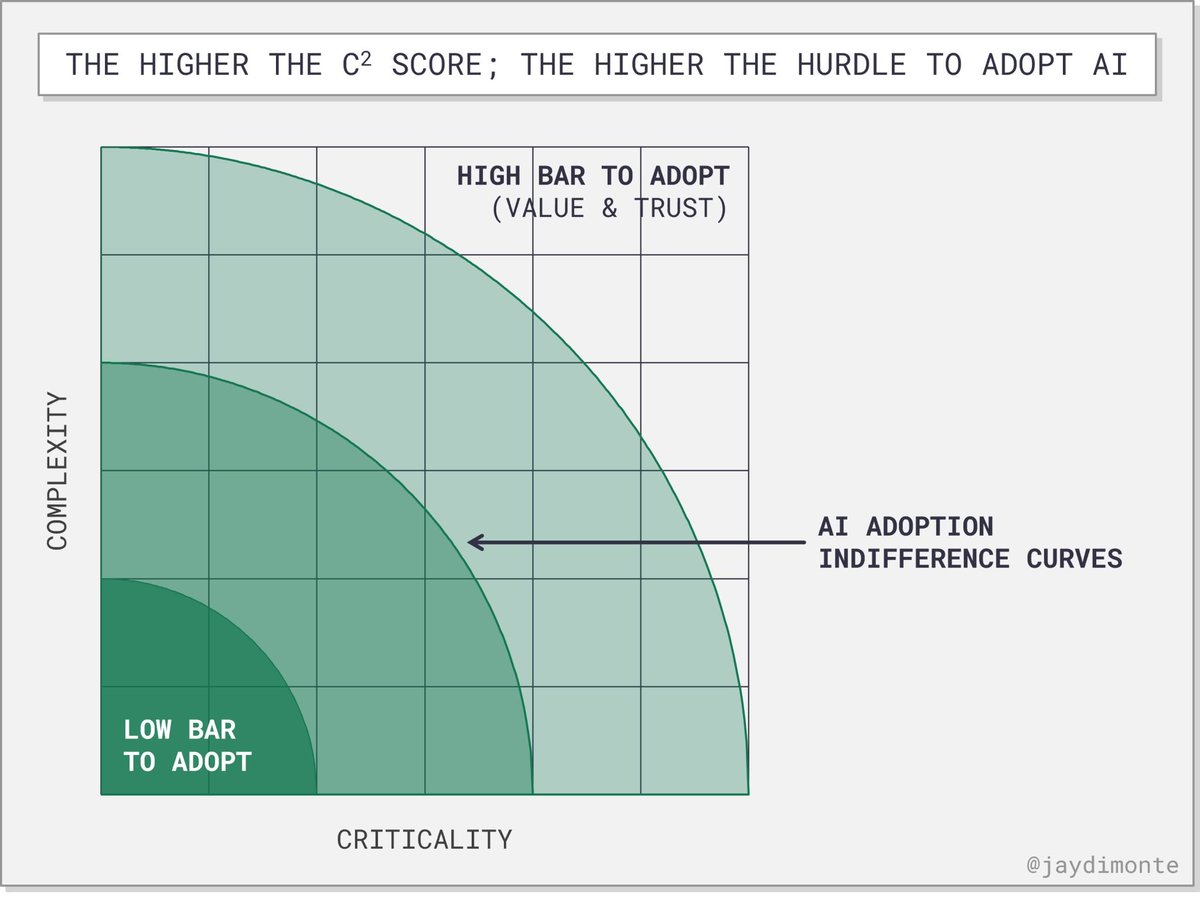
Building trust with customers is the #1 skill for vertical AI founders today. Especially in markets like manufacturing, healthcare, and construction where tolerance for error is near zero. Once a tool is in production, it has to work... and keep working. At Grid, we spend a lot of time thinking about what makes AI hard to adopt in these sectors. It usually comes down to two things: 1️⃣ Complexity — How hard is the organization, workflow, or task to model? 2️⃣ Criticality — How painful are the consequences if it fails? The higher the C² score (complexity × criticality) the harder it is to drive adoption. That’s why we’re focused on companies solving both the 𝘁𝗲𝗰𝗵𝗻𝗶𝗰𝗮𝗹 and 𝗰𝘂𝗹𝘁𝘂𝗿𝗮𝗹 side of the curve. The ones who know: if you want to transform high-C² sectors, you have to earn your place in the hands of the operator first.
Jackie DiMonte tweet media
English
0
0
1
94
Jackie DiMonte
Jackie DiMonte@jaydimonte·
Everyone says we’re early in AI. But capital flows suggest otherwise. New data from Carta shows a clear trend: The share of capital raised by AI startups increases sharply with stage, from 30% 𝘢𝘵 𝘚𝘦𝘳𝘪𝘦𝘴 𝘈 𝘵𝘰 70% 𝘢𝘵 𝘚𝘦𝘳𝘪𝘦𝘴 𝘌+. That challenges the idea that AI is still exploratory. Instead, it suggests: 1️⃣ 𝗔𝗜 𝗶𝘀 𝗺𝗼𝗿𝗲 𝗰𝗮𝗽𝗶𝘁𝗮𝗹-𝗶𝗻𝘁𝗲𝗻𝘀𝗶𝘃𝗲. It’s easy to start, but expensive to scale. 2️⃣ 𝗔𝗜 𝗺𝗮𝘆 𝗵𝗮𝘃𝗲 𝗽𝗲𝗮𝗸𝗲𝗱. What’s happening today at Seed and A will be reflected at C+ in a few years. 3️⃣ 𝗧𝗵𝗲 𝗔𝗜 𝘄𝗶𝗻𝗻𝗲𝗿𝘀 𝗮𝗿𝗲 𝗿𝗲𝗮𝗹𝗹𝘆, 𝗿𝗲𝗮𝗹𝗹𝘆 𝘄𝗶𝗻𝗻𝗶𝗻𝗴. Power laws are amplifying; mega funds are piling into perceived outliers. Either way, I’m glad to be investing early. Late-stage looks like a race for allocation in named winners.
Jackie DiMonte tweet media
English
0
1
3
111
Jackie DiMonte
Jackie DiMonte@jaydimonte·
Q1 numbers are in... Are frothy markets back? Deal value is back at 2021 peak levels. Deal volume, meanwhile, remains consistent with historical norms—between 3,000 and 4,000 deals closed per quarter. The driver isn’t surprising: AI now accounts for 70% of total deal value, but only 33% of volume. A few thoughts: 🔵AI requires significantly more capital? The “one-person, billion-dollar company” is out of reach for foundational AI companies. It may still apply to those building with AI—but not those building the infrastructure itself. 🔵Similarly for obvious AI-applications (think agents for X), the abundance of teams changing the opportunity will lead to / has led to overfunding and a massive spend on customer acquisition. 🔵However, in certain markets that still lack modern “core systems,” the ROI story can be compelling and the customer acquisition differentiated, leading to efficient growth. It’ll be worth watching if this continues throughout 2025. A dozen multistage funds raised massive pools capital in 2024, and they’ll need to deploy. Meanwhile, mega rounds in Q4 and Q1 are skewing the market. The question now is whether liquidity will support continued reinvestment in venture capital—or if the pace slows.
Jackie DiMonte tweet media
English
1
2
6
1.1K
Jackie DiMonte
Jackie DiMonte@jaydimonte·
Conventional wisdom says you can’t time the market. But if you raised a Series A last year—you did. Will that hold in 2025? Seed-to-A step-ups returned to the 2.5–3.0x range as median Series A pre-money valuations approached $50M. These are multiples we haven’t seen since—and valuations that now exceed—the 2021–22 peak. (Step-up = seed post-money vs. Series A pre-money, 12–24 months later) On the surface, it looks like a rebound. But zoom out, and it’s just more evidence of continued market volatility and shifts in the venture market. 📌 Inputs worth watching: ➡️ Time between rounds – Companies are raising later, meaning more mature companies at each stage ➡️ Graduation rates – higher step ups might be skewed by a flight to quality at A ➡️ Pricing equilibrium – With both seed and A climbing, are we in sync—or headed for another disconnect? Seed valuations rose in 2023 too (not shown—those rounds haven’t hit A yet) so it's critical to see just how healthy the A market remains: 📉 If A valuations dip, we could see another reset like 2022–23. 📈 If A holds—or keeps rising, especially with AI strength—seed may inflate further as multi-stage firms move earlier and seed funds chase higher ceilings. How do you see this playing out over the next 12 months?
Jackie DiMonte tweet media
English
1
1
3
270
Jackie DiMonte
Jackie DiMonte@jaydimonte·
Enterprises are consolidating spend across nearly every IT category—except AI. According to BCG, companies are reducing suppliers in infrastructure, cloud, CRM, ERP, and more. But AI is the outlier. It’s the only category where supplier bases are expanding. This is a temporary trend. Orgs are still in discovery mode—testing tools, experimenting with platforms, and figuring out what processes make sense for them. As adoption matures, AI will absorb into enterprise software, and consolidation will follow. I wrote I wrote last week about how this leads to a barbell market—core systems on one end, outsourced services on the other. So the question is, if consolidation has already started: What platforms are in a position to absorb? Or be absorbed?
Jackie DiMonte tweet media
English
1
2
6
481
Jackie DiMonte
Jackie DiMonte@jaydimonte·
𝐓𝐨𝐝𝐚𝐲 𝐈 𝐰𝐚𝐬 𝐚𝐬𝐤𝐞𝐝 𝐡𝐨𝐰 𝐭𝐚𝐫𝐢𝐟𝐟𝐬 𝐰𝐢𝐥𝐥 𝐢𝐦𝐩𝐚𝐜𝐭 𝐀𝐦𝐞𝐫𝐢𝐜𝐚’𝐬 𝐫𝐞𝐢𝐧𝐝𝐮𝐬𝐭𝐫𝐢𝐚𝐥𝐢𝐳𝐚𝐭𝐢𝐨𝐧. In some ways, that question is a red herring. Whether the latest tariffs are short-lived or enduring, they’re just one piece of a much larger picture: the ongoing reinvestment in America’s industrial base and workforce. The chart below tracks reshoring and FDI job announcements in the U.S. You can clearly see the inflection points: 📈 2020: Supply chain shocks 📈 2022: Ukraine invasion, IRA & CHIPS Acts 🌐 Now: Subsidies begin to sunset, but geopolitical risk—and importantly tariffs—are on the rise. We’ve gone from one administration’s carrot to another’s stick. But the fundamentals haven’t changed: Skilled labor is constrained. Supply chains are still volatile. Building capacity and resilience remain critical. Those are the kind of challenges I'm excited about solving.
Jackie DiMonte tweet media
English
1
0
2
197
Jackie DiMonte
Jackie DiMonte@jaydimonte·
There’s a reason we’re excited about the rise of industrial unicorns—and it’s not about $$$. Over the past decade, the number of venture-backed companies in manufacturing, construction, resources, and logistics has grown 10x. That didn’t just bring capital—it built a talent base. Today, there are 30–100x more people who understand the expectations of high-growth technology and the realities of operating in industrial markets. That’s the foundation founders need to build the next generation of industrial systems and AI-enabled services. 🏭 And it’s a big reason why we’re so energized at Grid—to back those building the new industrial era.
Jackie DiMonte tweet media
English
1
1
5
678
Jackie DiMonte
Jackie DiMonte@jaydimonte·
📈In the SaaS era, most value accrued to platforms that let users own their workflows. The further you got from being a source of record, the less value you created. Services businesses lagged even further, constrained by margins and growth ability. 📈In the AI era? Value will barbell to the edges. AI agents will automate large swaths of “operate” workflows—compressing the middle. That means more value flows to platforms (own) and services (outsource) with clear responsibility and better economics.
Jackie DiMonte tweet media
English
2
0
2
222
Jackie DiMonte
Jackie DiMonte@jaydimonte·
AI is turning software’s business model upside down. For years, software was unique—high margins, fast growth, and near-zero marginal costs. But AI is changing that. Traditional businesses are starting to look like software companies. And software companies? They’re starting to look more traditional. The real question on everyone's mind: where does the most value accrue? I wrote about how legacy industries can show us where AI-enabled businesses will be most durable and valuable. Link to full essay 👇
GIF
English
1
0
5
231
Jackie DiMonte
Jackie DiMonte@jaydimonte·
Each year, ~4,000 companies receive venture funding for the first time—a number that has held steady despite market volatility and macroeconomic shifts. This consistency raises some questions: ➡️Have we reached the natural limit for new company formation? ➡️What factors could shift this limit up or down over time? (i.e. does AI allow for more building or a consolidation of entrepreneurship?) I find it encouraging—founders start companies when they need to, regardless of the environment. Entrepreneurship is remarkably inelastic!
Jackie DiMonte tweet media
English
0
1
3
263