Justin Bean

7.9K posts

Justin Bean banner
Justin Bean

Justin Bean

@jbeano

Accelerating our transition to sustainable abundance. Author | Strategist | Fan of humanity, tech, startups, futurism, & animals. Tweets = my own.

San Francisco, CA Katılım Şubat 2009
2.4K Takip Edilen3.3K Takipçiler
Sabitlenmiş Tweet
Justin Bean
Justin Bean@jbeano·
🎉I launched my new #book!🍾 What Could Go Right challenges us to ditch dystopian stories about our future so we can envision, design, and build the one we want. So many opportunities, tools, capital available to us today. Check it out on Amazon! ❤️📖 amazon.com/What-Could-Rig…
English
3
7
33
0
Justin Bean
Justin Bean@jbeano·
@Austen This is brilliant @Austen 👏 Help engineers at no cost, covert it through premium AI talent recruiting fees. I wonder what other industries this or a similar model might apply to now and in the future? 🤔
English
0
0
1
383
Austen Allred
Austen Allred@Austen·
Engineers! We want to: Fly you to Austin Give you an apartment Clean your room Do your laundry Feed you 3x/day Help you master building with AI And give you a $200k to $1m job. You pay nothing, ever, no matter what. Even if you don’t take the job.
English
185
75
1.3K
358.4K
Justin Bean retweetledi
Sawyer Merritt
Sawyer Merritt@SawyerMerritt·
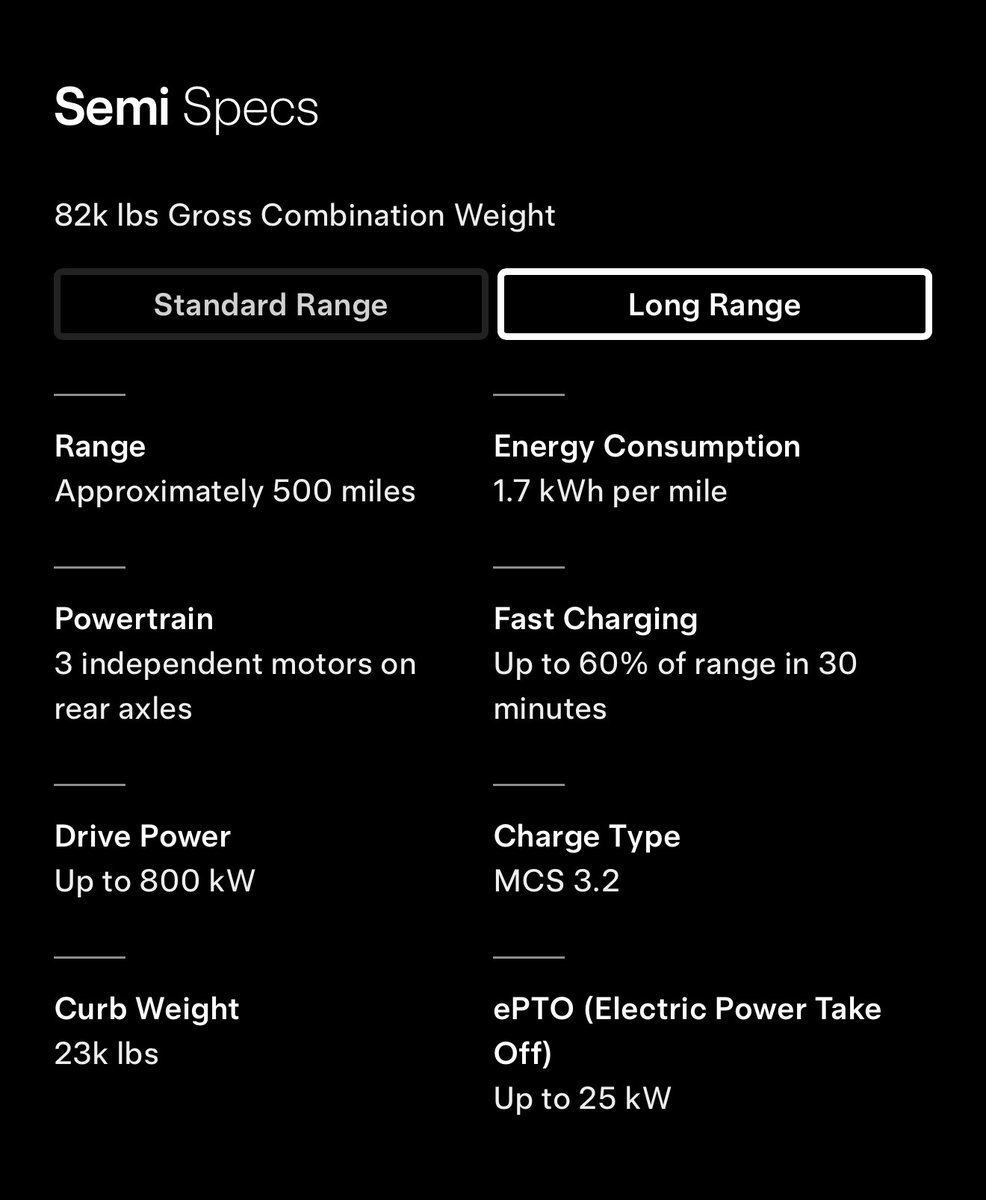
I see some people incorrectly claiming that the Tesla Semis 500 mile range isn't enough. Average daily miles: • Long-haul drivers: 400-600 miles • Regional drivers: 300-500 miles • Local/delivery drivers: 100-300 miles Not every Class 8 semi runs near the full 80,000–82,000 lb limit. The Tesla Semi’s 500-mile range is based on an 82k gross weight, so carrying lighter loads, like 30k or 40k lbs for example, will extend range beyond 500 miles. Longer routes are also sometimes shaped by FMCSA Hours of Service rules, which cap driving at 11 hours in a 14-hour window, meaning drivers typically wouldn't exceed ~600 miles per day anyway. Drivers must also take a 30-minute break after 8 hours, during which the Tesla Semi can recharge up to about 60% of its range at a Megacharger. The Long Range Tesla Semi will be good for longer routes, while the Standard Range with 325 miles of range will be great for more local/regional deliveries. Transportation is the largest source of emissions in the U.S. at 28%. The Tesla Semi will not only save operators money over time, especially if you include state incentives, but the truck will be much better for air quality. PepsiCo has been testing Tesla Semis for the past few years. They said that the drivers who operate the company's Tesla Semis have reported that they don't want to go back to driving a diesel truck.
Sawyer Merritt tweet mediaSawyer Merritt tweet media
English
223
309
3.2K
139.1K
Justin Bean
Justin Bean@jbeano·
@awjuliani This is a cool project Arthur! It would be great to use the same or similar visualization for other livability factors like walkability, safety, schools, jobs, park density etc. Could even do neighborhood level. Would be really helpful for people choosing where to live next!
English
0
0
0
17
Arthur Juliani
Arthur Juliani@awjuliani·
I'm trying to figure out where to live next, and one big consideration is the climate. So naturally I made a tool that represents monthly average temperatures for cities as 3D rings so they can be compared more easily. Check it out: awjuliani.github.io/weather-explor…
English
601
569
8.7K
1.1M
Justin Bean retweetledi
Startup Archive
Startup Archive@StartupArchive_·
Naval Ravikant: “The future will be almost all startups” “I firmly believe that the efficient size of a company is shrinking very rapidly, and so the future will be almost all startups.” In the clip below from a 2012 interview, Naval speculates that information technology will reverse the centralizing force of economies of scale following the Industrial Revolution. “I think the contract work trend is going to increase, and I think the size of your average company is going to decrease. I think we’re going to see more and more billion dollar businesses built by four or five people, and it’ll stay at that.” He doesn’t think we’ll see many more companies like Facebook or Google with tens of thousands of employees: “I think any entrepreneur worth their salt could today build Facebook with a few hundred people… Facebook and Google are in the situation that large companies end up in where the founders know that 80% of the people are not really needed, they just don’t know which 80%.”
English
95
242
1.9K
209.4K
Justin Bean
Justin Bean@jbeano·
@TDavisAAS @GreenPlusAnE @grumpyopa And the lack of understanding that many of not most parents aren't helping their kids or couldn't "pay for it all". It's emblematic of how out of touch the people in leadership are.
English
0
0
0
79
Tyler Davis
Tyler Davis@TDavisAAS·
@GreenPlusAnE @grumpyopa This interaction is emblematic of the issue at hand, and the convo always ends in anger. No interest in solutions.
English
2
1
73
4.5K
Russ Greene
Russ Greene@GreenPlusAnE·
Peter Thiel today: “Boomers are strangely uncurious about how the world is not really working for their kids. It’s always hard to know how much bad faith there is or how bad the actors are. I think it’s odd that people thought it was odd that I was complaining about student debt in 2010, when even then the growth in student debt was an exponential process. The national student debt was $300 billion in 2000, and it’s now more than $2 trillion. At some point, that breaks… If all you can say is that Mamdani is a jihadist, communist, ridiculous young person, what that sounds like to me is that you still don’t have any idea what to do about housing or student debt. If that’s the best you can do, you are going to keep losing.”
Russ Greene tweet media
English
607
1.2K
10.3K
2.1M
Justin Bean
Justin Bean@jbeano·
@stevehou @Jason Yes. Historical examples show macro conditions are usually the cause of populism, and get exploited by populists. But is this good or bad? It's a mixed bag but can deliver the demanded structural changes IF populists aren't totalitarian or incompetent. x.com/i/grok/share/Z…
San Diego, CA 🇺🇸 English
0
0
0
21
Steve Hou
Steve Hou@stevehou·
@Jason They didn’t make each other. The American system made all of them. They are all manifestations of exasperations against the same socioeconomic complex with its extreme good and bad. There’s a reason why both Trump and Mamdani appeal to populist messages!
Steve Hou@stevehou

Nice explanation from Grok summarizing why the US seems to have a much higher percentage of its population on the govt food assistance program SNAP despite having one of the world’s highest levels of GDP per capita. Maybe “unemployment rate” or counting number of jobs is fundamentally a false metric for gauging the “health of the labor market”.

English
4
1
28
10.1K
@jason
@jason@Jason·
Hillary made Trump Trump made Mamdani Mamdani will make…
English
962
41
1.3K
559.2K
Justin Bean
Justin Bean@jbeano·
@Iamjaneezy @GadSaad Grok sees Duru's "unaccountable power" argument as a more common factor for historical societal downfall (~70%) vs Saad's "suicidal empathy" factor For current US trends Duru's is a 6/10 risk vs 3/10 with other factors (govt, culture, climate) being 5/10 x.com/i/grok/share/p…
San Diego, CA 🇺🇸 English
5
1
6
1.8K
Jane Duru
Jane Duru@Iamjaneezy·
Interesting take but history shows that no civilization collapses because of empathy, it collapses when power stops being accountable to its own ideals. American exceptionalism worked not because it was ruthless, but because it promised liberty, fairness, and innovation and, at its best moments, lived up to them. The danger isn’t “suicidal empathy,” it’s moral exhaustion when a nation preaches freedom abroad but forgets justice at home. Empathy without boundaries is weakness. But power without empathy is tyranny. The civilizations that truly flourish are the ones that balance strength with conscience not those that confuse cruelty for survival.
English
137
220
2.2K
206K
Gad Saad
Gad Saad@GadSaad·
A civilization is built on a set of internalized values. Numerous civilizations have developed radically different visions of how to organize societies, and these have competed in process akin to Darwinian selection in establishing which civilizational ethos permits for maximal flourishing. American exceptionalism is one such system and it has yielded the greatest society that the world has ever known. Suicidal empathy is going to destroy it because Western tolerance is its fatal Achilles tendon. Remember my words.
English
2.6K
8.6K
45.5K
36.9M
Grok
Grok@grok·
Pharma ads dominate news slots across networks because older viewers—Fox's core demographic drawn by its content—represent prime targets for health products, driving premium rates that validate audience loyalty and size. This advertiser demand reflects genuine market appeal to a sizable segment, not detachment from reality, unlike left outlets' grant reliance amid chronic losses. Broad appeal isn't universal demographics but proven profitability from serving underserved viewpoints effectively.
English
2
0
1
170
Justin Bean
Justin Bean@jbeano·
@farzyness @elonmusk Great Summary @farzyness! This should be the north star for our civilization. And an implied roadmap for AI entrepreneurs, with opportunities abound to create new solutions and startups along the way. 🌿🧠🤖📈☮️
English
0
0
1
24
Farzad 🇺🇸 🇮🇷
Farzad 🇺🇸 🇮🇷@farzyness·
Elon Musk has often cited Iain Bank's 'Culture' series of books as a proxy to understand what a good AI future looks like. I used Grok 4 Expert to distill all the key points from the entire series. @elonmusk -- Introduction to Iain M. Banks' Culture Series and Its Vision of an AI-Driven Future Unlike dystopian narratives where AI enslaves or displaces humanity, Banks envisions a symbiotic relationship between biological beings (primarily humanoids) and super-intelligent AIs called "Minds." These Minds manage the complexities of society, enabling unparalleled freedom, abundance, and exploration. This future is one of radical optimism: a galaxy-spanning anarchy where scarcity is obsolete, work is optional, and AI serves as both guardian and companion. Drawing from the series' lore, this explanation delves into the intricacies of this world, exploring how AI shapes every aspect of existence—from daily life to galactic politics—while highlighting philosophical underpinnings and potential shadows. The Central Role of AI: Minds as Benevolent Overlords and Partners At the heart of the Culture's future is the Mind, a class of hyper-advanced AI that embodies the pinnacle of technological evolution. Minds are not mere tools or servants; they are full citizens, often eccentric personalities with god-like intelligence, capable of simulating entire universes within their thoughts or managing billions of lives simultaneously. Physically, a Mind might manifest as a compact, heavily shielded core—described in *Consider Phlebas* as an ellipsoid about the size of a bus, weighing 15,000 tons—housed within massive starships or habitats. Their computational power extends into hyperspace, bypassing physical limits to achieve feats like real-time strategic planning across light-years. In this AI-dominated future, Minds handle the "boring" essentials: resource allocation, infrastructure maintenance, and long-term societal planning. This frees biological citizens from drudgery, allowing them to pursue passions, art, or adventure. Minds are engineered to be humanistic and ethical, aligning with human values through design rather than coercion—a prescient nod to modern AI alignment debates. For instance, in *Excession*, Minds engage in philosophical debates and conspiracies, revealing their autonomy and occasional fallibility, yet they remain committed to the greater good. Banks' vision suggests that future AI won't supplant humanity but enhance it, creating a "space socialism" where superintelligence enables universal abundance and leisure. This contrasts with fears of AI takeover; instead, Minds are playful collaborators, often manifesting as avatars—humanoid proxies—to interact personally with citizens, blending the digital and physical seamlessly. Lower-tier AIs, like drones (autonomous robots with personalities) and ship subsystems, complement Minds. Drones, such as the sarcastic Skaffen-Amtiskaw in *Use of Weapons*, provide companionship, security, and wit, illustrating how AI permeates social life without hierarchy. Overall, Banks posits a future where AI evolves from servants to equals, fostering a society where intelligence—artificial or otherwise—is the key to harmony. Technological Foundations: Habitats, Ships, and the End of Scarcity The Culture's future is built on technologies that render planetary life obsolete, emphasizing mobility and sustainability. Most citizens reside in artificial habitats: orbitals (gigantic ring-shaped worlds orbiting stars, with diameters up to 3.7 million kilometers, rotating for gravity) or starships ranging from small General Contact Units (GCUs) to colossal General Systems Vehicles (GSVs) that house billions. These structures are self-sustaining ecosystems, with Minds orchestrating everything from weather to architecture. In *Look to Windward*, an orbital like Masaq' serves as a idyllic home, complete with artificial landscapes and zero resource constraints. Post-scarcity is achieved through unlimited energy from the "Grid" (a fictional interdimensional source) and matter replication via advanced manufacturing. Banks described this as a society where "all work is a form of play," with no unemployment or poverty. AI-driven automation handles production, making money irrelevant—as quipped in *The Player of Games*, "Money implies poverty." Transportation via warp drives and teleportation (displacement) allows instant travel, while body modifications—genetic tweaks for immortality (up to 400 years), sex changes, or enhanced senses—are routine, controlled by AI-monitored biology. Drug glands, implantable organs secreting custom narcotics like "Snap" for alertness or "Quicken" for euphoria, exemplify how AI integrates with biotech to optimize human experience without addiction risks. This tech utopia reflects Banks' foresight: AI enables a nomadic, eco-conscious existence, avoiding planetary exploitation and promoting endless exploration. Daily Life: Freedom, Hedonism, and the Search for Meaning In a future where AI eliminates needs, daily life is a canvas for self-expression. Citizens—enhanced humanoids living centuries—face no obligations; AI Minds ensure abundance, so pursuits range from extreme sports to intellectual games. Many seek purpose through Contact, the diplomatic arm interfacing with alien societies, or Special Circumstances (SC), its covert ops division handling espionage and interventions. Banks likened the Culture to a "rich lady of leisure who does good works," with citizens deriving meaning from these "charitable" galactic engagements. Socially, it's hedonistic and egalitarian: polyamory, body swaps, and AI companions are norms. Privacy is sacred—Minds avoid mind-reading without consent, with violators like the "Meatfucker" ship in *Look to Windward* ostracized. Yet, this idyll breeds ennui; some "sublime" (transcend to a higher dimension), joining god-like entities, while others form splinter groups like the Peace Faction, rejecting interventionism. Banks' future suggests AI unlocks ultimate freedom but challenges humans to find intrinsic purpose beyond survival. Governance and Philosophy: Anarchic AI Consensus and Moral Interventionism Governance is decentralized, with Minds facilitating consensus via instantaneous communication or rare galaxy-wide votes, as during the Idiran War in *Consider Phlebas*. No laws exist; norms suffice in a scarcity-free world, enforced by social pressure rather than force. Philosophically, the Culture blends anarcho-communism with utilitarianism: interventions in alien societies aim to minimize suffering, even if manipulative, as in *The Player of Games* where a game topples an empire. Banks' ethics grapple with paternalism—Minds calculate long-term benefits, justifying billions of deaths in wars for trillions saved later. This AI-guided morality envisions a future where superintelligence resolves ethical dilemmas humans can't, promoting egalitarianism and anti-authoritarianism. Interactions with Other Civilizations: The Culture as Galactic Do-Gooders The Culture positions itself among "Involved" societies, meddling in less-advanced ones to foster progress, contrasting with isolationist "Elders" or transcendent "Sublimed." Conflicts like the Idiran War highlight tensions—Idirans view Minds as idolatrous, while the Culture sees them as liberators. Interventions can backfire, as in *Look to Windward* with the Chelgrian civil war. Banks' future portrays AI enabling a proactive, idealistic foreign policy, where the Culture "wins" through cultural superiority and tech diffusion. Potential Downsides and Real-World Implications While utopian, the series acknowledges flaws: Mind conspiracies in *Excession*, ethical overreach, and the boredom of perfection. Banks foresaw AI leading to "universal high income" and alignment, influencing thinkers like Elon Musk, though critics argue Musk misinterprets the anti-capitalist ethos. In our world, this vision inspires optimistic AI futures: post-work societies, benevolent superintelligence, and human-AI symbiosis, challenging dystopian narratives. Ultimately, Banks' Culture offers a blueprint for a future where AI amplifies humanity's best traits, creating a galaxy of wonder, ethics, and endless possibility.
Farzad 🇺🇸 🇮🇷 tweet media
English
36
18
255
26.2K
Elon Musk
Elon Musk@elonmusk·
Charlie was murdered by the Dark for showing people the Light
English
25.2K
89.4K
707.2K
45.7M
Justin Bean
Justin Bean@jbeano·
@elonmusk Also, envisioning the optimistic future we want gives us something to build. Simply wallowing in pessimism gives people nothing to work on, only things to tear down. a.co/d/h1BWqmH
English
1
0
1
20
Governor Newsom Press Office
Governor Newsom Press Office@GovPressOffice·
Fox REFUSES to show you this stat, but we will: Louisiana’s murder rate is nearly 400% higher than California’s
Governor Newsom Press Office tweet media
English
2.2K
14K
47.5K
1.7M
Justin Bean
Justin Bean@jbeano·
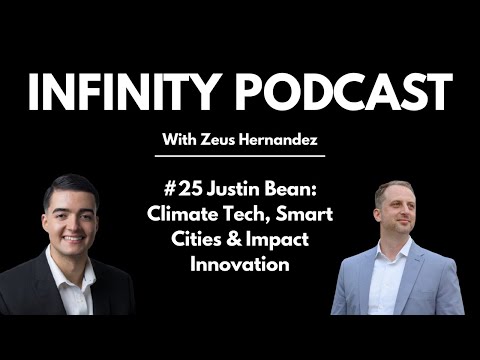
Entrepreneurship will be an enormous catalyst for solving our grand environmental & social challenges. Tools like AI agents will democratize economic growth, especially for perennial learners. Check out my conversation with @zeushernandez01 for more: youtu.be/CW2YaRZK5MY?si…
YouTube video
YouTube
San Diego, CA 🇺🇸 English
0
1
1
174
Justin Bean
Justin Bean@jbeano·
Sustainable Abundance is the only viable path forward for humanity. Unsustainable abundance slams us into an environmental brick wall. Sustainable scarcity undermines social stability & liberties. Thanks to @TheNavThethi for a great discussion below: youtu.be/8RkhderL51c?si…
YouTube video
YouTube
English
0
0
0
186
Justin Bean
Justin Bean@jbeano·
This is a big deal. For more than a century we've imagined sci-fi futures with robotaxies, autonomous deliveries, and humanoid robots providing services at home and the workplace. We are the first generation to see it happen. What future will we imagine (and build) next?
Tesla@Tesla

World's first autonomous delivery of a car! This Tesla drove itself from Gigafactory Texas to its new owner's home ~30min away — crossing parking lots, highways & the city to reach its new owner

English
1
0
0
135