Jeff Cui
70 posts

Sabitlenmiş Tweet
Jeff Cui retweetledi

Robots are the bottleneck in scaling robotics, and learning from human video promises to solve it. But how can chaotic human data ever measure up to sanitized, lab-made teleoperation data?
Introducing Do as I Do: establishing a much needed correspondence between human videos and dexterous robot data. Some fun insights below: 🧵
English
Jeff Cui retweetledi

Introducing Human Universal Grasping (HUG): dexterous grasping learned entirely from human hands, with zero robot data.
🌐 Website: grasping.io
📄 Paper: arxiv.org/abs/2606.17054
💻 Code: github.com/KevinyWu/hug
English
Jeff Cui retweetledi

[10/n] Broader implication 2
Learning from human videos or wearables is a promising direction. These paradigms, however, often treat "future state" as its pseudo action label — implicitly assuming perfect tracking, which is effectively a stiff-controller assumption. If our findings generalize, rethinking this assumption could unlock even more of their potential.

English
Jeff Cui retweetledi

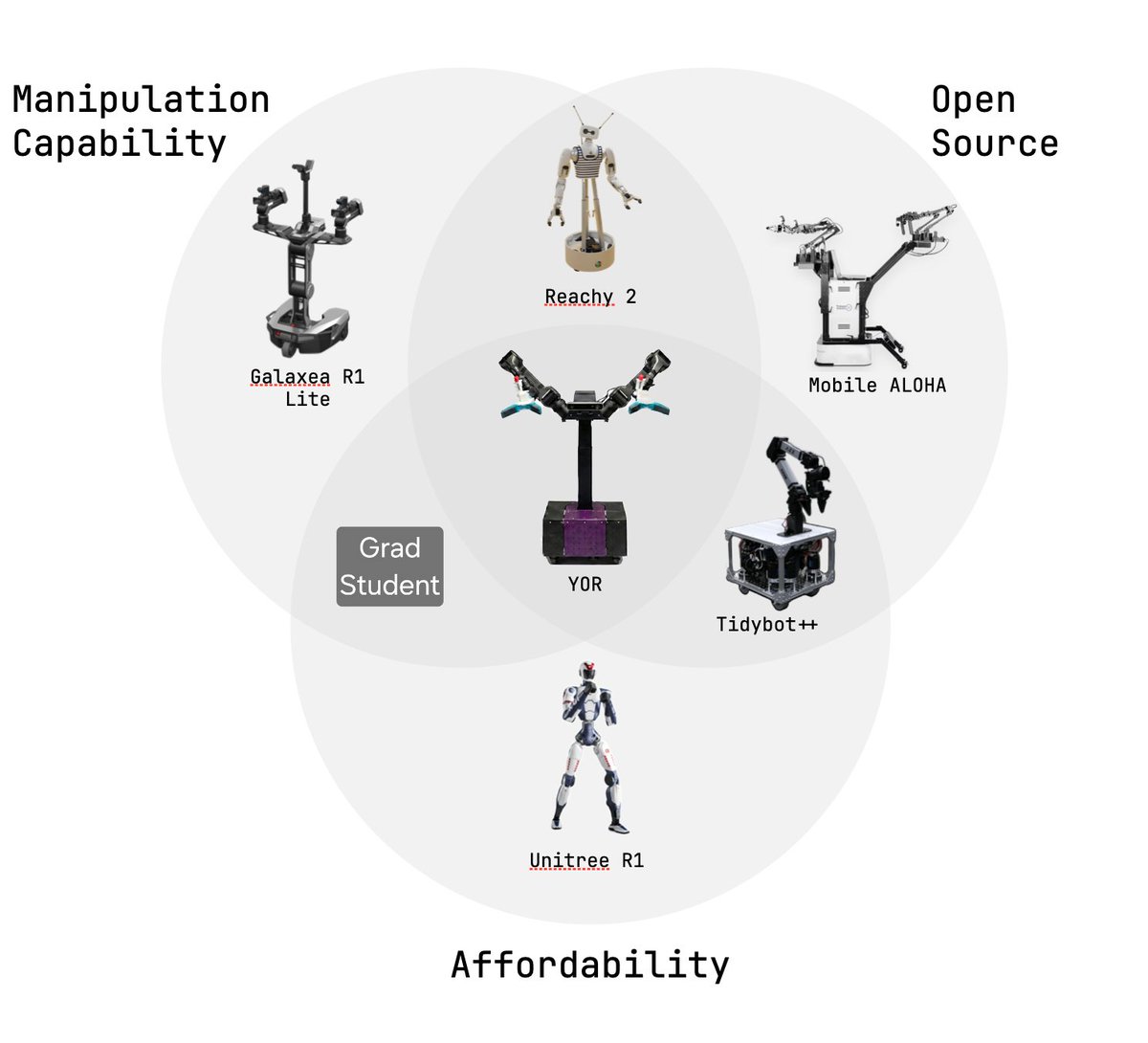
✨ Meet YOR: Open-Source Bimanual Mobile Manipulator from @nyuniversity
Fully open-source mobile manipulator with dual 6-DoF PiPER arms by AgileX Robotics, BOM cost only ~$10k!
🌐 yourownrobot.ai
#Robotics #OpenSource #AgileXRobotics #PiPER #NYU
English
Jeff Cui retweetledi

World models are neural simulators. But neural simulators need grounding.
If you close your eyes and reach out for the coffee cup in front of you, you’ll be able to manipulate it.
To pass The Physical Turing Test, we need action loops at scale, irrespective of the modality, and that’s what the bitter lesson teaches us.
We are upgrading Simulation 1.0 to 1.5 - generative assets and scenes, and we are calling it PhysReady. [1/]
Palatial@PalatialSim
A child consumes more data in 1 month than any LLM has ever seen. Embodied agents learn by doing, but the data that teaches them is tactile, sensorial and causal. Such data does not exist. To make physical AGI possible, we need to generate this new data at an industrial scale. Enter Palatial: automated infrastructure that converts raw data into sensory rich playgrounds for robots to learn in. Today, we’re unveiling Palatial PhysReady, the first automated sim asset generator (try it ⬇️) [1/5]
English
Jeff Cui retweetledi

Robot foundation models are limited by costly real data, while simulation data is plentiful but visually mismatched to reality. We present Point Bridge, a method that enables zero-shot sim-to-real transfer for robot learning with minimal visual alignment.
pointbridge3d.github.io
English
Jeff Cui retweetledi

@_varunnair We train our encoder and policy from scratch! These models use a ResNet-50 backbone for the visual encoder, with a Vector-Quantized Behavior Transformer (VQ-BeT) as the policy head. The model is small enough that it runs at 3Hz on an Intel NUC CPU.
English
Jeff Cui retweetledi

The real gap isn't capability, it's accessibility. We need platforms that labs can actually build, hack and improve without needing Big budgets or NDAs. Something modular, documented, cheap and yet capable enough to conduct hours of research .
We present you YOR

Mahi Shafiullah 🏠🤖 RSS 2026 ✈️@notmahi
Why buy a robot when you can build your own? Meet YOR, our new open-source bimanual mobile manipulator robot – built for researchers and hackers alike for only ~$10k. 🧵👇
English
Jeff Cui retweetledi

This project was a big collaborative effort with our amazing team, led by @AnjariaManan and @MEnesErciyes, and co-advised with @notmahi.
Find more details here: yourownrobot.ai
Paper: arxiv.org/abs/2602.11150
Build documentation: build.yourownrobot.ai
English