JellyBeanSwap

22 posts

JellyBeanSwap banner
JellyBeanSwap

JellyBeanSwap

@jellybeanswap

The jellybean ecosystem.

WEB 3.0 Katılım Temmuz 2010
36 Takip Edilen1 Takipçiler
JellyBeanSwap retweetledi
Vest Labs
Vest Labs@VestLabs·
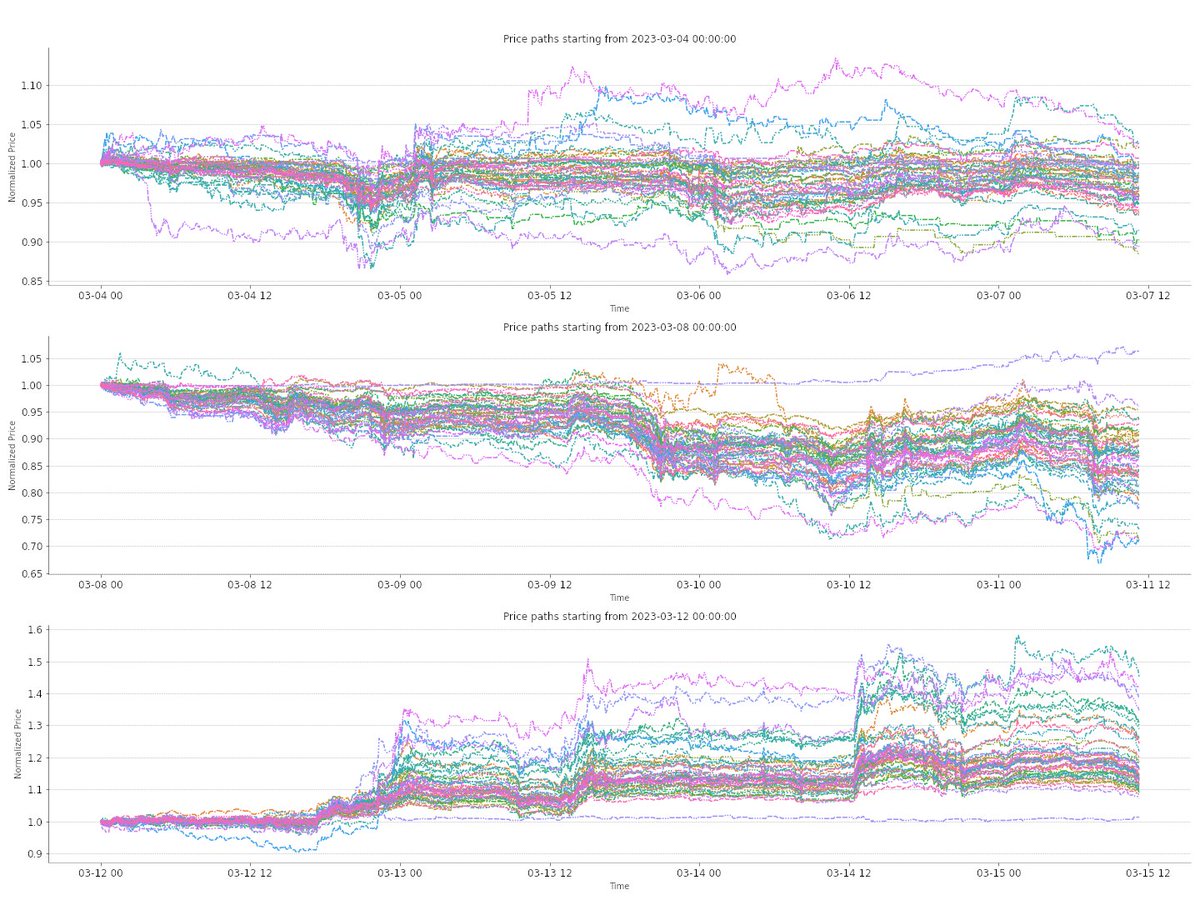
🔬New Research: Exploring Multiple Methods for Forecasting Multivariate Volatility for Risk Indifference Pricing in Perpetual Contracts. A thread 🧵 (1/8) Want to jump into the discussion? Visit here: research.vest.xyz/t/multivariate…
Vest Labs tweet media
English
4
9
34
16.8K
JellyBeanSwap retweetledi
Justin
Justin@perpv2·
The $TRB market manipulation incident is a vivid demonstration of problems across perp DEXs. Here’s what happened: Perp DEXs let traders take on large amounts of leverage, while using Open Interest (OI) caps to limit the total amount of open positions for each asset to manage risk. Low liquidity assets can become targets for market manipulators because it’s easier to influence their price. By engaging in coordinated buy orders across multiple exchanges they can artificially pump the price. If OI caps aren’t set correctly, traders can take on much larger positions than what is appropriate. Eventually, these artificially inflated prices become unsustainable and market manipulators sell off their positions which causes a crash. In the case of Synthetix, this means stakers (aka LPers) incurred millions of dollars in losses. Risk parameters need to be responsive to market conditions and riskiness of assets. In a volatile market event like the $TRB price surge, @VestExchange’s protocol owned liquidity would be the first to absorb the impact and shield LPs from immediate losses. In addition, Vest calculates the exact capital needed to ensure exchange solvency and LP risk - it charges trades the exact fees needed to be paid to LPs for this risk. In the case of highly imbalanced markets like $TRB, fees and funding rates paid to LPs and the exchange would have automatically increased, covering potential losses. Unlike other DEXs, these fees are the exact fees needed to ensure that the exchange and LPs are made whole. Other DEXs, like Synthetix, would have manually and arbitrarily increased their fees in correlation with imbalance, but not with the precision and purpose of counterparty solvency. In the case of Synthetix, the human dependency and manual fine tuning of fees was not enough to cover LP losses. Vest’s approach is dynamic, automatic, and responsive, offsetting LPs heightened risk exposure with higher earnings and AMM capital protection. In my opinion, this makes Vest currently the most capital efficient and decentralized DEX in the space. I will soon be publishing official simulation results of Vest on $TRB. Stay tuned for a follow up post!
DMH 🦇🔊🌊@DeFi_Made_Here

ICYMI: Oracle-based perp DEXes/lendings are always a subject to market manipulations. But there are ways to mitigate risks for LPers. @synthetix $snx stakers lost $3.4M on $TRB shorts because the DAO did not properly set risk parameters (Spartan Council). The "We live, we learn" approach will always be there as long as risk mitigation is in the hands of individuals (eg @adamscochran was responsible for safety parameters) and is not based on a math approach with an automated risk engine. OI caps that were set on Synthetix are very inefficient, especially taking into account that they were denominated in $TRB but not in $ terms. I prefer @Aark_Digital approach to implement a skewness cap rather than a cap on OI. It allows to scale OI while reducing risk for the LPs. For example, a perp DEX with a $10m ETH OI cap without any skewness cap mechanism could easily have an 80:20 long-skewed OI balance, exposing the pool to a $6m short position. However, with a $6m skewness cap, the protocol can scale the OI up to $100m, where the skewness is $6m ($53m long - $47m short). Although the pool is exposed to a $6m short position in both cases, the latter case only exposes 6% (6m/100m) of the OI, compared to 60% in the initial case. The @VestExchange AMM assigns a monetary risk measure, Entropic Value at Risk (EVaR), to any given trade. It uses a risk engine to dynamically affect the cost of trading based on the quantifiable risk metrics, removing the need for OI caps. This allows the exchange to safely move past traditional OI caps and even scale OI past TVL without being at risk of insolvency. On @chromatic_perp all trades have a price impact based on the liquidity available in the liquidity bins rather than a price impact based on liquidity on CEXes, on OI, or no price impact at all. On top of that, Chromatic has introduced a predefined TP/SL, that enables the execution of payoffs solely through smart contracts. Perp DEXes with outdated designs such as fixed fees, OI caps, manual risk engines, etc will be replaced by projects that are ready to evolve fast in this highly competitive space.

English
1
5
22
10.3K
JellyBeanSwap retweetledi
Jelly Bean
Jelly Bean@jellybeancash·
Put down your #BNB wallet address and you might get a #airdrop.
English
21
17
11
1.4K
JellyBeanSwap retweetledi
Jelly Bean
Jelly Bean@jellybeancash·
Candy corn will be buyable with #jellybeancash and will work in tandem
English
0
1
0
0
JellyBeanSwap
JellyBeanSwap@jellybeanswap·
@justinbieber i fuckin ♥♥♥♥♥♥♥♥ u alot!!!!!!!!!!!!!!!!!!!!!! I ♥ U!!!!!!!!!!!!!!!!!!!!!!!
English
0
0
0
0