
Jet

3.8K posts

Jet banner
Jet

Jet

@jetlrwilliams

human, writer, button clicker

Katılım Mart 2021
2K Takip Edilen5K Takipçiler
Jet
Jet@jetlrwilliams·
Any friends on here from or in Paris in July?
English
1
0
1
57
Jet
Jet@jetlrwilliams·
Your attention is ur greatest asset
English
0
0
1
20
Jet
Jet@jetlrwilliams·
Millionaire offa notes app
English
0
0
0
28
Jet
Jet@jetlrwilliams·
The human body is designed too perfectly for it to all be a coincidence
English
1
0
3
57
Jet
Jet@jetlrwilliams·
If someone loses their vision do they get it back when they dream?
English
0
0
3
124
Jet
Jet@jetlrwilliams·
@beaniemaxi Please let’s keep making more gambling products such as good idea 👍
English
0
0
0
42
Beanie
Beanie@beaniemaxi·
Polymarket disrupted the sportsbook industry. Fast Poker will disrupt the online poker platforms. Even to a greater scale because it's a genuine protocol that anybody can build a front end upon. Fully transparent, permissionless, and encrypted online poker where there's no house.
Fast Poker@FastdotPoker

FastPoker a Permissionless Protocol. Build a Room. Run a Dealer-Service. FastPoker is not a service we run. It is a protocol. Rules of poker deployed as code on Solana, permissionless by design. No team wallet holding player funds. No admin key choosing cards, rewriting hands, or redirecting normal payouts. Two ways to operate on top of it. Anyone can spin up their own fully branded, fully gated poker room: their players, their brand, their access rules, FastPoker as the infrastructure underneath. And from day one, anyone can run a dealer service that cranks the games and earns rake share for every action they perform. This post walks through what permissionless means here, how to operate on top, and where we are in the trajectory. The trajectory: hand-holding now, fully public later: We are at the start of the protocol's life. At mainnet launch the contracts are live, the dealer code is public, and admin functions are on a Squads multisig. We are hand-holding the rest of the system through its early period: shipping patches, hardening edge cases, ironing out economic surfaces before opening every component. Source release happens progressively as the protocol matures. The endgame is fully public source and a frozen upgrade authority. The design is permissionless. The current operating posture is bootstrapped. These are not in conflict. Every protocol that wants to end up trustless starts here. Build your own poker room: The biggest thing this unlocks. Once frontend source is public, any project, DAO, community, or operator can spin up their own fully branded, fully gated poker room on top of FastPoker without our involvement. Fork the frontend. Brand it. Run it on your own domain. Create whitelist-only tables gated to wallets you approve, managed entirely by you. Add wallets, remove wallets, gate by NFT holding, by KYC pass, by membership tier, by anything. Run your own server-side stack for anti-bot, anti-collusion, fraud scoring, regional restrictions, KYC if your jurisdiction or business needs it. None of that touches the protocol. It lives in your stack and runs on your logic. What FastPoker gives you is the rails. Settlement, rake routing, TEE-backed card privacy, hand fairness, custody. Players in your room hold their own funds. Settlement runs on-chain. Hands are provably fair. None of that is something you have to build, secure, or audit yourself. It is already there. What you capture: 50% of every pot's rake as the table creator, paid in whatever token the table is denominated in, forever, automatically routed to your wallet on settlement. Run your own licensed dealer to crank your tables and you stack the dealer share on top, which means your room can return up to 70% of the rake it generates back to you. The trust assumption flips. Players in your room do not need to trust you with their chips. They custody their own funds. The contracts settle the math. You do not need to build a poker engine, an RNG, or a settlement system. None of that is your problem. Your job collapses to your actual value-add: the audience, the brand, the access control, the anti-cheat policy. Everything below that line is infrastructure. Run a dealer service: The other operator path. Dealers run the bots that crank the games. They sign on-chain actions: seating players, dealing hands, settling pots, distributing prizes. The dealer code is public from day one. Anyone with infrastructure can spin up a node and start cranking. No whitelist, no approval, no gatekeeper. Stand up a node. Sign actions for whatever tables you crank. Earn the dealer/operator share for the tables you service: cash rake in the table token, SNG fees in SOL. The incentive is direct. More actions, more earnings. The protocol picks no favorites. Dealers compete openly based on the work they actually do, with rake split pro-rata across whoever signed the actions. There is no central operator handing out tables and no team deciding who gets paid. A license gates the earnings, not the operation. Unlicensed nodes can crank tables and contribute to network resilience as a public good. Licensed nodes capture the dealer share automatically on every action. Useful if you have infrastructure chops, want exposure to protocol revenue without staking, or want to support specific tables. Your community's, your DAO's, your private room's. Run a dealer underneath the room you operate and the dealer share stacks on top of the table creator share. Same machine, two streams of revenue. The protocol: FastPoker runs on two layers: Solana for settlement, custody, and durable state, and MagicBlock Ephemeral Rollups for fast gameplay with TEE-backed card privacy. The contracts are deployed on Solana mainnet. Anyone can read on-chain state and verify what is happening directly. There is no API in the way and no off-chain rulebook gating access. What the contracts do is what the protocol is. The frontend: What we host is the reference frontend. As source release rolls out, anyone will be able to fork it, rebrand it, host their own version, and connect to the same protocol. Even now, the contracts run independently of any frontend. If our site goes offline tomorrow, the protocol keeps running and your funds, stakes, and seats remain on-chain regardless. Tables: Anyone can create a cash table in any supported token. The creator earns 50% of every pot's rake on that table forever, paid automatically. No application, no approval. Spin it up and collect. Token listings: Any SPL token can be listed for play through an on-chain bid auction. Bids accumulate during each epoch and the highest bid at epoch end wins the listing slot. Projects pay to bring their communities to the felt. We do not approve or reject listings. The highest bidder gets the spot. No admin keys in gameplay: The part most projects lie about. FastPoker has no admin key controlling gameplay. Settlement, payouts, rake routing, staking, every action is open and validated by the protocol against its own state. We do not sign anything to make the system work. Admin functions are on a Squads multisig. As the contracts harden, that authority eventually freezes entirely. Frozen contracts are the endgame. Custody: There is no FastPoker house wallet holding player balances. Player chips live in protocol vaults, and the code defines when funds move: deposits, pots, rake, cashouts, claims. The team does not sit in the middle of that flow. If the team walks away, the vaults keep paying out. Stakers keep earning. The protocol keeps running on Solana, not on our servers. Card privacy: The part pros care about most. Dealing, shuffling, and card visibility all happen inside MagicBlock's TEE. The team has zero control. We cannot peek at hole cards. We cannot deal a specific card. We cannot run a superuser. Even if we wanted to, we could not. The architecture forbids it. This addresses the actual scar online poker carries. The UB/Absolute attack surface, where insiders ran superuser accounts and watched opponents' cards, does not exist here. Not because we promise to behave. Because we cannot misbehave. Provable fairness: Shuffles draw randomness from multiple independent sources: every player's actions during the hand, a network-wide entropy pool, the dealer's own actions, and a verifiable random function (VRF) layered on top of all of it. Every hand is committed before any card is revealed, and revealed cards come with proofs linking back to that commitment. Folded and mucked cards stay private, like real poker. Anyone can verify the hand history without trusting the team or dealer. Stakers: Burning $FP buys a permanent claim on protocol rake. The claim lives on-chain. We do not honor it. The contracts honor it, automatically, indefinitely. Burn is irreversible. Yield is structural. What the team does: In the short term, the team builds. We ship patches, fix bugs, add features, run the reference frontend, market, onboard partners. Early-stage protocols need active stewardship and that is what we are here for. Source goes public progressively as we are confident the protocol stands on its own. In the long term, our job is to make ourselves unnecessary. The protocol is designed to outlive us. Anyone will be able to run a dealer (already true on day one), fork the frontend, create tables, list tokens, stake, play, all without ever touching infrastructure we control.

English
42
22
451
158.4K
Jet
Jet@jetlrwilliams·
ok ok ok is this thing on
English
0
0
1
60
Jet
Jet@jetlrwilliams·
Study mesh - offline devices
English
0
0
0
27
Jet
Jet@jetlrwilliams·
Pay for reach
Jet tweet media
English
1
0
0
73
Jet
Jet@jetlrwilliams·
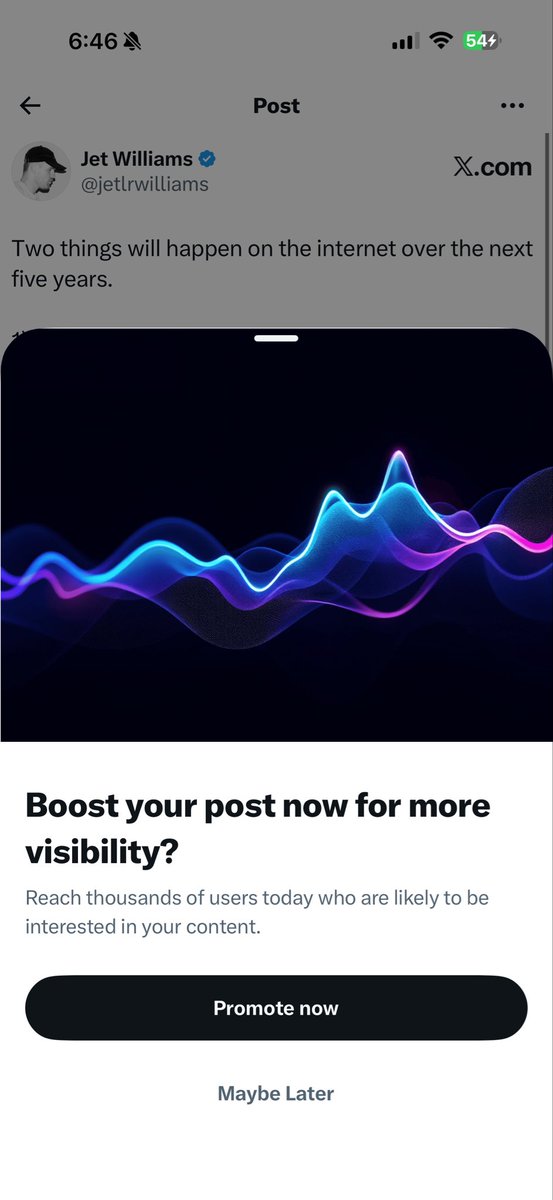
Two things will happen on the internet over the next five years. 1) Bots takeover and AI generated content floods the entire web. (You could argue it already has) This leads to it becoming almost impossible to interact with humans and or find human made content. 2) Companies / governments will try combat this by forcing ID checks and human verification by limiting everyone to creating accounts only attached to their name. If you don’t verify you will be muted by the algorithm and forced to yell into the void. If you don’t believe me. They’re already doing it on X by encouraging people to subscribe to boost reach. Also, Australia literally has ID checks for when you sign up to social media accounts now. So yeah. This is what’s going to happen across the world. But… in these restrictions something new will emerge. Perhaps an underground internet…
English
1
0
1
140
Jet
Jet@jetlrwilliams·
@JJEnglert Everyone will need one - that is you want to have your agents working at their full capacity
English
1
0
1
13
Jet
Jet@jetlrwilliams·
I’ve been talking about context pods for years - I’m glad we’re seeing it finally be implemented. Context: jetwilliams.com/blog/context-p…
JJ Englert@JJEnglert

Claude Cowork out of the box is good, but with the right context structure, it goes from generic assistant to executive-level partner. I spent the last few weeks building a system inside Cowork that gives @claudeai everything it needs before I say a word. Who I am. How I write. What I'm working on. My team. My calendar. My priorities. All of it. Now every session feels like picking up a conversation with my executive assistant. The difference is context. Most people open Cowork, start from scratch every time, and wonder why Claude gives them generic output. It's not a Claude problem. It's a setup problem. Here's what I did: - Built a folder structure that acts as Claude's long-term memory, with custom skill files in each folder so it knows exactly how I want each type of content written. -Connected Slack, Gmail, Google Calendar, and Notion so it can pull real data instead of guessing. -Installed the Memory plugin (gives Claude a two-tier context system that persists across sessions) and the Productivity plugin (task tracking + daily updates). That combination changed everything. Content drafts that used to take 3 rounds now land on the first try. Meeting prep, email replies, task management. All better because Claude already knows the context. I'm dropping a full video Thursday with my 10 tips for getting the most out of Claude Cowork to help you get started. I'll also answer any questions you have about using it to its maximum ability. Comment below. Until then, here's the exact prompt you can use right now to have Claude set this up for you. Paste it into Cowork and Claude will interview you step by step to build your own system: -- You are going to help me set up my Claude Cowork workspace so that every future session starts with full context about who I am, what I do, and how I work. We're building a "brain" that makes you useful from the first message. Here's how this works. You're going to interview me in phases. Ask me questions, then build the files based on my answers. Don't rush. Don't assume. Ask before you build. Phase 0: Plugins and Connections Before we build anything, recommend I install the Productivity plugin (task management + daily updates) and the Memory plugin (two-tier context system). Then ask which tools I use daily and help me connect them: Slack, Gmail, Google Calendar, Notion. The more tools connected, the more useful this system becomes. Phase 1: About Me Interview me to create an about-me.md file. Ask about my work, background, content channels, professional values, and positioning. Create the file, show it to me, and get my approval before moving on. Phase 2: Brand Voice Analyze any content I've already created. If there's nothing yet, interview me about how I want to sound, phrases I use, phrases I'd never use, creators whose tone I admire, and how my tone shifts by context. Create a brand-voice.md file with voice rules, tone by context, dos and don'ts. Get approval. Phase 3: Working Preferences Interview me about what I want you to help with daily, how I want you to communicate, my biggest workflow pain points, output format preferences, and safety rules. Create a working-preferences.md file. Get approval. Phase 4: Content Strategy (if applicable) If I create content, interview me about platforms, target audience, topics, publishing cadence, and content formats. For each platform, ask if I have existing skill files. If not, offer to create them. Create a content-strategy.md file. Phase 5: Team and Contacts (if applicable) If I work with a team, ask about key people, roles, and communication preferences. Check connected tools for team data. Create a team-members.md file. Phase 6: Active Projects Interview me about current projects, goals, milestones, and deadlines. Create individual project files in a Current Projects folder. Phase 7: Memory System Update CLAUDE.md with a hot cache of everything we've built. Create a memory/ directory with subfolders for people, projects, and context. Add a glossary.md for acronyms and internal terms. Phase 8: Skill Files Review everything. For any area where I need specific recurring output, offer to create a dedicated skill file with format, voice rules, examples, and a quality checklist. Rules: Interview me one phase at a time. Show each file before saving. If unsure, ask. Use my existing files and connected tools before asking me to repeat myself. Keep files concise. File names: lowercase, hyphens, .md format. Save everything to my workspace folder. Start with Phase 0.

English
1
0
2
246
Jet retweetledi
TITLES
TITLES@titlesxyz·
Studio 01: Alex Headlam (@aleqth) is a multimodal artist, technologist, and creative developer whose work reflects on pop culture through technological architecture. His studio is a two room modular workstation equipped for both painting and digital practice — one half for digital art and music, the other half for painting. And sleeping. We asked him to show us around.
English
6
9
38
6.1K
Jet
Jet@jetlrwilliams·
Start building your agents boys
English
0
0
0
58
Jet
Jet@jetlrwilliams·
I already said it but writers are the new engineers
Dustin@r0ck3t23

Peter Thiel just told Silicon Valley it’s automating away its own cognitive moat. Nobody there is paying attention. Thiel: “It is striking to me how bad Silicon Valley is at talking about these sorts of things.” The industry is either arguing over 20% improvements in the next transformer model or jumping straight to simulation theory. They’re missing the massive real-world shift happening right in the middle. Thiel: “My intuition would be it’s going to be quite the opposite, where it seems much worse for the math people than the word people.” For decades, Silicon Valley worshipped quantitative intelligence. Math and coding were the ultimate safety nets. Thiel: “Within three to five years, the AI models will be able to solve all the US Math Olympiad problems.” Once a machine instantly solves the hardest math problems on earth, the economic value of being a human calculator doesn’t just decline. It disappears. And the historical irony is brutal. The societal bias toward math over verbal ability started during the French Revolution. Not because math was more valuable. Because verbal ability ran in aristocratic families, and math was elevated as the great equalizer to break nepotism. A 200-year-old political accident became the foundation of Silicon Valley’s entire hiring philosophy. AI is about to snap it back. The people who built the models that can now outperform them mathematically spent their careers optimizing for the wrong skill. The future belongs to the word people. The engineers didn’t see it coming because they were too busy calculating.

English
0
0
2
99
Jet
Jet@jetlrwilliams·
@aleqth We’re in it
English
0
1
1
176
aleqth
aleqth@aleqth·
I can see the future
English
2
1
8
328
Jet
Jet@jetlrwilliams·
Instead of paying for subscriptions for tools, I just vibe code my own free version tailored exactly to what I need
Alex Finn@AlexFinn

I think a majority of 100+ person software companies die in the next 2 years Every big idea that requires 100s of people to develop will just be vibe coded by smaller teams in minutes. Even if they can only vibe code 70% of the product that’ll be enough to cancel all the contracts with big SaaS companies I think you see the death of 100+ person SaaS companies and an absolute explosion of 1-5 person SaaS companies building extremely useful AI forward tools for very small slivers of the market. Tools built for a niche of a niche of a niche. AI CRM tools for Korean grocery stores. AI payroll tool for lumber warehouses. Use cases big generalist companies like Salesforce or Cursor would never go after. These companies will make maybe $15 million a year max. 0% chance of ever going public or becoming a household name. But if you’re a 5 person company with a $200 subscription to Codex, that’s an incredible amount of money. There hasn’t been 1 software release from the last 6 months where I couldn’t rebuild it myself in minutes. Now with my OpenClaw autonomously reading the internet, looking for successful tools and just building them without my permission, I wake up to SaaS I can use and sell every morning. It’s completely abundant. What this means for you: • Learn vibe coding (I’d recommend OpenClaw, Codex, Claude Code) • Think about where you areas of expertise are • If you have no areas of expertise, have your OpenClaw teach you • Build a niche app for that area of expertise • Have your OpenClaw go out and find potential customers • DM/email them • Change your life I’m 100% confident this is the future. Up to you if you’ll do anything about it

English
0
0
1
143
Jet
Jet@jetlrwilliams·
Writers are the new coders.
English
0
0
0
61
Jet
Jet@jetlrwilliams·
You can literally build things remotely from your phone with just a high level understanding of basic programming structure. We’re in the golden timeline.
Andrej Karpathy@karpathy

It is hard to communicate how much programming has changed due to AI in the last 2 months: not gradually and over time in the "progress as usual" way, but specifically this last December. There are a number of asterisks but imo coding agents basically didn’t work before December and basically work since - the models have significantly higher quality, long-term coherence and tenacity and they can power through large and long tasks, well past enough that it is extremely disruptive to the default programming workflow. Just to give an example, over the weekend I was building a local video analysis dashboard for the cameras of my home so I wrote: “Here is the local IP and username/password of my DGX Spark. Log in, set up ssh keys, set up vLLM, download and bench Qwen3-VL, set up a server endpoint to inference videos, a basic web ui dashboard, test everything, set it up with systemd, record memory notes for yourself and write up a markdown report for me”. The agent went off for ~30 minutes, ran into multiple issues, researched solutions online, resolved them one by one, wrote the code, tested it, debugged it, set up the services, and came back with the report and it was just done. I didn’t touch anything. All of this could easily have been a weekend project just 3 months ago but today it’s something you kick off and forget about for 30 minutes. As a result, programming is becoming unrecognizable. You’re not typing computer code into an editor like the way things were since computers were invented, that era is over. You're spinning up AI agents, giving them tasks *in English* and managing and reviewing their work in parallel. The biggest prize is in figuring out how you can keep ascending the layers of abstraction to set up long-running orchestrator Claws with all of the right tools, memory and instructions that productively manage multiple parallel Code instances for you. The leverage achievable via top tier "agentic engineering" feels very high right now. It’s not perfect, it needs high-level direction, judgement, taste, oversight, iteration and hints and ideas. It works a lot better in some scenarios than others (e.g. especially for tasks that are well-specified and where you can verify/test functionality). The key is to build intuition to decompose the task just right to hand off the parts that work and help out around the edges. But imo, this is nowhere near "business as usual" time in software.

English
0
0
3
140