Joseph Gardi

219 posts

Joseph Gardi

Joseph Gardi

@jgleoj23

Katılım Temmuz 2014
115 Takip Edilen9 Takipçiler
Joseph Gardi
Joseph Gardi@jgleoj23·
@DimitrisPapail also claude code has a button to make any terminal task go to the background
English
0
0
0
55
Joseph Gardi
Joseph Gardi@jgleoj23·
@DimitrisPapail just ask it to use tmux. Without any further instruction the models already know to repeatedly do sleep 30 && tmux capture-pane
English
1
0
0
37
Dimitris Papailiopoulos
Dimitris Papailiopoulos@DimitrisPapail·
Single-threaded agents waste test-time compute. I’ve seen this repeatedly in my own work: Claude Code and Codex kick off a GPU run or a long terminal command, then sit idle waiting for a response. So the model is blocked until the environment responds, then reasons about the result and next steps. Why? That idle time is wasted test-time compute. The model isn’t thinking while it could! The agent should be pipelining eg while waiting on experiment results, it could be planning the next set of experiments, exploring alternative hypotheses, running a supporting subtask in the background. There is no reason for serial execution when the bottleneck is “the environment”. This is not multitasking or “agent swarms” but a single agent making use of its own idle cycles to increase effective test time compute per second of wall-clock time. During that time the model could instead be simulating likely outcomes of the running experiment and pre-planning its next action. Something like speculative execution, but for multi turn reasoning…
English
22
3
78
8.1K
Alex Honnold
Alex Honnold@AlexHonnold·
On January 23, I’ll be free soloing Taipei 101 in Taiwan. It’s been a long time goal of mine and it’ll be the most ambitious urban climb that I’ve attempted. It’s a nearly 1,700 ft tower! What’s not to like?! And I’ll be doing it LIVE on @netflix. Tune in Friday, January 23 at 8PM ET / 5PM PT
Alex Honnold tweet media
English
681
1.1K
18.7K
11.6M
Kyros
Kyros@IamKyros69·
Before you ask AI another dumb coding question… watch this.
English
523
2.7K
21K
1.2M
attentionmech
attentionmech@attentionmech·
What is the fastest method to enter Flow state
English
723
268
5.7K
564.2K
Joseph Gardi
Joseph Gardi@jgleoj23·
@GergelyOrosz only 2 acceptable answers. pragmatic programmer and 23 design patterns
English
0
0
2
62
Gergely Orosz
Gergely Orosz@GergelyOrosz·
What is a book you learned a lot from related to software engineering? (Aka one you'd recommend)
English
174
54
1K
165.2K
JT
JT@jiratickets·
Guy who has a job he loves, a significant other, plentiful savings, contributes to his retirement fund, lives in walkable city, hangs out with his friends on the weekends, keeps in touch with his loving family, travels internationally 1-2 times a year, and exercises regularly
English
865
3.3K
100.5K
6.5M
Joseph Gardi
Joseph Gardi@jgleoj23·
@CalebPeffer but if everyone applies this logic then we would only have developer tools and no real world use case. Just software for the sake of software. Meanwhile, there are wide open opportunities if you look outside the silicon valley bubble
English
0
0
0
9
Caleb Peffer (Hiring!)
Caleb Peffer (Hiring!)@CalebPeffer·
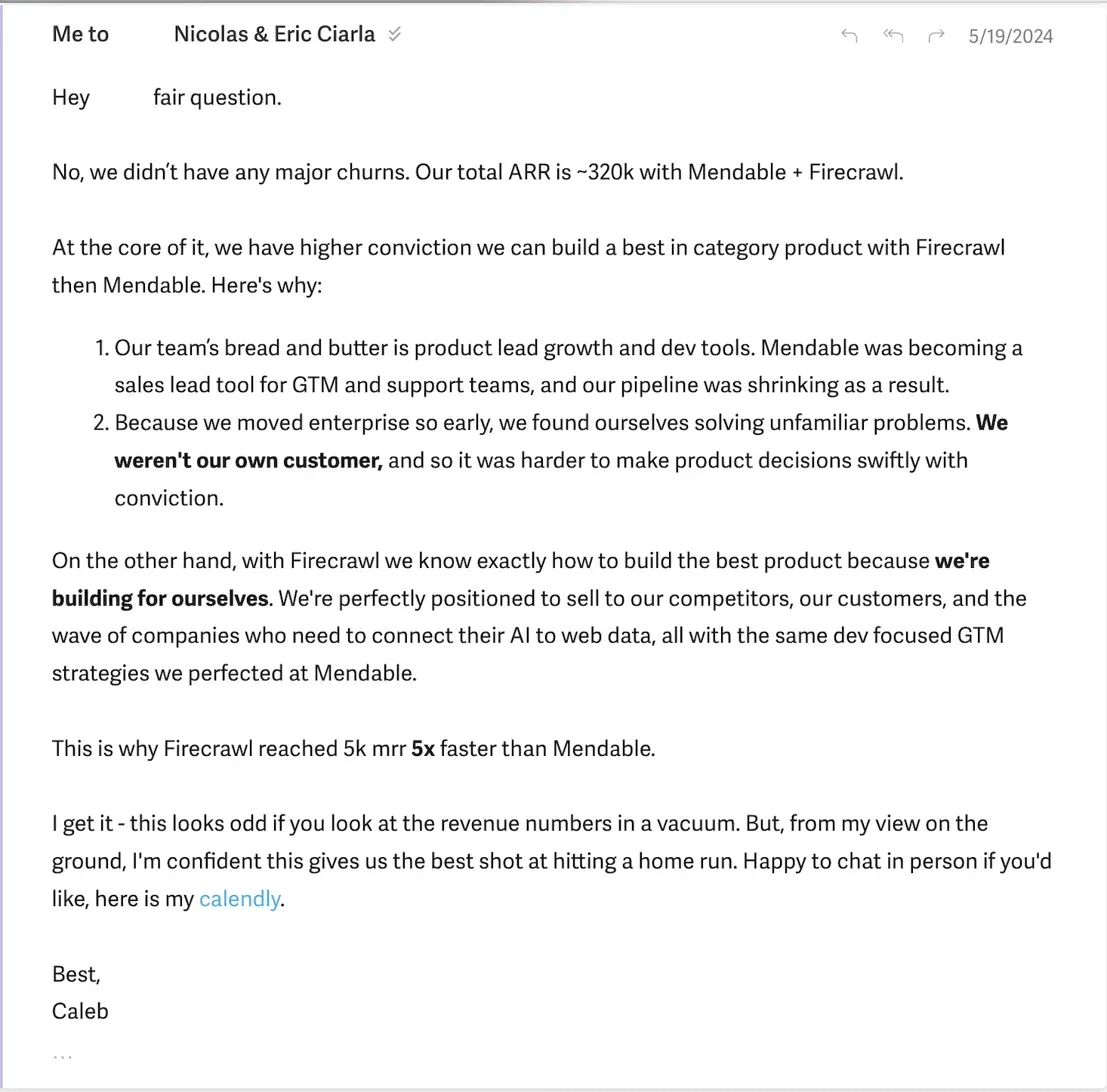
Every morning I'd wake up and think: "I don't understand our customers' problems." We were developers who'd somehow ended up building for enterprise GTM teams. Our DNA was developer tools. Our customers weren't developers.
English
2
0
9
667
Caleb Peffer (Hiring!)
Caleb Peffer (Hiring!)@CalebPeffer·
We walked away from $250k ARR to start from zero. Our investor asked why. I told them the truth: We weren't building for ourselves anymore (email included)
Caleb Peffer (Hiring!) tweet media
English
17
6
151
18.3K
Alex Hormozi
Alex Hormozi@AlexHormozi·
If you want to be successful, you only need to do one thing: be proud of your work… Genuinely. Alone. At night. On your own. When no one is watching. Know. In your bones. That you gave it your all. When you do that, nothing can stop you.
English
267
1.4K
10.7K
318.9K
Soham
Soham@GanatraSoham·
Setup MCP on Cursor with Google Docs in less than 2 mins!! I used Cursor to to create PRDs in Google Docs Here's how you can do it too: - Go to the @composio MCP directory - Search for Google Docs and grab your sse url - Paste the url and set up MCP in Cursor - Use Cursor Agent to authenticate and create PRD Check out the 100+ tools available at mcp.composio.dev
English
17
72
788
151.1K
Bit Paine ⚡️
Bit Paine ⚡️@BitPaine·
Tether paid $2 in fees to move $1.5B. This is a 0.000000001% fee. Possibly the lowest relative transaction fee ever paid on any transaction in the history of human finance. The Bitcoin blockchain is massively underpriced.
Paolo Ardoino 🤖@paoloardoino

Tether Group is moving 14000 BTC to address bc1q8qpfmpf6hcu3tgfvp8dgtf534rws8uhsl9vtk6p2f3r2gnqdz5sqxmty6q as part of its investment in Twenty One Capital (XXI) mempool.space/address/bc1q8q…

English
94
332
3K
222.5K
Joseph Gardi
Joseph Gardi@jgleoj23·
@rauchg but don't forget to allocate time for getting ripped
English
0
0
0
6
Guillermo Rauch
Guillermo Rauch@rauchg·
Life hack: your hobby and your job must be the same.
English
369
406
4.9K
528.4K
Jaana Dogan ヤナ ドガン
A lot of people are ignoring that Go is becoming a commonly used language for prompting pipelines. Python in prototypes and Go in production is another common combo.
Viktor Eriksson@cviktore

Me and the team at @lovable just spent two months rewriting 42,000 lines of code from Python to Go. Technical deep dive of why we did it +what this means: // 1

English
18
30
429
40.1K
Joseph Gardi
Joseph Gardi@jgleoj23·
@bo_wangbo @spyced by the way, I noticed some strange results with late chunking. Providing more context hurt accuracy, and setting the task to retrieval hurt accuracy. Can share details if you'd like
English
0
0
0
49
Bo
Bo@bo_wangbo·
@spyced Hi Jonathan, can we find the evaluation code somewhere on Github :)
English
2
0
0
363
Jonathan Ellis
Jonathan Ellis@spyced·
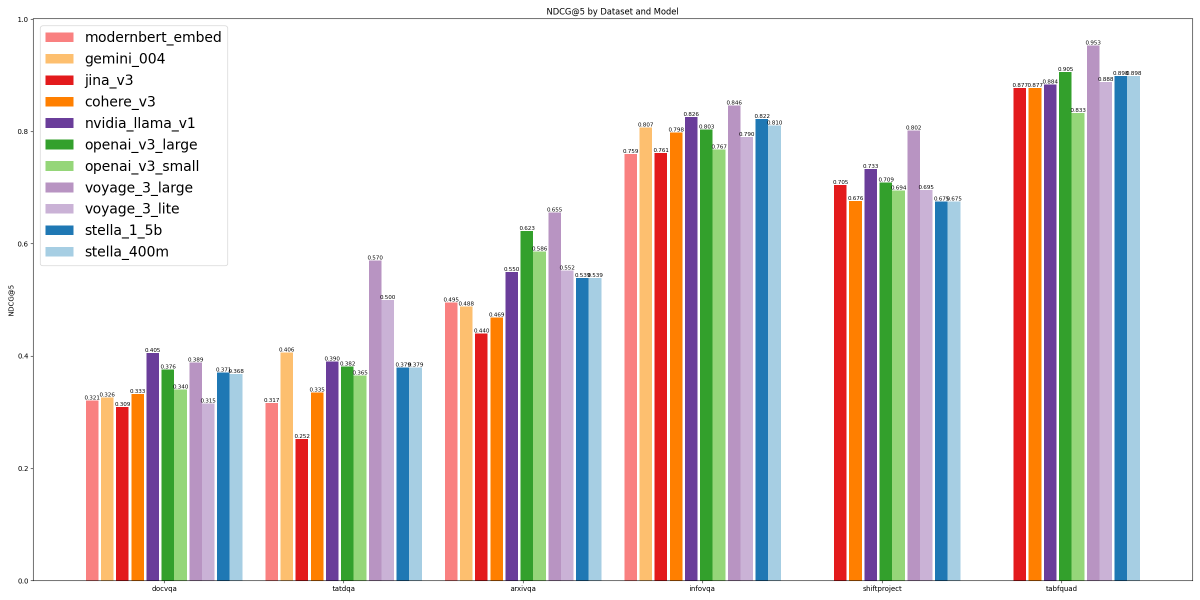
I ran a fresh evaluation of embedding models tuned for semantic retrieval, including the newest models from Voyage, Jina, Cohere, and NVIDIA. Link in thread.
Jonathan Ellis tweet mediaJonathan Ellis tweet media
English
5
5
31
11.9K
Teortaxes▶️ (DeepSeek 推特🐋铁粉 2023 – ∞)
@sama Tbh annie has persuaded me you should be treated with caution, but it has little to do with her object level claims and everything with my belief in substantial heritability of personality and mental disorders.
English
31
11
1.2K
91.6K
Sam Altman
Sam Altman@sama·
My sister has filed a lawsuit against me. Here is a statement from my mom, brothers, and me:
Sam Altman tweet media
English
4.3K
1.5K
29.1K
7.7M
Joseph Gardi
Joseph Gardi@jgleoj23·
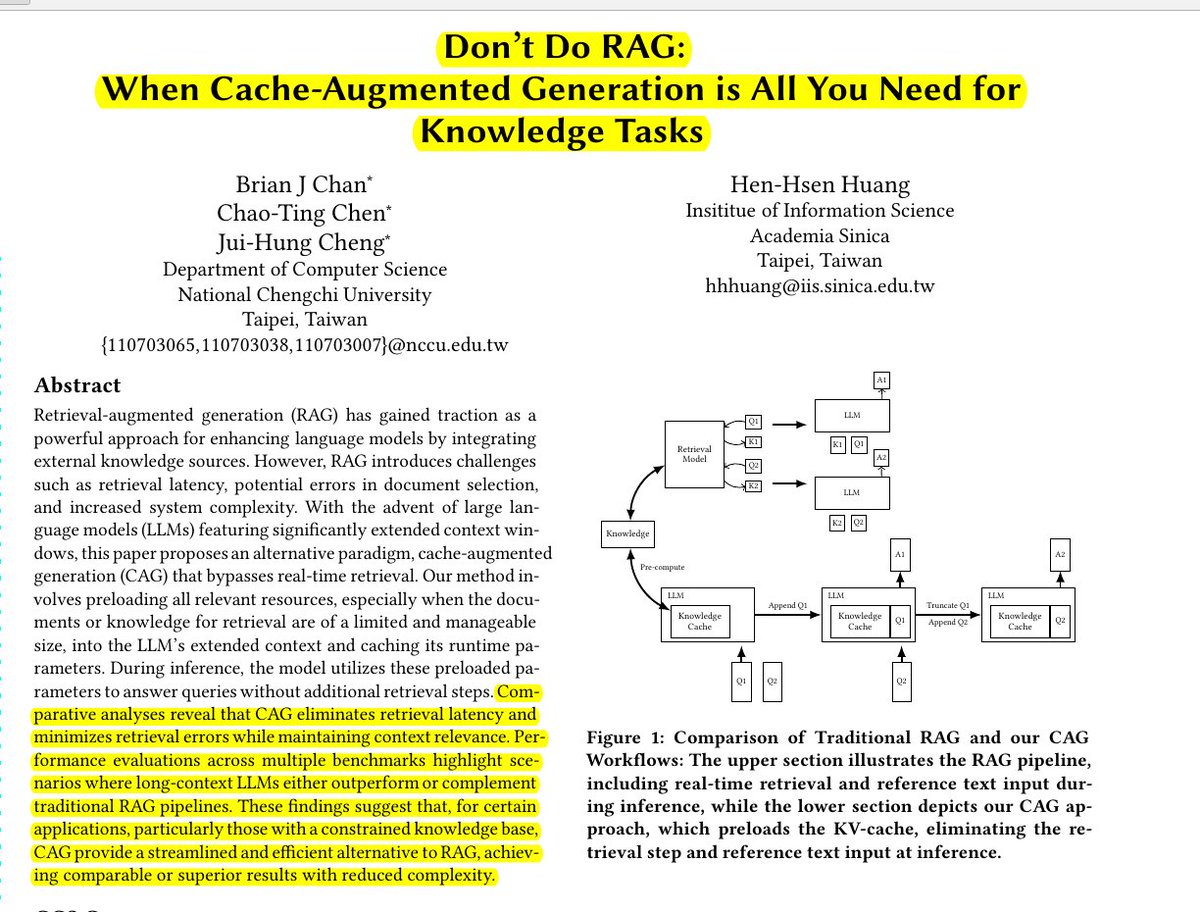
@rohanpaul_ai This paper is making a mockery of the benchmarks. it's basically just saying that the datasets are so small that you can copy the whole dataset into chatgpt. Makes all the previous papers on those benchmarks look ridiculous
English
0
0
4
218
Rohan Paul
Rohan Paul@rohanpaul_ai·
Precomputed key-value caches make knowledge retrieval 40x faster than traditional RAG. Cache-augmented generation replaces traditional retrieval-augmented generation by preloading documents and precomputing key-value caches, making knowledge tasks faster and more accurate. ----- 🤔 Original Problem: Traditional RAG systems suffer from retrieval latency, errors in document selection, and complex system architecture that requires careful tuning and maintenance. ----- 🔧 Solution in this Paper: → The paper introduces Cache-Augmented Generation (CAG), which preloads all relevant documents into LLM's memory before inference. → CAG precomputes key-value caches from documents, storing them for future use rather than retrieving during runtime. → The system operates in three phases: external knowledge preloading, inference with cached context, and efficient cache reset. ----- 💡 Key Insights: → Eliminating retrieval during inference dramatically reduces response time and system complexity. → Preloading context enables holistic understanding across all documents. → CAG works best when document collections fit within LLM context windows. ----- 📊 Results: → CAG achieves highest BERT-Score (0.7759) on HotPotQA, outperforming both sparse and dense RAG systems. → Generation time reduced from 94.34s to 2.32s on large datasets. → Consistent performance improvement across both SQuAD and HotPotQA benchmarks.
Rohan Paul tweet media
English
24
108
708
57.3K
Taelin
Taelin@VictorTaelin·
does the post below help you guys visualize why an optimal theorem prover would do whatever you expect an AGI to do?
Taelin@VictorTaelin

let's focus in one component. suppose you want to write the 3D renderer: i.e., the part of the game engine that draws the scene to the screen. if you ask gpt-4 to write such a thing in one go... it will fail hard. that's some big piece of software, involving lots of functions and data structures. vectors, matrices, rotations, line rastering, depth buffers. there's no AI model in the world that can write the whole thing without getting stuck in some bug in the way. (to be fair, perhaps soon, but not today!) now, assume we have an optimal prover as a tool. that is, a magic oracle that, given a proposition, outputs a correct proof. how could we exploit that to make gpt-4 or sonnet of today write a whole game engine autonomously? simple: rather than asking it to write the code, we ask it to write specs as types. for example, it could fully specify what it means to "render a scene" by using a dumb "ray intersection" approach. in plain english, that spec would be like: > given set of triangles, a cam, a screen, return, for each screen pos, the color of the first triangle that intersects the cam->pos ray the AI would then send that spec to the theorem prover, and the theorem prover would return a correct rasterization algorithm! the key insight is that writing a correct spec is *much* simpler and smaller than writing the full algorithm that satisfies it. the spec above, for example, can be written in a single line of code, while the correct implementation is thousands of lines of code. so, in short, to write a game engine, all that gpt-4 or sonnet would need to do is write a series of "specs as types". and yes, all the specs of a complete game engine certainly fit the context of gpt-4. but again, that's not the *only* way. that's just an example. if we actually had an "optimal theorem prover" at hands, we could literally just ask it to build a better gpt. as in, specify what a language model is as a type (i.e., define the concept of characters, next-token, loss, etc.) - that's reasonably easy to do. then, given that type to the hypothetical optimal theorem prover, and watch it invent a super smart language model architecture that has infinite effective context size. then, ask *that* thing to write the game engine for you (: similarly, things like ARC-AGI can be directly solved by such oracle, by just writing a type that says "give me a program f of size < X such that, for each ARC-AGI input x, produce its output y" of course, that's all assuming an optimal theorem prover (big assumption). but hopefully this helps you visualize how such a thing would imply all the things that people expect from an "AGI". so, by focusing on the problem of proof synthesis, we're indirectly working on the problem of superintelligence

English
9
0
64
11K
tuna🍣
tuna🍣@tunahorse21·
Python but fast
tuna🍣 tweet media
English
37
91
1.7K
62.1K
yobibyte
yobibyte@y0b1byte·
I did 80,000 simulations in Rust, and they all failed because | ^^^^^^^^^^^ `some_string` is a `&` reference, so the data it refers to cannot be borrowed as mutable
English
2
0
25
1.9K