John Musembi Musila

23.5K posts

John Musembi Musila

John Musembi Musila

@jmusembi

A Melancholic Pragmatist. Teacher. Liverpool FC. Gor Mahia. LALakers. Anime.

Kenya Katılım Temmuz 2009
426 Takip Edilen578 Takipçiler
John Musembi Musila retweetledi

Manwa Hosea
Manwa Hosea@ManwaOH·
Members of the Bar hold numerous concerns regarding the conduct of the Court of Appeal judges. However, Advocates are constrained from raising these concerns publicly for fear of reprisal and profiling. Social media posts made out of professional frustration are often brought to the attention of the Judges. The consequence is a perception that no Judge of that Court will thereafter determine a matter in favour of the said advocate and their clients. This explains why many Advocates are publicly supporting the Petition filed by Senator Okiya Omtatah before the Judicial Service Commission. While they agree that the Senator’s grievances are well-founded, they are reluctant to speak openly lest their clients be prejudiced. If only the Court of Appeal would discharge its mandate and administer justice as contemplated by the Constitution and the law. It is imperative that the Bar and the Bench jointly review the Court of Appeal Rules to ensure that appeals are heard and determined expeditiously and on merit by replacing 5(2)b applications with substantive appeals. Advocates can argue their appeals in 5-10 minutes. I wonder why stay applications are the most listed for hearing, but substantive appeals take years to determine. It is untenable that the Court should stay a decision of the High Court and only hear the substantive appeal five years later. What the public may not appreciate is that once the Court of Appeal grants a stay of a High Court decision, a litigant may wait upwards of four years for the substantive hearing. This is precisely why the Hon. Attorney General routinely seeks recourse in the Court of Appeal, aware that the Court’s timelines effectively grant the State an indefinite reprieve. The practice is unjust, prejudicial to litigants, and undermines public confidence in the administration of justice. Appellate justice appears to favour litigants with financial means and influence. For those in that category, their matters are listed for substantive hearing without undue delay. The delays in handling appeals has become the greatest judicial injustice of our time. Are wr ready to confront this injustice? Time will tell. I hope the AG will not file an application to stay the Ebola dispute before the COA. A stay will mean, free supply of Ebola to over 60M Kenyans. The AG will win, the matter will be scheduled for substantive hearing in 2030 and the AG by then will state that the matter is already overtaken by events, LSK and Katiba institute will be asked to withdraw the matter. Its that bad. @NelsonHavi @ckanjama
English
6
58
94
8.8K
John Musembi Musila retweetledi
Jeremiah Knight
Jeremiah Knight@iamrjknight·
The wrath of God is not an uncontrolled outburst. It is not heaven losing patience the way sinners lose patience. God’s wrath is His holy opposition to evil, flowing from the purity of His own nature. Men often want a god who smiles at sin, excuses rebellion, and calls darkness harmless. But such a god would not be holy. If God looked upon wickedness with indifference, He would not be righteous. He would be corrupt. Scripture does not give us that kind of God. “Your eyes are too pure to approve evil, and You can not look on wickedness with favor” (Habakkuk 1:13). This is why the wrath of God is terrifying. It is not random anger. It is perfect justice. It is holiness responding to everything that defiles His creation, insults His name, rejects His law, and tramples His glory. “For the wrath of God is revealed from heaven against all ungodliness and unrighteousness of men” (Romans 1:18). The modern world hates this because it wants love without holiness, mercy without repentance, forgiveness without blood, and heaven without bowing before Christ. But the cross itself proves that God does not treat sin lightly. If sin could be ignored, Christ did not need to bleed. “He made Him who knew no sin to be sin on our behalf, so that we might become the righteousness of God in Him” (2 Corinthians 5:21). The wrath of God is the fire of His holiness against all that is evil. And the only safe place from that wrath is not religion, not morality, not sincerity, but Christ Himself. “Therefore there is now no condemnation for those who are in Christ Jesus” (Romans 8:1).
English
9
37
135
1.9K
John Musembi Musila
John Musembi Musila@jmusembi·
@EduMinKenya @TSC_KE @NAssemblyKE Tragic boarding school fires need better response. Negligence by all concerned should no longer be entertained especially when young lives are lost. Tough decisions will have to be made. Slowly phasing out boarding schools or having them admit only the number they can handle.
English
0
0
0
9
John Musembi Musila
John Musembi Musila@jmusembi·
Eventually. Doesn't matter how long it will take. Boarding school Heads / Principals will be directed by @EduMinKenya to either sleep in the school house or just seek transfer to a day school. Eventually those powers of Principals will be checked by @TSC_KE @NAssemblyKE
English
2
0
0
11
John Musembi Musila
John Musembi Musila@jmusembi·
@EduMinKenya @TSC_KE @NAssemblyKE Digital AI enabled tool will have to be developed to aid BOMs in undertaking internal audits to ensure data based repair and development projects. Moving away from relying on Secretary - BOM who is the Principal. @OAG_Kenya will need to have a better AI tool.
English
0
0
0
11
John Musembi Musila retweetledi
#LandIsNotProperty Mwalimu Wandia
I recently read Griffin's book on school management. The school trusts students and allows them to leave the compound. And they barely had discipline issues. (At least at the time). Everything sounded good to me, but I realized that what he does is something Kenyan teachers would find very difficult to do. They don't have the psychological and philosophical makeup of Griffin. They are employed by TSC. Griffin was not. Teachers depend on fees and capitation. Starehe was receiving huge donations from foreigners. Most of all, Kenyan teachers are not wazungu. With our hatred of philosophy and history, many of us in the school system cannot make philosophical assessments, and the parents won't allow it anyway. But locking teenagers in a dorm so that they don't go out at night is just stupid. Even if you employ a dorm master or give the security the keys, how do you know that they will be there the whole night? Give the children the keys, explain to them the responsibility, tell them the dangers of going out at night. Teach them to be responsible. But that also means you need to give them opportunities to go out during the day, like field trips and (supervised) walks. Locking kids up with no escape route doesn't teach them anything except to look at life's opportunities as only possible by sneaking out. And surely, the mentality of the principals is the mentality of the Kenyan state that quickly crushes any new voice, idea and innovation that it doesn't understand. To transcend that mentality as a school principal requires the resources Griffin had. And it's not like Griffin didn't have a sordid legacy with the Mau Mau counterinsurgency. And his friend Patrick Shaw. But I'll bring that up in another post. #Tyrannyof3pc
English
11
102
167
12.2K
John Musembi Musila retweetledi
Ory Okolloh-Mwangi
Ory Okolloh-Mwangi@kenyanpundit·
During the Moi Girls fire I was shocked that parents were seeing the dorms for the first time. This fake ass policy no parents going to dorms needs to be fought by all PTAs and parents.
English
104
2.9K
9.6K
414.1K
John Musembi Musila retweetledi
habitual linecrosser
habitual linecrosser@omanyeric·
@anne_odida I worked in a school once. The power trip some of the staff and administrators have can be shocking. Utapata matron was one of the principals favorites. She could make stupid decisions with impunity.
English
0
1
3
342
John Musembi Musila retweetledi
Jeremiah Knight
Jeremiah Knight@iamrjknight·
The centre of Christian truth is not human greatness, earthly success, or religious self improvement. It is the crucified Christ. Everything true in Christianity leads us to the cross. There we see the holiness of God, the guilt of man, the horror of sin, the justice of divine wrath, the depth of mercy, and the glory of redeeming love. “But may it never be that I would boast, except in the cross of our Lord Jesus Christ” (Galatians 6:14). And the life of the Christian is shaped by that same cross. We do not follow Christ on a road of ease, self glory, and worldly approval. We follow the One who said, “If anyone wishes to come after Me, he must deny himself, and take up his cross daily and follow Me” (Luke 9:23). The cross does not merely forgive us. It reorders us. It humbles our pride, kills our self rule, teaches us repentance, and calls us to live no longer for ourselves, but for Him who died and rose again. “He died for all, so that they who live might no longer live for themselves, but for Him who died and rose again on their behalf” (2 Corinthians 5:15). A Christianity without the cross may still sound religious, but it has lost its heart. The truth we believe is shaped by Christ crucified, and the life we live must bear the marks of belonging to Him.
English
4
29
92
1.6K
John Musembi Musila retweetledi
Jeremiah Knight
Jeremiah Knight@iamrjknight·
I have read many books, but the Bible reads me. Other books may inform the mind, stir the emotions, sharpen thoughts, or expose the world around us. But Scripture goes deeper. It does not merely sit before me as something to be studied. It stands over me as the living Word of God, searching the heart, exposing motives, correcting lies, and bringing the soul before the face of God. “For the word of God is living and active and sharper than any two edged sword… able to judge the thoughts and intentions of the heart” (Hebrews 4:12). This is why the Bible cannot be handled like an ordinary book. We may open it to examine the text, but soon the text begins to examine us. It uncovers sins we have hidden, fears we have justified, pride we have protected, and unbelief we have dressed in religious language. The Bible wounds in order to heal. It humbles in order to restore. It exposes our ruin so that we may flee again to Christ. “Search me, O God, and know my heart; try me and know my anxious thoughts” (Psalm 139:23). Many books can teach us something. Only the Word of God can read us truly, judge us rightly, and lead us to the Saviour who alone can save.
English
5
23
105
1.4K
John Musembi Musila retweetledi
Jeremiah Knight
Jeremiah Knight@iamrjknight·
Adam blamed Eve. Eve blamed the serpent. And at the end of the day, fallen man still tries to blame God. That is what sin does. It does not only rebel. It hides. It excuses itself. It looks for someone else to carry the guilt. Man will blame his upbringing, his pain, his weakness, his circumstances, the devil, other people, and even God Himself before he will honestly say, “I have sinned.” When God confronted Adam, Adam said, “The woman whom You gave to be with me, she gave me from the tree, and I ate” (Genesis 3:12). That was not only blame toward Eve. It was blame thrown upward toward God. The heart of man has not changed. Eve then said, “The serpent deceived me, and I ate” (Genesis 3:13). The guilt was passed again. But God was not deceived by the excuses. Each one was held responsible. This is why we need grace. We do not naturally confess sin honestly. We protect ourselves. We explain ourselves. We soften our guilt. But true repentance stops hiding and comes into the light. David did not say, “My circumstances made me do it.” He said, “Against You, You only, I have sinned and done what is evil in Your sight” (Psalm 51:4). That is where mercy begins to shine. Not when we successfully shift the blame, but when we stop defending ourselves and fall before God with the truth. “If we confess our sins, He is faithful and righteous to forgive us our sins and to cleanse us from all unrighteousness” (1 John 1:9). The gospel does not give us a scapegoat to avoid guilt. It gives us Christ, the true Substitute, who bore the guilt His people could never excuse away.
English
6
29
137
2.2K
John Musembi Musila retweetledi
Yohan
Yohan@yohaniddawela·
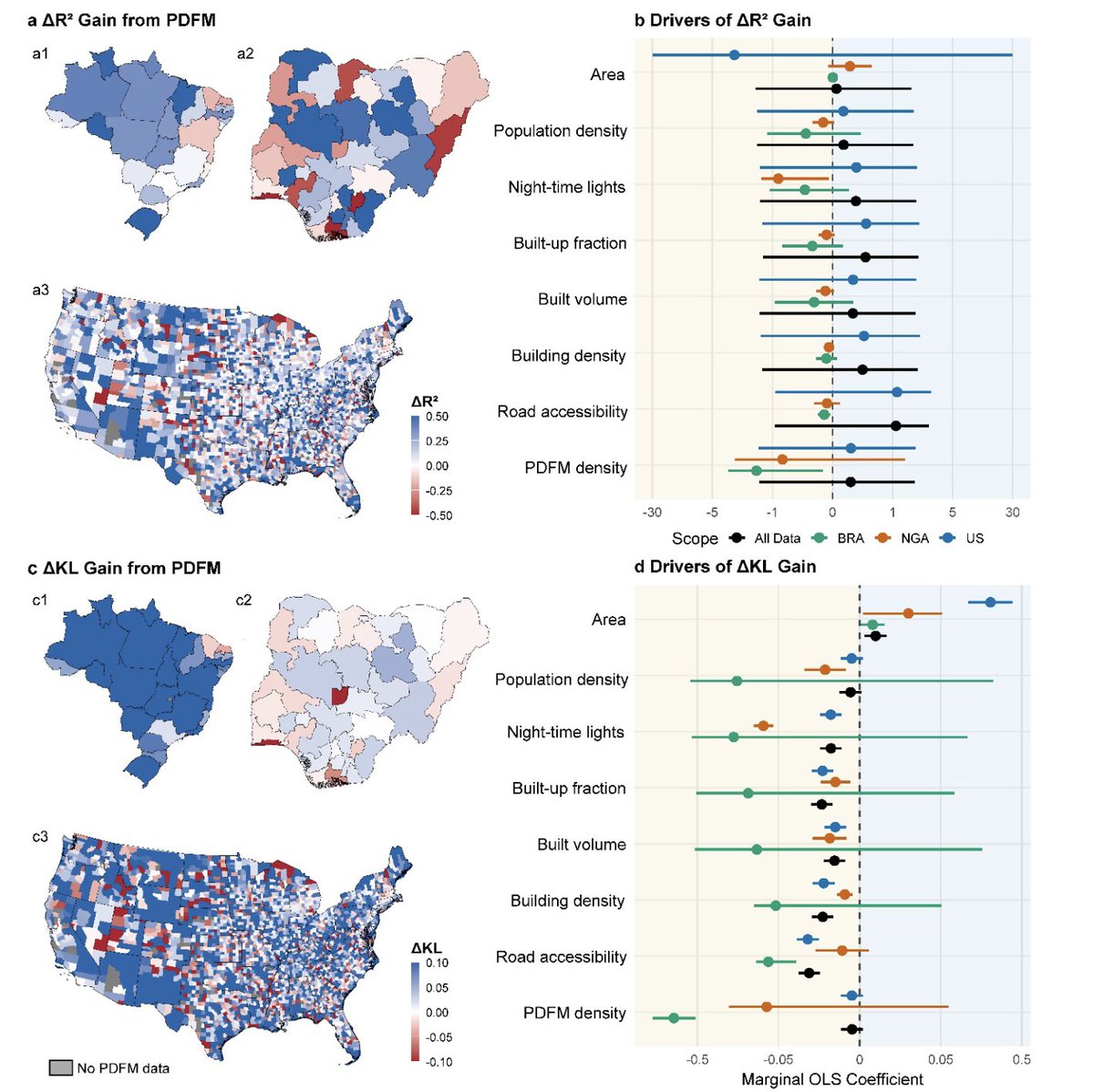
Google turned 46,000 places into 330-number fingerprints, then used them to predict where people live better than maps of nightlights, roads and buildings. That’s a strange sentence, but it points to a pretty big shift in population mapping. For decades, the standard approach has been to estimate population from things we can see from above: night-time lights, road networks, buildings, land cover, accessibility, elevation, slope, and other physical traces of settlement. The basic idea is that people tend to live where there are houses, roads, lights, services, and accessible land. But the visible world can actually mislead us. A bright place can be an industrial zone. A dense road network can serve commuters rather than residents. Two built-up areas can look similar from space while having completely different household sizes, incomes, migration patterns, or settlement histories. A new paper from @WorldPopProject tests Google’s Population Dynamics Foundation Model. Instead of feeding the model a fixed list of hand-built geography variables, PDFM gives each place a 330-dimensional embedding. You can think of an embedding as a compressed fingerprint: a set of numbers that captures patterns too complex to write down manually. Those 330 numbers come from several sources. The first 128 dimensions come from aggregated search trends. The next 128 come from maps and busyness indicators. The final 74 come from weather and air-quality signals. Then the model links places together in a graph, where districts, postal codes, ZIP areas and local government areas are treated as connected nodes. Places can be connected because they’re geographically close, because they sit inside the same administrative structure, or because their behavioural signals look similar. That means the model is actually learning the wider pattern of how that place functions. The authors tested this across three very different countries: • Nigeria: 783 local government areas • Brazil: 5,568 districts • United States: 39,649 ZIP Code Tabulation Areas Together, that’s 46,000 places. The benchmark was a standard WorldPop-style feature set: 23 geospatial covariates covering the built environment, night-time lights, accessibility, land use, land cover, elevation, slope and related variables. The models themselves were deliberately ordinary: Random Forest, XGBoost and Elastic Net. Interestingly, the paper wasn’t trying to win by hiding everything inside a more complex model. It was testing whether the predictors themselves carried useful information. The evaluation was also stricter than a simple random split. The authors used spatial cross-validation, grouping smaller places by larger administrative regions. Nigerian LGAs were grouped by state, Brazilian districts by state, and US ZIP areas by county. That’s important because neighbouring places often share the same roads, markets, lights, infrastructure and settlement patterns. If a model trains on one area and predicts the area next door, it can look more accurate than it really is. Spatial cross-validation makes the model prove that it can travel. Across the analyses, the PDFM embeddings consistently improved predictive performance relative to the standard geospatial covariates. In plain English: the learned place 'fingerprints' contained population-relevant information that the usual satellite and accessibility layers were missing. That’s a pretty interesting result because population maps sit underneath a lot of real-world decisions. They shape health planning, disaster response, poverty measurement, climate exposure analysis, infrastructure investment and humanitarian targeting. A small spatial error can change where clinics are planned, where vaccines are sent, where flood risk is counted, and where public money goes. A pretty interesting part of the paper is its restraint. The authors thankfully don’t claim that foundation model embeddings make old geospatial features obsolete. Their finding are a bit more useful than that. PDFM helped most when common physical indicators of settlement intensity and accessibility didn’t already explain the population pattern well. In places where night-time lights, buildings, roads and accessibility were already highly informative, the traditional covariates remained competitive. That’s exactly the kind of result a good population model should produce. Buildings matter. Roads matter. Lights matter. Search behaviour, busyness patterns, weather context and environmental signals can matter too. The real advance is learning when each signal adds value. This is where the paper becomes bigger than one benchmark. Population modelling is moving from a world built around visible settlement proxies to one built around richer place representations. The old question was: what can we see from space? The new question is: what combination of physical, behavioural, environmental and administrative signals best explains where people actually live? That shift matters because the census is still the anchor, but censuses are expensive, uneven, delayed and sometimes politically difficult. Satellite layers help fill the gaps, but they mostly capture the visible surface of settlement. Embeddings add another layer: the learned context of human activity around a place. The future probably belongs to hybrid models. Use the census where it exists. Use satellite covariates where the physical landscape is informative. Use learned embeddings where behaviour, accessibility and local context reveal things the visible landscape leaves out. I find that to be a more realistic path than replacing one data source with another. Link to paper: arxiv.org/pdf/2605.01650
Yohan tweet media
English
2
31
116
7.8K
John Musembi Musila retweetledi
Jeremiah Knight
Jeremiah Knight@iamrjknight·
Do not fear because your prayer is stammering, your words are feeble, and your language is poor. Jesus understands the cry of the heart even when the lips struggle to speak. Prayer is not powerful because our sentences are polished. Prayer is heard because we come to the Father through Christ. The weakest cry from a broken heart is not despised by God. “The sacrifices of God are a broken spirit; a broken and a contrite heart, O God, You will not despise” (Psalm 51:17). Sometimes the soul is too heavy to speak clearly. Sometimes sorrow, fear, guilt, weakness, or confusion leaves us with only a few words. But the Lord does not need eloquence to know His child. He knows the groaning beneath the words. “In the same way the Spirit also helps our weakness; for we do not know how to pray as we should” (Romans 8:26). So come to Him. Come with broken words. Come with tears. Come with trembling. Come when you do not know how to explain what is happening inside you. Christ is not confused by weak prayers. He is a merciful High Priest who sympathises with our weaknesses. “Therefore let us draw near with confidence to the throne of grace” (Hebrews 4:16). Your prayer may sound poor to you, but if it rises from faith in Christ, it is heard by the Father.
English
9
55
208
2.7K
John Musembi Musila retweetledi
#LandIsNotProperty Mwalimu Wandia
I'm looking at data on SMEs. You know how GoK struggles with the informal sector because it doesn't know how to tax the sector? It turns out that the highest segment of people who formalize their MSMEs are secondary school and university graduates. So GoK's war against education in the name of graduates not becoming entrepreneurs is actually nonsense. Education improves business.
English
1
35
78
4.3K
John Musembi Musila retweetledi
Chris Sambu
Chris Sambu@the_sambu·
Jimi Wanjigi admitting that he was part of the Greenfield project at JKIA, a deal awarded during the Kibaki regime, and acknowledging that Uhuru later cancelled it at a cost raises questions about accountability in Kenya’s debt journey. If he benefited from a state-backed mega-project financed through public borrowing, can Wanjigi really detach himself from the genesis of the debt burden that Kenyans continue to shoulder today? #CitizenSundayLive
English
20
69
300
31.5K
John Musembi Musila retweetledi
Jordan Rolfes
Jordan Rolfes@CoachRolfes·
The math behind Jesus being the Messiah is mind blowing. Here are the odds: 8 specific prophecies fulfilled by one man: 1 in 100 quadrillion 48 prophecies: 1 in 10¹⁵⁷ That’s a number beyond human comprehension. Jesus fulfilled 300–500+ Old Testament prophecies written centuries before His birth. This isn’t chance. This isn’t coincidence. The odds are literally astronomical.  Our King is the real deal.
English
551
2.6K
12.8K
287.6K
John Musembi Musila retweetledi
Mohamed Salah
Mohamed Salah@MoSalah·
I have witnessed this club go from doubters to believers, and from believers to champions. It took hard work and I always did everything I could to help the club get there. Nothing makes me prouder than that. Us crumbling to yet another defeat this season was very painful and not what our fans deserve. I want to see Liverpool go back to being the heavy metal attacking team that opponents fear and back to being a team that wins trophies. That is the football I know how to play and that is the identity that needs to be recovered and kept for good. It cannot be negotiable and everyone that joins this club should adapt to it. Winning some games here and there is not what Liverpool should be about. All teams win games. Liverpool will always be a club that means a great deal to me and to my family. I want to see it succeed for long after I have moved on. As I’ve always said, qualifying to next season’s Champions League is the bare minimum and I will do everything I can to make that happen.
Mohamed Salah tweet media
English
10K
44.2K
244K
17.6M
John Musembi Musila retweetledi
Julians Amboko
Julians Amboko@AmbokoJH·
For all those asking, I am just starting to read through the document circulating to make sense of it. Meanwhile, the budget has two sides & expenditure is equally, if not more, important. See quoted 🧵 & start here. It's a colossal Kes 4.82 trillion budget
Julians Amboko@AmbokoJH

My math on Kenya's latest tabled Budget Estimates put the size of the 2026/27 budget at Kes 4,817,847,837,259 (Kes 4.82 trillion). See 🧵 below giving a breakdown on salient features in the proposed spending plan.

English
1
25
24
9.1K
John Musembi Musila retweetledi
Vanilla Cars
Vanilla Cars@VanillaCars·
KE 🇰🇪 This may be your reality very soon. The government just changed what's in your fuel. Quietly. From April 30th, the petrol and diesel at every pump in Kenya has 5x more sulphur in it than it did last month. Here's what that means for your car. 🧵
Vanilla Cars tweet mediaVanilla Cars tweet mediaVanilla Cars tweet media
English
81
1.3K
2.5K
226.5K