Joel
38 posts


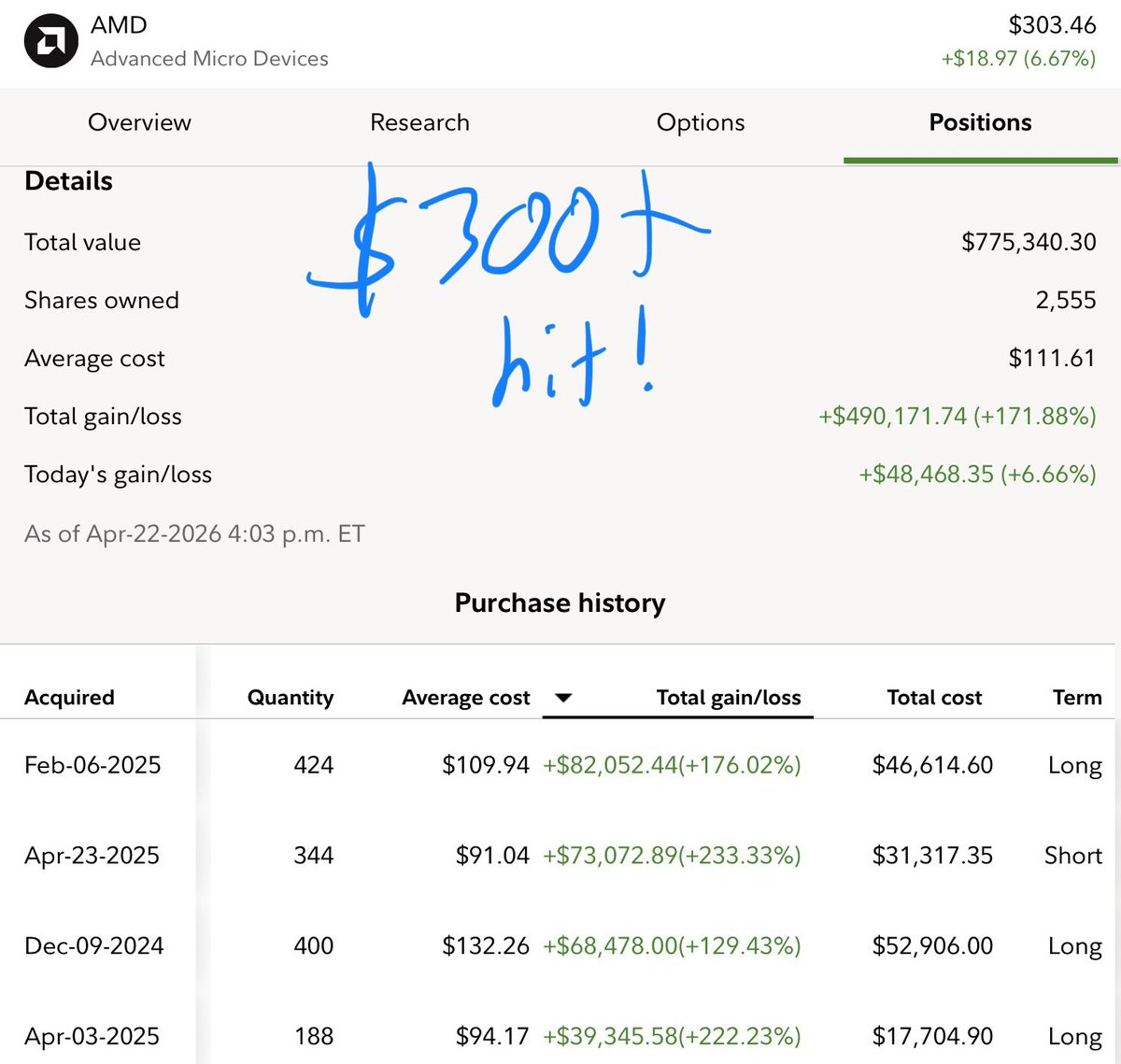
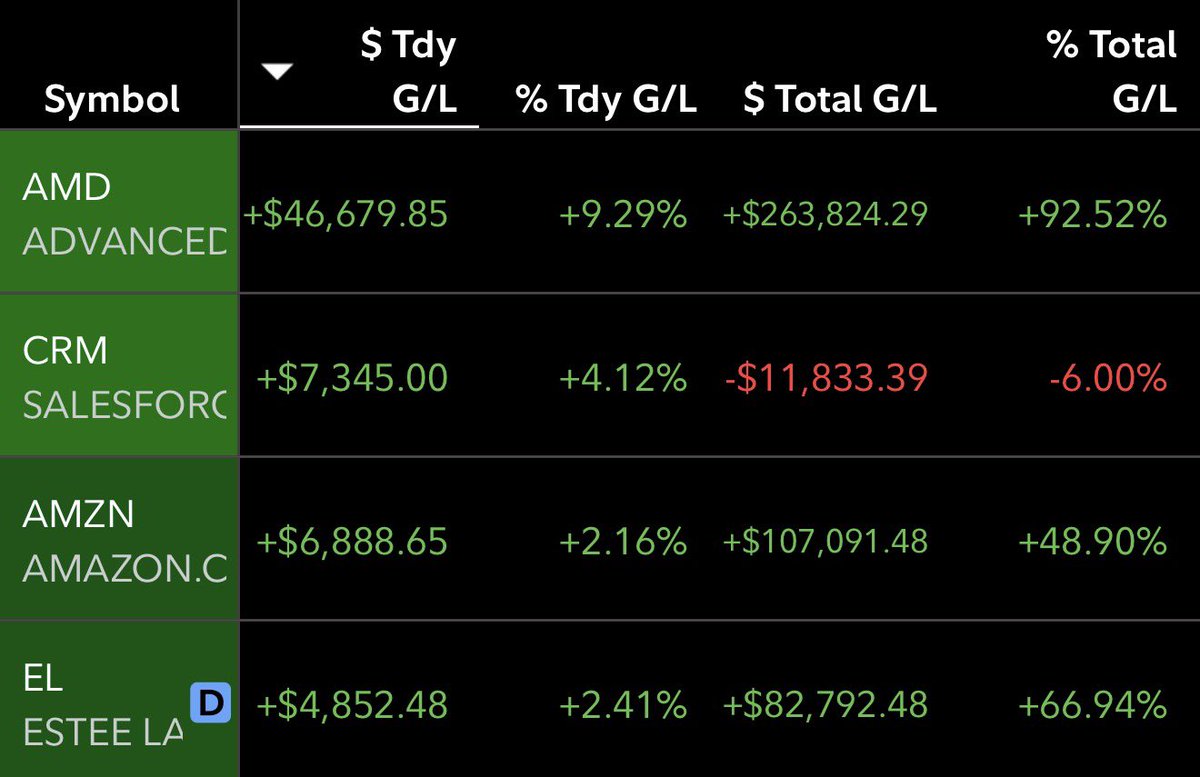
Here we are, $AMD at $300. You don’t need to chase the hottest themes to make great returns. Market frequently misprices even the largest and most well-known companies. I bought $AMD around $100 in early 2025. It’s now a 3x position for me. Still has room to run. Long $AMD.


Can you say…. Aaaaaaaaaaaaammmmmmmmmmmmmdddddddddddddddd $AMD

Stocks expected to more than 3X their revenue in the next 5 years: Nvidia $NVDA: +252% Broadcom $AVGO: +257% Oracle $ORCL: +294% Rocketlab $RKLB: +300% AMD $AMD: +314% Palantir $PLTR: +458% Iren $IREN: +1547% Ondas $ONDS: +3188% ASTS Spacemobile $ASTS +5471% Nebius $NBIS +6400%


$AMD 10x FWD P/S 🚀$770-$940/Share🚨 Consensus vs Actual Revenue🧵 Context:I'm not even asking much, just 10x FWD P/S lol The lowest end of FY2026 projection: AI GPUs: $40-50B (I'm very conservative already) EPYC Data center: $15-$20B(EPYC may contribute as large of revenue in 2027 due to explosive agentic AI demand) Client Segment: $12-$13B Gaming: $6B Embedded: $4-$5B Total Revenue: $77-$94B Non-GAAP net income $19.3B-$23.5B Non-GAAP EPS $12-$14.7 Consensus: $40-$55B(AMD Bears are sticking with outdated numbers) or $37-$39B off the actual revenue. I waited for weeks & months, no analysts came out to correct old forecast. If this continues, this would mean they deleted $40-$50B revenue Helios Rack from $META, @OpenAI, $ORCL, $MSFT, Softbank, @LumaLabsAI, G42, Dell, HPE and many more. $50B Is a very conservative figures already, as I didnt even include MI355X, which is selling very well right now. Don't forget the new estimated EPYC demand for Turin and Venice are 15-20m chips, which demand is 3-5x more than supply, and really need TSMC to ramp up production. The good new, $AMD booked through 2028 with TSMC. Would be helpful if Samsung gets to 70-80% yield sooner, currently they are at ~60%. Yet, $AMD is outperforming everyone while all stocks sold off like crazy in the last 3-4 weeks. All the dips got bought so quick like "they" know it is going to $1,000 in 12-18 months. Alright, that is it. Not Financial Advice!


BREAKING $AMD @Samsung Inked MoU🚀 Advanced Micro Devices ( @AMD ) has signed a memorandum of understanding with Samsung Electronics to expand their collaboration on AI memory and computing technologies, Samsung said Wednesday. The partnership will focus on supplying HBM4 memory for the AMD Instinct MI455X GPU, as well as advance DRAM for 6th Gen AMD EPYC CPUs. The companies will also work together on optimized DDR5 memory and explore potential manufacturing partnerships for future products, Samsung said.


Big day for @AMD and @Meta as we expand our strategic partnership to deploy 6GW of Instinct GPUs. Excited to partner across silicon, systems and software to help Meta push the boundaries of AI at massive scale!


$AMD is a $860 stock| At Just 20x Forward P/S 🧵 Disclaimer: I do own a large $AMD position, and I do believe it is heading to $5 Trillion MC long term as one of my highest conviction I cover for years. And I don't offer Financial Advice The rapid ascent of @AMD in the artificial intelligence sector, particularly through its strategic partnership with OpenAI, $META, $MSFT, $AMZN, $ORCL and others position the company for transformative growth that mainstream Wall Street analysts appear to be underestimating. At the heart of this mispricing lies a critical oversight: many analyst models and revenue forecasts for AMD in 2026 and beyond deliberately exclude or heavily discount the potential contributions from the OpenAI deal, treating it as speculative or contingent rather than a high-probability catalyst. This conservative approach fails to account for OpenAI's extraordinary access to capital($150-$163B Cash), which removes a major barrier to execution and accelerates the timeline for massive compute deployments. FY 2025, AMD grew revenue 34.34% YoY or to $34.64B far higher than most analysts projection, at 12-18%, hence AMD is stuck at 9x P/S. At this kind of size and growing faster than 97% of all US public companies should at least get 20-30x P/S. So I will stick to a conservative approach at Forward 20x P/S. In October 2025, AMD and OpenAI announced a landmark multi-year, multi-generation agreement under which OpenAI committed to deploying up to 6 gigawatts of AMD Instinct GPUs, beginning with an initial 1 gigawatt rollout of MI450-series chips in the second half of 2026. This partnership, structured with performance-based warrants allowing OpenAI to potentially acquire up to a 10% stake in AMD, represents one of the largest single-customer commitments in semiconductor history. This should push AMD FY2026 revenue to be in the $70–100 billion or more in cumulative revenue for AMD over the ramp period, depending on pricing, mix, and scaling. Even conservatively, the initial phases alone could add tens of billions annually to AMD's data center segment as deployments accelerate. My 2026 Projection: AI GPUs: $35-$50B EPYC Data Center: $15B-$17B Client Segment: $12-$13B Gaming: $6B Embedded: $4B-$5B Total Revenue $70-$100B Non-GAAP net income $18B-$25B Non-GAAP EPS $10.97-$15.40 Even at 20x Forward P/S, that is $1.4-$2 Trillion market cap, where many other $AMD bulls would argue 30-40x forward P/S. The chart below will show you AMD is on an explosive rocket on revenue, net income, FCF, and FCF margin growth. By year end, AMD at current valuation would mean trading at 15-17x P/E at this kind of growth, while mature value companies with 3-5% or declining growth trade at 35-55x P/E. Is it fair for Analysts to be this sexist? Is it fair that AMD is facing nonstop fake new from the like SemiAnal? Yet, current analyst consensus for AMD's 2026 revenue hovers in the $40–45 billion range overall, with AI/data center contributions often projected more modestly ($14–15 billion in some AI-specific forecasts from late 2025/early 2026 updates). Price targets cluster around $260–$310, implying forward multiples that remain compressed relative to peers experiencing similar hyper-growth. These figures largely strip out meaningful OpenAI-related upside, viewing the deal's realization as uncertain due to factors like funding availability, execution risks, or competition. This exclusion is misguided, as it overlooks OpenAI's robust and rapidly expanding financial firepower along with other massive hyperscalers' demand. As of February 2026, OpenAI is on the verge of closing one of the largest private funding rounds in corporate history, expected to exceed $100 billion in new capital. This mega-round, involving major commitments from Amazon (potentially up to $50 billion), SoftBank (up to $30 billion), Nvidia (around $20–30 billion), Microsoft, and additional sovereign wealth funds and venture players, would value the company at a pre-money $730 billion and push post-money figures above $850 billion. This follows prior massive raises and reflects sustained investor confidence in OpenAI's trajectory, even amid high cash burn rates projected for 2026 (including losses in the billions as infrastructure ramps). OpenAI's ability to secure such enormous sums far beyond typical startup constraints directly funds the compute purchases required for Stargate and related projects, including the AMD GPU deployments. The capital influx effectively de-risks the partnership's execution, ensuring OpenAI can meet its gigawatt-scale commitments without liquidity hurdles. This dynamic mirrors "startup-type" explosive growth in a mature semiconductor giant. AMD's data center business is already targeting 60%+ CAGR in AI segments, with company-wide revenue growth aspirations exceeding 35% annually over the coming years. When layered with OpenAI's contributions, the trajectory becomes even steeper: potential for $70–100 billion in incremental revenue run-rate from this single partner (and broader diversification) would propel AMD toward a higher premium than this compressed state. In Q3 Q4 2026, valuation multiples should rerate dramatically upward to reflect sustained hyper-growth, margin expansion (as high-margin AI GPUs dominate the mix), and scarcity value in the AI accelerator market. High-growth AI leaders like Nvidia have historically commanded 25–40x+ price-to-sales during peak expansion phases, even at large absolute revenue scales, because investors pay premiums for compounding revenue ramps, technological moats, and market share gains in trillion-dollar addressable opportunities. AMD, as the best AI inference chips with proven execution and now validated by a marquee customer like OpenAI, $META, $MSFT, $AMZN, $ORCL, @HUMAIN @LumaLabsAI and 42 other countries deserve similar at least A 20–25x P/S multiple or even 30x forward P/S on accelerating figures would be entirely reasonable and arguably conservative if the OpenAI revenue materializes as the partnership's structure and OpenAI's funding suggest it will. Today's ~9x trailing and ~7–8x forward P/S embed far too much skepticism and discrimination from wall street, failing to price in the funding-secured reality of OpenAI's commitments. Ultimately, the market's lag in pricing this reality stems from outdated models that discount what OpenAI's funding avalanche has made inevitable: AMD's metamorphosis into an indispensable AI powerhouse. As MI450 deployments commence in late 2026, incremental wins materialize (from $META, $MSFT, $AMZN, $ORCL, LumaAI, Tata collaborations in India, and beyond), and revenue inflection points arrive, the disconnect will narrow dramatically. Investors who recognize this capital-fueled acceleration stand to capture the re-rating toward multiples befitting a company achieving enterprise-scale growth at startup velocity potentially unlocking multi-trillion-dollar market cap potential and positioning AMD among the defining winners of the AI era. If you enjoy this kind of thread, slap the like and repost to please the X algo as I write only Long thread. If you want to support my work further, only if you can afford it, consider subscribe for more in-depth analyses! Not Financial Advice!