

John
445 posts
John
@john_morgs
CPA, Value Investor. Tweets are not investment or tax advice. Just my personal thoughts/opinions.
Katılım Ocak 2020
352 Takip Edilen207 Takipçiler

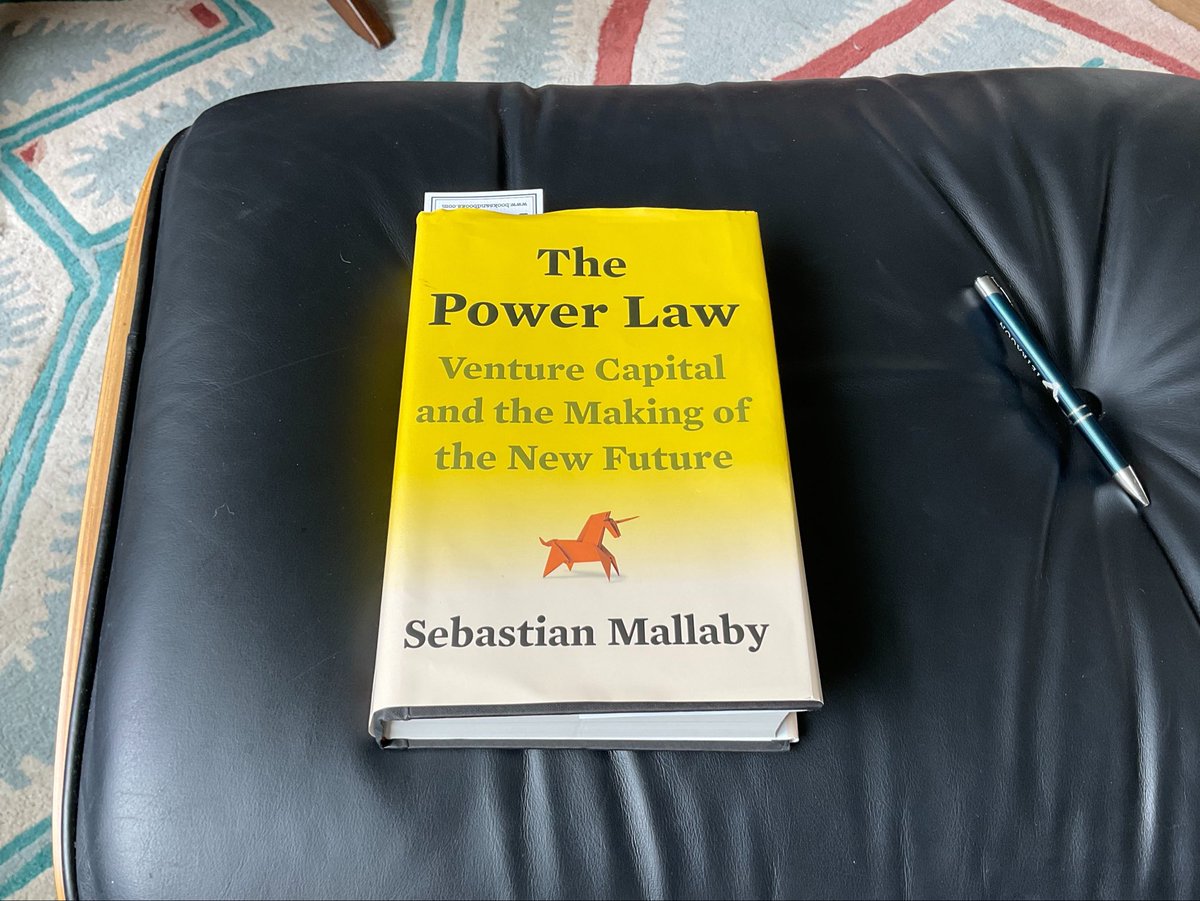
@john_morgs it’s a history book of Silicon valley from the VC angle, here’s one of them:
Francisco Amador | Sleepwell@SleepwellCap
On 1961, Arthur Rock and Tommy Davis setup Davis & Rock, the first venture capital vehicle as we know it today (GP/LP structure) It promised to make concentrated bets on a dozen or so ventures. What seemed like a reckless idea to modern portfolio theorists was totally sensible to them for two reasons: First, buying just under half of a startup’s equity, the partnership would get a seat on the board and a say in their strategy exercising a measure of control over the assets. Second, they would only invest in ambitious, high-growth companies whose value might jump at least tenfold in 5-7 years. Most startups would fail but the winners would have to win big enough to make the overall portfolio a success. Having discarded conventional investment wisdom they also realized that people, not financials, were all that mattered at this stage. The central principle became “Back the Right People” or as Rock liked to say finding “intellectual book value”. The firm proceeded to make 15 total investments from $3.4 million it raised and in less than 7 years it returned $77 million to its investors, or 22.6X. The fund’s gains came primarily from its investment in Scientific Data Systems (acquired by Xerox eventually) and Teledyne. This opened the floodgates to startup investing and the modern Venture Capital era began. Source: The Power Law by Sebastian Mallaby
English
currently reading this book and cannot put it down.
English
My renewal on @forbes magazine is like $60 year. You get about 8 magazines every year. Each magazine has great stories about all sorts of businesses and people. Reading the physical magazine is so much better than their website too. It’s a no brainer for anyone interested in business.
English
From a @Forbes article on boxer Terrence Crawford “He currently has a mix of nearly 80 properties, residential and commercial, spread across Omaha, Kansas City, and Colorado Springs, all paid for in cash… his portfolio operates at a loss right now, which he expects to change in a few years”
Why is his portfolio losing money??
Interesting article… Buffets a fan of his.
English
Here is a good article on Hyrox: europeanbusinessmagazine.com/lvmh-hyrox-pri…
Some interesting quotes:
"Most fitness brands pay between $100 and $300 to acquire a single paying customer through digital advertising. Hyrox’s affiliated gyms and its own participants market the brand organically: a competitor who finishes a race and posts their time is, functionally, an unpaid marketing channel, and the sheer volume of people doing this at scale is what produces both the unusual revenue growth and the unusually clean margin profile."
"Fitness is fragmenting away from the generic, all-purpose gym membership and toward narrow, identity-driven, competitive or performance-tracked formats that give a specific demographic a specific, comparable, shareable outcome. The generic gym sells access to equipment. The new wave of fitness businesses sells a result you can post, compare against your own history, and repeat."
English
Is Peloton $PTON attractive here?
GAAP profitable 9 months into their fiscal year.
Free Cash Flow going to be around $350 million, but includes at least $156 million in stock based comp.
They have cash of $1.1 billion and debt of $1.3 billion.
A negative... Gross profit of only 11% on the equipment. Compare this to before COVID, gross profit on the equipment was in the 40ish%.
The business has stabilized for now... but How will they grow subscribers? I feel like they'd be more profitable if they keep shrinking and just appeal to hardcore users.
I'd raise prices on equipment, pay off debt, build an "in person" type product (maybe instructors travel to commercial gyms outside of NYC and host classes for users who have certain milestones) keep coming out with new programs for people to follow, etc. Try and be the premium fitness brand.
English
Winmark $WINA is great but why does it trade at 35ish P/E?
How many more Plato’s closet’s can there be?
winmarkcorporation.com/wp-content/upl…
English
Great @_inpractise interview with Tom Gayner
The interviewer hits on a key point early on, that Markel $MKL is more concentrated in insurance than Berkshire ever was, limiting what Markel can invest in.
inpractise.com/articles/tom-g…
English
Some interesting stats on Markel $MKL Ventures:
The Industrial segment ROE:
2025=12.7%
2024=13.5%
(using operating income)
This segment includes businesses like Buckner, Cottrell, AMF Bakery, Lansing Building Products, VSC Fire and Security.
The Consumer Segment ROE:
2025=12.4%
2024=13.2%
(using operating income)
This segment includes businesses like Costa Farms and Brahmin.
Comparing this to Berkshire's $BRK early days...
Berkshire bought See's Candy in 1972 for $25 million. In 1984, See's operating income was $27 million.
In 1983, Berkshire paid ~$60 million for 90% of NFM. In 1984 NFM operating income was $12 million.
I think Ventures is doing fine, but is missing that slam dunk business, like Berkshire had with Sees or Nebraska Furniture Mart.
English
Intuit $INTU is really focusing on doing more of the work for customers like taxes and bookkeeping. TurboTax assisted (where you just pay one of their preparers to do the return) grew 36% this year. This is great but doesn’t it alienate all of the accounting professionals that refer their products to clients?
English
Some companies that IPO'd between 1969 and 1975:
Applied Materials
National Semiconductor
Advanced Micro Devices
Intel
Scientific Data Systems (made computers for Science focused projects..acquired quickly by Xerox)
Walmart
Casio Computer (Calculators and watches were a hit in schools/homes)
Disney
Hewlett Packard
John@john_morgs
Reece Duca's story is insane. During his time at Stanford Business School, he turned $7k to $75k. Business school is what? Two years? That's a 227% CAGR! Then, instead of getting a traditional job out of school, he decides he's going to just keep investing his own capital. Who can blame him after those results? This was the seed capital for his investment company, Investment Group of Santa Barbara (IGSB). The next 5 years, he turns the $75k into $2 million! 93% CAGR! (For context, I believe this was around 1969) What was he investing in??? He talks about focusing on companies that were newly public or that were about to go public, but I can't find any specific examples. On a practical note, how do you live as a private investor? Did he just sell investments for groceries? Did he keep cash aside for living expenses? The interview @BobCasey did with him is fantastic.
English
Reece Duca's story is insane.
During his time at Stanford Business School, he turned $7k to $75k. Business school is what? Two years? That's a 227% CAGR!
Then, instead of getting a traditional job out of school, he decides he's going to just keep investing his own capital. Who can blame him after those results? This was the seed capital for his investment company, Investment Group of Santa Barbara (IGSB). The next 5 years, he turns the $75k into $2 million! 93% CAGR! (For context, I believe this was around 1969)
What was he investing in??? He talks about focusing on companies that were newly public or that were about to go public, but I can't find any specific examples.
On a practical note, how do you live as a private investor? Did he just sell investments for groceries? Did he keep cash aside for living expenses?
The interview @BobCasey did with him is fantastic.
English