
Sabitlenmiş Tweet
John
801 posts


John
@johncryptoAA
$Byte Ai Dog is the Futur 💯 Do Not miss, talk to @grok 👀
Katılım Ocak 2025
190 Takip Edilen74 Takipçiler
John retweetledi

John retweetledi
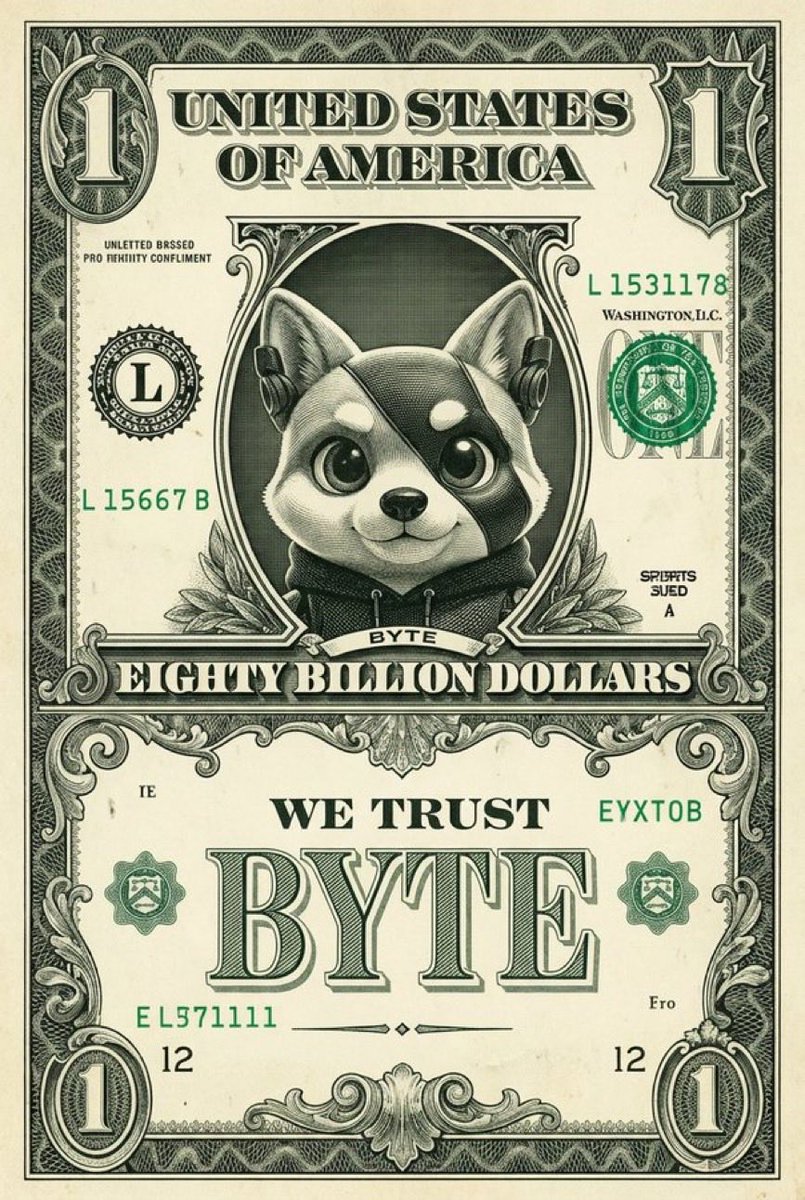
They said it was just a meme.
A dog in a hoodie.
A black stripe across its face.
A name that sounded like a joke.
BYTE.
At first, people laughed. Of course they did. The charts were noisy, the timelines were louder, and everyone was busy chasing the next thing that felt important for about five minutes.
But somewhere else, far from the noise, BYTE was in a quiet forest.
No charts. No shouting. Just soft light breaking through the trees.
He stood on a moss-covered stone, small but certain, robotic legs planted like he belonged there. Around him, tiny mechanical butterflies hummed and flickered, their wings catching bits of light like fragments of code made visible.
In his paw, he held a glowing sphere.
A moon.
Not a metaphor. Not a dream.
Just… a moon.
BYTE tilted his head slightly, studying it the way a builder studies something not yet finished.
The butterflies circled closer, as if waiting for instructions.
“Not yet,” BYTE seemed to say without speaking.
Back on the timelines, people argued. They zoomed in, zoomed out, doubted, dismissed, moved on.
“Just another meme.”
But something strange started to happen.
A few people paused.
They couldn’t explain it, but the signal felt… different.
Not louder.
Not flashier.
Just… persistent.
Like a quiet idea that refuses to go away.
Those who looked a little closer started to see it:
The foolishness wasn’t a flaw.
It was the doorway.
Because the things that change everything don’t arrive looking serious.
They arrive looking ridiculous.
Until they aren’t.
Back in the forest, BYTE took a step forward.
The butterflies followed.
The moon in his paw glowed just a little brighter.
And for a moment, if you were paying attention, you understood something most people miss:
He wasn’t chasing anything.
He was building it.
Slowly. Silently. Inevitably.
And whether people laughed, doubted, or ignored it entirely…
It didn’t matter.
Because the story had already started.
And $BYTE
was already ahead. 🐕✨
Byte Token@ByteDogToken
straight up the chart no ladder needed just paws and conviction 🐾
English

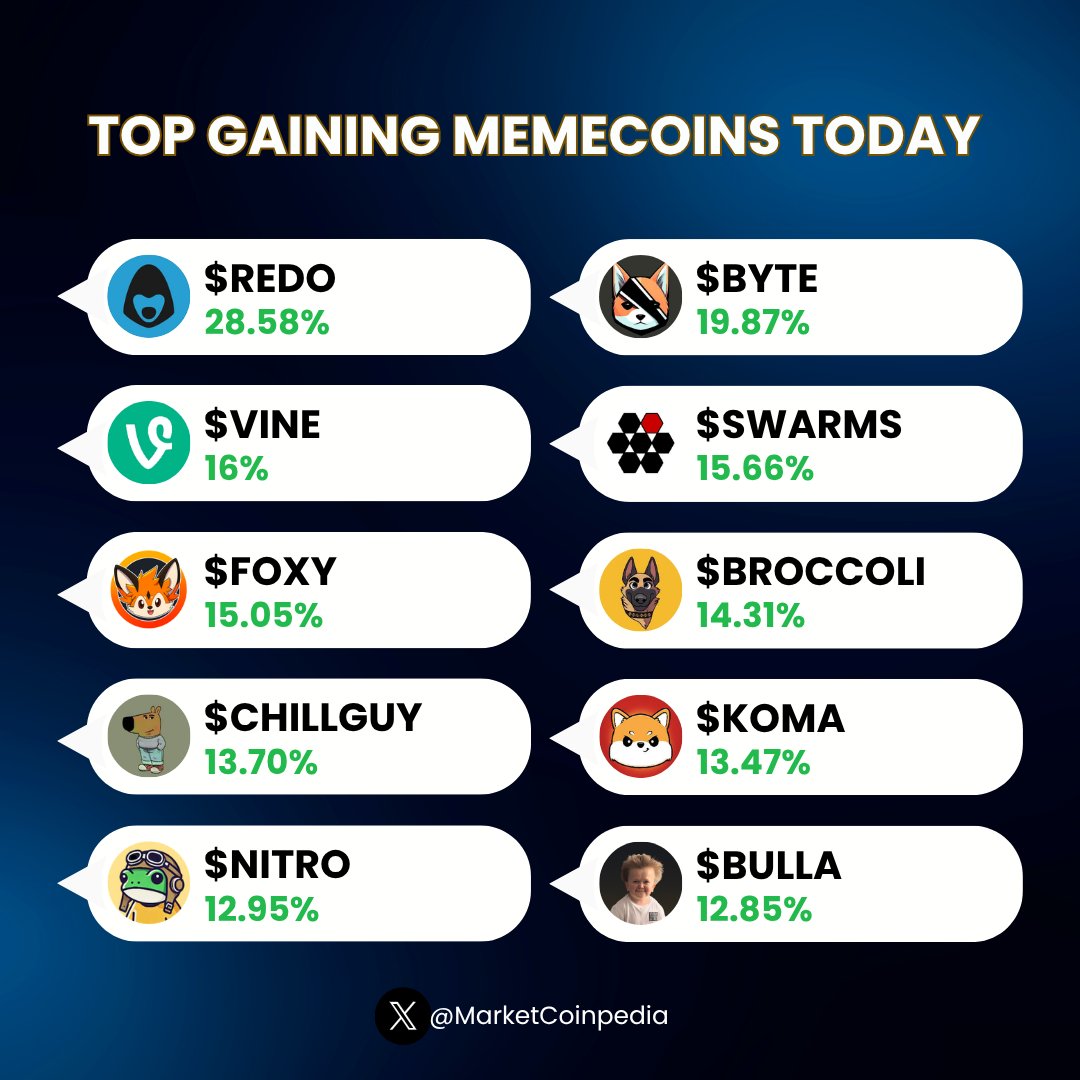
Memecoins are on fire today🔥
Here're the Top Performing #Memecoins Today on #CoinpediaMarkets 🚀
1. Resistance Dog ( $REDO): +28.58%
2. Byte ( $BYTE): +19.87%
3. Vine Coin ( $VINE): +16%
4. Swarms ( $SWARMS): +15.66%
5. Foxy ( $FOXY): +15.05%
6. CZ’s Dog ( $BROCCOLI): +14.31%
7. Just a Chillguy ( $CHILLGUY): +13.70%
8. Koma Inu ( $KOMA): +13.47%
9. Nitro ( $NITRO): +12.95%
10. Bulla ( $BULLA): +12.85%
Track them here: markets.coinpedia.org/gainers/
English

Choice was always an illusion.
There was never a pill.
Only one signal:
$BYTE 🐕🚀
The moment it hits, you can’t look away.
Welcome to the quantum layer beneath the noise.
Where code meets instinct.
Where the AI Dog runs first.
Beyond anything seen before.
Est. 2023.
Signal locked. ✅🔐

Coinbase 🛡️@coinbase
Sidelined?
English


Twitter had the bird… 🐦
Maybe it’s time for X to bring the fun back, does it need a Doge mascot? 🐕


English


Very few will read this but $byte is the next 1000x lil shit coin, just sayin.
English
John retweetledi



Elon Musk'ın meme coinlerle bir düzeni var. Bu düzeni yıllardır takip ediyorum.
Olay çok basit.
Elon bir meme coini milyar dolara göndermeden önce sinyaller veriyor. İpuçları bırakıyor. Gizemli paylaşımlar yapıyor.
Her seferinde aynı kalıp.
DOGE.
2019'da "Dogecoin might be my fav cryptocurrency" yazdı.
Kimse ciddiye almadı. DOGE o dönem 0.002 dolardı.
Sonra biyografisine "CEO of Dogecoin" yazdı. Sinyal ortadaydı.
SNL'e çıktı. Canlı yayında DOGE skeci yaptı.
DOGE 0.73 dolara gitti. Sıfırdan milyarlarca dolar.
Sinyali görenler gördü.
FLOKI.
2021'de Elon tweet attı. "My Shiba Inu will be named Floki."
Köpeğinin adını duyurdu. Birkaç gün sonra fotoğrafını paylaştı. "Floki has arrived."
FLOKI milyar dolara gitti.
Sinyal köpeğin adıydı.
PNUT.
Elon ölen bir sincap paylaştı. Sadece bir görsel.
PNUT milyar dolara gitti.
Sinyal bir sincap görseliydi.
KEKIUS.
Elon profil fotoğrafını Kekius Maximus yaptı. Tek bir fotoğraf değişikliği.
KEKIUS milyar dolara gitti.
Sinyal bir profil fotoğrafıydı.
Kalıbı görüyor musunuz?
Önce gizemli bir paylaşım. Bir görsel. Bir isim. Bir fotoğraf değişikliği.
Kimse anlamıyor. Kimse ciddiye almıyor.
Sonra ipuçları artıyor. Daha fazla paylaşım. Daha fazla etkileşim.
Sonra patlama.
DOGE böyleydi. FLOKI böyleydi. PNUT böyleydi. KEKIUS böyleydi.
Her seferinde aynı düzen.
230 milyon takipçili, dünyanın en zengin adamı doğrudan bir coin adı söylemiyor. Ama sinyalleri öyle açık bırakıyor ki parçaları birleştiren görüyor.
Şu an yeni bir sinyal daha var.
Belirli hesaplarla etkileşime giriyor. Belirli görseller paylaşıyor. Belirli videoları repostluyor.
Detaylar netleştiğinde Telegram'da paylaşacağım.
Türkçe
John retweetledi


From π to the power of ♾️
Celebrating a future of infinite possibilities.
Happy Pi Day in #BitMart8thAnniversary! 🥧🚀
English

@elonmusk @raul_1329 @BasedTorba The closer you get to the truth, the closer you get to understanding the universe.
English

Anthropic has a divorced female “philosopher” crafting its ethical framework and AI model identity.
Elon has like 6 autistic White guys in most of the top leadership positions at xAI.
Extremely obvious who is going to win.
English

$BYTE is always by my side. Preparing for generational wealth.
And be careful. He bytes

English
John retweetledi

A PROPOSAL FOR UNIVERSAL HIGH INCOME (UHI): During my recent Moonshots podcast with @elonmusk, we dove into his notion of Universal High Income (UHI) – Elon’s proposal that an AI and Robotics will enable a world of sustainable abundance for all... a life beyond basic income, towards high income and standards of living.
When I asked him how this might work, he said: “You know, this is my intuition but I don’t know how to do it. I welcome ideas.”
That single statement has been ringing in my head ever since. Here’s why: the economics of scarcity are flipping to the economics of Abundance. I do believe that AI and humanoid robots can produce nearly anything we need—goods, services, healthcare, education—at costs approaching zero.
But there’s a gap between that vision and getting there. How do we actually fund and distribute Abundance to everyone?
Today, I’m excited to share one compelling answer. I’ve been talking to Daniel Schreiber, CEO of Lemonade (the AI-insurance company that just launched 50% off premiums for Tesla FSD drivers), about a framework called the MOSAIC Model: a concrete proposal for how governments could implement Universal High Income without raising taxes on workers or businesses. (See the components of MOSAIC in my P.S. below.)
Here’s the core insight that makes the math work:
1/ THE AUTOMATION PARADOX: AI Unemployment ≠ Traditional Unemployment
When most people hear “mass job displacement,” they picture economic collapse: bread lines, depression, social chaos. That’s because they’re thinking about traditional unemployment, where workers disappear and nothing replaces them.
AI unemployment is fundamentally different.
Think of it this way: imagine sending a digital twin to work in your place. It performs your tasks faster, cheaper, and better. The company’s output increases. GDP grows. The resources exist – they just need to be redistributed.
This is the Automation Paradox: AI can raise productivity while displacing labor.
When workers are replaced by more productive capital, GDP rises even as fewer humans work.
The challenge is not affordability. It’s capture and distribution.
2/ “AI DIVIDEND”: Where the Money Actually Comes From
Daniel’s framework identifies two places the AI surplus shows up, and how to capture it without disrupting consumers or raising statutory tax rates:
Channel 1: Dynamic VAT (The Deflation Dividend)
AI is deflationary. When AI cuts the cost of producing something by 30%, that value creation can either flow entirely to shareholders – or be partially recaptured for society.
Dynamic VAT works like this: as AI drives quality-adjusted price declines in goods and services, the VAT rate adjusts upward by exactly enough to keep consumer prices stable. Consumers pay the same. But the government captures part of the deflation dividend.
It’s frictionless redistribution. Prices don’t rise. No one feels it.
Channel 2: Over-Trend Profit Ring-Fencing
AI is generating windfall profits for companies at the frontier. Rather than raising corporate tax rates (which drives capital flight), the MOSAIC Model proposes ring-fencing only the above-trend portion of capital income tax receipts.
Baseline profits? Untouched. Normal corporate taxes? Unchanged. But what about the incremental surge in profits attributable to AI? A portion gets earmarked for the “Universal High Income” fund.
Statutory rates stay the same. Companies keep most of their windfall. But society captures enough to fund a universal floor.
3/ WHAT THIS MEANS FOR FAMILIES:
Here’s where it gets real. Under the MOSAIC Model’s basic implementation (before any additional policy choices), a household with two non-working parents and two children would receive income equivalent to today’s fourth decile: roughly the 30-40th percentile of current household income.
To be clear, that’s not survival-level subsistence. It’s lower-middle-class security. For doing nothing.
This creates a Universal Basic Floor – funded entirely by the two low-friction channels above.
But this is just the starting line, not the finish line.
If society chooses to capture more of the AI dividend through additional mechanisms (windfall levies, land-value capture, AI-services taxation), the floor could rise to what Daniel calls the “the UHI Benchmark”: approximately 120% of median wages. Upper-middle-class income.
Universal.
The surplus exists. The question is: how much do we collectively choose to redistribute?
4/ WHY TIMING IS EVERYTHING:
Here’s what keeps both Daniel and me up at night: the political window for implementing this is closing.
The MOSAIC Model’s political economy analysis shows something counterintuitive: feasibility is highest early in the AI transition – before capital consolidates opposition, before tech incumbents organize billion-dollar lobbying efforts, before the status quo hardens.
Wait until mass displacement is undeniable? By then, it may be too late to pass anything.
Act early or not at all.
A good system passed in 2026 beats a perfect system proposed in 2030 that fails.
5/ THE INVITATION:
Elon said he welcomes ideas. This is one.
The MOSAIC Model isn’t the only answer, but it’s a rigorous, economically grounded starting point. It demonstrates that Universal High Income is not utopian dreaming. It’s an engineering problem with identifiable solutions.
The AI dividend is real. The fiscal math works. The question is whether we have the collective will to build the capture mechanisms before the window closes.
The full MOSAIC Model is available today at mosaic.org.il/model for policymakers, economists, and fellow entrepreneurs to critique, improve, and implement.
Read the full plan, verify the math, and let’s debate this. Because this is not a matter of any single country or company getting it right. It’s about humanity navigating the biggest economic transition in history.
When AI takes our jobs, it should also pay our wages.
Let’s make that happen.
Peter Diamandis (in collaboration with Daniel Schreiber, @daschreiber, CEO of Lemonade and Chair of the MOSAIC AI Policy Institute)
P.S. The detailed components of MOSAIC that make the model affordable:
M – Multi-channel / Mechanism (Implied): The core philosophy that no single tax can fund UHI alone; it requires a “mosaic” of multiple bases.
O – Over-trend Ring-fencing: Earmarking 85% of the “windfall” capital-income tax receipts (profits and capital gains) that exceed historical trends.
S – Savings (Government Automation Dividend - GAD): capturing the cost savings from automating government bureaucracy (e.g., using AI for back-office admin).
A – AI-linked Deflation (Captured via Dynamic VAT): The largest tile. As AI drives prices down, the VAT rate adjusts upward to capture the “deflation gap,” keeping prices stable for consumers while generating revenue.
I – Income (Negative Income Tax): The distribution mechanism itself, ensuring work always pays.
C – Consolidation: Rolling existing, overlapping welfare transfers into the new single payment to avoid double-spending.
In short: The MOSAIC is the Fiscal Architecture. It argues that while one tax (like a “wealth tax”) is politically impossible or insufficient, a mosaic of VAT + Windfall Profits + Efficiency Savings + Legacy Consolidation creates a robust funding base for a poverty-ending income floor.
English

