John Lin

156 posts

John Lin

John Lin

@johnlin08

Medical oncologist and health services researcher. Assistant professor, MD Anderson Cancer Center
Katılım Nisan 2010
303 Takip Edilen200 Takipçiler
John Lin
John Lin@johnlin08·
@zarekcb @ben_ippolito I missed the 0.299 restricted drugs per year for the average beneficiary so messed up my initial calculation in my initial skepticism
English
0
0
0
20
John Lin
John Lin@johnlin08·
@zarekcb @ben_ippolito I think the survey on PA cost likely ignores the cost of physicians spending time for peer to peer (maybe 10% claims but can spend up to an hour each time) so I think the PA cost could be $50
English
1
0
0
24
Ben Ippolito
Ben Ippolito@ben_ippolito·
This is a surprisingly common argument now: Prior authorization is unnecessary because most claims get approved. Obviously that ignores the entire deterrent effect. PA may be good or bad, but high approval rates isn't proof of ineffectiveness.
Ben Ippolito tweet media
English
3
2
14
1.3K
John Lin
John Lin@johnlin08·
@zarekcb @ben_ippolito In other words I believe r is multiple times higher than your preferred estimate. Admin costs have extreme uncertainty due to this being from surveys. I think it’s plausible that PA saves a minimal amount of money (globally) or doesn’t save money at all
English
0
0
0
26
John Lin
John Lin@johnlin08·
@zarekcb @ben_ippolito I think it’s quite plausible that PA saves money from a global perspective (ie payer+ health system). I’m just not convinced yet.
English
1
0
0
29
Seth Borman
Seth Borman@SethBorman·
@ben_ippolito Why would someone need to send in paperwork? Why is the prescription not enough?
English
1
0
0
35
Ben Ippolito
Ben Ippolito@ben_ippolito·
Lots of interesting and thorny institutional context behind these kinds of results. E.g., essentially all prior auth rejections are because there was no attempt to even send in a form. (Some docs tell us this is how they trigger the process now).
Larry Levitt@larry_levitt

This is a stunning new statistic from @IQVIA_global: 70% of new prescriptions are initially rejected by private insurers. Many of those prescriptions are eventually approved, but it can take up to a year, and about one-quarter are still ultimately denied.

English
1
2
6
2.2K
John Lin
John Lin@johnlin08·
@zarekcb @ben_ippolito I’m curious what you think of my argument that the effects of prior auth on utilization are very likely smaller in the (larger) non LIS population, where cost sharing would serve the same purpose
English
1
0
0
59
John Lin
John Lin@johnlin08·
@zarekcb @ben_ippolito I love your paper, particularly the innovative IV, and the convincing estimates of the impact on utilization. In general, I am with you that aggregating evidence can be informative. The conclusions on admin costs are too confident for me, based on how flawed the data are
English
1
0
0
56
John Lin
John Lin@johnlin08·
@YounisJoseph @DrDiGiorgio @DutchRojas Yep. The paper Ashvin links (which is really good in many respects) specifically describes how heterogeneous physician compensation is. Those who earn the most own their own practices and generate substantial business income. Those who work for health systems earn much less.
English
2
1
0
541
Joseph Younis, MD
Joseph Younis, MD@YounisJoseph·
Those are all great points. Going to read this article you linked soon. Just wanted to add: It also reports "income" as = physician’s individual wage income + (household AGI − all household wage earnings − taxable retirement distributions for people age 60+). In other words, when it reports a number its doesn't factor out all other sources of income (capital gains from stock trading, investments, bonuses, consulting, etc...) yet presents it as physician compensation.
English
1
0
1
46
John Lin
John Lin@johnlin08·
It doesn’t account for weekends and nights worked, which should have at least 1.5x compensation. It completely ignores “on call time” which is not technically hours worked but deserves compensation. (3/4)
English
0
0
1
46
John Lin
John Lin@johnlin08·
It uses *self-reported data* from the census on hours worked. Self reported data are notoriously inaccurate. The only neurosurgeons with the time to answer these surveys are the ones who work the fewest hours …. Like those who do elective spine procedures …. (2/4)
English
1
0
1
44
John Lin
John Lin@johnlin08·
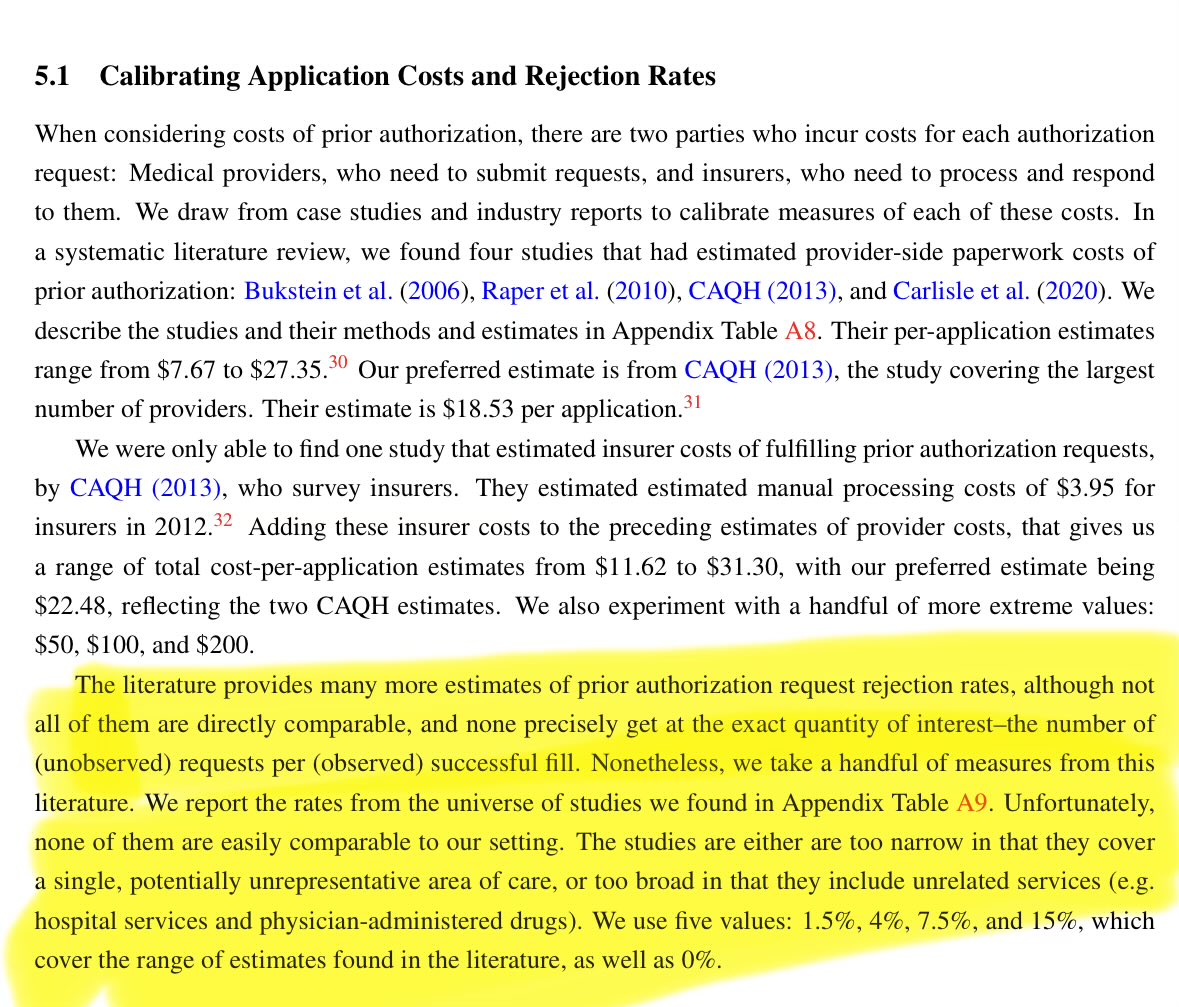
@ben_ippolito How can you state this so confidently when the admin costs were not observed in this or any other study? Here’s a snippet from the study that basically acknowledges the shoddy evidence they used to “simulate” admin costs.
John Lin tweet media
English
1
0
0
51
John Lin
John Lin@johnlin08·
@ben_ippolito However, for non LIS patients it is very common to use cost sharing tiers to steer patients to a preferred DOAC (or warfarin). Thus, prior authorization may add very little in this instance.
English
0
0
0
29
John Lin
John Lin@johnlin08·
@ben_ippolito The generalizability problem for LIS patients is non trivial. Using the example in DOACs, prior authorization *must* be used in LIS patients to steer them to a preferred DOAC (or warfarin) because they cannot steer patients via cost sharing
English
1
0
0
30