John Reinesch

876 posts

John Reinesch banner
John Reinesch

John Reinesch

@johnreinesch

Most marketing advice comes from people who've never had skin in the game. I own storage facilities, run a SaaS platform, and a marketing agency.

White Plains, NY Katılım Mayıs 2009
303 Takip Edilen412 Takipçiler
Sabitlenmiş Tweet
John Reinesch
John Reinesch@johnreinesch·
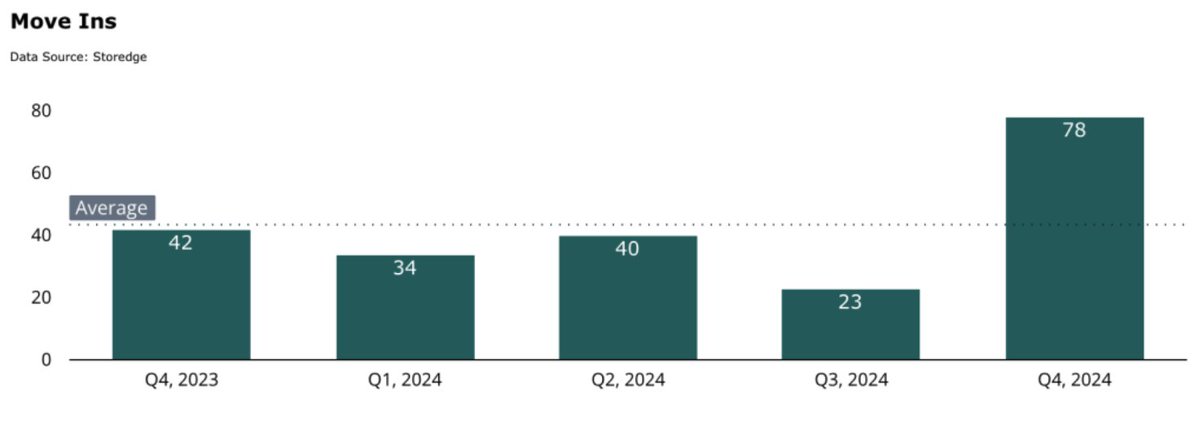
We recently helped a storage facility increase move-ins by 239% in Q4, achieve positive net move-ins, and hit #1 on Google. An operator of a storage facility in California came to me when his occupancy dropped to 58.63%, his lowest point. Net Move-ins had become negative each month, and their Q4 (typically the slowest season) threatened to make things worse. We had to create a marketing plan to help turn things around quickly before the next peak season. Our 3 Step Process: 1️⃣ SEO Overhaul: Optimized their Google Business Profile using our 33-point GBP optimization checklist. Improved on-page SEO of the facility page by adjusting key tags, adding internal links, and adding more content to help users convert on the page. Implemented our title tag and meta description testing system to maximize click-through rate on Google search results and get more potential renters onto our facility page. 2️⃣ Targeted Google Ads: Focused ad spend on users within a 5-mile radius actively searching for storage. Implemented our ad copy testing system to find the right messaging to maximize click-through and conversion rates (phone calls + online rentals). Paused underperforming keywords that were not cost-effective. We look at conversion volume and cost per conversion to make these decisions. 3️⃣ Conversion Rate Optimization: Identified UX and technical issues preventing rentals on the facility pages. We added social proof, a value prop explaining why our facility is different, and an FAQ section with common questions users ask before renting a unit. We set up tracking in Google Analytics to understand which marketing channels were most efficient at driving online rentals, which helped us evaluate all of our changes. 📊 Results: ✅ 239% move-in growth: 23 move-ins (Q3) → 78 move-ins (Q4) ✅ Positive net move-ins even in slow months: -4 (Q3) → +28 (Q4) With the right marketing process, even the toughest seasons can become opportunities for growth and new records.
John Reinesch tweet media
English
4
0
13
1.2K
John Reinesch
John Reinesch@johnreinesch·
Most self storage operators set up their Google Business Profile once and never touch it again. Then they wonder why the facility down the road is stealing their rentals and outranking them on Google. For self-storage, GBP is usually the #1 conversion surface. Online rentals, calls, and direction clicks. A facility we've been working with opened in Q2 2025. We built the foundation and stayed consistent every month. Q2 2025: 5 move-ins (lease-up just starting) Q3 2025: 23 Q4 2025: 28 Q1 2026: 31 Q2 2026: 50 (and the quarter isn't over) Now in their first peak season, they've already secured more move-ins than any prior quarter. Close to 70% of their online rentals are coming from GBP. That's a year of compounding work on the one asset most operators ignore. Here's the local SEO playbook we run on every facility. Initial setup (do this once, do it right): -Dial in your primary and secondary categories. Self-Storage Facility as primary, then relevant secondaries like storage facility, RV Storage, Boat Storage, if applicable. -Write a GBP description that names your city and what makes you different. Don't focus on stuffing keywords. Write naturally and write for people. Build out Services for the types of storage you offer (climate control, drive-up, RV, boat). Build out Products for specific unit sizes with pricing. Dial in every setting: hours, attributes, accessibility, payment methods, opening date. Upload 20+ high-quality photos and at least one walkthrough video. Then the monthly cadence (this is where most operators fall off): 1) Build or sync citations across the major directories. Consistent NAP is still a ranking factor. 2) Generate new reviews every month. Text or email automation after move-in is the easy win. 3) Respond to every review, positive and negative, within 48 hours. 4) Add fresh photos or video monthly. Google rewards active profiles. 5) Post weekly on GBP. Promos, unit availability, facility updates, community content. The operators winning the local map pack are treating GBP like a living asset, not a directory listing. This work isn't hard. It's just the consistency that is hard.
John Reinesch tweet media
English
0
0
0
13
John Reinesch
John Reinesch@johnreinesch·
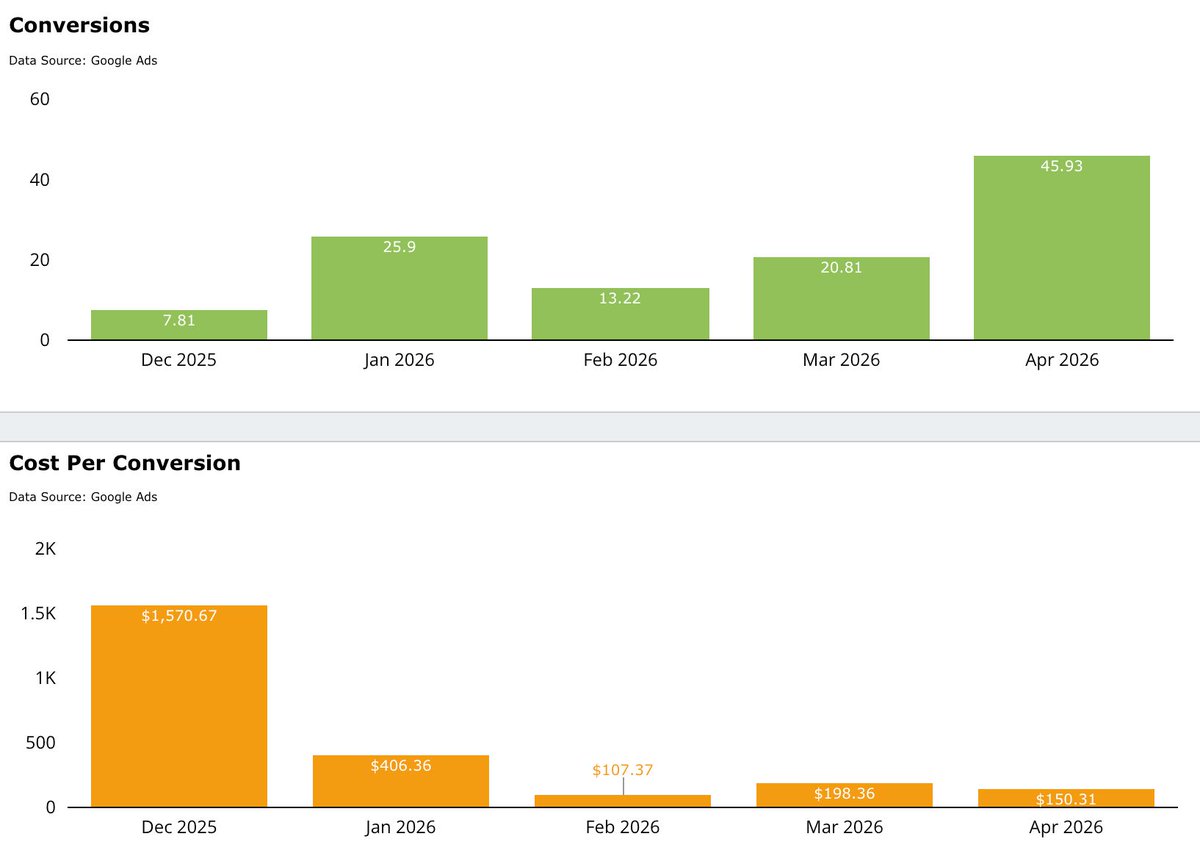
One of our self storage portfolios went from 7 PPC driven move-ins a month to 45. Cost per move-in dropped from $1,570 to $150. We didn't change a single keyword. PPC hasn't worked for your storage facility before. It's not your keywords. It's not your bids. It's not your ad copy. It's the data underneath all of it. Data is the only real moat left in Google Ads. Keywords, bid strategies, the PPC optimization playbook that you can get from ChatGPT. Everyone has access to the same tactics. What separates winning accounts from losing ones now is the quality of data you feed Google's algorithm. A client came to us spending on PPC with almost nothing to show for it. December: 7 move-ins at $1,570 cost per move-in. Month one of any PPC account is almost always rough. Google's algorithm starts with nothing. As you feed it data, it gets smarter. The higher the quality of the signals and the more of them you send, the faster it improves. That's why the three month cost per move-in trend matters more than any single month. We did three things to accelerate that learning curve. We connected their FMS and started syncing their customer list into Google Ads daily as a Customer Match audience. This gave Google a live signal of who their actual paying tenants look like. We layered in offline conversion tracking. Every single move-in got confirmed against the FMS and sent back to Google as a verified conversion. No more optimizing toward clicks or calls that never rented a unit. Google now optimized toward real revenue. We applied our negative keyword list on day 1, built off seven figures of self-storage ad spend, to cut the wasted clicks before they could pollute the data. Five months later: 45 move-ins at $150 cost per move-in. Move-ins up nearly 6x. Cost per move-in down 90%. Nothing magic happened. We fed Google better data and let the algorithm do what it's designed to do. That's what StorIQ's platform does at scale. Connect your FMS, verify your real move-ins, and feed Google's algorithm the signals it needs to actually find your next tenant. If PPC has been a coin flip for you, the problem probably isn't the keywords. It's the data underneath them.
John Reinesch tweet media
English
0
0
0
5
John Reinesch
John Reinesch@johnreinesch·
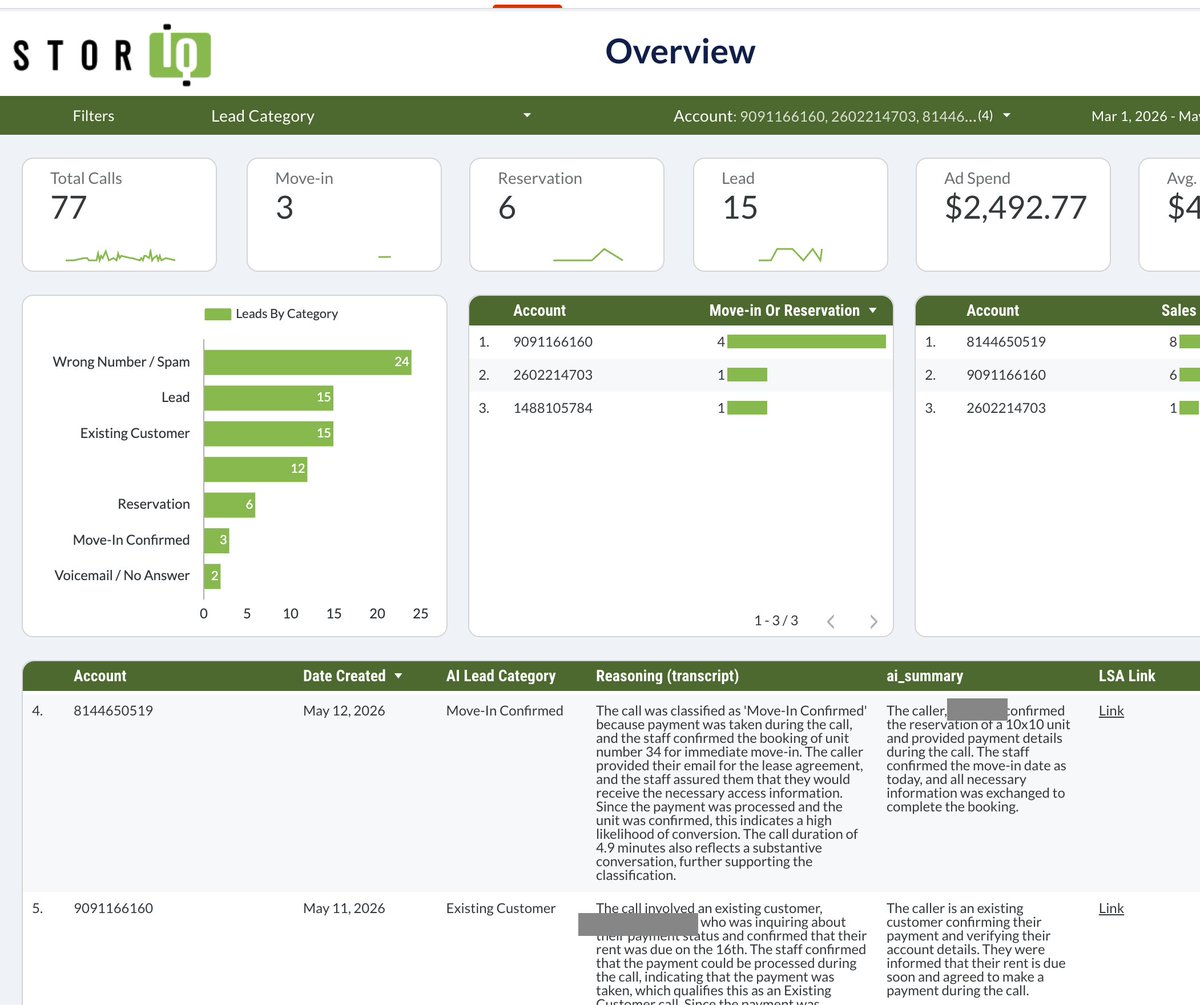
Google's biggest gap with Local Services Ads for self-storage: no call transcripts. If you're running LSA for self-storage, you've felt this. To know how your LSA ads are actually performing, someone has to physically listen to every single call. At 1 location, that's annoying. At 50, it's impossible. At 150, it's a full-time job that still doesn't get done well. And that's just the performance side. The second problem is that LSA charges you per lead, and Google lets you dispute bad leads for a refund. But you have to rate every call to do it. No rating, no refund. Multiply that across a portfolio and most operators just leave the money on the table. So we built the fix into StorIQ. Every LSA call gets: → Auto-transcribed → Scored and categorized by AI (Move-In Confirmed, Reservation, Lead, Existing Customer, Wrong Number / Spam, Voicemail / No Answer) → A plain-English summary with the reasoning → A direct link back to the LSA call so your team can dispute non-leads in seconds In the dashboard above, one portfolio month: 77 calls, 3 confirmed move-ins, 6 reservations, 15 leads, and 24 wrong number / spam calls flagged automatically. That's 24 potential refund disputes surfaced without anyone listening to a single recording. LSA has been a black box for storage operators since day one. It doesn't have to be anymore.
John Reinesch tweet media
English
0
0
0
4
John Reinesch
John Reinesch@johnreinesch·
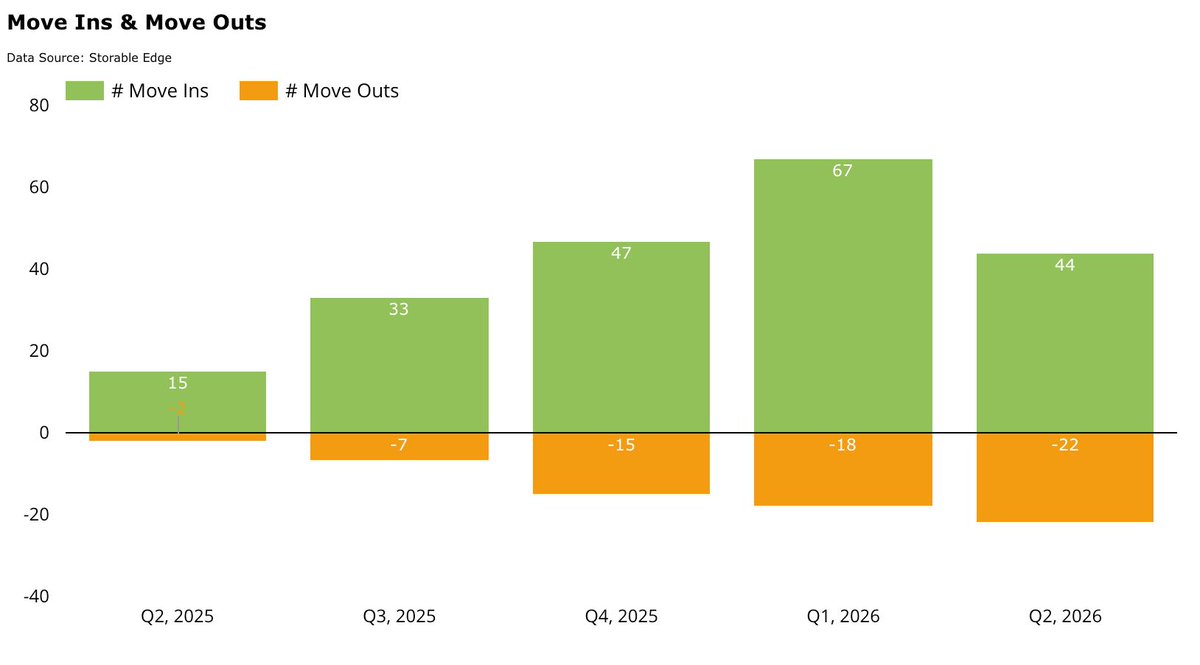
Sometimes during winter in self storage, no matter what you do, move-ins drop. December and January will be December and January. That doesn't mean focusing on improving your marketing or operations is wasted. It's actually the best time of year to roll out new things and fix the processes and systems you can't touch in peak season. But the results of your improvements will lag into spring. You have to trust that you are doing all of the right things and that your process is sound. This operator kept building through the slow months. Didn't pull back on SEO, didn't cut PPC, didn't stop fixing the fundamentals. They also rebuilt their lead follow-up process and put a system in place to respond to every lead within minutes. They didn't see immediate results from any of it. They had to keep focusing on the fundamentals and wait for seasonal demand to kick in. What most operators get wrong is that when April hits, and move-ins increase, they say it's just seasonality. Nothing they did. But seasonality lifts everyone. The real question is who captures the extra demand and who gets the leftovers. The systems and processes you build during the prior 12 months are what decide that. Every spring, your competitors are bidding for the same searches and showing up in the same map pack. The operator with the better site, faster follow-up, and tighter campaigns wins the move-in. The rest get the scraps. April just beat every month they had last year. YoY is up massively. Leasing season rewards the operators who showed up in the off season.
John Reinesch tweet media
English
0
0
0
10
John Reinesch
John Reinesch@johnreinesch·
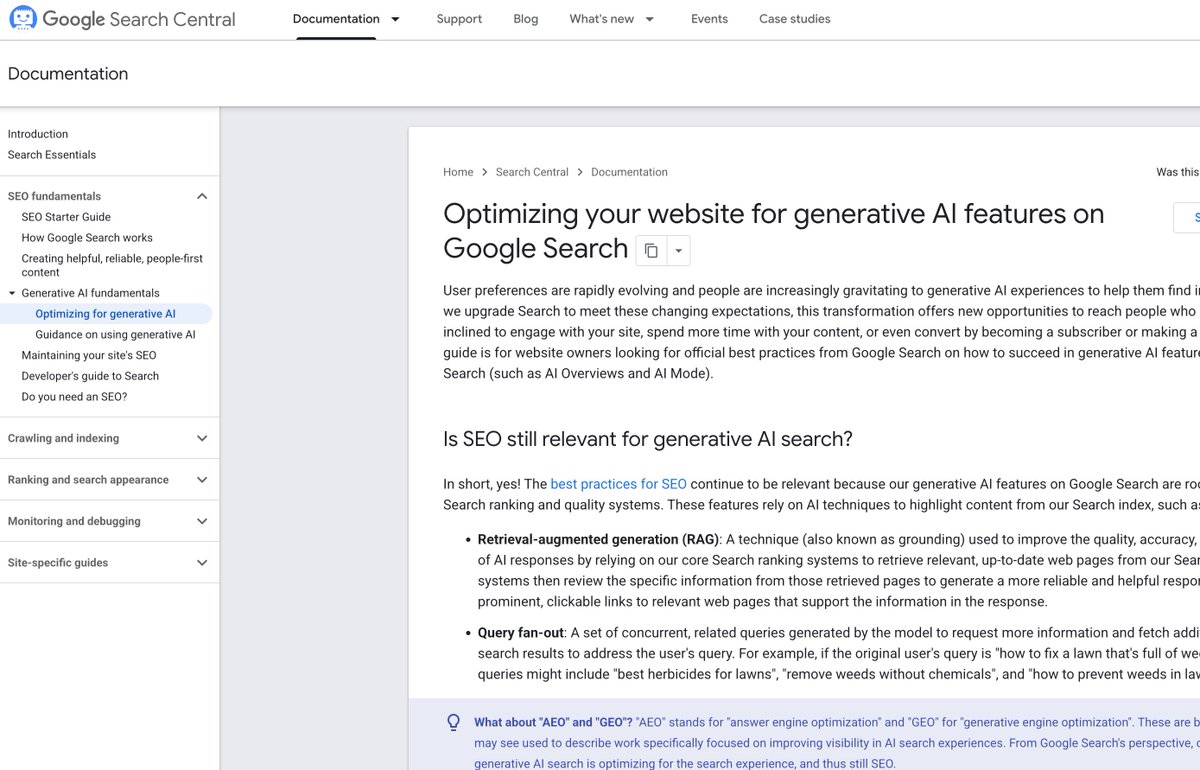
Google published its official AI search guide last week. Here are a few things that actually matter for self-storage operators. AI Overviews are powered by the same ranking systems as regular search. Same index, same quality signals. There's no separate AI to optimize for. Which means the work that wins in AI search for storage is the same work that's always won: a strong Google Business Profile, location pages that actually answer what customers ask, fast and crawlable site infrastructure, and reviews that reflect a real operation. The operators investing in those fundamentals are the ones AI cites. The operators chasing "GEO hacks" are spending money on nothing. Three things from the guide that independents should run with: First, non-commodity content. Google's example contrasts generic "tips" content with experience-driven content. Storage is full of commodity content right now. Every operator's website reads the same. The operator who answers the questions customers actually type into LLM's and Google at 9pm (will my king mattress fit in a 5x10, do you allow pickup trucks overnight, what happens if I miss a payment) is the one the AI cites. Second, GBP as the front door. AI answers pull from Business Profile for local queries. This is the asymmetry. A regional operator with 8 facilities can have 8 GBPs that feel personal, photographed monthly, with manager-written posts. A national chain managing 2,000 profiles can't. Third, the agentic future. Google is openly preparing for browser agents that will rent units on behalf of users. The facility with a clean, fast, accessible rental flow gets the booking. The one that requires a 7-step form on mobile doesn't. None of this is hard. It's just unfashionable. Google is telling you to do the boring work, and the boring work is where the moat is.
John Reinesch tweet media
English
1
0
0
37
John Reinesch
John Reinesch@johnreinesch·
Most self-storage operators think they have a marketing problem. They usually don't. One of our lease-up facilities is halfway through Q2 and already pacing for its best quarter ever, built on 12 straight months of compounding move-in volume heading into spring. Here's what actually drove it: 1. Marketing and traffic. Layer one, not the whole stack. 2. A high-converting website 3. A call center that can close 4. A lead follow-up process that is followed and executed consistently 5. A customer experience good enough to generate Google reviews on its own That's the system. Five layers, each one feeding the next. Most operations obsess over one or two and ignore the rest. They pour money into Google Ads while their website converts at 1%. They build a beautiful website while leads sit in voicemail for 6 hours. They answer the phone fast and then never follow up on the ones who said "I'll think about it." Long-term growth isn't a marketing tactic. It's the discipline of not having a weak link. Fix the weakest one. Then the next one and keep improving the weakest.
John Reinesch tweet media
English
0
0
0
10
John Reinesch
John Reinesch@johnreinesch·
Two models dominate the SEO citation market for self storage: Recurring sync (StorIQ, Yext, Birdeye): you pay monthly or annually, the platform pushes your business info to directories via API, updates propagate quickly. One-time build (BrightLocal, Whitespark): a team manually submits to a chosen set of directories. You keep the listings forever. Any updates you want to make to your listings require another payment and resubmission or manual updates. Both models push uniform data. The real trade-offs are ownership, update speed, drift defense, and cost shape. The location-count framework: 1-5 facilities: one-time build wins. Your data is stable, and the top 50 or so directories (GBP, Apple Maps, Bing, Yelp, BBB, Yellowpages, etc.) cover almost everything that matters. Volume beyond that doesn't move the needle. If something changes, you can update them manually at this scale without losing a weekend. 5-20 facilities: it depends on how often your info changes. If hours, pricing, or services shift a lot, sync saves you time. If your facilities run steady with minimal chnages, one-time still wins. If you spend time each quarter adjusting and optimizing your business description, the sync is a nice way to keep it updated across all directories. 20+ facilities: sync wins. Updating directories by hand across this many locations isn't realistic, and listings drift and change over time without something keeping them in sync. The trap at this size is going cheap on tools and letting your data get messy across the portfolio. One note on AI search. Keeping your hours, services, and descriptions current across the top 15-20 sources does help with ChatGPT, Perplexity, and Google AI Overviews, since they pull live data from Bing, Google, and a small set of directories. But the 200-directory breadth pitch doesn't translate. The top 20 do 95% of the work for both Google and AI. The right framework is to count your facilities, assess operational velocity, and pay for the model that matches.
John Reinesch tweet media
English
0
0
0
17
John Reinesch
John Reinesch@johnreinesch·
If you're running Google Local Service Ads for self storage, you already know the problem: The leads are there. But you have no idea which ones are turning into move-ins until someone listens to every single call. Move-in? Reservation? Existing tenant calling about their gate code? Spam? You have no idea unless a human sits there with headphones on, listening to every call. At scale across 20+ locations, that's a full-time job nobody wants. So we built it into StorIQ. Every LSA call gets: • Auto-transcribed • Scored by AI • Classified as move-in, reservation, existing customer, or spam In real time. Which means: → You actually know if LSAs are working, not in 30 days, today → You can dispute bad leads with Google with evidence → You get clean data on what's driving move-ins The ROI on LSAs can be hard to defend without reviewing every lead. Our tool makes that possible now. If you're spending real money on Local Services Ads and still listening to call recordings to figure out what worked, there's a better way.
John Reinesch tweet media
English
0
0
0
9
John Reinesch
John Reinesch@johnreinesch·
Anyone can rent units in July. The real test of your self storage marketing is what happens in February. Here's what our client's Q1 looked like: Q1 2025: 738 move-ins. Q1 2026: 918. +24% YoY in the hardest quarter on the calendar. We came within 20 move-ins of last year's Q2 peak, in the slow quarter. What actually moved the number: Offline conversion tracking in PPC ads. We match FMS move-ins back to the original Google Ads click. Once Google sees which keywords drive real tenants and not just calls, bid strategy stops optimizing for clicks and starts optimizing for move-ins. Negative keyword discipline. The average storage account wastes 30%+ of spend on terms that will never convert. Our tool blocks wasted spending in real time. GBP as a conversion channel, not a listing. Review velocity, weekly posts, adding content. Most operators treat Google Business Profile as set and forget. It's the highest intent surface you own. Off page SEO, citations and backlinks. Almost no storage operator does link building well, and it's the single biggest reason the REITs outrank everyone in local search. Their domain authority is the moat. Closing that gap is a durable way to compete on organic, and it compounds every month you keep at it. None of this is glamorous. But it works. If your marketing only looks good in busy season, it's not your marketing. It's the calendar.
John Reinesch tweet media
English
0
0
0
10
John Reinesch
John Reinesch@johnreinesch·
The goal for your self storage facility isn't to win one spot on Google. It's to make sure the searcher physically cannot scroll past you. That's the playbook we ran for a client starting in Q4 2025. Here's what their move-ins did: Q2 2025: 13 Q3 2025: 13 Q4 2025 (we start): 26 Q1 2026: 37 185% growth in two quarters, through the slowest months of the storage calendar. Here is the marketing stack we use: -Local Service Ads. Drive phone calls and leads quickly. -Search Ads. Owning the paid slots above the map. -Local Performance Max. Better ad targeting for maps. -GBP optimization and local SEO. Winning the map pack organically. -Traditional SEO on the facility page to show up in organic listings. Five listings. One searcher. The competition is fighting for whatever scraps are left. The next step was a facility page rebuild. We optimized it to rank higher on Google. But the conversion rate work is what turned traffic into move-ins. Rankings aren't enough. You need to make sure you are blending SEO with conversion rate optimization. If the change you are thinking of making helps SEO but hurts conversion, don't do it. This operator deserves credit too. Their checkout flow was already streamlined, the call team was doing a great job handling leads, and their lead follow-up process was very good. Now we head into peak season with momentum, not from a cold start.
John Reinesch tweet media
English
0
0
0
19
John Reinesch
John Reinesch@johnreinesch·
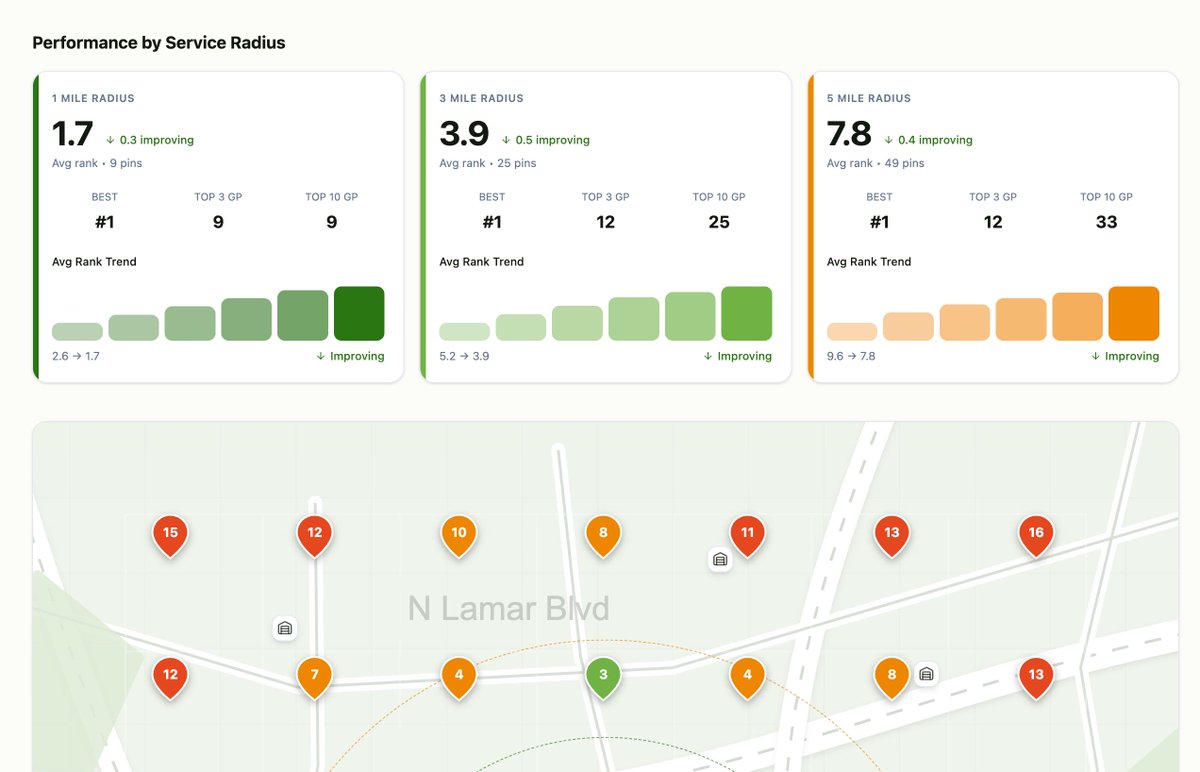
Most storage operators have no idea where they actually rank on Google Maps. They check their own facility on their own phone, see themselves at #1, and assume everything's fine. It's not. Google shows different results depending on where the searcher is standing. A tenant 3 miles east of your facility might never see you. You'd never know. In 3 weeks, we're shipping the Local Rank Tracker inside StorIQ. A few things I'm excited about: → See your avg rank across a 49-point grid around your facility → Performance broken out by 1mi, 3mi, and 5mi service radius (where you're winning vs. where you're getting beat) → 6-month trend line so you can actually see if SEO work is moving the needle → Top 10 competitor view at every grid point If you can't see where you're losing, you can't fix it. More details soon.
John Reinesch tweet media
English
1
0
0
133
John Reinesch
John Reinesch@johnreinesch·
We just launched Citations inside StorIQ. If you run self storage facilities, you already know the goal. Get into the top 3 of the Google Map Pack. That's where the best leads come from, the lowest cost per move-in, and the highest move-in volume. Citations (your business listings across directories) are one of the foundational ranking factors that get you there and keep you there. Google cares about two things: 1. Quantity: how many directories list your business 2. Accuracy: whether your business name, address, phone, hours, and category match everywhere Our new feature handles both automatically. Here's what it does: - Syncs your business info across 70+ directories - Pulls everything live from your Google Business Profile (no manual data entry) - Setup takes about 3 clicks per location - Goes live on 50 directories within 5 to 10 minutes - Re-syncs automatically when anything changes The other thing that's becoming more important: AI search. When someone asks ChatGPT or Claude for storage near them, those models are pulling from the same citation ecosystem Google uses. More accurate listings in more places means more visibility in AI tools too. For multi-location operators, this is the big one. Adding 30 or 50 facilities to a citation network used to be expensive or take too much manual work. Now it's a quick checkbox during onboarding with us. If you want to see how it works, send me a DM.
John Reinesch tweet media
English
0
0
0
15
John Reinesch
John Reinesch@johnreinesch·
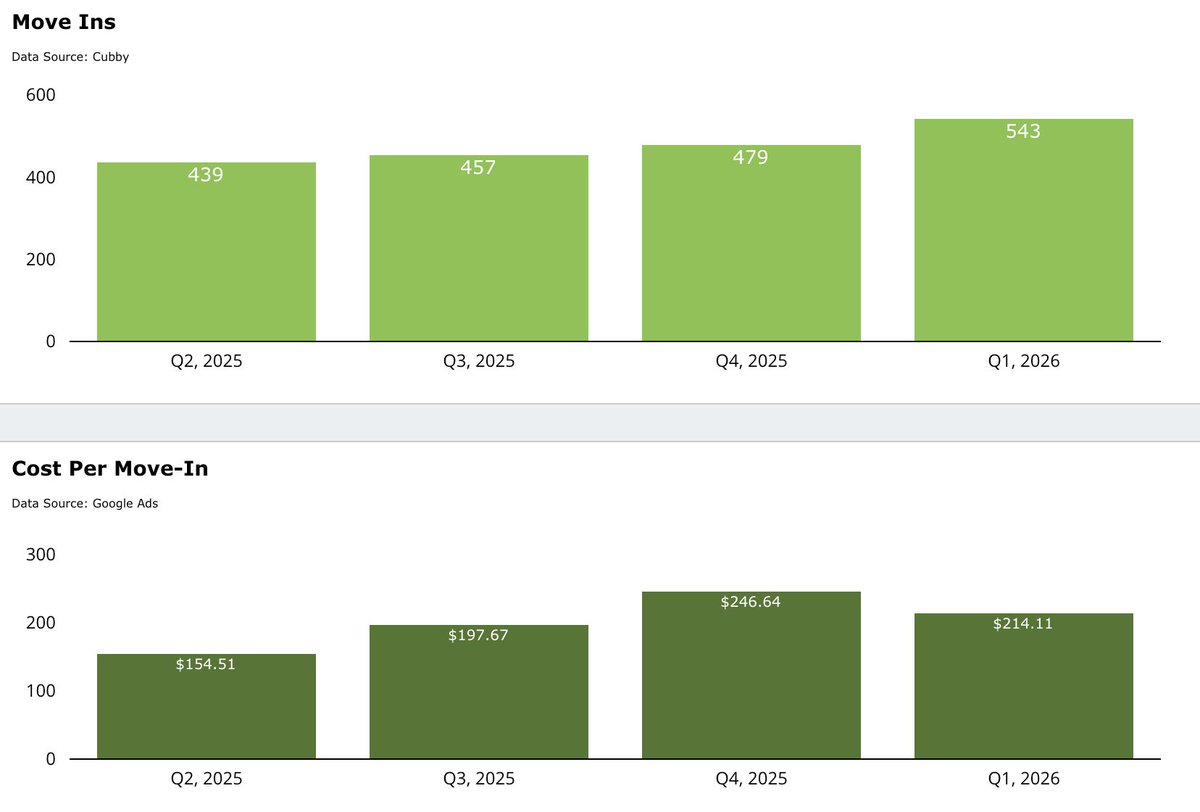
Last quarter, we intentionally raised a self storage portfolios cost per move-in by 39%. Most marketing agencies would never do this. They're terrified of how it looks on a report. But it's often the right move. Cost per move-in has a floor. When you drive it too low, you stop capturing demand that's sitting right there in your market. You leave volume on the table, and that volume goes to your competitors at a discount. Operators who obsess over cost per move-in are playing not to lose. Operators who obsess over LTV are playing to win the market. When you can afford to spend more than anyone else in your market, four things happen: → You buy speed. You capture demand the moment it shows up instead of waiting for the cheap clicks. → You buy scale. You take the best, highest-converting ad placements across Google and local search. → You discourage competition. You outspend competitors to the point where advertising in your market stops being financially viable for them. → You buy sustainability. Higher LTV means the customer acqusition math keeps working even when cost per move-in rises every year. This is what makes competitors scratch their heads and say "how are they spending that much?" The real question they should be asking is "why can't we spend as much as them?" Their LTV won't let them. Yours will. Across four quarters we let cost per move-in climb from $154 to $214. Move-ins climbed from 439 to 543 in the same window. None of that works without raising LTV first. That's the unlock. The customers we "overpaid" for were the ones their competitors couldn't afford to chase. Stop optimizing the wrong metric.
John Reinesch tweet media
English
0
0
0
4
John Reinesch
John Reinesch@johnreinesch·
Most operators quit Google Ads in month one. They launch a campaign, see a $1,800 cost per move-in, panic, and pull the plug. Then they tell everyone Google Ads "doesn't work for self-storage." Here's what real Google Ads performance looks like for a multi-location operator spending above $20k per month: Dec 2025: 12 move-ins at $1,832 each Jan 2026: 19 move-ins at $1,141 Feb 2026: 36 move-ins at $593 Mar 2026: 78 move-ins at $283 Apr 2026: 142 move-ins at $152 Same account. Same budget structure. 12x more move-ins at 1/12th the cost, five months later. This is what the real world looks like. Anyone showing you screenshots of campaigns that printed money on day one is either lying, doesn't know what they're actually measuring, or got lucky once and built a pitch around it. What changed? Nothing magical. We fed Google verified move-in data, let the algorithm learn, made the right adjustments along the way, and stayed patient through the winter when results looked ugly. This is ultimately a mindset problem, not a Google ads problem. Operators who think they'll spend a little, get an instant ROI, and call it a day will never win. The operators who win treat paid search as a core part of their business. They build a system around it. They don't ask "did it work?" after 30 days. They ask, "How do we make it work?" and they keep asking until the answer is obvious in the numbers. If launching Google Ads were as simple as turning it on and getting a 10x ROI, every operator would have full facilities by Friday. It doesn't work that way. It takes time, effort, patience, and knowing which levers to pull while the algorithm trains on your actual conversion data, not clicks, not form fills, real move-ins matched back from your FMS. The operators who quit in December never get to see April. All the work we did in the winter set us up to capitalize on spring. Spring makes everything easier, but only if you have the foundation in place. Without it, you watch your competitors take the demand you should have captured. The unglamorous truth about paid search in self-storage: the difficult months are the ones that matter most.
John Reinesch tweet media
English
0
0
0
22
John Reinesch
John Reinesch@johnreinesch·
Most self storage marketing tools only tell you what to do. We got tired of that. Here's what StorIQ is shipping in Q2: 1. PPC AI agent. Manages campaigns following our proven optimization system, the same one our specialists run, now automated and running 24/7. 2. SEO on-page optimization tool. Tests changes, implements the winners. Most SEO tools tell you what to do. This one actually does it for you. 3. Move-in attribution. Match every call and online rental to the source that drove it, then connect it to the actual lease in your FMS. The full loop from ad click to signed rental, solved. The StorIQ team kicked off our quarterly meeting on Zoom in hats. Pirate hats, squid hats, leprechaun hats, party hats, a Pepsi bottle hat (don't ask). Ambitious quarter ahead. Questionable hats already here.
John Reinesch tweet media
English
0
0
0
4
John Reinesch
John Reinesch@johnreinesch·
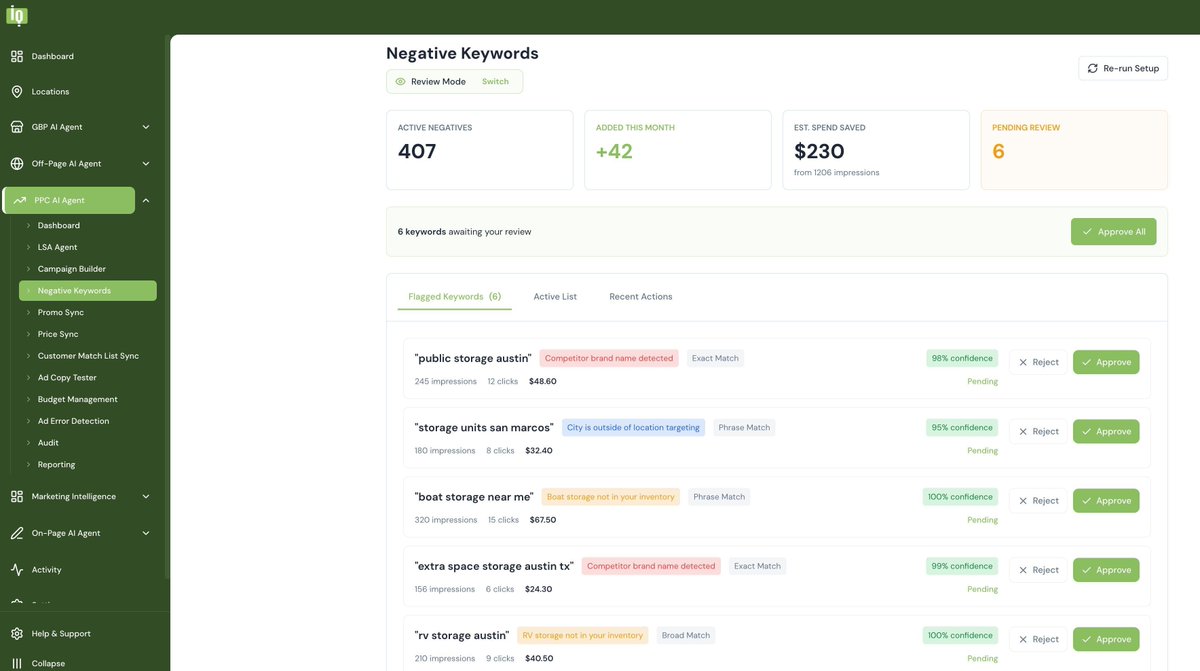
If you're running Google Ads for your storage portfolio, blocking irrelevant keywords is one of the highest-leverage things you can do to lower your cost per move-in. It's also one of the most tedious. Every storage operator I know has the same problem: search terms reports pile up, nobody has time to go through them weekly, and your budget quietly bleeds into queries like "boat storage," "RV storage," or competitor brand searches you were never going to win. No agency or marketing vendor is sitting there reviewing your search terms in real time. It's just not economical for them to do it. That's the problem we built our PPC AI Agent to solve. When you turn it on, it instantly pushes hundreds of negative keywords into your account. Competitor brands, cities outside your geo, storage types you don't offer, irrelevant intent queries, and then it monitors your search terms every single day after that, adding new negatives in real time as wasted spend appears. You can run it in full automation mode (it just handles it) or review mode (it flags negatives with a confidence score, and you approve with one click). The operators using it are seeing real money saved every month and improved cost per move-in. Wasted spend is a tax on your acquisition budget. There's no reason to keep paying it anymore. DM me if you want to learn more about how our tool works.
John Reinesch tweet mediaJohn Reinesch tweet media
English
1
0
0
13
John Reinesch
John Reinesch@johnreinesch·
Most self-storage operators have never sat down and tested their own conversion funnel as a customer. So I did it for CubeSmart instead. Facility page → reservation → online rental → speed-to-lead. Every step, with screenshots, broken down for what's working and what could be better. A few of the things I found: → CubeSmart uses a reservation-first checkout flow. → The reservation-first model only works if your sales team can call leads fast and you have a dialed-in follow-up process. Without that, you capture intent easier but lose half of it. → The thank-you page after reservation has a "Sign Your Lease Online" callout that funnels people directly into a full online rental flow, capturing customers who want to skip the office entirely → Showing the in-store price struck through next to the online price ($47 → $28.20) on every unit trains customers to self-serve online and frames the discount as real savings → The "Best For" copy on every unit ("contents of a one-bedroom apartment") translates dimensions into mental models customers actually understand and helps drive conversions on the facility page The full breakdown report is free. Just send me a DM or comment below.
John Reinesch tweet media
English
0
0
0
10
John Reinesch
John Reinesch@johnreinesch·
Most storage operators think clean marketing data is about reporting on what's working. It’s not. It’s about training your ad accounts to find paying tenants. Clean, consistent data across Google Ads, GBP, LSA, call tracking, GA4, and your FMS is how you actually scale marketing. Most operators think attribution is about understanding what’s working and where to double down. That’s part of it. It’s the part most operators understand. But it’s not the biggest benefit. The biggest benefit is what it does to your ad accounts. Google Ads and Meta ads optimize based on the conversion data you feed them. Scaling these platforms isn’t about making hundreds of changes to settings, bids, or audiences. It’s about sending clean move-in data and revenue data back into the platforms so their algorithms can sharpen your targeting. The operator with messy data is asking Google to optimize toward clicks or existing customer phone calls. The operator with clean data is asking Google to optimize toward paying move-ins. Same budget. Same keywords. Completely different outcomes. 90% of operators skip this. Then they wonder why their customer acquisition cost keeps climbing as they scale. Fix the data pipeline first. The growth follows.
John Reinesch tweet media
English
0
0
1
35
John Reinesch
John Reinesch@johnreinesch·
Most storage operators think scaling a Google Ads account means just raising budgets. It doesn't. Here's an account we took from $18K/mo to $78K/mo over 8 months. Aug 2025: $18K spend, 30 conversions Mar 2026: $78K spend, 3,321 conversions (Conversions = calls, reservations, store visits, and online rentals) The budget scaled 4.3x. The conversions scaled 110x. What changed wasn't the budget. It was what Google was being trained on. In the early months, Google only had keyword signals to work with. Bids, match types, negatives. That's the 101 layer every agency plays in. The unlock is offline conversion tracking. When you feed Google actual move-ins (not calls, not clicks, not reservations, not form fills), the algorithm stops optimizing for cheap clicks and starts optimizing for the customers that actually rent. Google learns which click patterns, devices, times, geographies, and audience signals produce real revenue. Layer on customer match lists (current tenants, high-LTV cusotmers) and you've now given Google more training signals stacked on top of each other: keyword intent, move-in outcomes, and your actual customer profile. Early on, Google had a small handful of conversions per week to learn from. Not enough signal, so the algorithm leaned on broad proxies. Now it has thousands of datapoints per month, weighted toward high intent signals like move-ins and not just clicks. More volume + better signals = better CPA. Better CPA = justifies more spend. Flywheel. If you're scaling an account and CAC is climbing, your problem isn't budget. It's that you're still training Google on surface level vanity metrics instead of actual customers. Feed the algorithm the right data. Scale follows.
John Reinesch tweet media
English
0
0
0
15