John Wires

999 posts

John Wires banner
John Wires

John Wires

@johnwires

Lawyer for founders & shareholders of tech, software, cybersecurity & e-commerce companies. Author of The Law for Founders available at https://t.co/nMWQgVaCj0

Toronto, ON & Victoria, BC Katılım Nisan 2009
459 Takip Edilen849 Takipçiler
Sabitlenmiş Tweet
John Wires
John Wires@johnwires·
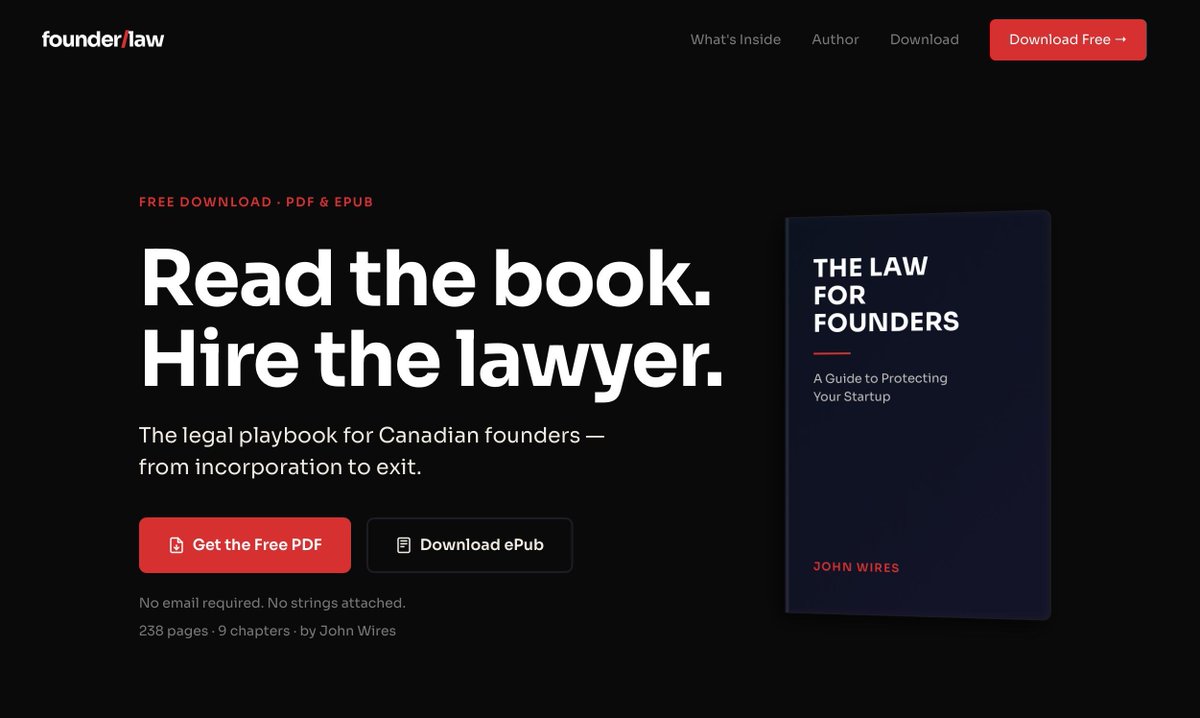
After years in the works, I am excited to launch The Law for Founders: A Guide to Protecting Your Startup. You can read the intro and grab your copy at founderlaw.ca The book is a legal roadmap to implementing your business idea and understanding the legal framework around your business. Why I Wrote the Book Over the past 10 years, I found myself explaining the same legal concepts to clients before decisions could be made. I sat one evening and outlined a core list of legal issues founders should be aware of before starting out. That outline became the framework for this book. Too often, I’ve seen founders wish they had consulted a lawyer sooner. Decisions they made, agreements they signed, or risks they took—without fully understanding the implications—can have a lasting impact on the success of a business. I wrote the book to bridge that legal knowledge gap for Canadian founders. My goal is to help founders understand how the law impacts their startup and the business relationships they form. What’s Inside? You'll find real-world examples, cautionary tales, and actionable information—all in plain English, intended for founders, on topics like: - Negotiating co-founder and shareholder agreements - Corporate structuring - Raising capital - Protecting intellectual property - Hiring and firing employees and contractors - Selling your business
English
1
2
14
908
John Wires
John Wires@johnwires·
I would love to be able to investigate fraud and government waste on a full time basis. Endless leads.
English
0
0
1
9
John Wires
John Wires@johnwires·
@NickSpisak_ I did this but to keep things familiar, I named all the agents characters from the office. Michael Scott is my CEO. Dwight my dev, Pam my designer, Kelly my social media person, etc.
English
2
0
4
2.4K
John Wires
John Wires@johnwires·
Key difference in the OpenAI/Tumbler Ridge lawsuit: Canada has no equivalent to U.S. Section 230. No broad immunity for online/AI platforms from negligence or third-party harm claims when they have specific knowledge of risks. This flips the dynamic—plaintiffs may dodge early U.S.-style dismissals → stronger shot at discovery, settlement, or trial. A stark reminder for platforms operating in Canada: the law is different here. No automatic shield. Could be a landmark for AI duties north of the border.
CTV News Vancouver@CTVVancouver

Mother of wounded Maya Gebala sues OpenAI over mass shooting in Tumbler Ridge, B.C. ctvnews.ca/vancouver/arti…

English
0
0
0
59
John Wires
John Wires@johnwires·
Had a great conversation on The Entrepreneur Podcast from Ivey Business School at Western — we covered startup law, what founders need to know early, and the legal mistakes that can actually kill a company. podcasts.apple.com/ca/podcast/the…
English
0
0
1
18
John Wires
John Wires@johnwires·
At this stage, I am wondering if there any government run programs that don’t have any fraud, abuse, or gross mismanagement. Now the startup visa program is thrown in the mix.
Nino M@ninomelikidze

Alright. As promised, @StevePaolasini and I have been really busy over the past few weeks compiling the full Canadian Startup Visa (SUV) program backstory complete with the fraud and mismanagement facts. And damn, do we have a story for you. Stay tuned for the full article when it comes out but let's start with some fun facts we discovered in the process. Like many things that have gone wrong, the SUV started off with great intentions. An ambitious, unique, innovation-driven pilot program meant to replace the antiquated Immigration Entrepreneur Program that got phased out in 2011. SUV had a very straightforward objective: attract innovative founders who would build companies in Canada and contribute to its long-term economic growth. What made the pilot unique was the selection mechanism: the private sector evaluated the business idea first while the government assessed admissibility second. In practice, this meant that before applying for permanent residence, applicants needed Commitment Certificates / support from a designated Canadian organization such as: venture capital funds, angel investor groups, or business incubators. The SUV pilot was launched in 2013 and the IRCC decided to convert the program into a permanent one in 2018. It had great initial results! Lower operating costs than the previous entrepreneur program and applicants raising higher capital in Canada: reinforcing the idea that private-sector validation was working. However, IRCC's own evaluation of the SUV pilot indicated a very important weakness: the government had limited visibility into the ongoing activities of the designated orgs. This is important because that's where all the issues started. IRCC's follow-up, 2023 program evaluation report indicated that "One-third (33%) of surveyed clients reported “an opportunity to immigrate to Canada” as the most appealing aspect of the SUV Program." The report also pointed out that some designated orgs were allegedly charging applicants additional fees to assess their businesses or create fraudulent documents and immigration applications. Let's talk about some of the biggest offenders. Starting in 2019, Empowered Startups was featured in a series of Federal Court decisions revealing troubling arrangements involving their applicants. There are multiple, public cases documenting that applicants each paid this designated org 300K CAD in incubation fees! Another one known as Manitoba Technology Accelerator (MTA) operated under two different names and submitted HUNDREDS of applications under both of them over 2023-2024. The total applications submitted by them over that time period was upwards of 1K cases. Funnily enough, MTA only lost its designation temporarily in 2025 and Empowered Startups never got de-designated. Instead of dealing with the fraud-abetting organizations, in December 2025, the IRCC stopped giving out SUV open work permits. And in January 2026 they indefinitely paused the entire SUV program. These drastic actions make sense from their end. Their backlog is now over 45K people and there are only 500 (!!!) spots allocated for business immigration in the 2026 levels plan. That is close to 90 years of inventory, not something that is feasible or even realistic to deal with... The main questions now remain: 1. Why did we turn a blind eye to this sheer scale of fraud going on in the SUV program for years? The warning signs were there as early as 2019 but the program only got paused after 2025 2. Why have these organizations not lost their designation before? Why did MTA only lose its designation temporarily? Why is there no further investigation being done into these fraudulent activities? 3. And most importantly, what on earth are we going to do with a SUV backlog of 45K applicants with support from predominantly questionable organizations and close to no spots available now for business immigration applicants? Is this where the powers of bill C-12 will potentially come in? I'm not sure anyone has the answers right now. But we do need to deal with the consequences of this mismanagement before launching a new program...


English
0
0
3
86
John Wires
John Wires@johnwires·
A UK barrister fed his own appeal brief to AI. Says the output was "at the level of a truly great KC." Done in 30 seconds. His conclusion: law is finished for almost everyone. Long term? He might not be wrong. The profession is facing a fundamental shift. Cab drivers still exist after Uber — but things aren't the same. But right now, in the short term, there's a massive opportunity for early mover firms and lawyers who take advantage of the RIGHT AI tools. That's the key word: right. Because the wrong ones will burn through your budget and give you nothing but headaches. And lawyers are still getting sanctioned for citing AI-hallucinated cases that don't exist. Both things are true at the same time. AI can draft at an elite level AND it can ruin your practice if you use it blindly. The gap between lawyers who figure this out and those who don't is going to get very wide, very fast. spectator.co.uk/article/ai-wil…
English
0
0
0
65
John Wires
John Wires@johnwires·
“A competent developer working with Claude Code or Codex could now replicate the core functionality of a mid-market SaaS product in weeks. Not perfectly or with every edge case handled, but well enough that the CIO reviewing a $500k annual renewal started asking the question “what if we just built this ourselves?” citriniresearch.com/p/2028gic
English
1
0
0
101
John Wires
John Wires@johnwires·
@sahill_og Cloudflare for domain, hosting and DNS. Its amazing.
English
0
0
1
136
Sahil
Sahil@sahill_og·
- Claude for coding. - Supabase for backend. - Vercel for deploying. - Namecheap for domain. - Stripe for payments. - GitHub for version control. - Resend for emails. - Clerk for auth. - Cloudflare for DNS. - PostHog for analytics. - Sentry for error tracking. - Upstash for Redis. - Pinecone for vector DB. You can literally ship a startup from your bedroom now. It’s not that deep bro.
English
310
1.2K
10.8K
1.4M
John Wires
John Wires@johnwires·
Is Bitcoin relevant to agentic commerce? Agents don't hodl. They transact. They need instant settlement and price certainty. x402 just turned HTTP 402 into a real payment protocol — Stripe integrated it, Coinbase shipped agentic wallets — and the entire stack runs on USDC over fast L2s (Base Polygon, etc.). Software bots are already out on the web doing deals for their humans. The money they use won't be volatile. It'll be stable, fast, and programmable. As a lawyer, the questions this raises are incredible: liability, agency law, contract formation between bots. Buckle up. bitcorp.ca
John Wires tweet media
English
1
0
3
138
John Wires
John Wires@johnwires·
The best website/marketing setup for a law firm in 2026: 1. Build it with Claude Code. Literally vibe code the whole thing. "Make me a clean law firm site with a contact form and practice areas page." Done in an afternoon. 2. Push it to GitHub. Sounds complicated. It's not. Claude Code does this for you. Three words: "push to GitHub." 3. Host it on Cloudflare Pages. Pull from GitHub, static site goes live. Free tier is genuinely free. Or pay $10/mo for extra security features because you're a law firm and your clients expect that padlock to mean something. 4. Drive traffic by posting nonsense on X, Medium, and Substack. Write about "5 things BigLaw partners won't tell you about outside counsel fees." Argue with people in the replies. Become a thought leader. Link in bio. Total cost: $0-$10/mo Total time: one weekend Vibe level: immaculate wireslaw.com
John Wires tweet mediaJohn Wires tweet mediaJohn Wires tweet media
English
0
0
2
948
John Wires
John Wires@johnwires·
Update: It built a blazing fast site, hosted for free on Cloudflare Pages. Hosting it at wireslaw.com before moving it to the .ca. Incredible.
English
0
0
0
44
John Wires
John Wires@johnwires·
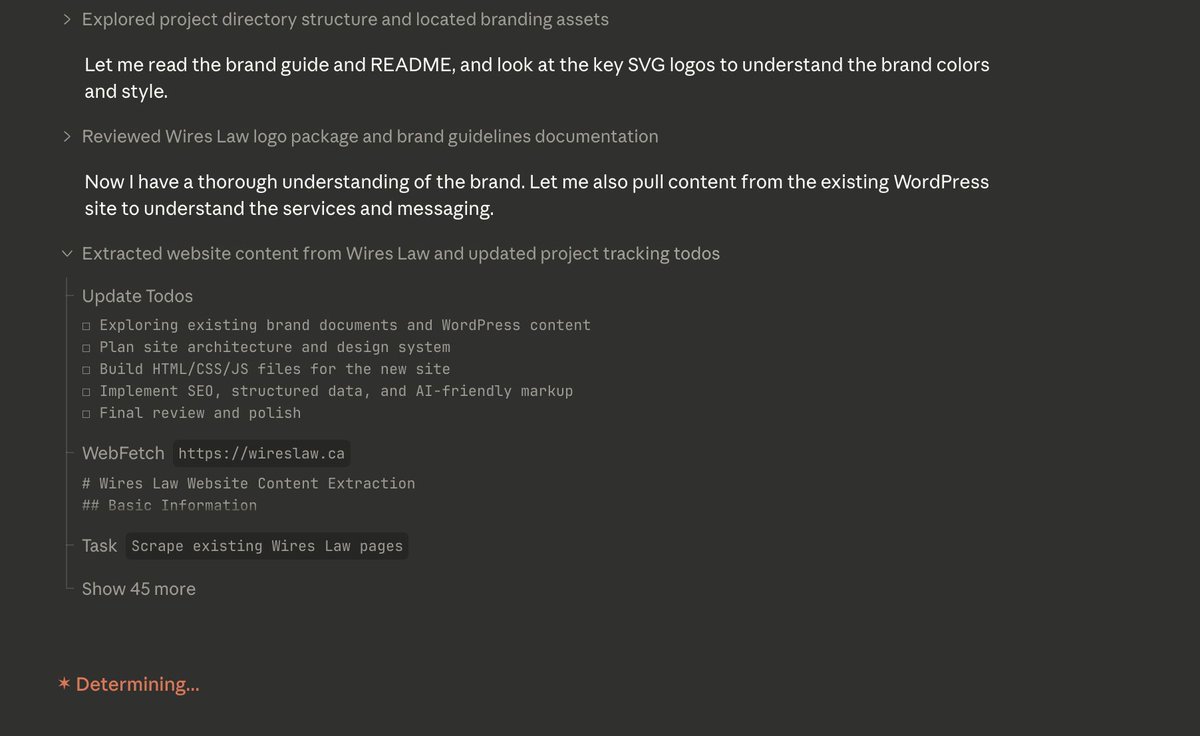
While I work today, Claude Code is scraping my firm's existing Wordpress website, extracting all the content, and using it to build out an entire new refreshed site.
John Wires tweet media
English
3
0
4
799
John Wires
John Wires@johnwires·
@CanadaTaxGuy Claude is even recommending I host it with Cloudflare Pages, which I didn't realize is free (and fast). For a simple static website, seems like a good option. pages.cloudflare.com
English
0
0
1
57