
Josh Wolff 🇺🇸

90 posts

Josh Wolff 🇺🇸 banner
Josh Wolff 🇺🇸

Josh Wolff 🇺🇸

@josh__wolff

Founder of Vulken, helping businesses use and integrate AI that actually works. Ask me anything - just DM. Or email me: [email protected]

San Francisco, CA Katılım Aralık 2019
162 Takip Edilen428 Takipçiler
Josh Wolff 🇺🇸
Josh Wolff 🇺🇸@josh__wolff·
Playing around with AI and using it daily is a must in order to figure out how to use it to your advantage - it is intelligence of a different form. It thinks and processes information in a way we do not. Through your own exploration, you can develop a better intuition of its strengths and weaknesses, where it excels and where it fails, and how to make your life better with it.
English
0
0
0
4
Josh Wolff 🇺🇸
Josh Wolff 🇺🇸@josh__wolff·
The more knowledge you're collecting about your business over time, in a digital format, the better. This prepares you to make the most of AI, and these practices compound over time. The earlier you start, the better!
English
0
0
0
7
Josh Wolff 🇺🇸
Josh Wolff 🇺🇸@josh__wolff·
The biggest breakthrough use case for crypto will undoubtedly be AI. AI is going to make stablecoin and crypto volume explode. Here's why: The future of AI will consist of micropayments to get work done. Your AI Real Estate Agent might, for example, scour the web, and pay $0.01 to read a neighborhood blog post, $0.10 to get an expert's posted opinion on the local markets, $0.05 to get a parent's opinion on the school system. Crypto allows for the instant and final settlement and verification of these payments in a way that legacy banking rails do not. It also makes these micropayments possible and profitable in the first place. Even better - it provides an easy API that AI can access.
English
0
0
0
18
Josh Wolff 🇺🇸
Josh Wolff 🇺🇸@josh__wolff·
When you chat with AI, it largely doesn't say, "I don't know" when it doesn't know something. Why? Because people largely do not say, "I don't know" in the data that trains AI. AI labs have tried to fix this with more "I don't know" data, and the problem has improved, but in all likelihood, major architectural changes are required in order for this to be fully and accurately solved. At Vulken, we keep these kinds of weaknesses in mind and engineer around them when building AI integrations for businesses.
English
0
0
0
12
Josh Wolff 🇺🇸
Josh Wolff 🇺🇸@josh__wolff·
I don't buy the hype claiming that AI is causing the disappearance of entry-level jobs. I believe the poor market is more a reflection of the economy and a continuation of the COVID-era over-hiring hangover. If anything, AI should make a smart but entry-level professional far more productive by multiplying their pre-existing intelligence and skills. It should also cut their onboarding time dramatically. Claiming AI is multiplier cuts both ways. It's not just a multiplier for seniors; it also is for juniors. That begs the question - why wouldn't I hire someone with entry-level pay who can now operate at a near senior level with AI? If you disagree, would love to hear your thoughts in the comments.
Josh Wolff 🇺🇸 tweet media
English
0
0
0
27
Josh Wolff 🇺🇸
Josh Wolff 🇺🇸@josh__wolff·
Currently, I am writing social media posts like this: 1. Email myself ideas 2. Whenever I feel like writing, write all the social media posts for as far out as I can in a one-or-two-hour sprint 3. Schedule them using Buffer The problem with writing for social media daily, I've found, is that only sometimes I'm in an "idea mood" and only sometimes I'm in a "writing mood." Furthermore, these often happen at different times. Sitting down to write a social media post is forcing my brain to be in both moods at the same time. The outcome is likely to be less than optimal. The truth is, I can't quite help when "idea mood" comes to me. When it does, I have countless ideas, and I can jot them down quickly. But focusing enough to write well is unlikely in those kinds of moments. I now have the humility to admit that I can't force these moods. As much as I used to try. And finally - no AI. I note the ideas as I encounter AI throughout my week, but refuse to use AI to actually communicate them. Writing is thinking. Using AI to write is using it to think for yourself. The problem with that is only you truly know the idea you have in your head. Explaining that idea to AI and asking it to write it out for you will result in a post that *sounds* like the idea you want but isn't exactly communicating it. You also lose your own and prose and piss people off.
English
0
0
0
13
Josh Wolff 🇺🇸
Josh Wolff 🇺🇸@josh__wolff·
Most software engineers today, including myself, sit in front of their screen and chat with AI for hours. And hours. This is the reality of how our workflow has been changed, and it is also why we understand so well how disruptive the technology is. However, you still need to understand how to code and how to engineer in order to perform the job and complete the task at hand. It's a strange world. Once AI becomes better optimized at other white-collar professions, this will also be their reality. Chatting with AI for hours and hours, needing your skills in order to do the task well but not directly using them to implement the task!
English
0
0
0
22
Josh Wolff 🇺🇸
Josh Wolff 🇺🇸@josh__wolff·
AI absolutely excels wherever there is a well-defined, correct answer. In code, that exists clearly. The biggest AI companies have optimized for this use case, and that's why their models perform incredibly well here. Other areas, where there is a well-defined and (at least somewhat) correct answer to each question, have not received as much attention, but will over the next 5-10 years. This is the next frontier of model development. You are seeing this with Meta's announcement of working with 1,000 physicians to develop Muse Spark and with xAI's recruitment of financial professionals to train their models. These models will perform shockingly well and will also enable the broader public to understand just how good this technology is.
English
0
0
0
19
Josh Wolff 🇺🇸
Josh Wolff 🇺🇸@josh__wolff·
That voice and interior monologue in your head (if you have one) was shaped over many years by those around you. If you're an avid user of AI -- or a parent! -- make sure to take into account that AI is now also influencing the voice in your head (or your child's) and the way you think, whether you like it or not. In the settings of the major AI apps, such as Claude or ChatGPT, you can add personal preferences for responses that apply to all conversations. This can include being optimistic, rational, neutral, empathetic - whatever you'd like.
English
0
0
0
16
Josh Wolff 🇺🇸
Josh Wolff 🇺🇸@josh__wolff·
Being mission-driven is a much more inspiring and happier way to live, if you can manage it. When you are truly committed to a greater goal, nothing else matters. Consider if your mission is to cure a genetic ailment that killed your cousin, or maybe it's simply to make your students inspired. Big or small, the effect is the same. In this world, there are no competitors, there is no risk of ruin, and there is no ego. If someone else inspires kids or cures the ailment, you are happy just the same. In reality, it's very hard to get to this point, because realistically, you need to survive, you have human goals, and you have human feelings and ego. Especially for those at my same age, you want to figure out what you're doing with your life and make a mark on the world. At least for me, getting to this point with clarity and conviction is a goal in and of itself.
English
0
0
1
31
Josh Wolff 🇺🇸
Josh Wolff 🇺🇸@josh__wolff·
I'm so sick of reading AI slop. I actively read newsletters and content where the author has unique ideas, great prose, and their own voice. Some authors used to have this. They used to be great writers. I was excited to see their newsletter in my inbox. Then they switched to AI, and now I cringe and could not care less about the content they produce. An increasing amount of people are just like me: The second we see your em dash and "correctio," our brains turn off and we stop reading your sloppity sloppy slop.
English
0
0
1
25
Josh Wolff 🇺🇸
Josh Wolff 🇺🇸@josh__wolff·
When China attacks Taiwan (or in a similar scenario), I wonder if the Defense Production Act could be used for data centers. Specifically, I'd imagine it could be used to redirect chip usage itself to the war or crisis of the time. For context, the President can invoke the DPA to produce the resources it needs during an emergency, such as when Trump invoked the DPA to produce more masks and ventilators. This forces a supplier to fulfill a government purchase request ahead of other requests. If the government issued a DPA order requiring a specific data center operator to dedicate X% of GPU-hours to a government workload, and fulfilling that order genuinely required displacing commercial customers, the operator would be legally required to do it. The commercial customers would have no recourse against the operator - DPA compliance is an explicit legal defense against breach of contract claims. In practice, you could imagine EC2 on-demand servers suddenly being freed, workflows suddenly interrupted, or similar and sudden breaking changes.
English
0
0
1
109
Josh Wolff 🇺🇸
Josh Wolff 🇺🇸@josh__wolff·
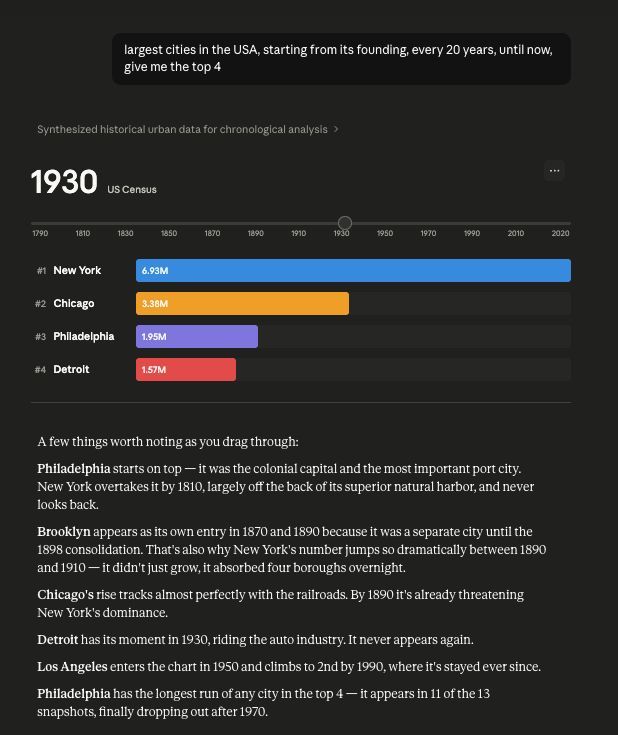
It's hard to believe that I can send a query like this and get an interactive widget with the information I wanted nearly instantly. Compare that to Google, where I would have to scroll through 10 links, click through a Buzzfeed article with 30 ads, and inevitably be redirected to one of the advertisers without even clicking on the ad. As a consumer, one experience is obviously way better than the other.
Josh Wolff 🇺🇸 tweet mediaJosh Wolff 🇺🇸 tweet media
English
0
0
1
18
Josh Wolff 🇺🇸
Josh Wolff 🇺🇸@josh__wolff·
There are satellites today that have high enough resolution to read license plates! You can imagine the implication of this with AI. This guarantees that the outside world will be monitored and understood 24/7. Within perhaps 30 years, every square inch of the U.S. and other countries will be monitored, every face will be identified, and every person will be tracked in real-time. There is very little that can prevent this. The U.S. will also not be the only government or organization monitoring the U.S. population - there will be multiple. It will also mean speeding and red light cameras everywhere (if humans are still driving); higher clearance rates for murder, assault, burglary and other crimes; and definitely way more umbrella purchases by those few who end up caring! It's not all negative - better understanding the movement and flow of goods and development of communities will improve the efficiency of the economy overall. The benefits though, are far less tangible than the fears most would reasonably have.
Josh Wolff 🇺🇸 tweet media
English
0
0
0
14
Josh Wolff 🇺🇸
Josh Wolff 🇺🇸@josh__wolff·
Over the next 5-10 years, we will see some of the biggest hacks in software's history. This will range from massive personal data leaks to bank infrastructure itself. Why do I think this? There are two trends happening today: Finding and exploiting vulnerabilities in software is becoming massively easier and quicker. At the same time, those writing the software understand it *LESS* than they ever have before. Yes, many people writing software today quite literally don't fully understand or even read what they are writing. This trend is accelerating. We have seen early warning signs like the Verizon outage, AWS outages, and Cloudflare outages. But I predict we will have something even more intense that will shake people's confidence in the Internet and its technology itself. This could range from a bank being hacked to massive email hacks and leaks, or even mass remote and undetected webcam or mobile camera/microphone access. It will shake the very idea of how much we trust software.
English
0
0
0
40
Josh Wolff 🇺🇸
Josh Wolff 🇺🇸@josh__wolff·
Just switched to OpenAI in Cursor for the first time in over a year. The new Claude version is snarky, argues with you, and is often wrong.
Josh Wolff 🇺🇸 tweet media
English
0
0
0
29
Josh Wolff 🇺🇸
Josh Wolff 🇺🇸@josh__wolff·
New, slightly unethical cold email hack I just thought of. If you're starting a new company, your email domain has zero reputation. The process of gaining early reputation in order to avoid spam filters is called "warming up." There are services you can pay to do this, and they will send emails back-and-forth to each other to gain that reputation. One idea I had, that startups can use, is to set your personal LinkedIn's email (and that of your co-founders') to your company email. Once you do that, all of the recruiter email spam will go to your company's email inbox rather than your personal email. Engaging with it can be as simple as the following: "Not interested, but let's keep in touch." That cycle will warm up your email automatically and increase your domain's reputation over time.
English
0
0
0
52
Josh Wolff 🇺🇸
Josh Wolff 🇺🇸@josh__wolff·
Journaling is one of the many things that AI has made dramatically more useful. If your journal every day - your thoughts, emotions, feelings, events - you can now forward this entire feed to AI periodically. In doing so, you can uncover patterns in your ideas, routine, and thoughts that were entirely subconscious to you prior. You can come up with new ideas you had not before. You can reflect in ways that were largely impossible prior, and you can search for ideas or thoughts you had far easier than every before too. And you don't need an app. You can just use Word, or whatever you prefer.
English
0
0
1
32
Josh Wolff 🇺🇸
Josh Wolff 🇺🇸@josh__wolff·
Over the last 9 years, I've built countless things that have failed, with some minor success along the way. Those misses have created a voice of self-doubt in my head that's much stronger than it was when I was 18. Entrepreneurship is tough and I have immense respect for those that pursue it. One of my new favorite uses of AI is to create retrospective success stories. > Here's where I am now and what I am doing. Write a success story looking back, starting from the year April 1, 2030. You can then iterate from there, tailoring it to discuss what's important to you. I found it to be very motivating in times of doubt or tribulation. I even have it bookmarked to throw in a self-doubting thought whenever it comes up. Claude then, as the kids say it, "glazes" me. It's great, and I recommend using it to change that voice in your head and keep pushing.
English
0
0
1
20
Josh Wolff 🇺🇸
Josh Wolff 🇺🇸@josh__wolff·
GitHub just lost its last 9 of availability... Software uptime is measured in 9s. Four 9s, or being available 99.99% of the time, is a decent target for an average software service. One 9 is simply 90% of the time. GitHub just hit 89.24% of availability according to "The Missing GitHub Status Page." Being available less than 90% of the time for a piece of software infrastructure is simply put embarrassing. In a weird way, this is also expected. The ease of creating software has plummeted and so the sheer amount of software has skyrocketed, putting a greater load on GitHub's services. This pattern will continue to be a story for the rest of the decade as information itself is easier to generate. As I've said in a previous post, this includes frauds, scams, and cyberattacks (at least attempts). It will also extend to telemarketers (one day last week I got 5+ spam calls), ArXiv paper submissions, renter application fraud (forging W-2s), etc.
English
1
0
1
80