

Josh TW

8.9K posts

Josh TW banner
Josh TW

Josh TW

@josh_tw

Hacking Africa's energy abundance. Cactus Is The New Lithium.

Earth Katılım Mart 2012
132 Takip Edilen374 Takipçiler
Josh TW retweetledi
Jan Zizka
Jan Zizka@janz1zka·
China is spending billions on robot training farms. Here’s why that is one of the smartest strategic moves in AI today: 1. Data is the real bottleneck The biggest constraint in training reliable, generalizable VLAs is diverse real-world embodied data — robots interacting with objects, environments, and edge cases at scale. That data is slow and expensive to generate. 2. State funding changes the economics In China, this data is not only subsidized, but effectively shared across the ecosystem. The result is a much larger training base and a faster learning cycle across the industry. Competition is no longer about who can afford to collect the most data, but who can process, label, train on, and productize that data best. 3. It strengthens the manufacturing flywheel Last year, 61% of humanoid robot sales went to R&D and data collection. Each state-funded lab that buys a humanoid helps scale manufacturing volumes, which lowers hardware costs, improves supply chains, and makes the next round of deployment cheaper. How defensible this advantage becomes will depend on the quality and diversity of the data being collected. The more varied the data, the more valuable it is. That’s why lab-generated data is fundamentally more limited than real-world data collected in homes, public spaces, and commercial environments. And it’s not hard to imagine China extending this same state-backed strategy beyond labs into exactly those settings.
English
20
67
279
33K
Josh TW retweetledi
StockMarket.News
StockMarket.News@_Investinq·
A robot just replaced the human who draws your blood, and it is already inside European hospitals right now. The device called Aletta is CE-marked, the European equivalent of FDA approval and it is already operating on real patients. Vitestro built a machine that maps your veins using AI powered Doppler ultrasound, locks onto the right one with submillimeter precision, inserts the needle, fills the tubes, removes the needle and applies the bandage completely on its own. No human hands touch you during the procedure and one trained supervisor can oversee up to three of these machines running simultaneously. And 98% of patients who went through it said they would accept the procedure again. The machine does not care if your veins are difficult or your skin tone, body type, or whether past draws were painful. It finds a vein on almost every patient regardless and roughly 1.4 billion blood draws happen in the United States alone every single year. Every one of those is currently done by a human being and that human has a job title, phlebotomist. There are roughly 130,000 of them working in the US today and that job is now directly in the crosshairs of this technology. Northwestern Medicine, one of the most prestigious hospital systems in America already signed a multi-year collaboration agreement with Vitestro to bring this machine to US hospitals.
English
223
748
2.7K
537.3K
Josh TW retweetledi
Dustin
Dustin@r0ck3t23·
Elon Musk just handed America a mirror. Musk: “It seems like China listens to everything I say and does it, basically.” For over a decade, he outlined the exact blueprint for the next industrial era. Massive solar. Industrial-scale battery storage. Electric everything. Not in classified memos. Not behind closed doors. In public speeches, interviews, and the founding missions of every company he built. America debated it. China built it. Musk: “They’re certainly making massive battery packs… vast numbers of electric cars… vast amounts of solar.“ This is not a technology gap. Not an intelligence gap. Not a vision gap. A will gap. The blueprint was never classified. Never hidden. Never proprietary. China read it. Declared it a national mandate. Mobilized an entire industrial economy behind a single word. Execute. Musk: “These are all things I said we should do here.” Here. America. The country that produced the man who wrote the blueprint and spent a decade arguing about whether to follow it. The AI arms race does not run on ideas. It runs on power. Gigawatts of it. The kind that takes years of permitting, construction, and grid buildout before a single model ever trains on it. You cannot debate your way to a power grid. You cannot regulate your way to energy dominance while a competitor is already running the lines. Every year of delay compounds on the other side of the world. Nobody wants to say it plainly, so here it is. The nation that controls the energy controls the AI. The nation that controls the AI controls the century. America produced the vision. Had every structural advantage. Wrote the blueprint. China is building the century.
English
67
163
603
118.8K
Josh TW retweetledi
Philosophy Of Physics
Philosophy Of Physics@PhilosophyOfPhy·
After the Space Shuttle Challenger exploded in January 1986, killing its seven crew members, President Reagan appointed a commission to investigate. Richard Feynman, already battling cancer and reluctant to join, accepted because a former student asked. He quickly grew frustrated with the slow, formal hearings and NASA’s optimistic safety claims (1 in 100,000 chance of failure). Instead, he talked directly to engineers, who revealed far higher risks. The night before a key televised hearing, Feynman bought a C-clamp from a hardware store. During the session, he took a sample of the rubber O-ring material from the solid rocket boosters, clamped it, and dropped it into a glass of ice water (mimicking the cold launch temperature that day). After a moment, he removed it and showed how the rubber had lost its elasticity, it no longer sprang back. He explained simply: at low temperatures, the O-rings couldn’t seal properly, allowing hot gas to leak and cause the disaster. His live demonstration cut through layers of management denial and became one of the most iconic moments in engineering accountability. In his personal appendix to the report, he famously wrote: “For a successful technology, reality must take precedence over public relations, for nature cannot be fooled.”
Philosophy Of Physics tweet media
English
127
2.7K
13.4K
405.7K
Josh TW retweetledi
Guillermo Rauch
Guillermo Rauch@rauchg·
Some people have been contemplating an idea for years, maybe decades. Obsessing, attempting, discarding, agonizing, retrying. Some of these ideas are unpopular, niche, impractical. Not obviously capitalizable. They live on in the inventor's mind. In 2026, millions of these ideas will come to life thanks to superintelligent coding agents. AI doesn't get tired. It amplifies the individual, and for better and sometimes for worse, it always takes you seriously. "Great idea. Splendid. Wow. You're absolutely right." A world of digital wonders awaits us. This world will disproportionally favor the boldest ideas. Software that once seemed impossible will be one hyperlink away. I can't wait to see it.
English
165
147
1.7K
253.7K
Josh TW retweetledi
X Freeze
X Freeze@XFreeze·
Tesla Semi's total cost of ownership destroys diesel economics The numbers are wild: • Electricity: $0.15-0.25/mile • Diesel: ~$0.75 - 0.80+/mile • Electricity costs 60-80% less than diesel per mile • Near-zero maintenance (no diesel aftertreatment, fewer moving parts) • Remote diagnostics = maximized uptime • OTA updates = continuous improvements • Operators will spend less time at service centers and more time on the road Fleet operators achieve positive ROI before their standard diesel replacement cycle
English
88
301
1.8K
70.8K
Josh TW retweetledi
Dustin
Dustin@r0ck3t23·
Bill Gates walked into the Tesla Gigafactory and declared the long-range electric semi impossible. The truck was already in production. Pepsi was running it on live routes. Musk: “I was like, well, but we literally have them. And you can drive them. And Pepsi is literally using them right now.” Gates was standing inside the factory that built the vehicle he was dismissing. It existed. It was moving freight. Musk: “He’s like, ‘No, no, it doesn’t work, it doesn’t work.’ And I’m like… I’m kind of stuck here.” Musk didn’t argue. He asked for the math. Musk: “You must think we can’t achieve the energy density of the battery pack, or that the watt-hours per mile of the truck is too high. Which one of those numbers do you think we have wrong, and what numbers do you think are correct?” Gates didn’t have wrong numbers. He had no numbers. Musk: “He didn’t know any of the numbers.” The co-founder of Microsoft walked into an operating factory, stood next to a truck hauling Pepsi’s freight, and declared it impossible without a single figure. No energy density. No efficiency metric. No math. Just conviction wearing a $130 billion net worth as a credential. Musk: “Doesn’t it seem that it’s perhaps premature to conclude that a long-range semi cannot work if you do not know the energy density of the battery pack or the energy efficiency of the truck chassis?” One question. Nowhere left to stand. Musk: “You’d think he’d be really quite strong in the sciences. But actually, he is not strong in the sciences. It is really surprising.” Gates built his empire on software. Abstraction. Code that never has to satisfy a physics equation. Musk builds in atoms. Battery cells have energy densities. Truck chassis have drag coefficients. A semi either makes the route or it doesn’t. There is no patch. Physics does not negotiate. Thirty years inside abstraction and a man starts believing his intuition applies everywhere. It doesn’t. The truck exists. The routes are logged. Pepsi is running them. Gates declared it impossible and couldn’t produce the math to prove it. The truck already had.
English
497
1.9K
9.9K
605.4K
Josh TW retweetledi
Tansu Yegen
Tansu Yegen@TansuYegen·
Mihaly Csikszentmihalyi's flow theory, the content suggests disciplined focus not only achieves objectives but enhances well-being…
English
20
272
1.1K
135.6K
Josh TW retweetledi
Ming
Ming@tslaming·
🚨 Ever wondered how @elonmusk applied the first principles to the fullest extent to build reusable rockets at @SpaceX?💡 Here’s his detailed sharing: “The first-principles approach is a good way to understand what new things are possible. It doesn't mean you'll be successful, but at least you can determine if success is one of the possibilities, and that is important. This is how I decided to start SpaceX. First-principles thinking built SpaceX. Most people think, ‘Historically, all rockets have been expensive. Therefore, in the future, all rockets will be expensive.’ But that's not true. This is where it's helpful to use the analytical approach again. The way we applied first-principles thinking to rocketry was asking, ‘What are the materials that go into a rocket?’ A rocket is made from aluminum, titanium, copper, and carbon fiber. Break it down further and ask, ‘How much of each material is used? Now, what is the cost of all these raw components?’ If you have them stacked on the floor and could wave a magic wand to create the rocket, what would the cost of the rocket be? We imagine the cost of rearranging the atoms was zero. That's going to set the floor of the cost of the rocket. I call this the "magic wand number," the hypothetical best-case scenario. For rockets, that turned out to be a relatively small number, well under 5 percent of the current cost, in some cases closer to 1 or 2 percent. The manufacturing must be very inefficient if the raw material cost is only 1 or 2 percent of the finished product. I was able to see a great deal of room for improvement. Now our challenge was to figure out how to get the atoms in the right shape more efficiently. That first-principles thought process around the rocket became general purpose for all parts. I call it ‘The Idiot Index.’ How much more does a finished product cost than the cost of its materials? If a part or product had a high Idiot Index, we could cut the cost with more efficient manufacturing techniques. A component that costs $1,000 when the aluminum it was made of costs only ten dollars likely has a design that is too complex or an inefficient manufacturing process. If the ratio is high, you're an idiot. One part of the rocket, the half nozzle jacket, cost $13,000. But it was only made of $200 worth of steel. I expect all my engineers to know all the best and worst parts in their systems as judged by the idiot index at all times. That's what I mean by thinking about things from a first-principles standpoint. If I had analyzed it by analogy and said, ‘What are all other rocket companies doing? What do their rockets cost? What historically have other rockets cost?’ That is reasoning by analogy, but it really doesn't illustrate what the true potential is. The first-principles approach is a good way to figure out counterintuitive solutions. It was a helpful thing to learn.” Source: The book of Elon
Ming tweet mediaMing tweet media
English
5
11
60
3.4K
Josh TW retweetledi
Bearly AI
Bearly AI@bearlyai·
New book by Sebastian Mallaby (“The Infinite Machine”) has new details on Google’s acquisition DeepMind in 2014: ▫️Larry Page pitched a deal to Demis during a birthday party for Elon. ▫️Facebook came in with big offer. ▫️Demis had dinner with Zuck, who was excited about AI but also talked about his interest in AR/VR and 3D Printing. ▫️Demis said “Facebook offered more money but I wanted someone who really understood why AI would be bigger than all these other things.” ▫️Spurned, Zuck wanted to get an AI superstar. He hired Yann LeCun and wanted him poach to DeepMind researchers. ▫️To battle Facebook’s war chest, Demis knew he had to close a deal quickly with Google. ▫️Google’s deal team tried to value pre-revenue DeepMind: there were 40 top-tier scientists and Google was willing to pay $10m per (~$400m) ▫️Demis wanted more, but also certain restrictions on AI use cases and to keep the team in London. ▫️Larry & Google’s top execs determined Demis was worth the ask…they paid $650 That deal wouldn’t even be an AI pre-seed in 2026!! Wild timeline. *** Excerpt in WSJ: wsj.com/tech/ai/deepmi…
Bearly AI tweet mediaBearly AI tweet media
English
14
56
405
157.1K
Josh TW retweetledi
David Senra
David Senra@davidsenra·
If you put David Goggins, Richard Feynman and Napoleon together you get @elonmusk. "He's David Goggins' level intensity, he's Richard Feynman's level of unconventional technical brilliance, and he's Napoleon's strategic genius and insane bias to action. Those three traits combined make him just incredibly singular. Even if you put in this amount of time trying to know your business from A to Z, without that deep technical intuition or sense of the fundamentals of the physics and the materials, you couldn't make the calls that he's making. The founder is the guardian of the company's soul."
David Senra@davidsenra

My conversation with @EricJorgenson, author of The Book of Elon (@elonmusk). 0:00 Book Reveal 0:39 Build Useful Things 2:19 Engineering Talent Edge 4:26 Wired for War 6:47 Tip of the Spear 8:47 Burn the Boats 13:13 Facing Fear 15:16 Origin Story Myths 18:19 Know Business A to Z 22:17 Simplify and Fail Fast 25:35 Reality and Physics 28:18 The Algorithm Begins 30:34 Delete and Simplify 34:25 Starlink War Room 36:52 Repetition as OS 38:18 Step Three Simplify Optimize 38:43 Question Every Requirement 39:13 Tesla Battery Pack Delete 40:43 Repetition Installs Ideas 42:02 Step Four Accelerate 43:26 Design Org for Speed 46:06 Step Five Automate 46:29 Control and Clean Sheet 48:54 Vertical Integration and Costs 50:47 SpaceX Incentives and Mars 57:11 Frontier Unlocks Starlink 1:00:26 Time as True Currency 1:03:58 Speed Triage and Bottlenecks 1:10:11 Internalized Responsibility 1:12:56 Avoid Serialized Dependencies 1:14:31 Aligning the Team 1:15:07 Time Is the Constraint 1:16:00 One Metric Focus 1:18:03 Directional Predictions 1:19:06 We Must Make Stuff 1:25:39 Manufacturing as Moat 1:26:23 Speed and Direct to Customer 1:28:41 SpaceX Feasibility Study 1:33:07 Edge of Sanity Leadership 1:37:10 Bottlenecks and Integration 1:40:01 Design and Simplify 1:45:15 Catch the Rocket 1:48:14 Capitalism and Closing Includes paid partnerships.

English
11
54
475
36.6K
Josh TW retweetledi
Emeka Ajene ✍🏽
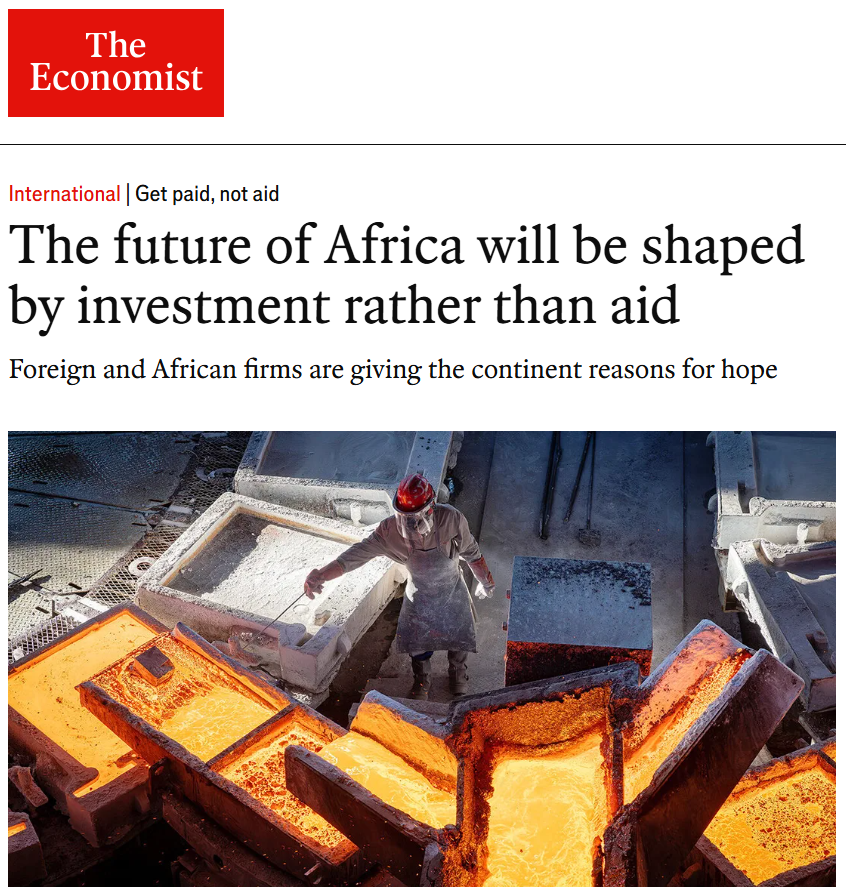
Everyone wants a piece of Africa right now. That's one clear takeaway from this article @TheEconomist published last week. 🇺🇸 America wants Africa's critical minerals — copper, nickel, lithium, cobalt — to loosen China's grip on global supply chains. It's using 'commercial diplomacy', government-backed funds, and even aid as leverage to secure access. The prize: $8.6 trillion in undeveloped mineral assets. 🇨🇳 China also wants Africa's minerals — and it wants its markets, too. Chinese firms bought rare-earths in Tanzania, copper in Botswana, gold in Congo, Ghana, and Ivory Coast — all in the last two years. But its firms are also buying farmland, building apartment blocks, and making other scale bets on the continent's rising consumer class. 🇪🇺 Europe wants Africa's energy. TotalEnergies resumed a $20B LNG project in Mozambique. And Eni announced two new African oil and gas discoveries in February. 🇸🇦 🇦🇪 🇶🇦 The Gulf wants Africa's food and logistics. Saudi Arabia's PIF paid $1.8B for a controlling stake in Olam Agri. Vision Invest paid $700M for a stake in Arise IIP, which runs industrial sites in over a dozen African countries. DP World took over the port of Dar es Salaam. And Qatar's state-owned airline Qatar Airways holds a 60% stake in Rwanda's $2B Bugesera International Airport. Engaging with Africa now means doing business, and this new commercial era requires commercial leverage. But that's something most African governments lack individually — at least compared to outside powers. It's an urgent reason to accelerate the pace of economic integration across the continent. The world is figuring out what Africa is worth. The question is whether the continent can negotiate accordingly. -- Afridigest Intelligence — real intelligence to win in Africa's growth markets: afridigest.com/intelligence
Emeka Ajene ✍🏽 tweet media
English
22
155
312
16.6K
Josh TW retweetledi
Ricardo
Ricardo@Ric_RTP·
OpenAI just admitted Anthropic is KILLING their business. Their own applications chief told employees it was a "code red." Said Anthropic was a "wake-up call." Then admitted OpenAI had been "spreading efforts across too many apps" and it was "slowing them down." This is an internal confession. Here's why Anthropic is eating up OpenAI: 12 months ago, OpenAI owned 50% of all enterprise AI spending. Today it's just 27%. Anthropic went from nearly ZERO to winning 70% of every first-time enterprise AI deal. Seven out of ten companies buying AI tools for the first time are choosing Claude over ChatGPT. A year ago, one in 25 businesses on Ramp paid for Anthropic. Today it's one in four. OpenAI just had its biggest single-month adoption decline ever recorded. And Anthropic literally charges MORE than OpenAI for roughly the same performance. And businesses are STILL choosing them. In enterprise software, that never happens. The cheaper product usually wins. But Claude became something OpenAI never figured out how to be: Cool. Celebrities publicly switched to Claude. Senators are tweeting about using it. Engineers are shipping entire products with Claude Code in hours that used to take weeks. It started to became an identity signal. Like blue bubble vs green bubble in iMessage. Choosing Claude says something about you now. Meanwhile OpenAI went the opposite direction: They took the Pentagon contract that Anthropic refused. Greg Brockman donated $25 million to fund wars. ChatGPT uninstalls jumped 295% in a single day. Reddit posts saying "Cancel and Delete ChatGPT" got 30,000 upvotes. Anthropic said no to mass surveillance and autonomous weapons. Got blacklisted by the Pentagon. Trump called them a "Radical Left AI company." And their downloads went to #1 on the App Store the next day. Turns out refusing to build weapons is good marketing. But the real damage isn't consumer downloads. It's the MONEY. Claude Code hit $2.5 billion in annual revenue in six months. OpenAI's competing product Codex just barely crossed $1 billion. And Anthropic literally cannot meet demand. They're turning away paying customers because they don't have enough compute to serve them. A company REJECTING revenue because it's growing too fast. While OpenAI scrambles to consolidate. Last week OpenAI announced they're merging ChatGPT, Codex, and their browser into one "superapp." But what this really means: "We launched too many products, none of them worked well enough alone, so now we're cramming everything together and hoping it sticks." And remember their video tool Sora? Launched standalone. Hit #1 on the App Store. Usage flatlined within weeks. Now they're forced to shut it down. Their browser Atlas? Still hasn't launched publicly. Their IPO? Polymarket odds dropped from 55% to 35%. OpenAI has 900 million users. Anthropic has maybe 10 million daily actives. But here's the thing... OpenAI won the consumer war. ChatGPT is where your mom asks about recipes and your cousin makes memes. Anthropic won the war that actually MATTERS. The developers. The engineers. The enterprises writing 7 figure checks. OpenAI built the biggest chatbot on Earth. Anthropic built the tool that companies can't stop paying for. This is Yahoo vs Google all over again. Yahoo had the users. Google had the product. And we all know how that ended. OpenAI has 12 months to prove the superapp works, land the IPO, and stop the enterprise bleeding. If they can't, the most valuable startup in history becomes the most cautionary tale in tech. 900 million users don't mean anything if the people who actually pay are walking out the door. What do you think?
English
45
37
210
34.5K
Josh TW retweetledi
The Kobeissi Letter
The Kobeissi Letter@KobeissiLetter·
BREAKING: Elon Musk is planning an unprecedented move for retail investors in the SpaceX IPO: Elon Musk is considering allocating up to 30% of SpaceX’s IPO to retail investors, far above the typical 5% to 10%, per Reuters. Under this plan, @ElonMusk looks to "tap loyal fans" in the upcoming IPO which could exceed $1.75 trillion in valuation. The plan includes a hands-on approach to banks, assigning firms specific roles rather than broad competition. Bank of America is expected to lead US retail distribution, alongside firms like Morgan Stanley and UBS. The biggest IPO in history is prioritizing retail.
The Kobeissi Letter tweet media
English
508
785
7.9K
779K
Josh TW retweetledi
Ming
Ming@tslaming·
GOOD NEWS 📰 Elon Musk is planning a non-traditional IPO for SpaceX by allocating as much as 30% of the offering to individual retail investors. This move represents at least three times the typical Wall Street allocation of 5% to 10%. By prioritizing his loyal fan base, Musk aims to create a stable post-debut environment. He believes these investors are less likely to engage in "pop-and-dump" trading compared to institutional firms that may rush for the exits. The structure departs from the standard playbook by using a "lane" system for investment banks. Instead of allowing firms to compete broadly for the entire deal, SpaceX has assigned them narrowly defined roles based on geography and investor type. SpaceX CFO Bret Johnsen has assigned Morgan Stanley to handle smaller retail investors via E*Trade. Meanwhile, Bank of America will focus specifically on high-net-worth individuals and family offices within the United States. Internationally, UBS and Citi are coordinating distribution to retail and institutional pools. Regional specialists have also been tapped for the rollout, including Mizuho for Japan, Barclays for the UK, Deutsche Bank for Germany, and RBC for Canada. With a potential valuation reaching $1.75 trillion, the IPO is drawing comparisons to Google’s historic debut two decades ago. High demand is expected from investors who have followed Musk’s success with Tesla and Starlink. While the final size and timing of the offering are not yet finalized, it is poised to be one of the largest public listings in history. The strategy underscores Musk’s determination to personally shape the company's ownership and trading dynamics. Source: Reuters
Ming tweet mediaMing tweet media
English
21
38
284
17.8K
Josh TW retweetledi
David Senra
David Senra@davidsenra·
I've never heard anyone think about money this way. @elonmusk on early SpaceX: "Everything we did was a function of our burn rate. We were burning through $100,000 per day. In the same way I expected the revenue in 10 years to be $10 million a day, every day we were slower to achieve our goals was a day of missing out on that revenue."
David Senra@davidsenra

My conversation with @EricJorgenson, author of The Book of Elon (@elonmusk). 0:00 Book Reveal 0:39 Build Useful Things 2:19 Engineering Talent Edge 4:26 Wired for War 6:47 Tip of the Spear 8:47 Burn the Boats 13:13 Facing Fear 15:16 Origin Story Myths 18:19 Know Business A to Z 22:17 Simplify and Fail Fast 25:35 Reality and Physics 28:18 The Algorithm Begins 30:34 Delete and Simplify 34:25 Starlink War Room 36:52 Repetition as OS 38:18 Step Three Simplify Optimize 38:43 Question Every Requirement 39:13 Tesla Battery Pack Delete 40:43 Repetition Installs Ideas 42:02 Step Four Accelerate 43:26 Design Org for Speed 46:06 Step Five Automate 46:29 Control and Clean Sheet 48:54 Vertical Integration and Costs 50:47 SpaceX Incentives and Mars 57:11 Frontier Unlocks Starlink 1:00:26 Time as True Currency 1:03:58 Speed Triage and Bottlenecks 1:10:11 Internalized Responsibility 1:12:56 Avoid Serialized Dependencies 1:14:31 Aligning the Team 1:15:07 Time Is the Constraint 1:16:00 One Metric Focus 1:18:03 Directional Predictions 1:19:06 We Must Make Stuff 1:25:39 Manufacturing as Moat 1:26:23 Speed and Direct to Customer 1:28:41 SpaceX Feasibility Study 1:33:07 Edge of Sanity Leadership 1:37:10 Bottlenecks and Integration 1:40:01 Design and Simplify 1:45:15 Catch the Rocket 1:48:14 Capitalism and Closing Includes paid partnerships.

English
32
137
1.6K
215.6K
Josh TW retweetledi
TBPN
TBPN@tbpn·
Former Tesla President @jonmcneill says Elon Musk kept employees motivated post-IPO by "starving the balance sheet": "Even after we were public, we operated Tesla on a quarter's worth of cash." "I kept saying to Elon, 'I would like a little breathing room.' He's like, 'No. We've got to think like we're young entrepreneurs: if you're two steps from death—you operate differently.'" "I was like, 'Man, we have a quarter's worth of cash, but we have 70 days of payables. That means we have less than three weeks of cash. This is tight.' But that kept everybody sharp." "The experience of working in a Musk company is—you are literally on the biggest challenge you've ever faced in your life, with the best people, and you're doing the best work of your life. That's what keeps most people engaged—it's not the balance in their bank account."
English
34
147
2.3K
223.6K
Josh TW retweetledi
Tansu Yegen
Tansu Yegen@TansuYegen·
Chinese street vendors cook meat in rotating steel ‘cannons,’ sealing in heat and flavor for a fast, intense cook.
English
44
143
967
386.9K