Over 70 gigawatts of nuclear in the pipeline, most of it for non-light water reactors, and mostly for hyperscalers and data centers.
New analysis from @TheBTI’s @joyjiang1997:
✅After nearly 7 years of work, the NRC’s final Part 53 rule is not perfect, but it is a real step forward and worth recognizing as a significant accomplishment. It is the most significant modernization of reactor licensing in decades. thebreakthrough.org/issues/nuclear…@stoohill13
Aluminum smelting could hold the secrets to industrial decarbonization and advanced manufacturing. But to rebuild its aluminum sector, the U.S. needs to learn how and why China seized control.
New whitepaper from @wang_seaver@joyjiang1997 and myself:
thebreakthrough.org/issues/energy/…
@Woodymcnorway@Dr_A_Stein@TheBTI Russia is indeed a major player in nuclear. In this piece, though, I focused specifically on China’s domestic success and what the U.S. can learn from it. Russia’s export model will be a separate analysis.
How China Raced Ahead of the U.S. on Nuclear Power.
As @joyjiang1997@thebti notes, serial orders allow developers to refine construction, streamline licensing, simplify the supply chain, and reduce costs.
nytimes.com/interactive/20…
One of my original findings: 19 out of 30 (63%) Chinese nuclear plants now under construction reached final investment decision (FCD) within just weeks of approval, while US plants waited for months or years for state/local approval after NRC construction permit.
In the article, I explain what is actually driving China’s nuclear execution success, and what the U.S. can realistically adapt, including:
• lower rate financing
• predictable licensing and regulatory certainty
• core design standardization
• orderbook deployment
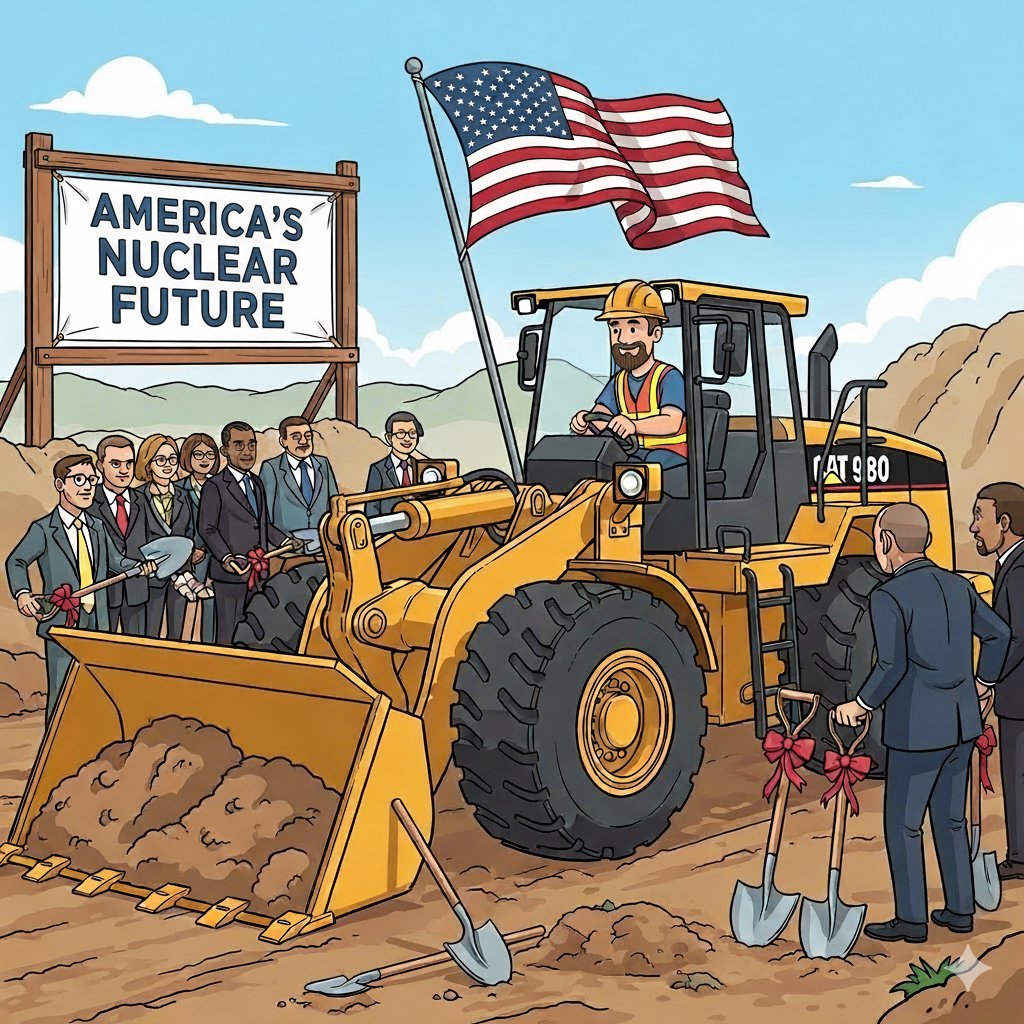
If I had to plan a groundbreaking I wouldn't use a shiny shovel in a staged box of dirt. I would use a wheel loader. The point is to break ground and get to work, right?
Release: Commissioner Caputo announced her resignation from the NRC, a year before her term was scheduled to end. Caputo’s departure is a loss for the NRC and a setback for efforts to reform the agency. thebreakthrough.org/press/release-…
"The government should create a milestone-based program for advanced nuclear energy projects that incrementally reduces interest rates through credit subsidies when project milestones are achieved on time."
Important new report @TheBTI:
thebreakthrough.org/issues/energy/…
🚨New paper out on reconsidering the radiation protection model at the NRC. The paper discusses what science indicates, what it cannot demonstrate, and how policy is separate but informed by science. We recommend a pragmatic, tiered approach that aligns with other hazards.
The unprecedented step to remove Commissioner Hanson from the NRC could upend the current bipartisan support for nuclear energy. A return to partisan polarization will almost certainly cripple efforts to make progress. thebreakthrough.org/press/release-…
World Bank lifts ban on funding nuclear energy, enabling countries to choose the energy sources that fit their needs. This is particularly a boost for developing countries that need firm clean 24/7 electricity and industrial heat ft.com/content/d80b68…
The recent nuclear EOs are an interesting attempt at central planning. The EOs have no teeth, and the govt lacks the state capacity to build 400 GW of nuclear by 2050. In the US, politicians issue orders, but decisions are made by individuals and firms, guided by market forces.