
Sabitlenmiş Tweet
jp
2.9K posts


Can someone tell my the value in doing revenue projections?
We’re at mid 8 figure run rate and I’ve never done one and don’t see the point
Ok you set a target. So what you gonna do if you’re below target? Same shit you would do anyway - keep pushing
What you gonna do if you’re above target? Pull back? No - keep pushing
I don’t get it
English
@colinvmcguire What are you using here/what is your workflow? I’ve found chat to actually be better at the science stuff than Claude but still far from perfect. Running into stupid errors like different actives having different optimal pH
English

A niche business category that will be severely disrupted very soon is beauty formulation. I can get to near-final formulations with AI. Lab just has to mix our formulas, we make 1-2 rounds of revisions, and it's done.
Even checks IP, helps formulate around IP, and can simulate shelf stability very well.
English
@C_Angermayer Is there such thing as b2b biotech? Or you mean like purely cosmetic/discretionary interventions
English
I’ve said this before: I believe consumer biotech will become the most compelling sub-sector within biotech - without question - and one of the most attractive investment opportunities overall.
At its core, this category targets products that slow or reverse aging, tap into human vanity, and measurably improve health, performance, and happiness. That is a market that, quite simply, approaches 100% of the global population.
As a result, I expect consumer-driven pharma/biotech revenues to scale aggressively, expanding well beyond the current wave of GLP-1s and into a much broader portfolio of interventions.
Crucially, I believe a significant share of this value will be captured at the distribution layer - specifically by telehealth platforms such as $HIMS , as well as our own “Live Enhanced” platform, a core business line of the @enhanced_games $APAD soon $ENHA 🚀
Avi Roy@agingroy
A weekly jab in the belly is generating more revenue than the entire AI industry. Ozempic + Mounjaro: $71B in 2025. OpenAI + Anthropic: $29B. And they've barely started. ~2% of the 800 million eligible patients can currently access them. h/t @DrSamuelBHume
English
@IstvanicMarin If 7 day attribution window it will sometimes assume it can spend into TOF now and convert later. Especially if there was just a big sale or product launch its algo will update for a longer assumed “consideration cycle”.
English

In my scaling CC campaign, CPA went from $85 to $180 while spending 3x more on a daily basis
No changes in ads or bids were made overnight
There's no specific change in placement, country, age or gender breakdown
The only thing I noticed is that CTR dropped 30%, and CR dropped 30%, and more spend over the night went to the prospecting segment, as I can see my % of new visits increased 50%
So, okay, FB decided to do more prospecting, but how come all of a sudden, and why would it ignore the bid almost completely and spend the budget fully - any ideas on what else to check?
English
@MehtabKarta The problem is that raising prices, even if it looks great in an a/b test, shrinks your TAM. We Ecom boys forget that the average American survives on hamburger helper and $50 isn’t an impulse buy
English

The hardest part about running a DTC brand is managing inventory, which has huge lead times.
You can usually trade some of the cost in your business around though and fix this.
For example...
Assume you run a business where an increase in price = commensurate increase in customer acquisition costs.
Raising prices as much as possible until this relationship breaks is a massive win for your business because it obliterates inventory risk.
Raising prices + higher CAC = same profit, but... COGS as % of revenue drops → lower inventory requirement per $ of revenue.
That means you can afford to be less precise with forecasting, because the penalty for being wrong (overstocking or understocking) is reduced.
Ad spend is extremely flexible, inventory is not.
so any shift in the business model that favors “more variable” levers like ad spend gives you more agility.
English
@jeffreympark -31% to +269% lol. What’s this got 13 orders? Don’t worry at that volume you should stat sig in 2-3 months
English

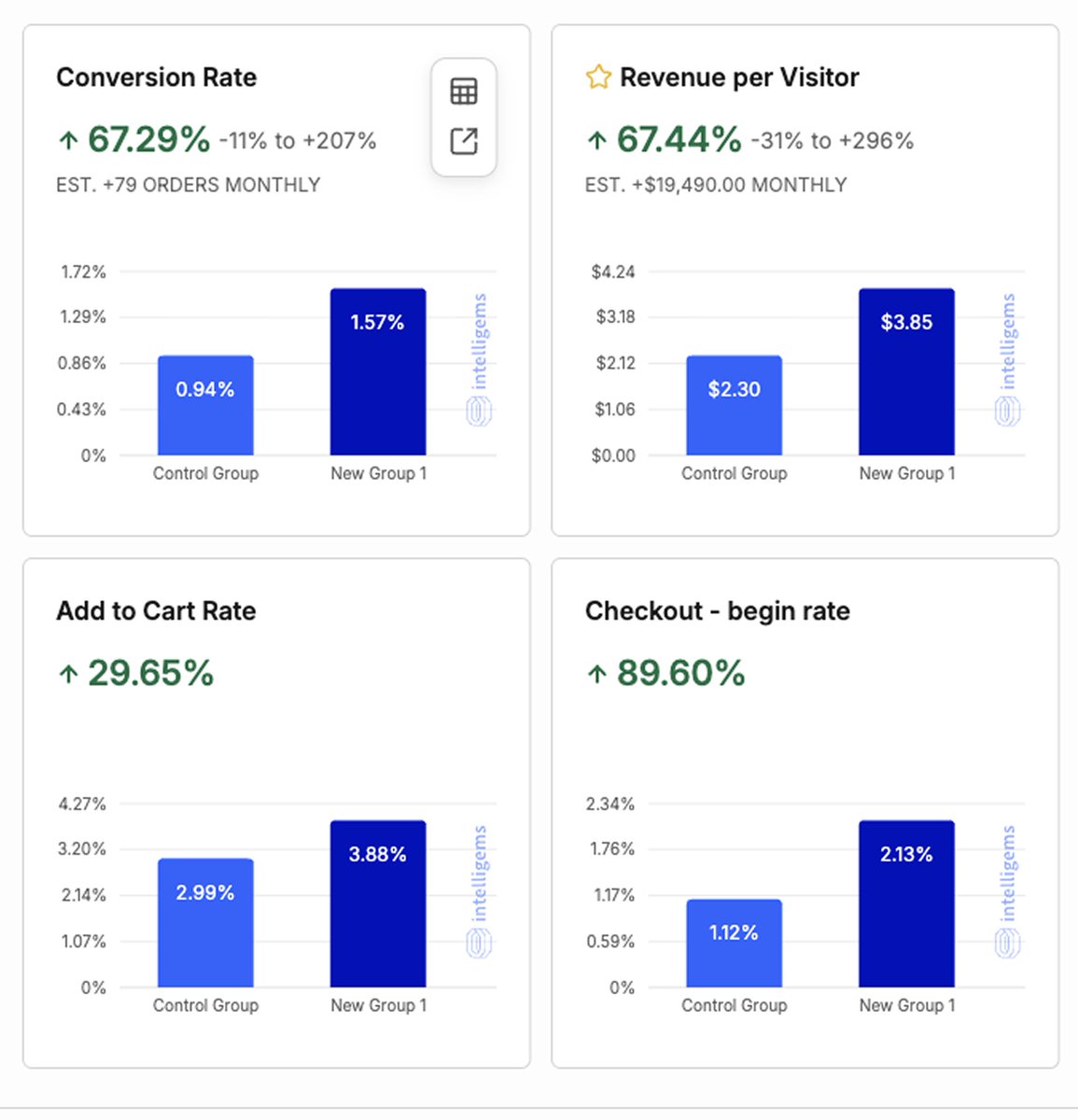
We tested new product images for Cyclone using a structured CRO framework
Result:
+67.29% Conversion Rate
+67.44% Revenue per Visitor
+29.65% Add to Cart
+89.60% Checkout Rate
Same product. Same price. Same traffic
Only changed the images
Most brands treat product images as decoration
We treat them as conversion assets
Every image should answer a buying question:
- What is the product?
- What problem does it solve?
- How does it work?
- Size & materials clarity
- Objection handling
- Objection handling #2
- Social proof
Click below to see all 7 images we did:
English

People keep asking for this and I've been sitting on it for a while.
Here's my 50 founder ad swipe file - you can copy and rinse and repeat.
Lot's of these are running at scale - lot's are just cool concepts and variations to give you ideas to test.
Pulled it all together into one swipe file.
P.S this is a working file so I will keep adding too it! Everytime I see a new banger I will add.
Comment "SWIPE" and I'll send it over.

English

I feel like this is always happening to the same 3 people on my timeline.
Daniel ⛰️@thedanielokon
Can anyone tell me why Meta just blew through our daily budget and it's not even mid-afternoon yet? Terrible CPA btw.
English
@drewfallon12 but total customers is lower bc you can't compete in the same auctions. If you run caps on meta and cut your cap in half, you can reasonably expect your spend to drop by 90%.
The LTV matters if you're willing to spend into it, which we're not due to the 3:1 demand
English

How did Gruns actually scale the way they did, financially speaking?
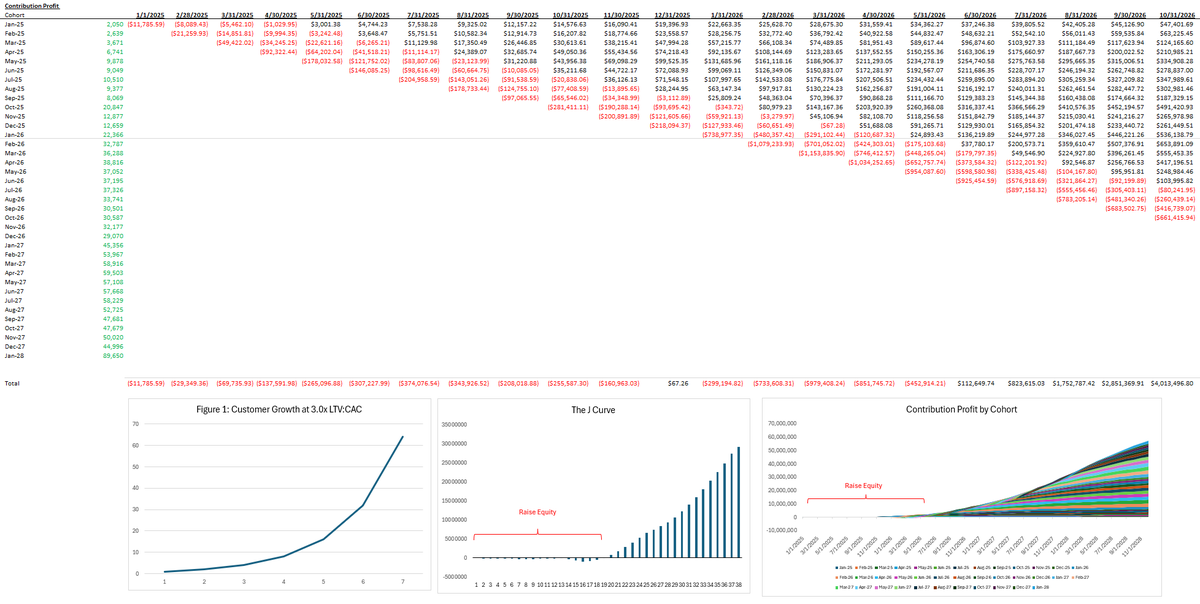
I dont have any inside info, but I can tell you how. Balancing inventory, CACs, opex, etc during hypergrowth is an extremely difficult task; however on a spreadsheet it can in fact all be reduced down to a very simple mathematical model that is highly dependent on two variables and one ratio:
Lifetime profit per customer divided by the cost to acquire said customer
or for the initiated; LTV:CAC
Put simply, there is approximately a zero percent chance that Gruns had an LTV:CAC less than 3.0x. Further, if they did manage to somehow scale without 3.0x, Unilever wouldn't have acquired them.
My best performing substack post ever (will link in the comments) is titled "Why 3.0 LTV:CAC"
Summarized into a sentence; the answer is: because when 1 customer gives you enough profit to pay back the first customer and acquire 2 more customers, you can grow exponentially. 1 customer turns into 2, 2 customers turns into 4, 4 turns into 8 and voila - you have your hockey stick (figure 1).
Over time, the wide majority of revenue becomes repeat customers. Terminally, a healthy ratio for new:repeat is about 30% new to continue compounding at an exponential rate.
However, you are acquiring these customers at a loss on the first purchase. In the early days, this creates a cash burn. I theorize that this is why Gruns raised fairly significant capital early on, becuase they recognized the nature of the 'J-curve'
The J-curve is when you are burning cash on customer acquisition, and you don't yet have enough cohorts returning to actually cover the cost of the marketing investment you're deploying to acquire new customers. It creates a period of negative contribution prior to a period of compounded profits, in the shape of a J.
When you have the proper LTV:CAC, the business case for financing the negative portion of J curve with equity is very very strong, hence the early capital raising.
So the calculus is essentially:
establish unit economics -> raise capital ->scale
The most critical part of executing on this model is ensuring that as you scale customer acquisition, each cohort is CREATING enterprise value, not DESTROYING it. This is where 99% of founders fail.
EV is only created then those cohorts pay back and start generating profit. As you scale, often CAC goes up so much that cohorts never pay back, and you are actually losing money and destroying enterprise value, even if revenue is going up.
This is where the phrase 'not all growth is good growth' comes from.
And that ladies and gentleman, is your financial modeling primer. Someone told me not to put the term 'financial modeling' at the front of this post because they will fall asleep, but ha ha i've tricked you into learning it!
This is the kind of work we do every day with brands at iris. We deploy agents to clean your data & build your models. if that sounds like something you could benefit from, shoot me a DM
English
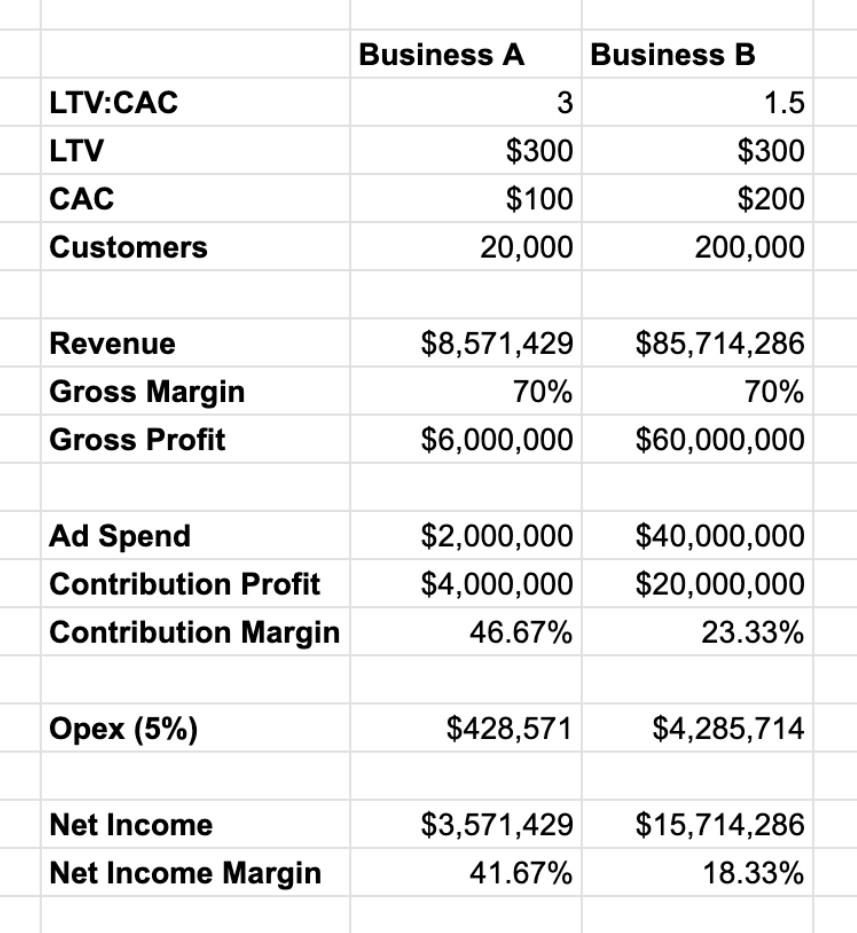
@drewfallon12 how does it do that if it can only afford to pay half as much per customer?
English
@jpecom_ business A scales to the same revenue as business B while maintaining the superior margin profile is like the whole point
English
@drewfallon12 would you rather run company A instead of company B? I just don't see why I'd choose to make 5x less profit dollars
English
@jpecom_ you would generate half the margin, and burn through more customers to generate the same profit
English
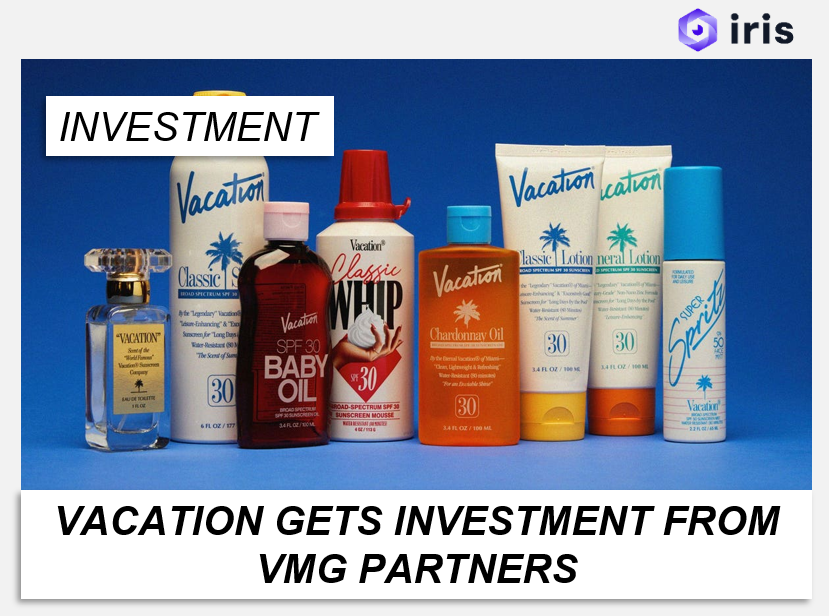
VACATION GETS INVESTMENT FROM VMG PARTNERS
Vacation, the nostalgia-branded sunscreen company co-founded by Lach Hall in 2021, has closed a minority investment from VMG Partners. While terms were not disclosed, spitballing that the check was between $30M and $60M for a 20% to 40% stake.
The transaction follows the brand recently hiring investment bank Raymond James to explore a minority stake deal.
Existing backers are True Beauty Ventures and Silas Capital (which led the original $6M Series A).
VMG's beauty track record is strong: they backed Drunk Elephant (sold to Shiseido for $845M in 2019), K18 (sold to Unilever in 2023), and Kosas (still in portfolio, was reportedly exploring a sale as of early 2024).
VMG closed a $1 billion Fund VI in May 2025, so they have fresh capital to deploy.
Vacation generates approximately 5M weekly organic social media views, driven by its nostalgic takes on branding and marketing. According to WWD, they recorded $60M to $75M in 2025 net sales.
English

@jpecom_ different service providers that offer this as a service (TrueMed, Flex, Binkey, etc.) are reporting it as case studies for their clients


English
So bullish on DTC brands in Health & Wellness that are HSA/FSA eligible – meaning their customers can buy at full price using pre-tax dollars.
The customer saves 30-40%. The brand never discounts a thing.
- 40%+ increase in average order value
- 30% boost in checkout conversion
- Zero margin erosion
Lot of companies already doing this. Such a smart idea.

English

Happy to announce that after some intense weeks of hiring, we have secured the 1st of 4 new Creative Strategist hires and we are in the midst of making a second offer.
Not that anyone cares 😅
We are turning our attention now to the AppLovin & TikTok organic roles. DMs open!
Jason@JasonJh1319
This is your regular reminder that we are hiring 4 Creative Strategists (1 more than last week!) We will likely fill one spot this week: Meta x2 AppLovin x1 Affiliate Creators x1 (IG/TikTok) DMs are open. Strong track record is a must.
English

There you have it. Google telling you to test your branded search ads.
Google Ads@GoogleAds
If you aren’t testing for incrementality, you’re likely paying for customers who were going to buy from you anyway. ROAS is often a “real-time gauge” that reflects correlation – it tells you what happened, but it doesn’t prove your ads caused it. To find that truth, you need to shift your marketing culture from assumed credit to causal proof. As Gaurav Bhaya (VP of Ads & Analytics at Google) and Patrick Gilbert (CEO at @adventureppcinc) emphasize, you need to upgrade your technology to move beyond defensive reporting and start reporting offensively. Testing turns marketing costs into growth investments. Calibrate your data to invest with data-backed confidence. Here’s how: ⚙️ Move beyond the real-time gauges: Attribution tells you what’s happening now, but causal gauges like incrementality help you understand the why behind your performance. ⚖️ Calibrate for reality: Use incrementality as your ground truth to calibrate all your other gauges, ensuring your budget reflects actual causality rather than just data points. ❤️ 🩹Avoid emotional budgeting: Don’t cut budgets based on short-term anxieties; let a proper time horizon of data prove the effectiveness of your brand investments. 🧪 Lead with a true hypothesis: Define exactly what you expect to happen – like a lift in brand search – before you launch. 💎 Run ongoing experiments: Running a high volume of experiments per year is how you prove marketing is a growth driver. By calibrating your models with incrementality, you stop guessing at ROI and start investing with mathematical certainty. How often is your team running incrementality tests?
English

Big beauty brand site redesign has been in traffic split validation tasting for a week.
Up 9% on revenue per user.
Imagine making 9% more money for all your site traffic.
Awesome stuff.
English
@daviefogarty $300/mo for literal days of work and maintenance is the worst possible trade off you can make
English

As a brand owner you should be using claude to save $1000s on costs by building AI tools to replace all the different SaaS products you’re using.
Here's 6 tools that you can easily build in one day.
1. Organic social tracker for competitors - track their viral videos for the week and get it in a message
2. Inventory reorder alerts - connects to your 3PL and sheets, calculates velocity, pings you before stockouts
3. Margin calculator - pulls COGS, ad spend, shipping, gives you real profit per SKU
4. Review aggregator - scrapes Trustpilot, Amazon, Google, summarises sentiment weekly
5. Creative brief generator - takes your top performers, outputs briefs for editors
6. Product tracker for competitors - lets you know when a major product launch happens via one of your competitors
None of these need a dev, Claude Code can build them in an afternoon.
If you're still paying $300/month for 6 different tools, you're doing it wrong.
Claude@claudeai
New in Claude Code: Remote Control. Kick off a task in your terminal and pick it up from your phone while you take a walk or join a meeting. Claude keeps running on your machine, and you can control the session from the Claude app or claude.ai/code
English