Dr. Knockamoto

6.4K posts

Dr. Knockamoto banner
Dr. Knockamoto

Dr. Knockamoto

@jram_01

🇺🇸 / Ph.D. ECE / Signal Processing / Graph Theoretic Signal and Information Processing / Visionary / Risk Taker / Investor / Bitcoin / Posts are my own

CyberSpace Katılım Nisan 2013
5K Takip Edilen2.4K Takipçiler
Sabitlenmiş Tweet
Dr. Knockamoto
Dr. Knockamoto@jram_01·
🎉🎉 Congrats Everyone🎉🎉… you just found some high quality content on X… below you will find some true 💎💎💎… Surf my replies… if you see something you don’t understand ask… ask grok… enjoy…
GIF
English
8
2
126
8.7K
Dr. Knockamoto
Dr. Knockamoto@jram_01·
👀👀👀
Utkarsh Sharma@techxutkarsh

BREAKING: MIT just mass released their Al library for free. (Links included) I went through these and honestly... this is better than most paid courses I've seen. Here's the full list of books: Foundations 1. Foundations of Machine Learning Core algorithms explained. Theory meets practice. 2. Understanding Deep Learning Neural networks demystified. Visual explanations included. 3. Machine Learning Systems Production-ready architecture. System design principles. Advanced Techniques 4. Algorithms for ML Computational thinking simplified. Decision-making frameworks. 5. Deep Learning The definitive textbook. Covers everything deeply. Reinforcement Learning 6. RL Basics (Sutton & Barto) The classic. Agent training fundamentals. 7. Distributional RL Beyond expected rewards. Advanced theory. 8. Multi-Agent Systems Agents working together. Coordination and competition. 9. Long Game Al Strategic agent design. Future-focused thinking. Ethics & Probability 10. Fairness in ML Bias detection. Responsible Al practices. 11. Probabilistic ML (Part 1 & 2) Links: lnkd.in/gkuXuexa Most people pay thousands for bootcamps that teach half of this. Bookmark it. Start anywhere. Just start. Repost for others Follow for more insights on Al Agents. MIT's books on Al Foundations 1. Foundations of Machine Learning - lnkd.in/gytjT5HC 2. Understanding Deep Learning - lnkd.in/dgcB68Qt 3. Machine Learning Systems - lnkd.in/dkiGZisg Advanced Techniques 4. Algorithms for ML - algorithmsbook.com 5. Deep Learning - lnkd.in/g2efT6DK Reinforcement Learning 6. RL Basics (Sutton & Barto) - lnkd.in/guxqxcZZ 7. Distributional RL - lnkd.in/d4eNP-pe 8. Multi-Agent Systems - marl-book.com 9. Long Game Al - lnkd.in/g-WtzvwX Ethics & Probability 10. Fairness in ML - fairmlbook.org 11. Probabilistic ML (Part 1) - lnkd.in/g-isbdjj 12. Probabilistic ML (Part 2) - lnkd.in/gJE9fy4w

ART
0
0
0
10
Dr. Knockamoto
Dr. Knockamoto@jram_01·
@BritishHodl This is the plan… the handshake deal both the petrodollar and petroyuan will coexist… weaken the dollar is the program this is just the next subroutine….🤯🤯🤯🤯
English
1
0
0
209
BRITISH HODL ❤️‍🔥🐂❤️‍🔥
Watch the $MOVE move. Stimulus and resolutions are on the way if we breach 120-140. The bond market finally started welching because of Trump administrations communication strategy.
English
8
3
87
11.8K
Dr. Knockamoto
Dr. Knockamoto@jram_01·
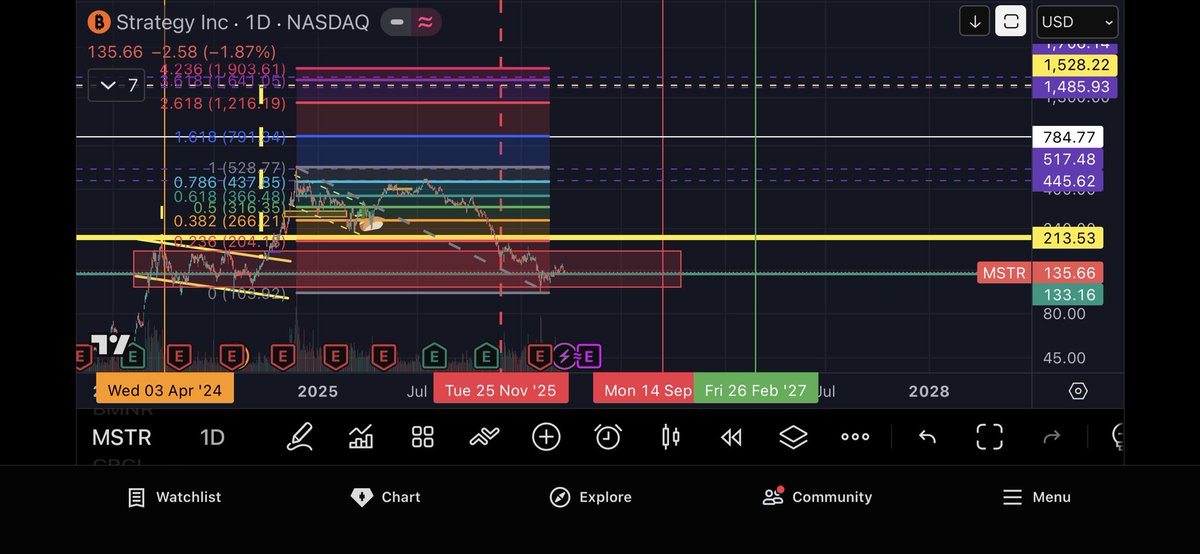
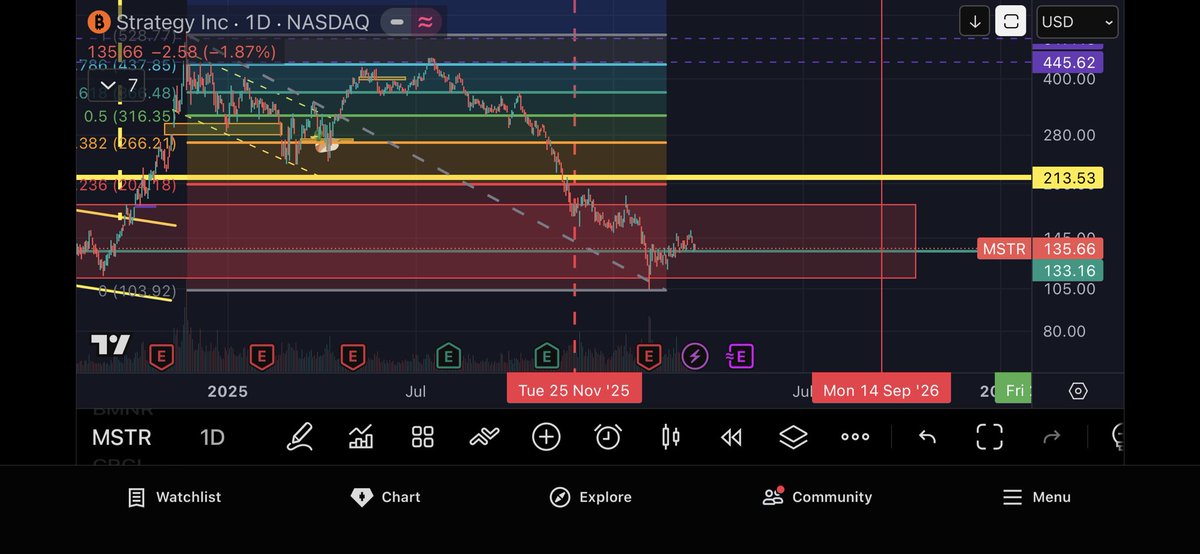
$MSTR This bottomed and followed again the Net Global Liquidity… we just passed the time to buy, that was it, that how you get 2700% gains in several years… the next cycle takes us back to $500 all the way to $1100… the time to buy isn’t $800…. NGL leads and people act… its boom and bust over and over again🚀🚀🚀🚀
Dr. Knockamoto tweet mediaDr. Knockamoto tweet media
English
0
0
1
38
Dr. Knockamoto
Dr. Knockamoto@jram_01·
$CRCL This is going to be back at $300 soon…. Net Global Liquidity told me when to buy, I’m glad I listened🚀🚀🚀🚀🚀
Dr. Knockamoto tweet media
English
0
0
1
95
Dr. Knockamoto
Dr. Knockamoto@jram_01·
The Strait of Hormuz has been **effectively closed** since early March 2026 (following U.S.-Israeli strikes on Iran starting late February), choking off ~20% of global oil flows (~17-20 mbpd) plus major LNG and other exports. As of March 21, 2026, we're roughly **3 weeks** into this crisis, with tanker traffic down 90%+, insurance pulled, and some limited passages (mostly Chinese/Iranian flagged) but no real reopening. ### Why 3 Weeks Is the Critical Tipping Point Analysts (including JPMorgan and others) highlight ~3 weeks as the boundary because: - **Producer-side storage fills up**: Gulf exporters (Saudi Arabia, UAE, Iraq, Kuwait, etc.) have limited onshore spare storage (~100 million barrels collective headroom pre-crisis). At lost export rates of 15-20 mbpd, tanks hit capacity fast. Iraq/Kuwait already forced sharp cuts (days/1-2 weeks buffer); Saudi/UAE reach limits around the 3-week mark, triggering **forced production shut-ins** (not just export halts—actual wells/offline capacity). - **Consumer-side buffers deplete**: Pre-closure loaded tankers (transit time ~20-30 days to Asia/Europe) deliver for the first 2-4 weeks. After that, physical shortages hit refineries and strategic stocks (many hold only weeks of working inventory). Beyond 3 weeks, the shock escalates from "disrupted exports" to "structural supply loss," with no quick fix—bypass pipelines handle only ~4-7 mbpd max, rerouting around Africa adds 10-20 days + massive costs. Current reality (mid-March 2026): We're hitting/through that window. Oil already surged (Brent ~$100-110 range recently, with spikes toward $120 modeled), production cuts underway (~6-10 mbpd lost), fertilizer/LNG chaos emerging. ### Phased Breakdown: What Happens Day by Day / Week by Week - **Days 1-7 (Panic + initial buffer)**: Markets spike on fear (10-40% jumps). Insurers exit, tankers divert/anchor. Some pre-loaded oil still arrives. Early cuts in low-buffer producers (Iraq already slashing). Prices climb steadily; minor attacks reported. - **Days 8-14 (Storage filling accelerates)**: More producers max tanks, voluntary cuts ramp. Last big wave of pre-closure deliveries arrive. Global inventories draw down. Rerouting starts for non-oil cargo (huge added time/cost). Fertilizer/chemical exports tighten → early ag price pressure. - **Days 15-21 (The boundary—hitting the wall)**: Major players (Saudi/UAE) exhaust usable storage → forced shut-ins begin. Final pre-closure tankers finish deliveries. Importer stocks hit critical lows. Brent pushes $100-120+. Gasoline/diesel pump spikes, manufacturing slowdowns, food-price warnings (urea/fertilizer disruptions). - **Day 22+ (Acute crisis mode)**: Full Gulf shut-ins compound ~15-20% global loss. No new supply at scale. Oil surges $120-150+ (worst-case $200 if mining/escalation worsens). Recession signals strong: higher inflation (0.5-1%+ added), job losses in transport/energy sectors, potential rationing. LNG triples in Europe/Asia. Global shipping backlogs. Geopolitical scramble (U.S. escorts? China pressure?). If it drags months: 1970s energy crisis level—sustained high prices, growth contraction, forced energy shifts (e.g., renewables acceleration long-term). **Bottom line**: We're at the edge right now. Three weeks isn't magic—it's when producer storage + in-transit buffers both collapse, turning a bad disruption into a systemic shock. Markets are pricing this volatility daily; any de-escalation (escorts, ceasefire) could unwind fast, but prolongation risks deep economic pain. Stay tuned—every day counts. #HormuzCrisis #OilShock #EnergySecurity
English
0
0
1
150
Jim Bianco
Jim Bianco@biancoresearch·
Monday is going to be lit! *TRUMP SAYS READY TO DEPLOY ICE TO AIRPORTS ON MONDAY *TRUMP GIVES IRAN 48 HOURS TO OPEN STRAIT OF HORMUZ
English
103
89
1.4K
157.3K
Dr. Knockamoto
Dr. Knockamoto@jram_01·
It’s deeper… The Strait of Hormuz has been **effectively closed** since early March 2026 (following U.S.-Israeli strikes on Iran starting late February), choking off ~20% of global oil flows (~17-20 mbpd) plus major LNG and other exports. As of March 21, 2026, we're roughly **3 weeks** into this crisis, with tanker traffic down 90%+, insurance pulled, and some limited passages (mostly Chinese/Iranian flagged) but no real reopening. ### Why 3 Weeks Is the Critical Tipping Point Analysts (including JPMorgan and others) highlight ~3 weeks as the boundary because: - **Producer-side storage fills up**: Gulf exporters (Saudi Arabia, UAE, Iraq, Kuwait, etc.) have limited onshore spare storage (~100 million barrels collective headroom pre-crisis). At lost export rates of 15-20 mbpd, tanks hit capacity fast. Iraq/Kuwait already forced sharp cuts (days/1-2 weeks buffer); Saudi/UAE reach limits around the 3-week mark, triggering **forced production shut-ins** (not just export halts—actual wells/offline capacity). - **Consumer-side buffers deplete**: Pre-closure loaded tankers (transit time ~20-30 days to Asia/Europe) deliver for the first 2-4 weeks. After that, physical shortages hit refineries and strategic stocks (many hold only weeks of working inventory). Beyond 3 weeks, the shock escalates from "disrupted exports" to "structural supply loss," with no quick fix—bypass pipelines handle only ~4-7 mbpd max, rerouting around Africa adds 10-20 days + massive costs. Current reality (mid-March 2026): We're hitting/through that window. Oil already surged (Brent ~$100-110 range recently, with spikes toward $120 modeled), production cuts underway (~6-10 mbpd lost), fertilizer/LNG chaos emerging. ### Phased Breakdown: What Happens Day by Day / Week by Week - **Days 1-7 (Panic + initial buffer)**: Markets spike on fear (10-40% jumps). Insurers exit, tankers divert/anchor. Some pre-loaded oil still arrives. Early cuts in low-buffer producers (Iraq already slashing). Prices climb steadily; minor attacks reported. - **Days 8-14 (Storage filling accelerates)**: More producers max tanks, voluntary cuts ramp. Last big wave of pre-closure deliveries arrive. Global inventories draw down. Rerouting starts for non-oil cargo (huge added time/cost). Fertilizer/chemical exports tighten → early ag price pressure. - **Days 15-21 (The boundary—hitting the wall)**: Major players (Saudi/UAE) exhaust usable storage → forced shut-ins begin. Final pre-closure tankers finish deliveries. Importer stocks hit critical lows. Brent pushes $100-120+. Gasoline/diesel pump spikes, manufacturing slowdowns, food-price warnings (urea/fertilizer disruptions). - **Day 22+ (Acute crisis mode)**: Full Gulf shut-ins compound ~15-20% global loss. No new supply at scale. Oil surges $120-150+ (worst-case $200 if mining/escalation worsens). Recession signals strong: higher inflation (0.5-1%+ added), job losses in transport/energy sectors, potential rationing. LNG triples in Europe/Asia. Global shipping backlogs. Geopolitical scramble (U.S. escorts? China pressure?). If it drags months: 1970s energy crisis level—sustained high prices, growth contraction, forced energy shifts (e.g., renewables acceleration long-term). **Bottom line**: We're at the edge right now. Three weeks isn't magic—it's when producer storage + in-transit buffers both collapse, turning a bad disruption into a systemic shock. Markets are pricing this volatility daily; any de-escalation (escorts, ceasefire) could unwind fast, but prolongation risks deep economic pain. Stay tuned—every day counts. #HormuzCrisis #OilShock #EnergySecurity
English
0
0
0
25
Tyler Rowe
Tyler Rowe@TylerCompiler·
Oh, THIS is why there's a record $8.2 TRILLION in money markets.🔒💰 They're just waiting to buy the dip. 📉📈
Tyler Rowe tweet media
English
2
0
7
441
Dr. Knockamoto
Dr. Knockamoto@jram_01·
This time it’s different… ☠️☠️☠️ According to grok… The Strait of Hormuz has been **effectively closed** since early March 2026 (following U.S.-Israeli strikes on Iran starting late February), choking off ~20% of global oil flows (~17-20 mbpd) plus major LNG and other exports. As of March 21, 2026, we're roughly **3 weeks** into this crisis, with tanker traffic down 90%+, insurance pulled, and some limited passages (mostly Chinese/Iranian flagged) but no real reopening. ### Why 3 Weeks Is the Critical Tipping Point Analysts (including JPMorgan and others) highlight ~3 weeks as the boundary because: - **Producer-side storage fills up**: Gulf exporters (Saudi Arabia, UAE, Iraq, Kuwait, etc.) have limited onshore spare storage (~100 million barrels collective headroom pre-crisis). At lost export rates of 15-20 mbpd, tanks hit capacity fast. Iraq/Kuwait already forced sharp cuts (days/1-2 weeks buffer); Saudi/UAE reach limits around the 3-week mark, triggering **forced production shut-ins** (not just export halts—actual wells/offline capacity). - **Consumer-side buffers deplete**: Pre-closure loaded tankers (transit time ~20-30 days to Asia/Europe) deliver for the first 2-4 weeks. After that, physical shortages hit refineries and strategic stocks (many hold only weeks of working inventory). Beyond 3 weeks, the shock escalates from "disrupted exports" to "structural supply loss," with no quick fix—bypass pipelines handle only ~4-7 mbpd max, rerouting around Africa adds 10-20 days + massive costs. Current reality (mid-March 2026): We're hitting/through that window. Oil already surged (Brent ~$100-110 range recently, with spikes toward $120 modeled), production cuts underway (~6-10 mbpd lost), fertilizer/LNG chaos emerging. ### Phased Breakdown: What Happens Day by Day / Week by Week - **Days 1-7 (Panic + initial buffer)**: Markets spike on fear (10-40% jumps). Insurers exit, tankers divert/anchor. Some pre-loaded oil still arrives. Early cuts in low-buffer producers (Iraq already slashing). Prices climb steadily; minor attacks reported. - **Days 8-14 (Storage filling accelerates)**: More producers max tanks, voluntary cuts ramp. Last big wave of pre-closure deliveries arrive. Global inventories draw down. Rerouting starts for non-oil cargo (huge added time/cost). Fertilizer/chemical exports tighten → early ag price pressure. - **Days 15-21 (The boundary—hitting the wall)**: Major players (Saudi/UAE) exhaust usable storage → forced shut-ins begin. Final pre-closure tankers finish deliveries. Importer stocks hit critical lows. Brent pushes $100-120+. Gasoline/diesel pump spikes, manufacturing slowdowns, food-price warnings (urea/fertilizer disruptions). - **Day 22+ (Acute crisis mode)**: Full Gulf shut-ins compound ~15-20% global loss. No new supply at scale. Oil surges $120-150+ (worst-case $200 if mining/escalation worsens). Recession signals strong: higher inflation (0.5-1%+ added), job losses in transport/energy sectors, potential rationing. LNG triples in Europe/Asia. Global shipping backlogs. Geopolitical scramble (U.S. escorts? China pressure?). If it drags months: 1970s energy crisis level—sustained high prices, growth contraction, forced energy shifts (e.g., renewables acceleration long-term). **Bottom line**: We're at the edge right now. Three weeks isn't magic—it's when producer storage + in-transit buffers both collapse, turning a bad disruption into a systemic shock. Markets are pricing this volatility daily; any de-escalation (escorts, ceasefire) could unwind fast, but prolongation risks deep economic pain. Stay tuned—every day counts. #HormuzCrisis #OilShock #EnergySecurity
English
0
0
0
24
Dr. Knockamoto
Dr. Knockamoto@jram_01·
According to Grok… The Strait of Hormuz has been **effectively closed** since early March 2026 (following U.S.-Israeli strikes on Iran starting late February), choking off ~20% of global oil flows (~17-20 mbpd) plus major LNG and other exports. As of March 21, 2026, we're roughly **3 weeks** into this crisis, with tanker traffic down 90%+, insurance pulled, and some limited passages (mostly Chinese/Iranian flagged) but no real reopening. ### Why 3 Weeks Is the Critical Tipping Point Analysts (including JPMorgan and others) highlight ~3 weeks as the boundary because: - **Producer-side storage fills up**: Gulf exporters (Saudi Arabia, UAE, Iraq, Kuwait, etc.) have limited onshore spare storage (~100 million barrels collective headroom pre-crisis). At lost export rates of 15-20 mbpd, tanks hit capacity fast. Iraq/Kuwait already forced sharp cuts (days/1-2 weeks buffer); Saudi/UAE reach limits around the 3-week mark, triggering **forced production shut-ins** (not just export halts—actual wells/offline capacity). - **Consumer-side buffers deplete**: Pre-closure loaded tankers (transit time ~20-30 days to Asia/Europe) deliver for the first 2-4 weeks. After that, physical shortages hit refineries and strategic stocks (many hold only weeks of working inventory). Beyond 3 weeks, the shock escalates from "disrupted exports" to "structural supply loss," with no quick fix—bypass pipelines handle only ~4-7 mbpd max, rerouting around Africa adds 10-20 days + massive costs. Current reality (mid-March 2026): We're hitting/through that window. Oil already surged (Brent ~$100-110 range recently, with spikes toward $120 modeled), production cuts underway (~6-10 mbpd lost), fertilizer/LNG chaos emerging. ### Phased Breakdown: What Happens Day by Day / Week by Week - **Days 1-7 (Panic + initial buffer)**: Markets spike on fear (10-40% jumps). Insurers exit, tankers divert/anchor. Some pre-loaded oil still arrives. Early cuts in low-buffer producers (Iraq already slashing). Prices climb steadily; minor attacks reported. - **Days 8-14 (Storage filling accelerates)**: More producers max tanks, voluntary cuts ramp. Last big wave of pre-closure deliveries arrive. Global inventories draw down. Rerouting starts for non-oil cargo (huge added time/cost). Fertilizer/chemical exports tighten → early ag price pressure. - **Days 15-21 (The boundary—hitting the wall)**: Major players (Saudi/UAE) exhaust usable storage → forced shut-ins begin. Final pre-closure tankers finish deliveries. Importer stocks hit critical lows. Brent pushes $100-120+. Gasoline/diesel pump spikes, manufacturing slowdowns, food-price warnings (urea/fertilizer disruptions). - **Day 22+ (Acute crisis mode)**: Full Gulf shut-ins compound ~15-20% global loss. No new supply at scale. Oil surges $120-150+ (worst-case $200 if mining/escalation worsens). Recession signals strong: higher inflation (0.5-1%+ added), job losses in transport/energy sectors, potential rationing. LNG triples in Europe/Asia. Global shipping backlogs. Geopolitical scramble (U.S. escorts? China pressure?). If it drags months: 1970s energy crisis level—sustained high prices, growth contraction, forced energy shifts (e.g., renewables acceleration long-term). **Bottom line**: We're at the edge right now. Three weeks isn't magic—it's when producer storage + in-transit buffers both collapse, turning a bad disruption into a systemic shock. Markets are pricing this volatility daily; any de-escalation (escorts, ceasefire) could unwind fast, but prolongation risks deep economic pain. Stay tuned—every day counts. #HormuzCrisis #OilShock #EnergySecurity
English
0
0
0
59
unusual_whales
unusual_whales@unusual_whales·
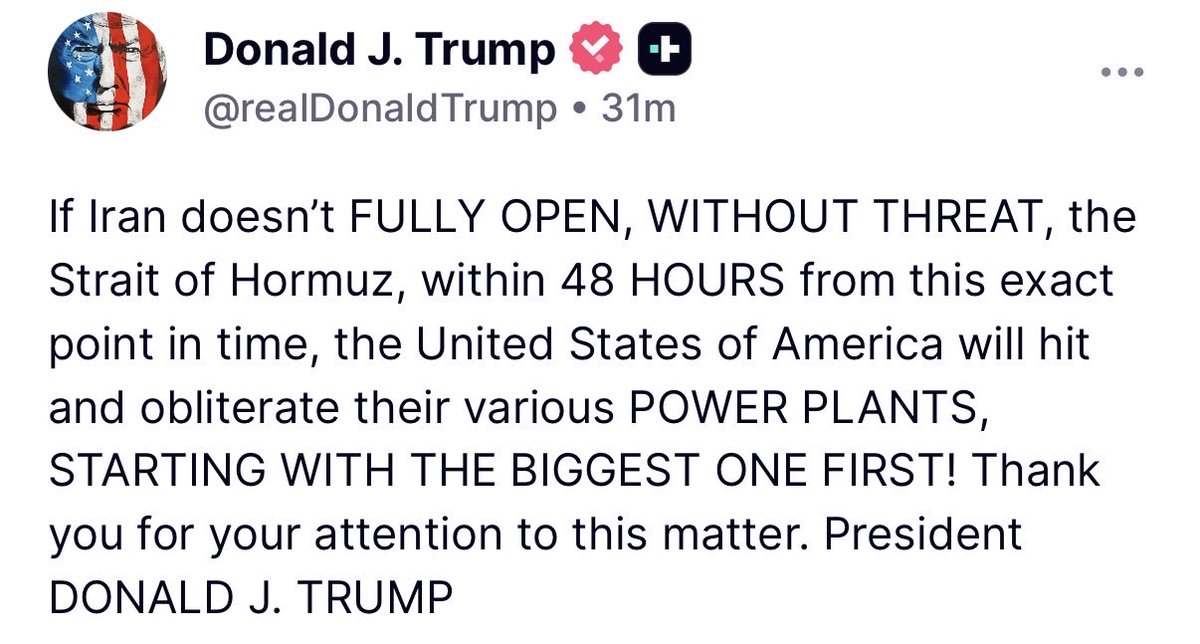
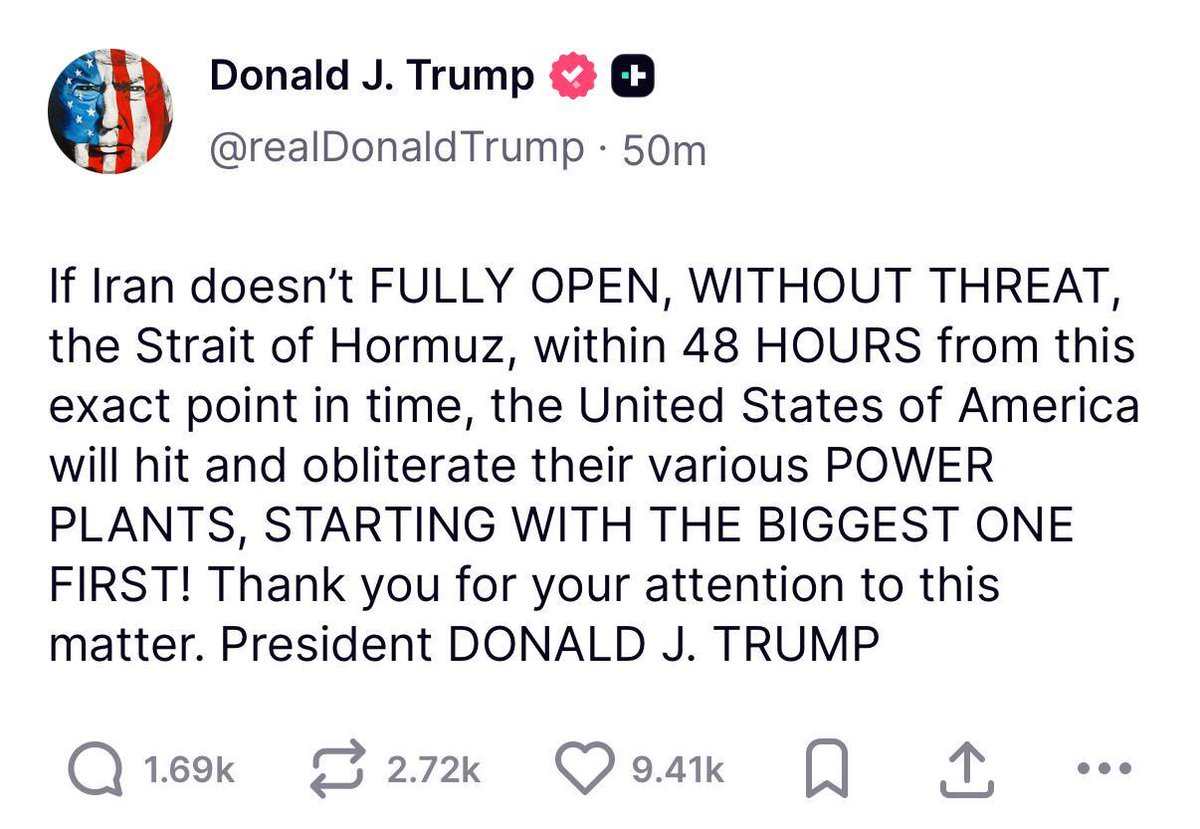
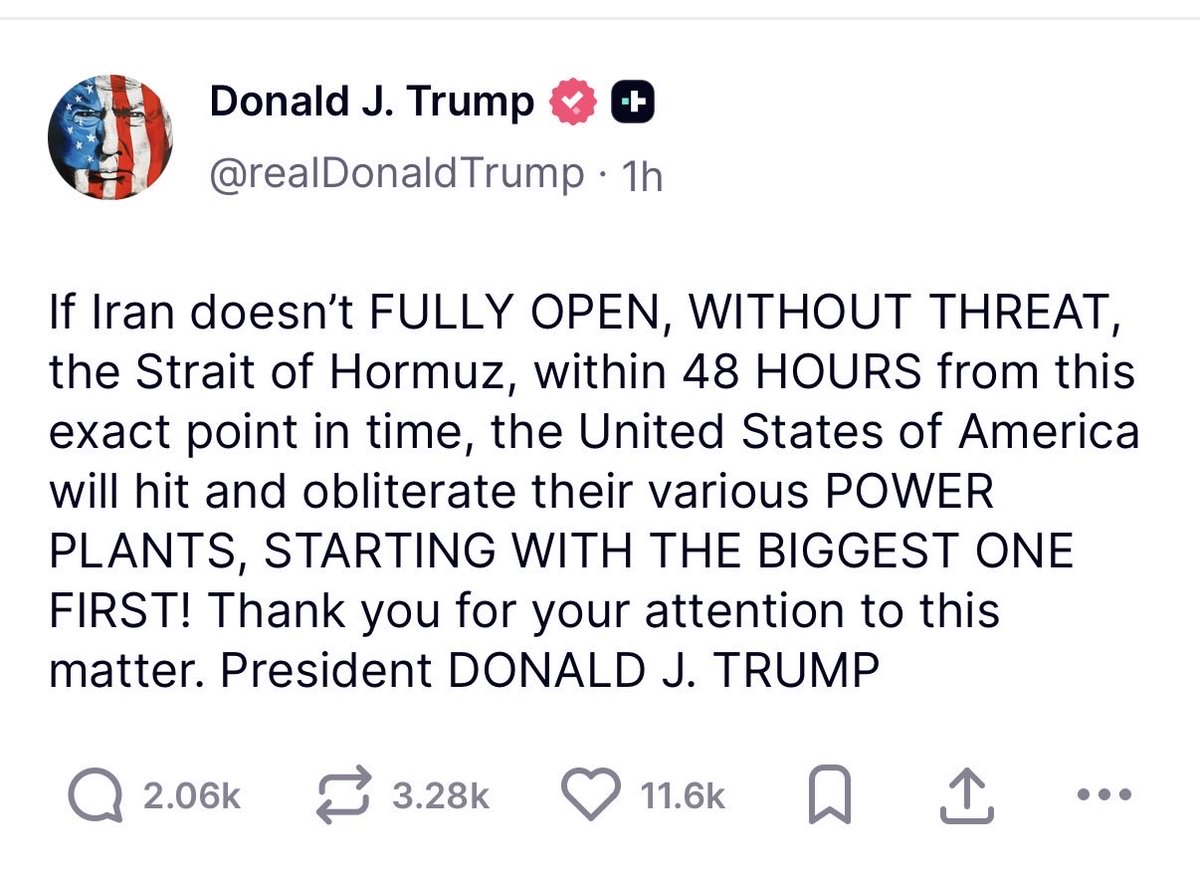
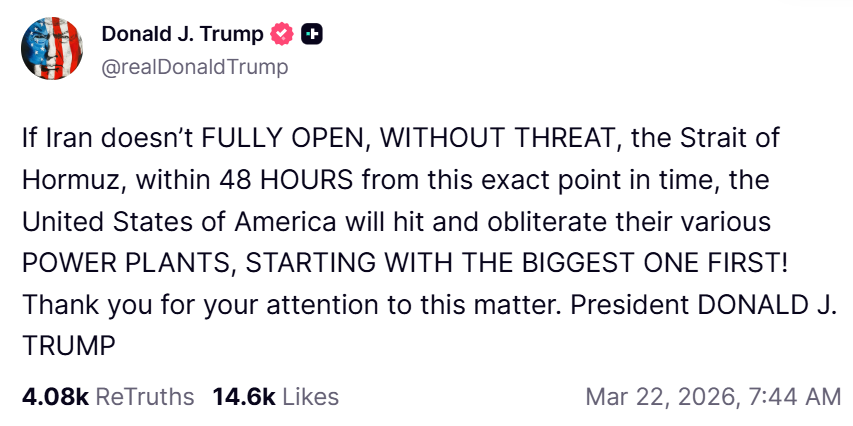
Trump has said the US will obliterate Iran’s power plants if the Strait of Hormuz isn’t open in 48 hours
unusual_whales tweet media
English
200
85
1.2K
162.7K
Dr. Knockamoto
Dr. Knockamoto@jram_01·
The Strait of Hormuz has been **effectively closed** since early March 2026 (following U.S.-Israeli strikes on Iran starting late February), choking off ~20% of global oil flows (~17-20 mbpd) plus major LNG and other exports. As of March 21, 2026, we're roughly **3 weeks** into this crisis, with tanker traffic down 90%+, insurance pulled, and some limited passages (mostly Chinese/Iranian flagged) but no real reopening. ### Why 3 Weeks Is the Critical Tipping Point Analysts (including JPMorgan and others) highlight ~3 weeks as the boundary because: - **Producer-side storage fills up**: Gulf exporters (Saudi Arabia, UAE, Iraq, Kuwait, etc.) have limited onshore spare storage (~100 million barrels collective headroom pre-crisis). At lost export rates of 15-20 mbpd, tanks hit capacity fast. Iraq/Kuwait already forced sharp cuts (days/1-2 weeks buffer); Saudi/UAE reach limits around the 3-week mark, triggering **forced production shut-ins** (not just export halts—actual wells/offline capacity). - **Consumer-side buffers deplete**: Pre-closure loaded tankers (transit time ~20-30 days to Asia/Europe) deliver for the first 2-4 weeks. After that, physical shortages hit refineries and strategic stocks (many hold only weeks of working inventory). Beyond 3 weeks, the shock escalates from "disrupted exports" to "structural supply loss," with no quick fix—bypass pipelines handle only ~4-7 mbpd max, rerouting around Africa adds 10-20 days + massive costs. Current reality (mid-March 2026): We're hitting/through that window. Oil already surged (Brent ~$100-110 range recently, with spikes toward $120 modeled), production cuts underway (~6-10 mbpd lost), fertilizer/LNG chaos emerging. ### Phased Breakdown: What Happens Day by Day / Week by Week - **Days 1-7 (Panic + initial buffer)**: Markets spike on fear (10-40% jumps). Insurers exit, tankers divert/anchor. Some pre-loaded oil still arrives. Early cuts in low-buffer producers (Iraq already slashing). Prices climb steadily; minor attacks reported. - **Days 8-14 (Storage filling accelerates)**: More producers max tanks, voluntary cuts ramp. Last big wave of pre-closure deliveries arrive. Global inventories draw down. Rerouting starts for non-oil cargo (huge added time/cost). Fertilizer/chemical exports tighten → early ag price pressure. - **Days 15-21 (The boundary—hitting the wall)**: Major players (Saudi/UAE) exhaust usable storage → forced shut-ins begin. Final pre-closure tankers finish deliveries. Importer stocks hit critical lows. Brent pushes $100-120+. Gasoline/diesel pump spikes, manufacturing slowdowns, food-price warnings (urea/fertilizer disruptions). - **Day 22+ (Acute crisis mode)**: Full Gulf shut-ins compound ~15-20% global loss. No new supply at scale. Oil surges $120-150+ (worst-case $200 if mining/escalation worsens). Recession signals strong: higher inflation (0.5-1%+ added), job losses in transport/energy sectors, potential rationing. LNG triples in Europe/Asia. Global shipping backlogs. Geopolitical scramble (U.S. escorts? China pressure?). If it drags months: 1970s energy crisis level—sustained high prices, growth contraction, forced energy shifts (e.g., renewables acceleration long-term). **Bottom line**: We're at the edge right now. Three weeks isn't magic—it's when producer storage + in-transit buffers both collapse, turning a bad disruption into a systemic shock. Markets are pricing this volatility daily; any de-escalation (escorts, ceasefire) could unwind fast, but prolongation risks deep economic pain. Stay tuned—every day counts. #HormuzCrisis #OilShock #EnergySecurity
English
0
0
3
426
Cointelegraph
Cointelegraph@Cointelegraph·
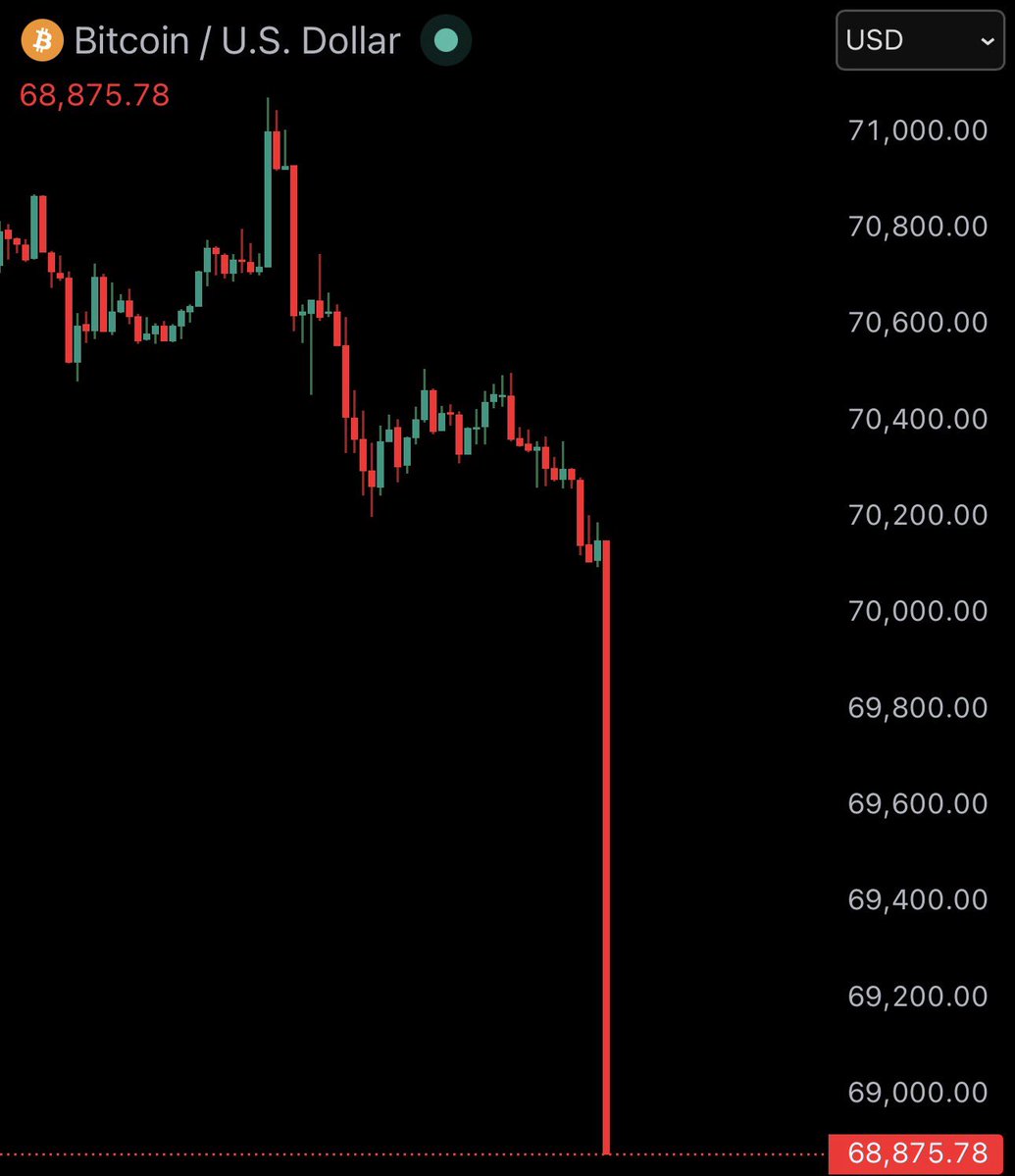
🚨 JUST IN: President Trump threatens to strike Iran’s power plants if the Strait of Hormuz isn’t fully opened within 48 hours. $BTC dipped below $69K following the post.
Cointelegraph tweet mediaCointelegraph tweet media
English
114
87
551
59.6K
jamie Miner
jamie Miner@Jamieminer·
Weekend Special: Retail Traders Getting Absolutely Yeeted While Institutions Sip Mai Tais Oh look, Trump fires off another galaxy-brain Truth Social nuke: “Iran, you’ve got 48 hours to reopen Hormuz or we turn your power grid into a very expensive fireworks show. Biggest one first. Tick tock.” Markets? Instantly decide Saturday night is prime time for a bloodbath Futures dumping like they're allergic to gravity Retail bags getting lighter by the millisecond Meanwhile, the big boys (institutions) clocked out Friday at 4 PM like responsible adults. Classic weekend retail dump: no circuit breakers, no volume, just pure, unfiltered despair liquidity. #Trump #Iran #Hormuz #WeekendDump #RetailPain #OilSpike #MarketChaos @dotkrueger @jprice614 @JM_speakss @TheDumbGreek @tomyoungjr
jamie Miner tweet media
English
13
0
13
1.4K
Dr. Knockamoto
Dr. Knockamoto@jram_01·
The Strait of Hormuz has been **effectively closed** since early March 2026 (following U.S.-Israeli strikes on Iran starting late February), choking off ~20% of global oil flows (~17-20 mbpd) plus major LNG and other exports. As of March 21, 2026, we're roughly **3 weeks** into this crisis, with tanker traffic down 90%+, insurance pulled, and some limited passages (mostly Chinese/Iranian flagged) but no real reopening. ### Why 3 Weeks Is the Critical Tipping Point Analysts (including JPMorgan and others) highlight ~3 weeks as the boundary because: - **Producer-side storage fills up**: Gulf exporters (Saudi Arabia, UAE, Iraq, Kuwait, etc.) have limited onshore spare storage (~100 million barrels collective headroom pre-crisis). At lost export rates of 15-20 mbpd, tanks hit capacity fast. Iraq/Kuwait already forced sharp cuts (days/1-2 weeks buffer); Saudi/UAE reach limits around the 3-week mark, triggering **forced production shut-ins** (not just export halts—actual wells/offline capacity). - **Consumer-side buffers deplete**: Pre-closure loaded tankers (transit time ~20-30 days to Asia/Europe) deliver for the first 2-4 weeks. After that, physical shortages hit refineries and strategic stocks (many hold only weeks of working inventory). Beyond 3 weeks, the shock escalates from "disrupted exports" to "structural supply loss," with no quick fix—bypass pipelines handle only ~4-7 mbpd max, rerouting around Africa adds 10-20 days + massive costs. Current reality (mid-March 2026): We're hitting/through that window. Oil already surged (Brent ~$100-110 range recently, with spikes toward $120 modeled), production cuts underway (~6-10 mbpd lost), fertilizer/LNG chaos emerging. ### Phased Breakdown: What Happens Day by Day / Week by Week - **Days 1-7 (Panic + initial buffer)**: Markets spike on fear (10-40% jumps). Insurers exit, tankers divert/anchor. Some pre-loaded oil still arrives. Early cuts in low-buffer producers (Iraq already slashing). Prices climb steadily; minor attacks reported. - **Days 8-14 (Storage filling accelerates)**: More producers max tanks, voluntary cuts ramp. Last big wave of pre-closure deliveries arrive. Global inventories draw down. Rerouting starts for non-oil cargo (huge added time/cost). Fertilizer/chemical exports tighten → early ag price pressure. - **Days 15-21 (The boundary—hitting the wall)**: Major players (Saudi/UAE) exhaust usable storage → forced shut-ins begin. Final pre-closure tankers finish deliveries. Importer stocks hit critical lows. Brent pushes $100-120+. Gasoline/diesel pump spikes, manufacturing slowdowns, food-price warnings (urea/fertilizer disruptions). - **Day 22+ (Acute crisis mode)**: Full Gulf shut-ins compound ~15-20% global loss. No new supply at scale. Oil surges $120-150+ (worst-case $200 if mining/escalation worsens). Recession signals strong: higher inflation (0.5-1%+ added), job losses in transport/energy sectors, potential rationing. LNG triples in Europe/Asia. Global shipping backlogs. Geopolitical scramble (U.S. escorts? China pressure?). If it drags months: 1970s energy crisis level—sustained high prices, growth contraction, forced energy shifts (e.g., renewables acceleration long-term). **Bottom line**: We're at the edge right now. Three weeks isn't magic—it's when producer storage + in-transit buffers both collapse, turning a bad disruption into a systemic shock. Markets are pricing this volatility daily; any de-escalation (escorts, ceasefire) could unwind fast, but prolongation risks deep economic pain. Stay tuned—every day counts. #HormuzCrisis #OilShock #EnergySecurity
English
0
0
2
40
Dr. Knockamoto
Dr. Knockamoto@jram_01·
According to Grok… The Strait of Hormuz has been **effectively closed** since early March 2026 (following U.S.-Israeli strikes on Iran starting late February), choking off ~20% of global oil flows (~17-20 mbpd) plus major LNG and other exports. As of March 21, 2026, we're roughly **3 weeks** into this crisis, with tanker traffic down 90%+, insurance pulled, and some limited passages (mostly Chinese/Iranian flagged) but no real reopening. ### Why 3 Weeks Is the Critical Tipping Point Analysts (including JPMorgan and others) highlight ~3 weeks as the boundary because: - **Producer-side storage fills up**: Gulf exporters (Saudi Arabia, UAE, Iraq, Kuwait, etc.) have limited onshore spare storage (~100 million barrels collective headroom pre-crisis). At lost export rates of 15-20 mbpd, tanks hit capacity fast. Iraq/Kuwait already forced sharp cuts (days/1-2 weeks buffer); Saudi/UAE reach limits around the 3-week mark, triggering **forced production shut-ins** (not just export halts—actual wells/offline capacity). - **Consumer-side buffers deplete**: Pre-closure loaded tankers (transit time ~20-30 days to Asia/Europe) deliver for the first 2-4 weeks. After that, physical shortages hit refineries and strategic stocks (many hold only weeks of working inventory). Beyond 3 weeks, the shock escalates from "disrupted exports" to "structural supply loss," with no quick fix—bypass pipelines handle only ~4-7 mbpd max, rerouting around Africa adds 10-20 days + massive costs. Current reality (mid-March 2026): We're hitting/through that window. Oil already surged (Brent ~$100-110 range recently, with spikes toward $120 modeled), production cuts underway (~6-10 mbpd lost), fertilizer/LNG chaos emerging. ### Phased Breakdown: What Happens Day by Day / Week by Week - **Days 1-7 (Panic + initial buffer)**: Markets spike on fear (10-40% jumps). Insurers exit, tankers divert/anchor. Some pre-loaded oil still arrives. Early cuts in low-buffer producers (Iraq already slashing). Prices climb steadily; minor attacks reported. - **Days 8-14 (Storage filling accelerates)**: More producers max tanks, voluntary cuts ramp. Last big wave of pre-closure deliveries arrive. Global inventories draw down. Rerouting starts for non-oil cargo (huge added time/cost). Fertilizer/chemical exports tighten → early ag price pressure. - **Days 15-21 (The boundary—hitting the wall)**: Major players (Saudi/UAE) exhaust usable storage → forced shut-ins begin. Final pre-closure tankers finish deliveries. Importer stocks hit critical lows. Brent pushes $100-120+. Gasoline/diesel pump spikes, manufacturing slowdowns, food-price warnings (urea/fertilizer disruptions). - **Day 22+ (Acute crisis mode)**: Full Gulf shut-ins compound ~15-20% global loss. No new supply at scale. Oil surges $120-150+ (worst-case $200 if mining/escalation worsens). Recession signals strong: higher inflation (0.5-1%+ added), job losses in transport/energy sectors, potential rationing. LNG triples in Europe/Asia. Global shipping backlogs. Geopolitical scramble (U.S. escorts? China pressure?). If it drags months: 1970s energy crisis level—sustained high prices, growth contraction, forced energy shifts (e.g., renewables acceleration long-term). **Bottom line**: We're at the edge right now. Three weeks isn't magic—it's when producer storage + in-transit buffers both collapse, turning a bad disruption into a systemic shock. Markets are pricing this volatility daily; any de-escalation (escorts, ceasefire) could unwind fast, but prolongation risks deep economic pain. Stay tuned—every day counts. #HormuzCrisis #OilShock #EnergySecurity
English
1
0
0
137
Lark Davis
Lark Davis@LarkDavis·
Trump issues new warning. The clock is ticking.
Lark Davis tweet media
English
86
13
185
24.1K
Dr. Knockamoto
Dr. Knockamoto@jram_01·
@SteveUrkelDude Three weeks of it being limited to closed… that’s the threshold… ☠️☠️☠️
English
0
0
2
189
Urkel
Urkel@SteveUrkelDude·
The Trump tweet that dropped the crypto markets - warning Iran to open the Strait of Hormuz within 48 hours, or the USA will start obliterating power plants. The issue with this threat is that the regime - who is under threat of being overthrown - doesn’t give a shit.
Urkel tweet media
English
53
3
109
9.3K
Mike Alfred
Mike Alfred@mikealfred·
Just a few more Trump Truth Social posts before the market becomes completely apathetic. We’ve seen this pattern before. At some point he will say we are doing something truly insane and the market will actually go up. It’s a process.
English
88
37
1K
89.9K
Dr. Knockamoto
Dr. Knockamoto@jram_01·
@mikealfred This is different… we are at the three week mark of limited traffic through the strait of hormuz… ☠️☠️☠️ Look it up…
English
1
0
3
353
Watcher.Guru
Watcher.Guru@WatcherGuru·
JUST IN: Bitcoin crashes under $69,000 after President Trump threatens to "obliterate" Iran's power plants if Strait of Hormuz is not opened within 48 hours.

Watcher.Guru tweet mediaWatcher.Guru tweet media
English
802
1.2K
10.9K
1.3M
Quinten | 048.eth
Quinten | 048.eth@QuintenFrancois·
Things are escalating and $BTC falls below $69,000
Quinten | 048.eth tweet media
English
15
9
111
15.1K