

John Timpane
15.5K posts

John Timpane
@jtimpane
Freelance writer, editor; former Books Editor, Theater Critic, and Commentary Page Editor (Phila Inquirer); spouse of 1, dad of 2, musician, would-be poet
Lower half of New Jersey Katılım Mart 2009
2.4K Takip Edilen1.6K Takipçiler


For those accusing me of admitting to “not knowing” Greek (or Latin for that matter) Armand’s long and careful discussion here is an excellent explanation
Armand D'Angour@ArmandDAngour
Have you studied classical languages? It takes some explaining if you haven’t. Greeks in antiquity themselves found Thucydides a hard read and Pindar often barely intelligible. One can more or less create a spoken language based on, say, Xenophon, but that won’t be sufficient for understanding Aeschylus’ lyrics only 50 years earlier. To ‘know’ Greek is to know a changing language and literature across a thousand years or more and spread across the Aegean, Mediterranean, and Asia. It’s not the same as learning a standard modern language unless, perhaps, you specify a circumscribed time and place, and the dialect in which it was spoken. And then there are disputable matters of idiom (the subject of philological scholarship) as well as meaning to contend with - even “just reading” a text requires that text to be accurately transmitted.
English



What’s your favorite book on the visual arts? History or criticism or creative comment on the paintings?
Mine is Mark Strand’s “Hopper.” It’s short and to the point, beautifully written too.
What’s your favorite? I’m looking for something good to read on the subject. Thank you

English

@aliner @iycrtylph @mimeticmagic This movie is a true sleeper … daffy, utterly mystical yet earthy, quite happymaking … with young (7? 9?) Petula Clark in a cameo (she went on to be a huge pop singer of the sixties and seventies). Those guys were great filmmakers.
English

This is the only reason ferries exist— to ferry lovers back and forth between islands. Sometimes people act like ferries exist for other reasons but they are all liars.
Nostos@NostosLit
Lovers on Ferry, New York City, Photo by Don Donaghy, 1964
English
John Timpane retweetledi

Today marks 50 years since the world premiere of "Music for 18 Musicians" by Steve Reich on April 24, 1976, at New York’s Town Hall, performed by Steve Reich and Musicians.
English




Shakespeare - what can you say, he was the best, a force, the most creative playwright ever in English. He died on this date in 1616. Still, he’ll never really die as there’s so much of him available to us. I’m so glad of that.

English
One of the best movies ever. And Antonin Artaud is in it too, so besides the intense pathos of Joan (Maria Falconetti), you get to see his wild self too.
I can't say how much I love this movie.
DepressedBergman@DannyDrinksWine
Carl Theodor Dreyer's "The Passion of Joan of Arc" (1928) was released in Paris, France, only 6 months after it was released in Denmark. This was due to the fact that the French Nationalists were offended because Dreyer was neither French nor Catholic. They were also upset by the rumour that an American Actress, Lillian Gish was cast as Joan in the movie. Under the orders of the Archbishop of Paris and government censors, Carl Theodor Dreyer's "The Passion of Joan of Arc" (1928), received numerous cuts & Dreyer had no control over it. The only negative of Dreyer's version was destroyed in a fire at the UFA Studios in Berlin. Dreyer then had to stitch together the movie using alternate and unused takes. Unfortunately, that cut too was destroyed in a fire at the French Studio where it was kept. Over the next 40 years a few different truncated versions of the movie surfaced much to Dreyer's dismay. In 1981, a miracle occurred. When a janitor at the Dikemark Hospital mental institution was cleaning out a store cupboard, he found three film canisters labelled 'The Passion of Joan of Arc'. These were sent to the Norwegian Film Institute, where they sat unopened for three years before finally being examined. Inside, they found Dreyer’s original 1928 cut, pre-government and religious censorship, fully intact. ("‘The Passion of Joan of Arc’: the silent masterpiece destroyed in a fire (twice)", Sam Kemp, Farout Magazine, 2023) P.S: On this day, 98 years ago, "The Passion of Joan of Arc" (1928) was released in Denmark.
English


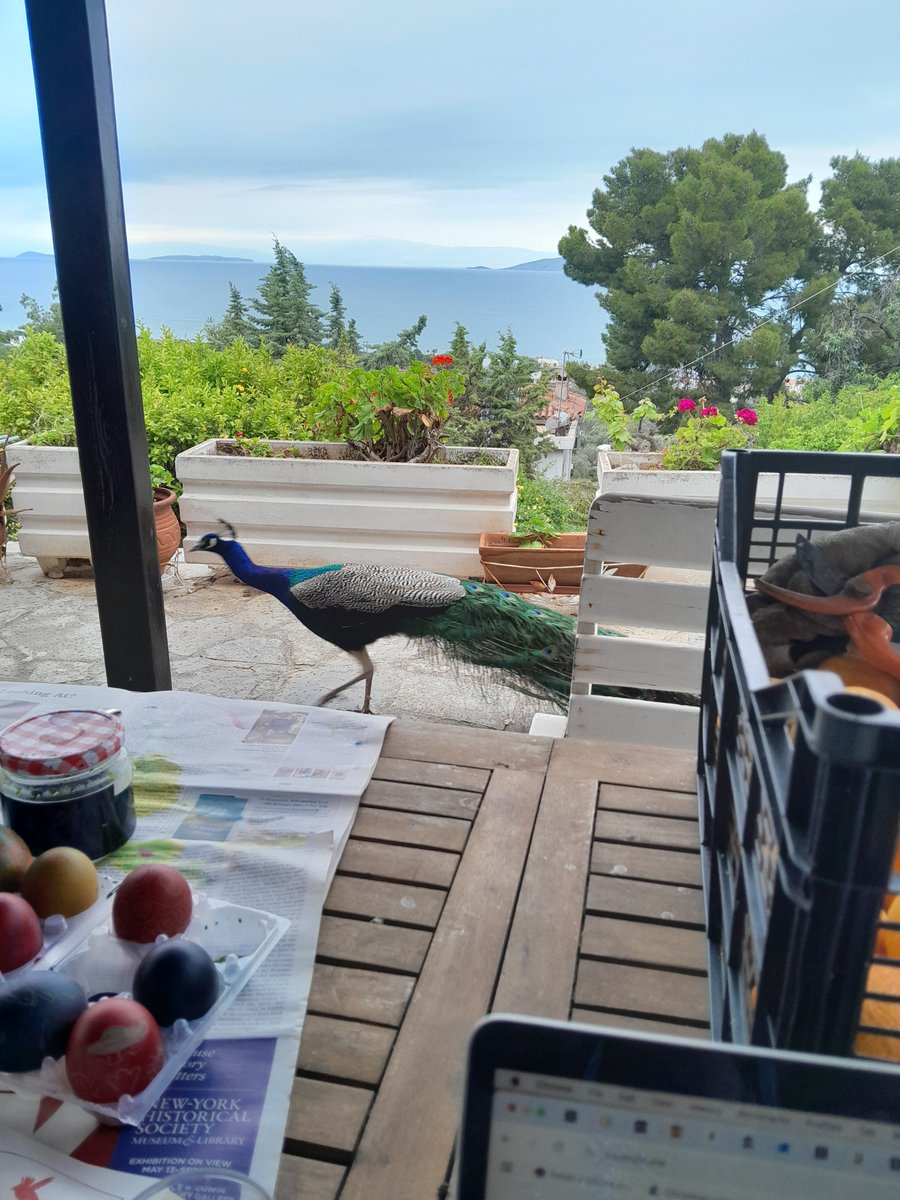
Peacock (Indigo Montoya), sneaking past drying Easter Eggs, in search of cat food...
English

You're a fan of The Beatles music, right?
Prove it by naming a song from their Sgt. Pepper's Lonely Hearts Club Band album that isn't, A Day in the Life, With a Little Help from My Friends, or Lucy in the Sky with Diamonds.

English
Describe this album with 1 word 👇🏻
English