Change is not difficult.
People who say that change is difficult are evil, as they are blaming (other) human beings for being "resistant."
That is a terrible, a despicable thing to do.
@snowded@kaimarkaru Case in point: discussion about "are we doing proper Kanban", when the discussion should be more on the lines of "given the working context, how should we constrain&monitor WIP, how do we sequence work, what things we consider when deciding on taking new work..."
Agile really needs to break the drug of platitudinous statements about how things should be, based on ideal ‘stories’. Instead start to use methods & processes that recognise reality then institute micro-nudges in the right direction
@allenholub Kanban is just one way to configure a flow system. Certain rules for wip management, work release mechanism, buffer configuration and work sequencing. There is infinite ways to configure it. Are you/am I doing kanban is the wrong q. How should I configure my system more relevant.
@anitssh@cyetain Given that the improvement of quality reduces variability, freeing up capacity (less rework, failures, replanning etc.) thus lowering utilization and reducing queuing potential the effects would not be proportional (linear).
@RossiTimo Parkinsonin laki. Annettu tila täytyy aina ja toisaalta lisää samaa lääkkeksi ruuhkiin (tai mihin tahansa sen puoleen) harvemmin toimii… Sama ilmiö vaikkapa projektiaikatauluissa.
@viktorcessan@ComplexWales Add in some management consultants to analyze ’painpoints, make suggestions for improvement and establish implementation plans’ to be implemented by the teams close to the problem (with some goveranance model applied on top of course). Spot on 👌
“People do not devise formal, abstract plans and goals and then execute them as the old cognitive model [] would have it. Rather, they use a dynamic and situated improvisation where plans are resources and are renegotiated as circumstances warrant”
- Bowker
“People do not really follow formal rules: they make up their own. They tailor rigid computer systems to their everyday working needs. Expert systems do not formally model people’s thoughts as they fail to capture tacit knowledge”
1/2
- Bowker
@madplatt@TeamTopologies Yes, sounds like a good approach. What’s your experience on applying in practice? I would imagine it might be atleast awkward (4 mgmt&staff) if conditioned on the fact that busy is good. Not to mention the arguments eg.”why are we not utilizing the team potential fully”…
@jtpihala Great question. The simple answer is that it’s complicated. Depends on the view (process vs team). But overall, I think behaving as an Enabling team (as per @TeamTopologies) is the way to organise for it. Teams need to be trained to deal with most of the normal variability
Next time you think that the solution to your Infosec problem, lies in an arbitrary list of 16 specialisms you must have to "do it right"...
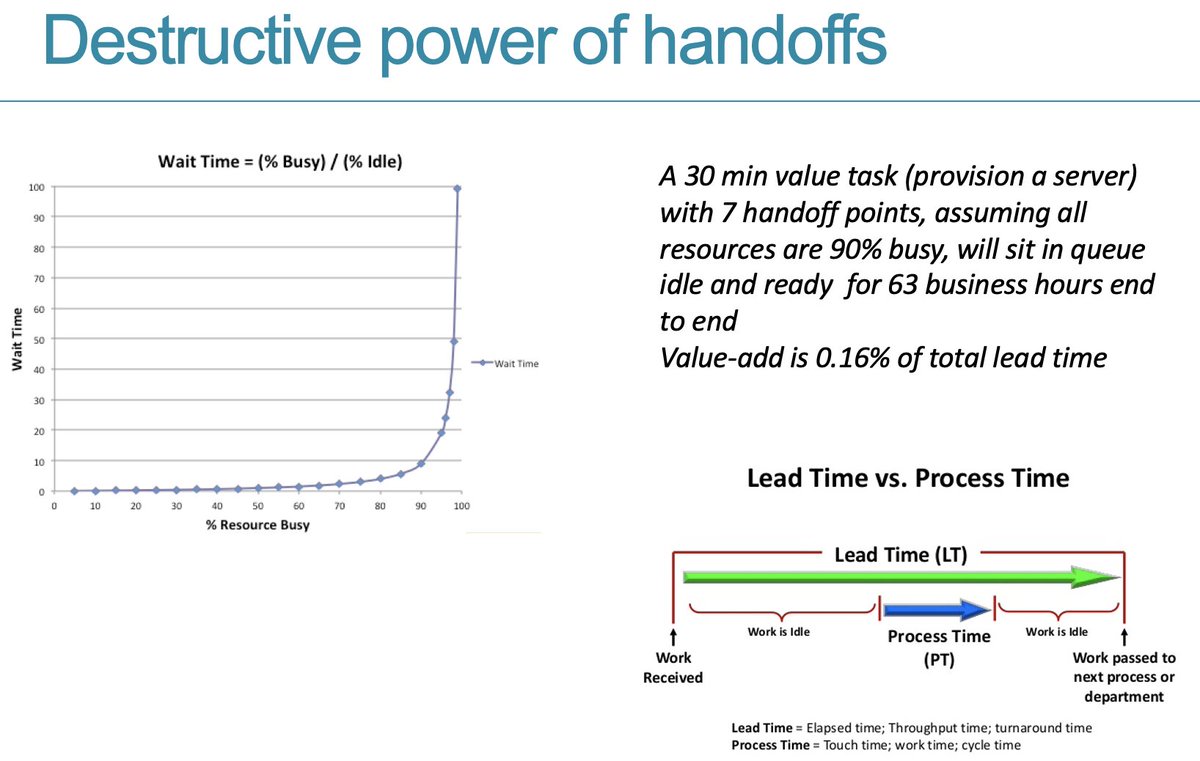
know about the destructive power of handoffs in organisations and what that implies to value creation structures in your organisation
Help help! Tilitoimisto teki todella kusiset oharit ja nyt on paniikki! Toiveissa pieni ja ketterä tilitoimisto, jolla on palveluasenne kohdallaan! Vinkatkaa pliis! Ja saa RT! ❤️🙏🙏#tilitoimisto
@allenholub The term ’root cause’ might be fine in itself. Maybe it’s just that we have to acknowledge that the ’root cause’ might also be a certain pattern (and have to describe it as such)?
The main problem with "root cause analysis" is that, more often than not, there’s more than one "root cause," and those factors interact with one another in complex ways. It’s simplistic to believe that all problems can be resolved to a single root cause.
@lasse_laitinen@Pasisillanp Jos käytäntö on paras, niin miksi sitä ei käytetä? ”Skaalautuvuus” ja kopiointi on mielenkiintoisia asioita. Välillä tuntuu että ainoa asia joka voi skaalautua/kopioitavissa on konsepti. Jokainen organisaatio onneton omalla tavallaan. Käytäntö löydettävä itse.
@Pasisillanp Erinomainen kirjoitus! Etenkin tuota julkisen puolen haluttomuutta/kyvyttömyyttää muuttaa käytäntöjään olen ihmetellyt aina. Espoon Matinkylän terveysaseman esimerkki oli hämmentävä jo aikoinaan siitä lukiessani: Miksei samaa voi kopioida muuallekin?
@pekkasauri@Pasisillanp Ehkä se isompi painoarvo onkin tuossa ”...ei edes nähdä”? Ongelma on että pitäisi olla vimpan päälle toimintamalli paperilla ennenkuin tehdään mitään? Ehkä keskustelu näiltä osin ennemmin siinä miten tilanteessamme ongelmanratkaisua pitäisi lähestyä?
@Pasisillanp Kiinnostavaa. Nostan neljästä pointistasi yhden: "Sekä julkisella puolella että yrityksissä ollaan vanhojen toimintamallien vankeina, eikä edes nähdä, mitä toisenlaisella toimintamallilla voidaan saavuttaa." Voitko avata sitä "toisenlaista toimintamallia"?
Miltä Suomen kehitys teollisuusmaana näyttää konsultin silmin?
Tässä on kahden blogin sarjan ensimmäinen: Missä on ongelma?
puheenvuoro.uusisuomi.fi/pasisillanp/su…
@erik_schon I feel like these pics describing the kanban mechanism obscure the more meaningful thing: is WIP somehow limited? If no -> we’re not working in a pull system. If yes -> kanban is just one of many many alternatives to set up a coordination system.