Kafmur.btc

7.2K posts

Kafmur.btc banner
Kafmur.btc

Kafmur.btc

@kafmur

.

Thought Katılım Şubat 2022
372 Takip Edilen759 Takipçiler
Sabitlenmiş Tweet
Kafmur.btc
Kafmur.btc@kafmur·
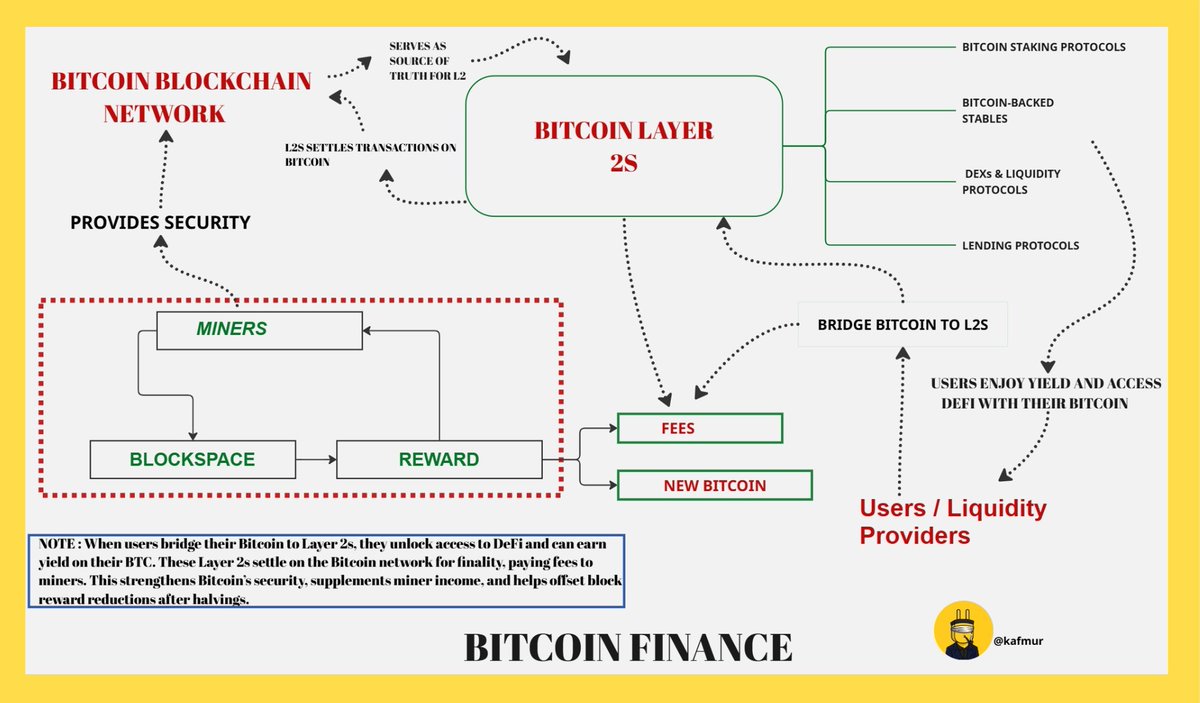
Bitcoin Finance: Explained in Visuals
Kafmur.btc tweet media
Kafmur.btc@kafmur

THE PURPOSE OF BITCOIN FINANCE Audience: Anyone seeking to understand why Bitcoin Finance exists, and anyone already involved in it. A Brief History of Bitcoin and the Reason Behind Its Creation The Bitcoin network was launched in 2009 by an anonymous developer under the alias Satoshi Nakamoto. It succeeded in building a decentralized network of participants who, through the use of Proof of Work (PoW), reach consensus on the state of transactions without relying on any central authority. Bitcoin was designed to solve several shortcomings of traditional banking, particularly the reliance on centralized intermediaries and custodians. It enables peer-to-peer transactions and gives individuals direct control over their assets, as long as they hold their private keys. The Role of Miners Bitcoin’s network is secured by independent participants known as miners. The integrity of the blockchain depends on them, and its economic incentives are designed to reward their participation. Miners verify transactions, package them into blocks, and compete to add these blocks to the blockchain by solving complex cryptographic puzzles. This process, Proof of Work, makes it prohibitively expensive to alter or reverse past transactions, ensuring immutability and security. When miners successfully add a block, they receive a block subsidy and transaction fees as rewards. The total supply of Bitcoin is capped at 21 million, ensuring scarcity and reinforcing its appeal as a digital store of value. Every four years, the block reward is cut in half, in what is known as the halving. Currently, the reward stands at 3.125 BTC per block and will fall to 1.5625 BTC after the next halving. By around 2035, approximately 99% of all Bitcoin will have been mined, leaving the remainder to be gradually distributed over the following century. Why On-Chain Activity Is Limited Bitcoin uses a non–Turing-complete scripting language known as Bitcoin Script, which supports basic logical operations and conditions such as multisignature transactions, timelocks, and hash locks. However, it intentionally excludes complex loops or arbitrary computation to keep validation predictable and secure. This deliberate simplicity ensures determinism and prevents vulnerabilities such as infinite loops or resource exhaustion. Yet, this same simplicity limits the network’s on-chain activity, since most transactions are simple transfers rather than programmable financial operations. Consequently, Bitcoin generates relatively low transaction fees, which becomes important when considering the network’s long-term economic sustainability as mining rewards diminish. The Coming Security Challenge While Bitcoin’s fixed supply underpins its long-term value, it introduces potential risks to network security. As block rewards decline, miners’ income depends increasingly on transaction fees. Rising energy costs and competition are likely to push smaller miners out of the market, potentially leading to centralization and weaker network resilience. Ideally, transaction fees would rise to sustain miners, but limited on-chain activity constrains that outcome. This economic imbalance highlights the need for new forms of Bitcoin utility, ways to increase demand for block space and maintain decentralization incentives as rewards fall. THE FOCUS OF BITCOIN FINANCE The focus of Bitcoin finance is to extend utility to Bitcoin and tap into its vast liquidity. Since the launch of Ethereum, that network has dominated the on-chain economy, hosting most decentralized financial activity. As of 2025, Ethereum holds over $78 billion in total value locked, representing more than 60 percent of the global DeFi ecosystem. Its programmability enables a wide range of decentralized applications such as lending, stablecoins, exchanges, and derivatives. Bitcoin, by contrast, has remained a settlement layer for value transfer, but that is beginning to change. Bitcoin finance aims to make Bitcoin as Ethereum-like as possible, except for its consensus mechanism, the simplicity of its chain, and its fixed total supply. It seeks to make Bitcoin useful in DeFi in the same way Ethereum is, without compromising its foundational design. The Evolution of Bitcoin Utility in DeFi >> Wrapped and Tokenized Bitcoin The first stage involved representing Bitcoin on programmable blockchains through tokenization. This allowed Bitcoin’s value to participate in decentralized systems for lending, trading, and collateralization. Bitcoin Layer 2 Networks Secondary layers expanded Bitcoin’s capabilities with faster transactions, improved scalability, and limited smart contract functionality while maintaining linkage to Bitcoin’s security. >> Cross-Chain Bridges and Interoperability Protocols These enabled the decentralized transfer of Bitcoin’s liquidity across multiple blockchains, improving flexibility and reducing reliance on centralized custodians. >> Bitcoin DeFi Protocols With stronger infrastructure, native financial protocols emerged, supporting lending, exchanges, and yield strategies anchored to Bitcoin’s security model. >> Synthetic and Derivative Bitcoin Assets These assets replicate Bitcoin’s price exposure through collateralized or algorithmic models, further integrating Bitcoin into broader decentralized markets. Problems Facing the Adoption of Bitcoin Finance Skepticism toward Bitcoin finance remains strong within the Bitcoin community. Many developers and advocates fear that complex financial layers could introduce vulnerabilities, rent-seeking behaviors, or value extraction mechanisms that contradict Bitcoin’s ethos of sound, decentralized money. This ideological resistance emphasizes maintaining Bitcoin’s simplicity and security, allowing experimentation to occur off-chain or on secondary layers such as the Lightning Network. While this conservatism safeguards the network’s integrity, it also slows innovation and limits Bitcoin’s participation in decentralized finance. The Importance of Bitcoin Finance Bitcoin finance is not merely an effort to replicate Ethereum’s DeFi ecosystem. It is an essential evolution for Bitcoin’s longevity and economic sustainability. First, it strengthens network security by increasing transaction demand and fee revenue as block rewards decline. Second, it enhances liquidity and capital efficiency, enabling idle Bitcoin holdings to support decentralized markets. Third, it expands global adoption, offering financial access and yield opportunities without intermediaries. Most importantly, Bitcoin finance preserves Bitcoin’s ethos while extending its utility. It allows innovation to occur around Bitcoin rather than within its base layer, maintaining decentralization while unlocking new financial possibilities. Practical Solutions to Encourage Bitcoin Finance Adoption Developers are now expanding Bitcoin’s financial utility through layered and trust-minimized architectures that preserve its security model. Layer 2 and sidechain networks anchor to Bitcoin but operate independently, supporting smart contracts and scalable transaction throughput. Decentralized custody and multi-signature bridges replace centralized intermediaries, distributing control across participants and aligning with Bitcoin’s trustless ethos. To preserve efficiency, off-chain frameworks such as Taproot Assets and RGB move complex financial logic away from the base chain, settling results on Bitcoin for finality. Privacy-centric designs like Fedimint improve accessibility while maintaining security through community-based custody. Collectively, these innovations allow Bitcoin finance to mature responsibly, growing around Bitcoin’s principles rather than altering them. Current Use Cases of Bitcoin in DeFi Bitcoin’s integration into decentralized finance has evolved significantly. Today, it plays a growing role in: >> Lending and Borrowing: Bitcoin can be used as collateral to access decentralized loans or to earn yield by providing liquidity. >> Liquidity Provision: Users can contribute Bitcoin or Bitcoin-backed assets to liquidity pools, facilitating decentralized trading. >> Derivatives and Synthetic Assets: Platforms now enable Bitcoin exposure through futures, options, or algorithmic tokens that track its price. >> Cross-Chain Settlements: Bitcoin serves as a neutral settlement asset across multiple blockchains, supporting multi-chain applications. >> Payment Channels: Layer 2 networks such as the Lightning Network enable fast, low-cost payments and micropayments directly in Bitcoin. >> Yield and Staking Models: Bitcoin holders can participate in decentralized protocols that offer yield opportunities while retaining exposure to BTC’s value. These use cases reflect the steady expansion of Bitcoin’s role from passive store of value to active economic participant within decentralized markets. Conclusion Bitcoin finance represents a turning point in the digital economy. While Bitcoin began as a simple yet revolutionary form of sound money, the maturation of blockchain finance demands broader functionality and interoperability. Through tokenization, Layer 2 architectures, and new programmability layers, Bitcoin is evolving into an active component of decentralized finance, a foundation for trust-minimized, global liquidity. Ideological caution will continue to guide development, but innovation around Bitcoin proves that utility and purity need not be at odds. As Bitcoin finance grows, it ensures that Bitcoin remains not only the most secure monetary network but also a vital part of the future decentralized financial infrastructure.

English
6
0
16
1.2K
caiman
caiman@0_caiman·
@Ifeanyichukvu This, my mother helicoptered over me my whole childhood. So many things I didnt get to experience because she thought it would be dangerous or too risky. Now I'm socially stunted and inexperienced in so many things that my peers are lightyears ahead of me. And-
English
11
10
229
14.3K
Ifeanyichukwu Samuel😎
Ifeanyichukwu Samuel😎@Ifeanyichukvu·
Paid off? Wait till you freeze up when your peers are talking. •Networking in your late 20s feels like climbing a mountain. • Social anxiety steals jobs, relationships, and confidence. •The ‘obedient child’ becomes the insecure adult. It didn’t and it will never
Dafenet@patdafenet

lowkey, strict parenting paid off.

English
223
3.2K
14.8K
548.9K
Botanix 🕷️
Botanix 🕷️@botanix·
Bitcoin doesn’t compete with banks. Banks will compete on Bitcoin.
English
7
1
29
1.4K
Botanix 🕷️
Botanix 🕷️@botanix·
Happy New Year from the Botanix team!
English
12
2
48
1.9K
Kafmur.btc
Kafmur.btc@kafmur·
Botanix: A Bitcoin-Native DeFi Chain Comes Alive ( July–December 2025 Year-End Recap ) The second half of 2025 marked a defining chapter for Botanix. From launch through year end, the network demonstrated that Bitcoin-native DeFi can scale, generate real revenue, and deploy capital productively, without compromising on uptime or security. What follows is a data-driven recap of Botanix’s growth between July and December 2025, highlighting network adoption, TVL expansion, Bitcoin staking impact, and the performance of core ecosystem protocols. ➥ Network Revenue: Fees Since launch, Botanix has generated approximately $230,000 in revenue, all of it derived directly from transaction fees. There are two important takeaways here for Bitcoin-native users: ➤ No artificial incentives or emissions; revenue is driven by real network usage ➤ 50% of total revenue is distributed to Bitcoin stakers, aligning network growth with BTC holders rather than speculative capital Basically as a bitcoin staker on botanix, you only pay 50% of txn fees whenever you interact with the chain. This fee-driven model reinforces Botanix’s positioning as a sustainable Bitcoin execution layer, where activity, not token inflation, powers the economy. ➥ TVL Growth & Capital Efficiency By year end, Botanix reached a significant milestone: ➤ TVL peaked at $28.2M ➤ Current TVL stands at $18.52M ➤ Botanix now ranks among the top 10 Bitcoin sidechains by TVL More importantly than raw TVL was how that capital was used. Following the deployment of Bitcoin staking, Botanix saw a major improvement in capital efficiency: ➤ Productive TVL increased to 47% This shift signals a transition from passive liquidity to actively deployed BTC, generating yield and supporting DeFi primitives rather than sitting idle. Bitcoin Staking: Activating Idle BTC Bitcoin staking became one of the most impactful upgrades of the year. Staked BTC TVL reached $8.7M For Bitcoin holders, this represents a meaningful unlock: BTC retained its monetary identity while becoming productive on a secure execution layer. The rise in productive TVL post-staking confirms that demand exists for Bitcoin-denominated yield without sacrificing custody or ethos. ➥ Chain Usage & Adoption Beyond capital metrics, Botanix showed strong signs of real user adoption: ➤ 20.4M total transactions ➤ 3.5M blocks produced ➤ 100% network uptime ➤ 175,000 total unique wallets ➤ 7,000 daily active users ➤ 14 live dapps These numbers paint a clear picture: Botanix is not a dormant chain propped up by TVL alone. It is an actively used Bitcoin-native network, processing millions of transactions reliably while onboarding a growing user base. ➥ Ecosystem Performance ➤ Dolomite: Bitcoin-Native Lending & Borrowing Dolomite emerged as a foundational DeFi primitive on Botanix: $6.7M in deposits $400k in borrows 5.97% utilization rate This reflects early but healthy lending activity, with room for expansion as more BTC-backed assets and strategies come online. Importantly, it establishes BTC as usable collateral within a capital-efficient framework. ➤ GMX: Bringing Perpetuals to Bitcoin DeFi GMX’s deployment on Botanix marked a major step toward Bitcoin-native derivatives: $5.14M in TVL $4.8M in trading volume The presence of a battle-tested perp DEX reinforces Botanix’s ambition to support serious financial activity, not just spot trading or yield farming. ➤ Bitzy: The Leading DEX on Botanix On the spot side, Bitzy established itself as the dominant DEX: $2.93M in TVL Average transaction fees of $0.01 Ranked as the largest DEX on Botanix Low fees combined with growing liquidity highlight the chain’s suitability for everyday Bitcoin-native trading activity. Other dApps and Infrastructures on Botanix include: Blendmoney, Morpho, Palladium, OmniHub, Chainlink, Alchemy and others... Why This Matters for Bitcoiners and everyone? Botanix’s progress in 2025 challenges a long-standing assumption: that Bitcoin cannot support expressive, capital-efficient DeFi without compromising its principles. The journey is just getting started, doing bigger numbers in 2026. Happy New Year!
Kafmur.btc tweet media
English
2
0
4
956
Kafmur.btc retweetledi
Botanix 🕷️
Botanix 🕷️@botanix·
1/ Bitcoin Finance broke into the mainstream in 2025. The ability to earn, borrow, and spend Bitcoin without leaving the asset or surrendering custody resonated with users globally. Let's dive into the details 👇
English
9
4
37
1.8K
Kafmur.btc retweetledi
Botanix 🕷️
Botanix 🕷️@botanix·
1/ A peg-in lifts Bitcoin from L1 into Botanix by locking BTC inside a Spiderchain multisig and minting an equal amount of synthetic BTC on the EVM. Total synthetic BTC = total BTC locked.

Botanix 🕷️ tweet media
English
2
4
31
2.9K
Kafmur.btc
Kafmur.btc@kafmur·
One of the living legends to actually study!
Kafmur.btc tweet media
English
0
0
2
27
Axion
Axion@axion_io·
Watch How Fast AXION AI Reacts! When markets move, Axion moves quicker — scanning trends, spotting opportunities, and helping you trade smarter every second. 🚀 Level up your trading with AXC AI. #AxionCoin #AXCAI #SmartTrading #CryptoAI #DeFiRevolution
English
269
80
94
15.8K
Kafmur.btc
Kafmur.btc@kafmur·
@axion_io Farming yield on Axion is the best to do right now.
English
0
0
0
9
Botanix 🕷️
Botanix 🕷️@botanix·
Normies: Bitcoin can’t do DeFi Botanix: records 16M+ transactions in 6 months Normies:

Botanix 🕷️ tweet media
English
10
5
47
1.6K