Kage

45 posts

Kage banner
Kage

Kage

@kage_fun00

The Fastest Copy Trading Bot on PolyMarket. 80% in the same block as traders. Support: https://t.co/mDIt3WcmGC Insider SM: https://t.co/bxI8OGFbCl

Katılım Mayıs 2026
54 Takip Edilen49 Takipçiler
Sabitlenmiş Tweet
Kage
Kage@kage_fun00·
Every copy-trading tool on @Polymarket claims to be fast. Almost none of them are. Real users got rekt — chasing trades that filled too late, buying tops while the target wallet bought the bottom. kage came late to this market. We know.But we didn't come to play the same game. We came to redefine what copy trading actually means. 20 trades. Head-to-head. 95% same-block. The data speaks for itself.There's kage. And then there's the rest 🥷 Test us yourself.
Kage tweet media
English
9
4
13
1K
Kage
Kage@kage_fun00·
Polymarket copy trading is difficult? Actually, it’s not. We used some methods to scrape many addresses that engage in copy trading and analyzed them to identify their target addresses. Because we are the fastest, as long as we replicate others’ copy trades, we can make money—this is almost certain.
Kage tweet media
English
0
0
4
80
Kage
Kage@kage_fun00·
In internal testing—please stay tuned. Kage uses a global full-capture algorithm combined with a user-to-target address matching model to identify all wallets with proven profits on other copy-trading platforms — then runs deep AI analysis to deliver high-quality target addresses. Speed defines copy-trading success — Kage is the fastest on the market. Follow with confidence.
Kage tweet media
English
0
0
4
98
Kage
Kage@kage_fun00·
Today's FIFA World Cup 2026 slate is LOADED 🌑 Live Polymarket odds (price = implied %): 🇫🇷 France vs Iraq 🇮🇶 Poly: France 90¢ · Draw 8¢ · Iraq 3¢ Odds: 1.10 / 13.33 / 36.36 🇳🇴 Norway vs Senegal 🇸🇳 Poly: Norway 42¢ · Draw 28¢ · Senegal 30¢ Odds: 2.35 / 3.64 / 3.39 🇯🇴 Jordan vs Algeria 🇩🇿 Poly: Jordan 16¢ · Draw 22¢ · Algeria 64¢ Odds: 6.45 / 4.44 / 1.57 The sharpest WC bettors are already positioned. Shadow their trades LIVE 👇 t.co/7s5OtrNS8i
Kage tweet media
English
0
0
1
283
Kage
Kage@kage_fun00·
On Polymarket, only 20% of addresses are making money. And of that 20%, only 10% are actually suitable for copy trading. Stop trusting the so-called "smart money" addresses other platforms feed you — and definitely stop trusting their so-called backtests. If money were really that easy to make, nobody would hand it to you so freely. That's why I created a community. I've scanned on-chain addresses through certain methods and used algorithms to identify suspected copy-trading addresses. I've decided to share this data with users of our platform — just join the community to get it. Think about it: you know who's out there copy trading, you know what the target addresses are, and you're using Kage, the fastest copy-trading product around — that gives you an almost limitless edge. Of course, you'll still need to work on your own settings and conditions. I can't guarantee you'll make money — I'm just giving you data that could give you an edge. t.me/PolyinsiderKage
English
0
0
2
146
Kage
Kage@kage_fun00·
How to copy trade crypto wallets on Polymarket 1/Finding a profitable crypto wallet on Polymarket takes 5 minutes. Losing money copying it takes 5 minutes too. The difference isn't the wallet. It's the one thing almost nobody configures correctly 👇 2/First, know what you're playing. Crypto on Polymarket = a stack of ultra-short markets: 5-min, 15-min, 1-hour "BTC Up or Down." A 5-min market goes from open to settled in 300 seconds. Ultra-short windows + high-vol BTC/ETH + thin order books. Everything below follows from those three. 3/What follows is one word: speed. After the wallet enters, your window to follow is seconds. Spot ticks → odds jump from 0.5 to 0.7 instantly. You're not the only one watching that wallet — the more followers, the more crowded the price. Whether you get the same price it got comes down to one thing: how far behind it you are. 4/The wallets you'd copy are basically two types — completely different logic. Type 1: High-frequency arbitrage. Doesn't bet direction, just harvests spreads. In and out of one market repeatedly, often quoting both Yes and No. Razor-thin profit per trade, stacked through frequency. It's earning on speed. Lag a beat, and the spread it created is already gone. 5/Type 2: Event-driven. Bets on information edge. The second data drops, a wallet moves on-chain, or news lands, it enters before the odds reprice — then leaves once it plays out. Bigger size per trade. It enters at 0.40. By the time your signal arrives, price is 0.75. Blindly following = buying the tail of its profit. (Market-makers quoting both sides for spread? You can't replicate that P&L structure. Don't copy them.) 6/Once you get the types and the speed, here's what actually decides the outcome: parameters. For any crypto copy trade, these four are non-negotiable: ▫️ Slippage ≤ 2% ▫️ Max buy price ▫️ Min buy price ▫️ Max allocation per market One by one 👇 7/Slippage ≤ 2% — the lifeline. Thin books, high vol. Loosen slippage and you go from "same price as the wallet" to "lifting it on its exit." Cap it at 2%: fill at parity or skip. Miss a trade before you chase one. 8/Max buy price — the most important one. This is what kills "followed too late." Set an odds ceiling per market. Once price blows past that line, the info has spread and the profit's already eaten — skip the trade. Passing on one trade always beats buying in at 0.85. 9/The other two guard your floor and your exposure: Min buy price: filter out near-zero positions that have bled to 0.02–0.05 — don't copy a wallet's hedges or test orders. Max per market: crypto markets settle 1 or 0, no stop-loss cushion. Cap each one so a single wrong call can't blow up the account. 10/Then tune by type: Copying HF arb: tightest slippage (1–1.5%), smallest size, pure small-size high-frequency. This is the most speed-sensitive type — can't keep up? Don't touch it. Copying event-driven: max buy price is everything — use it to block every late fill. Size can run a bit heavier, but never chase after the news has spread. 11/So, back to tweet 1: On Polymarket crypto, finding a profitable wallet is just the entry ticket. What actually decides your P&L is execution speed + a parameter set that locks down speed risk. The wallet is someone else's. The speed and the parameters are yours. 12/This is exactly why we built Kage: ⚡ The fastest fill execution on Polymarket ⚙️ Every parameter finely configurable on web — slippage, max/min buy price, per-market caps Turn someone else's strategy into execution that fits your account.
English
0
1
4
249
Kage
Kage@kage_fun00·
@SirCallens Hey brother, we've been following your work in spreading Polymarket content, and we really admire your talent — we'd love to set up a promotional collaboration…
English
0
0
0
5
Kevin
Kevin@SirCallens·
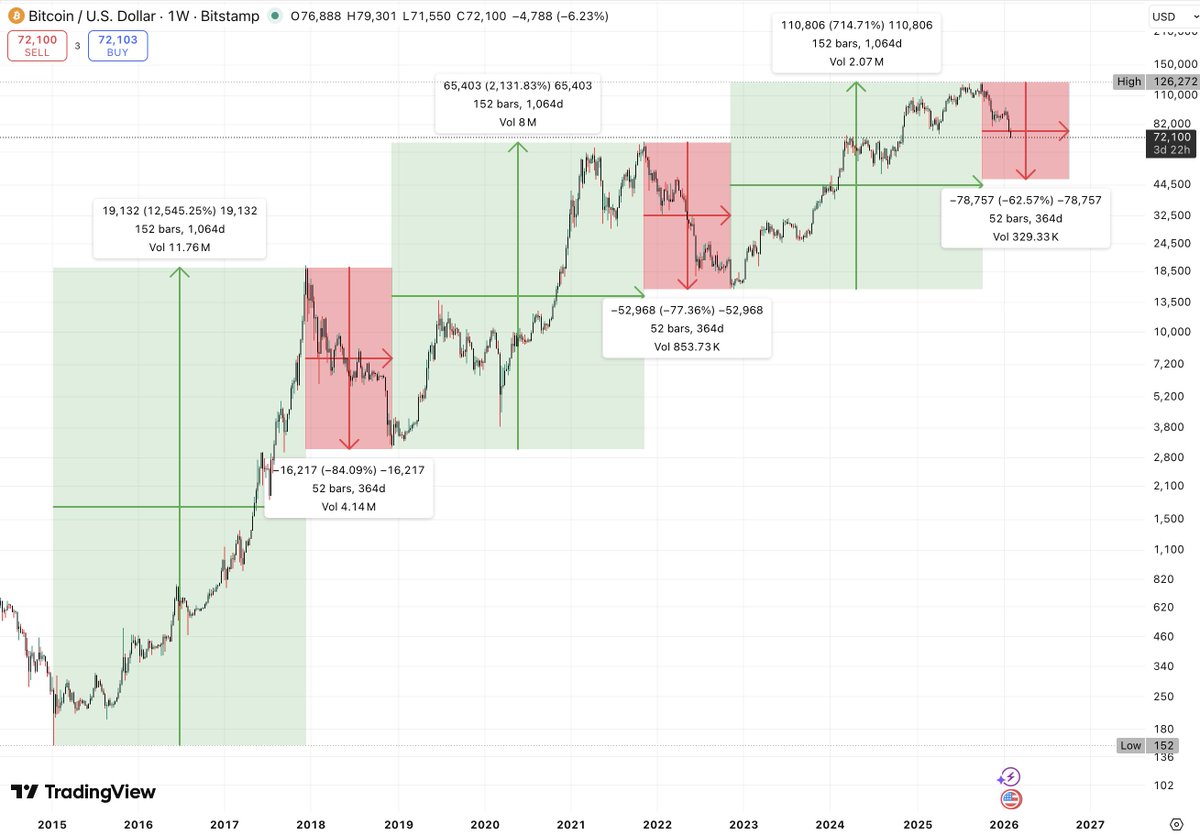
Four year cycle continues
Kevin tweet media
English
5
2
18
700
Kage
Kage@kage_fun00·
Every copy-trading tool on @Polymarket claims to be fast. Almost none of them are. Real users got rekt — chasing trades that filled too late, buying tops while the target wallet bought the bottom. kage came late to this market. We know.But we didn't come to play the same game. We came to redefine what copy trading actually means. 20 trades. Head-to-head. 95% same-block. The data speaks for itself.There's kage. And then there's the rest 🥷 Test us yourself.
Kage tweet media
English
9
4
13
1K
Kage
Kage@kage_fun00·
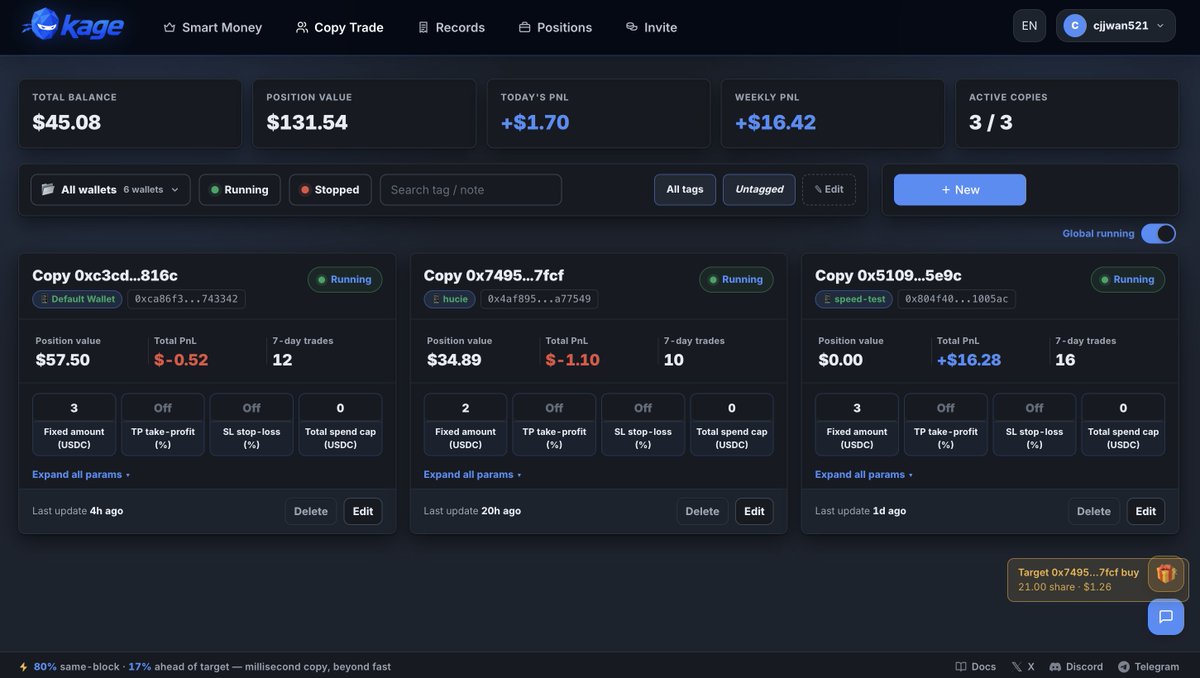
Copy trading through a TG bot? That's not how copy trading is supposed to work. You can't analyze each of your trades inside a bot — and worse, you can't even compare yourself against the target wallet you're mirroring. Everyone who's been copy trading long enough asks the same question: why is the target wallet making money while I'm not? How did I end up losing without even knowing why?? The web app is the right way to do this. Every trade laid out clearly. The P&L of each task, crystal clear. You just configure your strategy fast — and from there, you're either in profit, or you figure out exactly why you're not. When it comes to that, nothing beats the web app.
Kage tweet mediaKage tweet mediaKage tweet media
English
0
0
3
159
Kage
Kage@kage_fun00·
Making money isn't about the amount — a small win is a blessing, a big win is skill. Made 11 bucks today, guess that's enough for a coffee. ☕
Kage tweet media
English
0
0
3
91
Kage
Kage@kage_fun00·
More and more people are paying attention to Kage, and we're grateful for the fair, objective reviews. @natesonchain What I want to say is this: Kage is the only one that has truly put in the work on speed. Before Kage, there was barely a product on @Polymarket that could copy-trade into the highly competitive markets. That's something we're proud of.👍👍👍👍👍 youtu.be/goIbnbyqYqo?si…
YouTube video
YouTube
English
0
0
3
165
Kage
Kage@kage_fun00·
How to Follow "Football Smart Money" on @Polymarket @PolymarketSport the Wor ld Cup When the World Cup rolls around, everyone's talking about who'll lift the trophy and which match will throw up an upset. Talk is one thing — but when it comes to actually betting on Polymarket, most beginners just go with their gut and back their favorite team. The result is usually the same: your team loses, and so do you. The truth is, on prediction markets like Polymarket, there's a group of people who make money off football markets consistently, over the long run. They don't run on sentiment — they run on information, discipline, and a feel for the odds. This post is about how to find these "football smart money" addresses, and how to follow them. 1. Why follow a wallet, not a tipster With traditional sports betting, all you get is some influencer saying who they're backing. Whether they actually placed the bet, how much, when they exited — you have no idea. A tipster hyping up Brazil while sitting in cash himself? Happens all the time. Polymarket is different. It's an on-chain market, and every single bet is public and traceable. Which match a wallet bet on, which side, how much, the price they entered at, whether they bailed early — it's all written on-chain, and nobody can fake it. That means you don't have to listen to anyone talk about how good they are. You just look at what their wallet actually did. This is the biggest edge prediction markets have over traditional betting: real money on the line replaces empty promises. 2. Which football wallets are worth following? Not every wallet playing football markets on Polymarket is worth copying. You need to filter out two types: Type one: the gamblers. They go all-in on a single match — win once and look like a god, lose once and go to zero. These wallets can show terrifying returns over a short window, but it's luck. Follow them and you'll blow up together sooner or later. Type two: the bots / arbitrageurs. They profit off tiny price gaps between platforms. Their logic has nothing to do with yours, so copying them gets you none of that edge. The wallets actually worth following are long-running, stable, and copyable. A few things to judge by: Track record length: they've been through multiple tournaments and seasons, not some account that popped up two weeks ago; Consistent profit: they grind it out steadily rather than getting rich off one or two lucky bets; Disciplined sizing: each position is a reasonable share of their bankroll — they never shove it all in at once; Football focus: they have a clear win rate edge in football markets specifically, not someone betting on everything. Stack these four together and you can pull the real "football smart money" out of thousands of wallets. 3. The biggest problem with copying by hand: speed Say you actually found a great wallet. That's when the real trouble starts. You have to watch its on-chain moves, and the moment it places a bet, rush to Polymarket and place the same one yourself. The problem is — by the time you see it and click through manually, the price has already moved. World Cup matches change in an instant. One red card, one goal, and the odds swing wildly within seconds. The smart money enters at the best price; if you're even a few dozen seconds behind, you're catching the trade at a far worse price — or the chance is already gone. Copying by hand is basically using human reaction speed to chase machine speed on-chain. You're almost guaranteed to lose out. 4. Kage: millisecond copy, same-block fills with the smart money This is exactly the problem Kage is built to solve. You pick the football wallets you want to follow on Kage, and the system handles the rest. The moment that wallet places a bet on-chain, Kage copies it for you within milliseconds — 80% of copies on a target wallet land in the same block (filled in the same block, at virtually the same price), and 17% of the time it even fills ahead of the target wallet. In plain terms: whatever price the smart money gets, you get basically the same price. No staying up to watch the charts, no frantic copy-pasting. Set it once, and through the whole World Cup it follows every bet for you, automatically. Final thoughts The World Cup is a celebration — but betting shouldn't be a game of pure luck. Instead of staking your heart on your favorite team, follow the football smart money that the market has already proven, again and again, over the long run. Finding the right wallet is step one. Following them fast enough is what actually turns someone else's edge into your own returns.
English
0
0
3
338
HMS
HMS@SamperHugo·
@kage_fun00 @Polymarket Creo que estoy haciendo algo mal o mi configuración no está bien porque desde hoy que activé Kage, no tengo nada de PNL. Ni ganancias ni pérdidas. Acepto sugerencias. Gracias
Español
1
0
0
76
Kage
Kage@kage_fun00·
6 Types of @Polymarket Wallets You Should Never Copy-Trade The biggest mistake in copy-trading isn't "failing to find a pro" — it's following the wrong wallet while thinking you got it right. On the leaderboard, the higher the profit, the more dangerous the wallet often is — because high profit can come from luck, from an edge you simply can't replicate, or even from a profit model where following it guarantees you lose. Today I'm not covering who to follow — only which wallets you must never touch, and why. Read this, and you'll save yourself a lot of tuition. 1. Market-Maker / Arbitrage Wallets: The way they earn structurally forbids you from following This is the pit beginners fall into most easily, and the most hidden one. Open the leaderboard and you'll see wallets with steady profit, tiny drawdowns, almost never losing — they look like gods. But pull up their trade history and you'll find: they hold YES and NO simultaneously in the same market, or shuffle between several correlated markets, with razor-thin profit per trade, relying on massive trade count + spread. These are market makers and arbitrageurs. Polymarket data shows that from April 2024 to April 2025 alone, arbitrage traders earned over $40 million — but only a tiny fraction made real money. Their profit comes from spread and maker rebates, not directional calls. Why you can't follow: He buys YES while also buying NO; you follow only one side, which means you shoulder all the risk he hedged away; He makes thin 0.5% margins across thousands of trades — the slippage on your single copy trade can eat dozens of his trades' profit; This strategy demands extreme speed and infrastructure — low-latency servers, API rate-limit management, Fill-or-Kill orders — retail simply can't play it by hand. How to spot it: Check if he holds both sides in the same market, with tiny per-trade profit and absurdly high trade frequency. If yes, no matter how steady, don't touch it. 2. "French Whale" Wallets: They profit on an information edge — you can copy the action but not the information In the 2024 US election, a trader known as the "French Whale" (Théo) earned roughly $85 million betting on a Trump win. Countless people wanted to follow him. But the truth: he used multiple wallets to spread his orders, and paid out of pocket for private polling to build an information edge with data others couldn't get. Why you can't follow:What you see is what he "bought," but his real edge is what he "knew." By the time you see his heavy position on-chain, his information is already priced in, and the price you enter at is no longer his cost basis. You take on the same risk as him, without getting his information edge. With this kind of wallet, you're not following an action — you're following a cognition, and cognition can't be copied. How to spot it: Profit highly concentrated in one major event (election, ruling, sudden geopolitical event), with extremely early entry and an extremely heavy position. These "legendary trades" usually can't be replicated. 3. Lucky-Gambler / One-Hit-Wonder Wallets: Sample size too small — it's statistical noise A wallet on the leaderboard shows "$1M profit," and you instinctively assume he's a pro. But you have to ask: how many trades did he make? $1M over 10 trades versus steady profit over 800 trades have completely different credibility. The widely accepted statistical threshold in the field is at least 50 settled positions to be meaningful — below that, the profit is most likely luck, not skill. Why you can't follow:A gambler being right once and having replicable skill are two different things. Following a "one-hit-wonder" wallet is essentially betting his luck will continue — and luck never continues. How to spot it: Pull up his P&L distribution. If 80%-90% of total profit comes from one or two super-bets, with everything else small wins and losses, that's a lucky gambler. Look for wallets with evenly distributed profit. 4. High-Drawdown / All-In Wallets: He can stomach a drawdown you can't Some wallets are profitable long-term, but the process is brutal — drawdowns of 50%, 60% at the drop of a hat, clawing back through repeated heavy gambles. Why you can't follow:The problem isn't the math, it's human nature. He can stomach a 60% drawdown because that money might be 5% of his spare cash; what you're following might be your entire capital. When an account is down 60% unrealized, 99% of people cut their losses at the very bottom — you simply won't last until the moment he claws it back. The result: he profits in the end, you bail out mid-way and eat the loss. How to spot it: Look at historical max drawdown and position volatility. The bigger the drawdown and the more extreme the sizing, the more it demands a psychological tolerance and capital base that don't match yours. 5. Single-Lane Specialist Wallets: Follow across lanes, and you've followed an amateur A wallet that's a legend in NBA markets — his NBA edge is real; but if you follow him into political or crypto markets, you'll probably lose. Many pros' edges are structural and confined to a specific domain — a sports modeling team only understands sports, a political source only works on political markets. The moment he leaves his lane, he's just an ordinary player like you. Why you can't follow:You think you're following "this pro," but you should only follow "this pro's trades within his strong lane." Blindly following all his positions is like having a basketball expert pick your stocks. How to spot it: Look at which category his profit concentrates in. Screen wallets by lane, not by total profit — this is the dividing line between advanced players and the slaughtered retail crowd. 6. Speed-Game Wallets: The window is only seconds — by hand, you're always a step behind In Polymarket's short-cycle markets like BTC 5-minute and 15-minute, there's a type of wallet that profits by monitoring Binance spot prices and sniping in seconds before settlement, or by earning millisecond-level market-making rebates. The window for these opportunities is often only a few seconds. The consensus in the field: for small retail, this game is basically "dead" — you need low-latency servers, you need to subscribe to oracle-delay alerts, and by hand you don't even qualify to enter. Why you can't follow:By the time you see his fill on-chain, manually switch to the order page, enter the amount, and click confirm, the price has already reverted. The price you get is always worse, and over time that spread is enough to eat your entire theoretical edge. Summary: Ask yourself three questions before copy-trading How does he make his money? Directional calls (possibly followable), or market-making/arbitrage/speed games (not followable)? Can I replicate his edge? Information edge, capital base, psychological tolerance, execution speed — miss any one, and the copy trade gets distorted. Is the sample size enough to support "skill, not luck"? 50 settled positions is the floor.
English
2
1
10
613
Kage retweetledi
Kage
Kage@kage_fun00·
Kage Copy-Trading Playbook: On Polymarket, Why "Speed" Is Profit Itself Written for anyone who wants to avoid the costly detours in prediction markets—whether you've never touched Polymarket or have already lost a few rounds. This article breaks down the underlying logic of copy trading, and tells you why "speed" is the most underrated yet most life-or-death variable in this game. 1. Let's Get One Brutal Premise Straight First Copy trading is not "duplicate someone's wallet and rake it in while you sleep." Most people's misunderstanding of copy trading is treating it as a shortcut: "find a god, then mindlessly copy." But the essence of a prediction market is a crowd of people pricing the same future event in real time, with prices constantly reflecting the latest consensus. When you see a smart-money wallet load up heavily on YES in some market, what you're seeing is often a trade from minutes—or even hours—ago, and that price may already have changed. This leads us to the core proposition of this article, and of Kage as a product: In a prediction market, the time gap between you and smart money translates directly into your losses. So this article isn't just teaching you to "copy the answers." It's meant to help you understand: Why copy trading can work under Polymarket's mechanics, and under what conditions it inevitably fails; Why "latency" is the biggest invisible killer for copy traders; How to screen for wallets actually worth following, and turn copy trading from gambling into a system with positive expected value. 2. Why Copy Trading on Polymarket Is Completely Different from Crypto Copy Trading Many people treat Polymarket copy trading as the same thing as perpetual-futures copy trading. That's the first big pitfall. The two mechanisms differ enormously: 1. The underlying asset is "probability," not "price trend" Each Polymarket market's share price fluctuates between $0 and $1, essentially the market's pricing of an event's probability of occurring. A 0.30 YES share means the market believes the event has a 30% chance of happening; bet correctly, and it settles at $1 at expiry. This means: No leverage liquidation, but there is "going to zero"—settle wrong, and the share value drops straight to 0; P&L is non-linear. Buying the same YES at 0.10 versus 0.60 gives wildly different risk-reward structures; Differences in entry price get amplified. Smart money enters at 0.15, you follow at 0.45—he might win big while you actually lose. Note that last point—it's the very root of the speed problem. One step behind, and often you don't just earn less; you get pushed out of the profit zone and into the loss zone. 2. Information-driven, not emotion-driven A lot of crypto-perp action is driven by liquidity and emotion. But the wallets that profit consistently on Polymarket usually earn from information asymmetry or a deep understanding of the settlement rules: reading a court filing earlier, better grasping the vote-counting pace in a particular state, or spotting the market's misreading of an ambiguous clause. This is crucial for copy traders: what you're following isn't an "action," but a "cognition + timing." You can slowly build up the cognition, but once the timing is missed, it never comes back. 3. Settlement is a discrete event, and the order book thins over time The value of many Polymarket markets is only realized at the moment the event settles. The closer to settlement, the thinner the order book—you can't get in when you want to follow, and can't get out when you want to run. The more critical the moment, the scarcer speed becomes. 3. The Real Sources of Copy-Trading Profit: Broken Down for You Setting aside the mysticism, copy-trading profit can only come from a few sources. Figuring out which one you're earning from matters far more than just following blindly. Source 1: Replicating an information edge (most valuable, hardest to replicate)Some wallets profit long-term because they hold a structural information edge in a specific domain—a sports modeling team, a political source, on-chain data analysis ability. The key to following these wallets is to follow accurately and follow narrowly: a wallet that only profits in NBA markets will probably lose you money on political markets. Screening wallets by "lane" rather than by "total returns" is the dividing line between advanced players and the slaughtered retail crowd. Source 2: Capturing mispricings (pure speed play)Prediction markets occasionally produce obvious mispricings—breaking news already confirmed, but the order book hasn't reacted yet. Smart money sweeps up the wrong prices within seconds. The window for these opportunities is often only a few seconds; manual copy trading simply can't make it in time. This is the rawest demonstration of speed's value, and it's the battlefield where Kage excels most. Source 3: The statistical edge of diversified betting (best fit for ordinary people)Follow a group of verified, low-correlation profitable wallets, and even if the win rate on each single trade is only slightly above 50%, enough independent bets can yield positive expected value over the long run. This turns "gambling" into "market-maker thinking," relying on the law of large numbers. For the vast majority of ordinary users with no information edge, this is the most sustainable path. 4. Speed—How Much Is It Actually Worth? Let's Do the Math This section is the reason this article and Kage exist. Please read carefully. Here's the real workflow of manual copy trading:Watch the screen → spot smart money's move → decide whether to follow → switch to the order page → enter the amount → confirm the trade. This whole sequence takes tens of seconds at best, several minutes at worst. And what happens during those tens of seconds? The trade you saw was actually smart money's move minutes ago; While you hesitate, other copy traders are already pushing the price up; By the time you click confirm, the share price may have already climbed from 0.20 to 0.35. This means: smart money earns the 0.20 → 1.0 spread, while you earn the 0.35 → 1.0 spread. Same correct bet, but your return is slashed by a large chunk; and if the price keeps moving against you, you can even flip from profit straight to loss. Even more brutal are the pure mispricing opportunities from Source 2—the window is only a few seconds, manual players can't touch them at all, and that slice of profit has nothing to do with you from the start. So when it comes to prediction-market copy trading, speed isn't "icing on the cake"—it's the core variable that determines whether you can capture smart money's real returns. What latency eats isn't the small change of transaction fees, but your entire theoretical edge. What Kage does is push the latency from "cognition to execution" to the extreme. The moment smart money makes its move, the system follows almost simultaneously under your preset rules, so the price you get is infinitely close to the price the followed wallet got—rather than that wallet's price plus a premium fought up by a crowd of others. Built around "fast," Kage also helps you do several things that are nearly impossible by hand: Lightning-fast copy execution: the chain from detection to order placement is compressed to the shortest, purpose-built to capture short-window opportunities; Simultaneous multi-wallet monitoring: a human can't watch 10 wallets, but the system can—and each one equally fast; Rule-based filtering: only follow a certain lane, a certain price range, only follow when a single trade exceeds a certain amount, set a maximum copy-trade limit; Automated risk control: max exposure per market, total position caps, stop-loss rules—all running by the rules, not relying on human self-discipline. In one sentence: while others are still switching tabs, you've already filled your order. 5. How to Screen for Wallets Worth Following: An Actionable Due-Diligence Checklist Speed solves "keeping up," but the prerequisite is following the right person. Following based on leaderboard total profit is the most common beginner mistake—what you see are the survivors, not the equally aggressive wallets that have already blown up. Screening a wallet should at minimum clear these checks: ① Is the sample size enough—Earning $1M over 10 trades versus steady profit over 800 trades have wildly different credibility. A "pro" with fewer than a few dozen trades is basically luck. ② Is the profit concentrated in one or two trades—If 90% of the profit comes from a single super-bet, this person is more like a gambler who bet right once, rather than someone with replicable ability. Look for wallets with relatively evenly distributed profit. ③ Is the lane focused—A wallet that only profits consistently in one category (sports/politics/crypto/finance) usually signals genuine domain ability; one that earns across everything is mostly a luck-runner whose true colors haven't shown yet. ④ Drawdown and holding period—What's their max drawdown, and average holding time? This determines how much psychological tolerance and how long a capital lockup you need. With a wallet that routinely draws down 60%, you'll most likely cut your losses at the worst possible moment. ⑤ Entry price habits—At what probability do they usually enter? With an ambush-the-longshot type wallet, it's hard to follow at the same good price—which is exactly why copy-trade speed matters especially for this type. Practical tip: First "shadow copy-trade" a wallet with small capital for a month or two, recording how you'd have done if you'd followed, then go in with real money. The cost of paper verification is far lower than the tuition paid in real money. 6. The Risks and Pitfall-Avoidance Checklist You Must Know Copy trading isn't a risk-free "money printer." These pitfalls trip up nearly every beginner: 1. Survivorship bias—Leaderboards only display the winners still alive. Always assume there's a luck component in high returns. 2. Price slippage—Your fill price is almost always worse than the followed wallet's, especially severe in thin markets. This is exactly the money speed can directly save you. 3. The liquidity trap near settlement—The closer to settlement, the thinner the book; you can't get in to follow, and can't pull out. 4. Wallet "style drift"—A consistently steady wallet may suddenly start going all-in on tilt; the past doesn't guarantee the future. Continuous monitoring matters more than one-time screening. 5. Over-following leading to hidden full exposure—Follow 5 wallets at once, and they may bet the same direction in the same market; you think you're diversified, but you're actually leveraged up. Look at total exposure, not at how many people you're following. 6. Treating someone else's risk appetite as your own—He can stomach a 50% drawdown because it's 5% of his spare cash; what you're following might be your entire capital. Always use money you can afford to see go to zero. 7. Specific Action Advice for Three Types of Users Complete beginners: Don't rush to follow. Use the smallest amounts to trade a few markets you genuinely understand by hand, and grasp shares, probability, and settlement. Once you have intuition for a "0.30 YES," start with shadow copy trading using Kage. Played prediction markets but never copy-traded: Start with Source 3 (diversifying across a group of verified wallets), let Kage handle the screening, execution, and risk control, and focus on building discipline rather than chasing single-trade jackpots. Experienced traders: Your edge is understanding "why" a wallet does what it does. Use Kage to expand your monitoring range, hand execution speed over to the system, and concentrate your energy on identifying information-edge wallets and capturing short-window mispricings—the latter being where speed monetizes most fiercely. 8. Closing Can copy trading make money? Yes—but not because you copied someone, but because you understood what you're copying, why you're copying it, and whether you can copy the right price at the right time. Prediction markets reward cognition and discipline, and the step that turns cognition into real profit depends almost entirely on speed. Smart money's edge gets diluted with every second of latency, and what Kage does is keep that from happening to you. Cognition is your homework; leave the speed to Kage.
English
1
1
5
572
Kage
Kage@kage_fun00·
Kage scanned @Polymarket all day for addresses actually worth copy-trading. Found 20.👀 Want them? They're yours, free. Follow me → DM me → I'll send them over. Don't want them? Then you just don't know their value yet.👋 0x30be23...f4c1 0x002217...5f11 0xc5d521...6caa 0x93acc5...2761 0x88f296...a6c1 0x6804b5...29e2 0xd6c40a...d354 0xf6beaf...f6a3 0x12b407...a662 0x872149...78f5 0xe647ab...2040 0xbc4281...b12c 0xa44249...d722 0xc850cf...8c51 0x6e4d97...1cb0 0x294035...304c 0x5d5a68...4289 0xbf9cbd...3648 0x78d998...70f6
English
2
0
3
141