Nirmalya Kajuri

15.3K posts

Nirmalya Kajuri banner
Nirmalya Kajuri

Nirmalya Kajuri

@Kaju_Nut

Physics and Sci-Comm. IIT Mandi. Currently writing a book on the black hole information loss paradox.
Mandi Katılım Kasım 2011
478 Takip Edilen27.7K Takipçiler
Sabitlenmiş Tweet
Nirmalya Kajuri
Nirmalya Kajuri@Kaju_Nut·
📚 Book deal Alert 📚 I have signed with @Harvard_Press to write a deep dive on the the universe's greatest locked room mystery--the black hole information loss paradox.
English
59
27
399
46.2K
Nirmalya Kajuri
Nirmalya Kajuri@Kaju_Nut·
They made simplifying assumptions about the star (equation of state) which Einstein had tried to avoid. But Oppenheimer-Snyder's result turned out to be far closer to the truth than Einstein's. Perhaps it was Einstein's conviction that BH could not exist that led him astray.
English
0
0
0
30
Nirmalya Kajuri
Nirmalya Kajuri@Kaju_Nut·
(To be fair to Einstein, it would be a few more decades before a realistic collapse could be modeled---numerically using powerful computers. ) Later that year, Oppenheimer and Snyder produced the first computation of a star collapsing into a black hole.
English
1
0
0
31
Nirmalya Kajuri
Nirmalya Kajuri@Kaju_Nut·
Einstein got this one wrong. The math was right. The model, not so much. When a star collapses, it's particles don't move in circular orbits. Einstein was over-optimistic in assuming that non-circular orbits will give similar results.
English
1
0
0
32
Nirmalya Kajuri
Nirmalya Kajuri@Kaju_Nut·
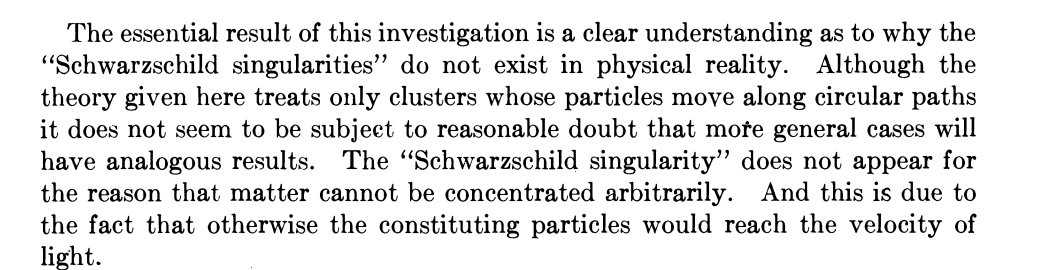
The answer, Einstein proved, was no. Well before the black hole limit (Schwarzschild radius) was reached, the particles would be moving faster than light. "Schwarzschild singularities" (black holes) do not exist in physical reality, the paper concluded.
Nirmalya Kajuri tweet media
English
1
0
0
28
Nirmalya Kajuri
Nirmalya Kajuri@Kaju_Nut·
Einstein wanted to show that no collection of matter (like a star) could collapse into a black hole. He modeled the matter by a spherically symmetric cluster of particles moving on circular orbits. Can such a system be crammed into a tiny enough region to form a black hole?
English
1
0
0
23
Nirmalya Kajuri
Nirmalya Kajuri@Kaju_Nut·
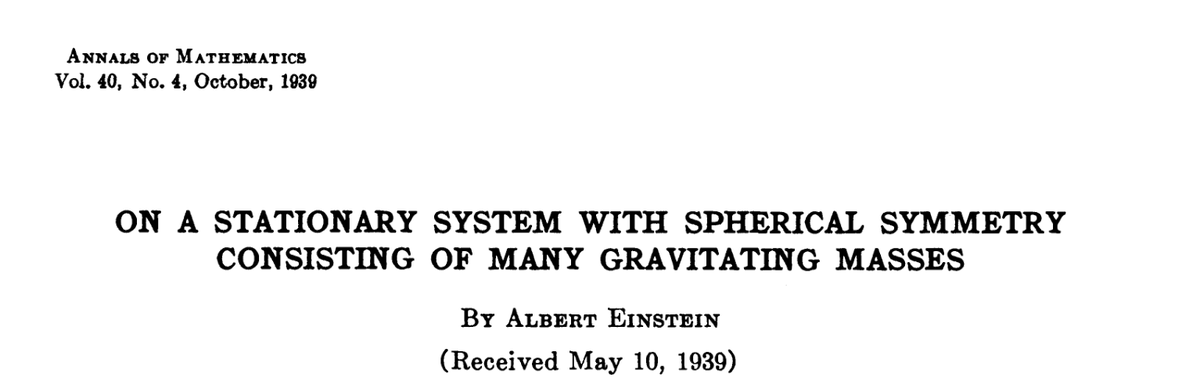
In 1939, Einstein wrote a paper which claimed that black holes cannot form. Even though his own theory of general relativity predicted their possibility, Einstein believed that they were bugs of the maths, not features of the world. In this paper, he set out to prove it. 🧵
Nirmalya Kajuri tweet media
English
1
0
4
86
Nirmalya Kajuri retweetledi
Nirmalya Kajuri
Nirmalya Kajuri@Kaju_Nut·
A thread on BMS symmetries. 🧵 We start with an example. Take a complicated distribution of charges. It will produce a complicated electric field. But if I could get far enough away from all the charges, the entire distribution would look like a point charge to me.
English
6
31
179
31.4K
Nirmalya Kajuri retweetledi
Nirmalya Kajuri
Nirmalya Kajuri@Kaju_Nut·
In 1930, a 19 year old student set sail from the Madras port for England. Young Subrahmanyan Chandrasekhar was going to join Cambridge and study physics. It was a long journey, but Chandrasekhar had something to occupy him. He was trying to calculate the fate of stars. Stars are very very heavy. So heavy that they are in danger of collapsing under their own gravitational pull. But they don't, because stars produce tremendous energy via nuclear fusion. Just like water vapor pushes against the lid of your vessel and tries to escape when you boil water, same with the super-hot gases inside stars. This outward thermal pressure balances out gravity. But eventually stars run out of nuclear fuel. When our Sun runs out of nuclear fuel, it will start feeling the squeeze of gravity. Fortunately for the Sun, there is still something to balance it out. The core of the Sun will have mostly electrons. Electrons are notoriously claustrophobic. If you try to squeeze electrons close together, they push back hard. This is called electron degeneracy pressure. The electron degeneracy pressure of the shrinking Sun will balance out its gravity and arrest its collapse. Demotion, but not complete demise, is the destiny of our Sun. When Chandrasekhar started his voyage, it was generally believed that all stars will share the same fate. Chandra wanted to carry out the computations himself during his journey. In the end, it took a few more years to fully incorporate the quantum and relativistic effects. Chandrasekhar's result (also obtained independently by Edmund Stoner) is summarised in the graph. The blue line is how the electron degeneracy pressure behaves when a star shrinks. The red lines mark the forces of gravity for stars of different masses. When the blue and red line meet, the two forces balance out. Our Sun will reach and stabilise in one such point. But the graph also had a surprising feature: for stars of mass >1.4 times mass of the Sun, there is no point of equilibrium. Their gravity is simply too strong to be arrested. Such a star can only implode under its own mass. This inevitable conclusion of Chandrasekhar's work earned the ire of Arthur Eddington, the foremost astronomer of the time. Eddington thought the conclusion of stars collapsing without cease was ridiculous. It must be that Chandrasekhar's approximations combining relativity and quantum were wrong. Eddington's immense stature ensured that Chandrasekhar's result was not taken seriously by most astronomers, even though his objection did not make sense to most physicists. Eventually Chandrasekhar was proved right. Heavy stars collapse into themselves and form black holes. As physicist Leon Rosenfeld had written to Chandra at the time, don't let high priests scare you.
Nirmalya Kajuri tweet mediaNirmalya Kajuri tweet media
English
29
220
1K
137.8K
Nirmalya Kajuri
Nirmalya Kajuri@Kaju_Nut·
@gnit_me @Furietra No one is tweeting about physics much these days. Earlier it was a little better but many physicists left for Blusky and others (like myself) don't tweet as often as we used to
English
1
0
1
16
Nirmalya Kajuri retweetledi
Nirmalya Kajuri
Nirmalya Kajuri@Kaju_Nut·
I am really enjoying the physics tweets from Japanese physics twitter. It's a welcome change to see that posts are openly passionate about physics!
English
13
14
194
7K
Nirmalya Kajuri retweetledi
pi0us
pi0us@pi0us0·
A friend of me who is studying math said: "It's like creating a magic system in a fantasy world. Only there is no story and no characters and no world, just the magic-system."
English
43
589
8.7K
196.8K
Nirmalya Kajuri retweetledi
Shion Chen | 陳詩遠
Shion Chen | 陳詩遠@ributsuman·
王道がない今が一番楽しくないですか。誰かに目標決めてもらうのは楽なだけで楽しいかどうかとは別だと思う
ゆきまさかずよし@Kyukimasa

「素粒子物理学の危機」 quantamagazine.org/is-particle-ph… ヒッグス粒子発見で標準模型の枠組みが完成したがその先をどうするのか。LHC超える加速器作れば何か出る仮説はあるけど保証がないので作れない。 次の大きな目標がないから研究者の意欲も下がって実験物理学から人材流出してるという現状なのだそうだ

日本語
1
7
65
14.9K
Nirmalya Kajuri retweetledi
Breakthrough
Breakthrough@brkthroughprize·
Congratulations to Dillon Brout, Maria Vincenzi, Mathew Madhavacheril, J. Colin Hill, Daniel Scolnic and W. L. Kimmy Wu on winning the 2026 New Horizons in Physics Prize for advances in cosmic microwave background and supernovae cosmology. breakthroughprize.org/News/98
Breakthrough tweet media
English
0
12
49
2.8K
Nirmalya Kajuri retweetledi
Breakthrough
Breakthrough@brkthroughprize·
Congratulations to Carolina Figueiredo of @Princeton on winning inaugural 2026 Vera Rubin New Frontiers Prize for contributions to the geometric structure of scattering amplitudes. breakthroughprize.org/News/98
English
4
15
83
8.7K
Mandu
Mandu@fynmaaandu·
@Kaju_Nut Didn't S.S. Nameki and Lakshya B. also do a lot of work in this area? is Shao et.al work much more fundamental? (I haven't explored this generalised symmetry topic, so idk much)
English
2
0
1
129
Nirmalya Kajuri
Nirmalya Kajuri@Kaju_Nut·
Congratulations to the winners!
Nirmalya Kajuri tweet media
English
2
1
36
1.1K
Nirmalya Kajuri
Nirmalya Kajuri@Kaju_Nut·
@RichardHanania More trusting/less questioning of authority, less individualistic culture. Among other reasons.
English
1
0
4
227
Nirmalya Kajuri retweetledi
Ntzsch
Ntzsch@xiNietzsche·
曲率って種類ありすぎだろ全部教えて
日本語
2
4
70
11.5K