Kenta Kasai 笠井健太

208 posts

Kenta Kasai 笠井健太 banner
Kenta Kasai 笠井健太

Kenta Kasai 笠井健太

@kasai_lab

Assoc. Prof. Science Tokyo, Quantum LDPC codes 准教授 東京科学大学(旧 東京工業大学)量子LDPC符号を研究しています。

Katılım Mayıs 2025
96 Takip Edilen300 Takipçiler
Kenta Kasai 笠井健太
One thing I would like to add: I was impressed by how strongly the people I met wanted to learn high-level, intuitive design principles from modern classical coding theory and apply them to quantum error correction. Modern coding theory developed substantially in the 2000s, and it is striking to realize that nearly twenty years have already passed since then. I also came away feeling that there is a great deal of room for researchers in classical coding theory to contribute their expertise to quantum error correction. I sincerely hope this connection will continue to grow.
English
0
1
20
1.6K
Kenta Kasai 笠井健太
I am deeply grateful to everyone at QuEra, Harvard, and MIT for their kindness and hospitality during my Boston research visit from May 11 to May 15, 2026. Thanks to them, I was able to spend the visit very comfortably and have many stimulating discussions. The visit was prompted by the recent paper “Towards Ultra-High-Rate Quantum Error Correction with Reconfigurable Atom Arrays” (arXiv:2604.16209) by researchers from QuEra, Harvard, and MIT, which builds on my quantum LDPC codes from arXiv:2601.08824. It was very encouraging to see these codes being used to study ultra-high-rate quantum memories for neutral-atom arrays, and to see the research moving forward in this direction. In my talk, I discussed how classical LDPC design principles, including degree distributions, randomness, girth, and minimum distance, can be carried over to quantum LDPC code design under CSS constraints. I also loved Boston itself: the city felt young, energetic, and full of culture. I hope to visit again in the near future. Slides and script are available here: #BostonVisit2026" target="_blank" rel="nofollow noopener">kasai.ict.eng.isct.ac.jp/en.html#Boston
English
1
3
49
3K
Kenta Kasai 笠井健太
Kenta Kasai 笠井健太@kasai_lab·
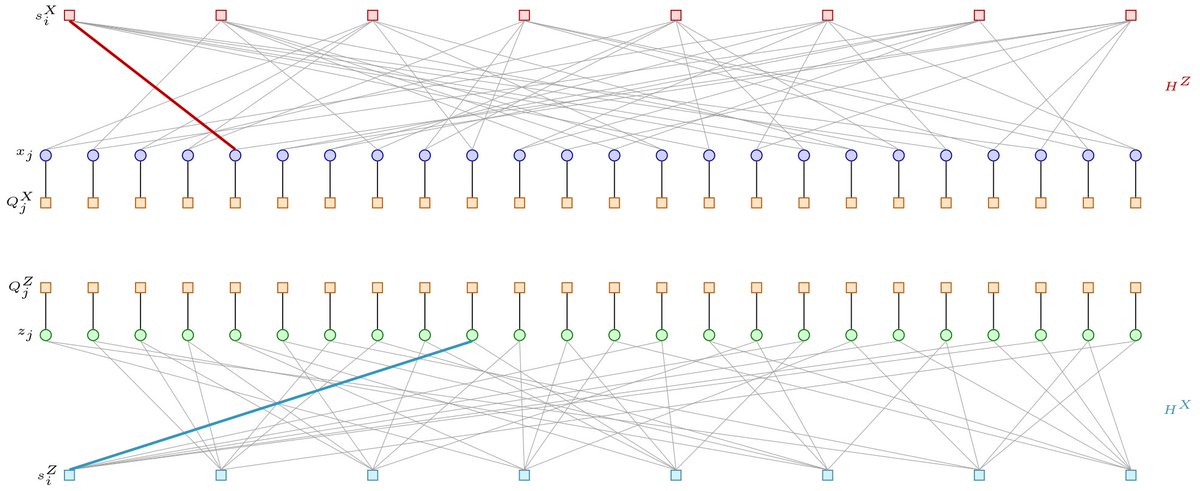
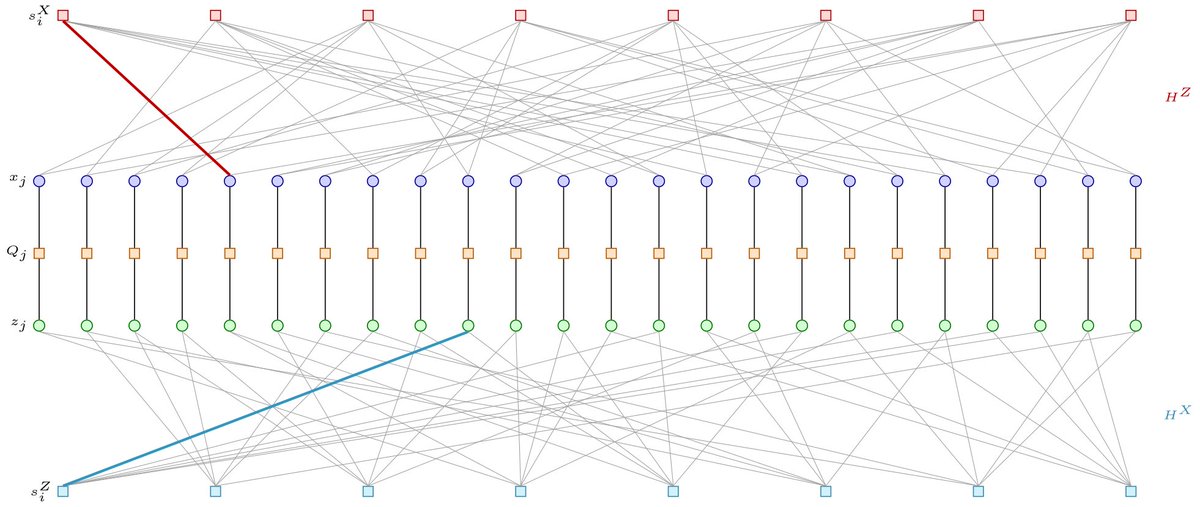
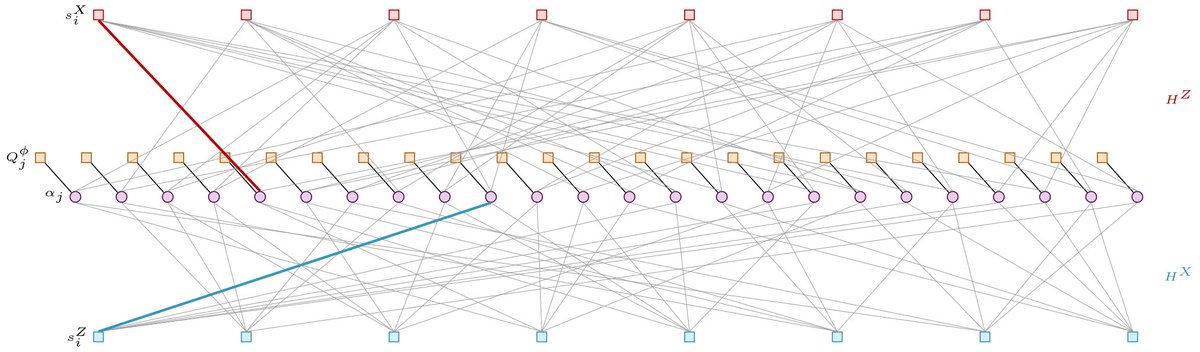
CSS syndrome decoding has a natural binary factor-graph formulation. The sum-product algorithm on this graph, joint BP, keeps the local X/Z channel correlation and is message-level equivalent to four-state BP after relabeling and marginalization. arXiv:2605.05132 arxiv.org/abs/2605.05132
Kenta Kasai 笠井健太 tweet mediaKenta Kasai 笠井健太 tweet mediaKenta Kasai 笠井健太 tweet media
English
0
3
11
1.3K
Kenta Kasai 笠井健太
Kenta Kasai 笠井健太@kasai_lab·
今日はTSUBAMEがセキュリティ対応で使えないのでAWSを使ってみようと思いましたが、価格を見てTSUBAMEの安さを再認識しました。 40コア使える cpu_40 は、学内価格だと概算で約9円/時、10分なら約1.6円。平日は30本で1200コア、週末は100本で4000コアまで同時に走らせられます。arXiv:2604.20838の計算も1万円いかないくらいでできました。 AWSの48 vCPU級オンデマンドは10分で約50〜70円なので、だいたい30〜40倍差。 AWSはやめておこう。TSUBAMEさん、いつもありがとう。
日本語
0
0
1
379
Kenta Kasai 笠井健太
Kenta Kasai 笠井健太@kasai_lab·
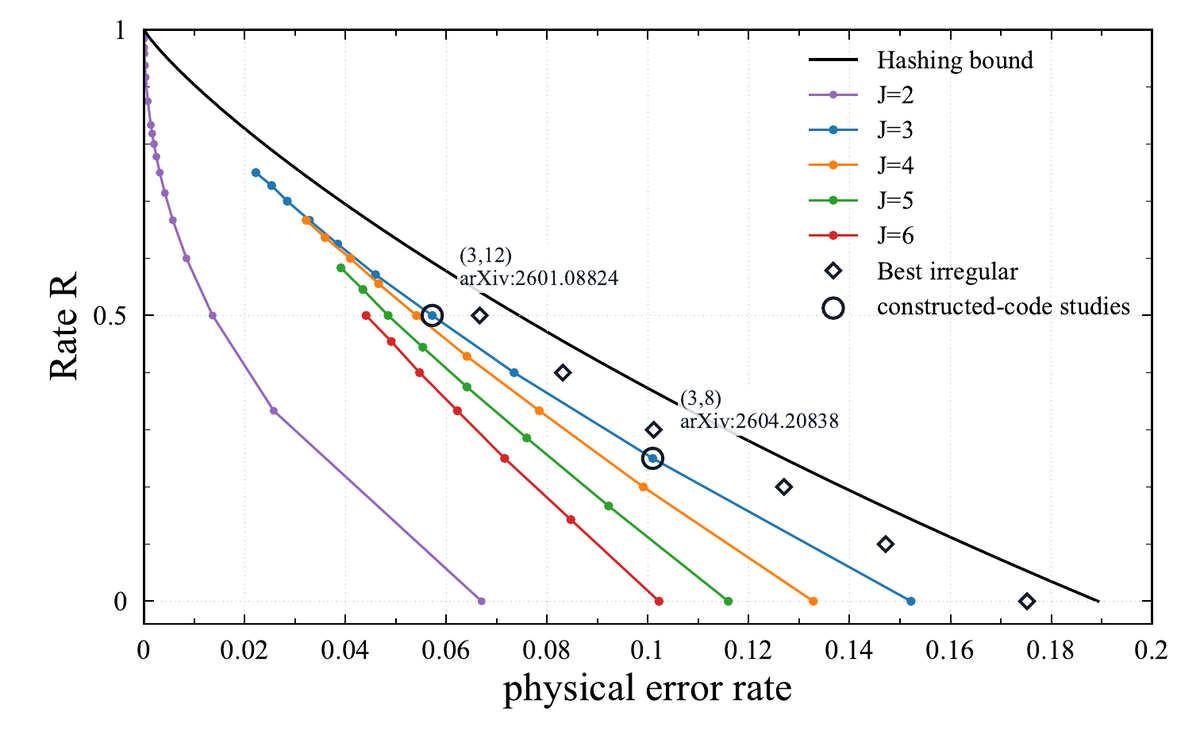
Density evolution (DE) is a useful way to ask a design question before constructing finite-length quantum LDPC codes: which degree distributions should have good belief-propagation thresholds? I added a short DE-based benchmark study to my homepage: #de-degree-optimization" target="_blank" rel="nofollow noopener">kasai.ict.eng.isct.ac.jp/en.html#de-deg… The regular (3,12) and (3,8) points are especially interesting because our finite-length experiments in arXiv:2601.08824 and arXiv:2604.20838 show decoding performance close to the corresponding DE predictions. I also plot optimized irregular degree distributions. These points are design targets, not constructed CSS codes, and the plot is not an asymptotic analysis of a CSS-code ensemble satisfying orthogonality. The question is: if quantum LDPC-CSS codes with such irregular degree distributions can be constructed, how much closer can finite-length performance get to the hashing bound? arxiv.org/abs/2601.08824 arxiv.org/abs/2604.20838
Kenta Kasai 笠井健太 tweet media
English
0
0
4
453
Kenta Kasai 笠井健太
Kenta Kasai 笠井健太@kasai_lab·
I will present work related to our paper arxiv:2601.08824 at QIT54, held on May 27–29, 2026, at Sinfonia Technology Hibiki Hall Ise, Japan, and as a poster at QEC26, held on June 7–12, 2026, in Santa Barbara, California. I look forward to discussing quantum LDPC codes and affine permutation constructions with many researchers there.
English
0
0
13
803
Kenta Kasai 笠井健太
Kenta Kasai 笠井健太@kasai_lab·
Quantum error correction is one of the key challenges on the path toward practical quantum computing. At Science Tokyo, we are working to advance quantum error correction through research, education, and the training of young researchers. If you are interested in supporting this work, donations can be made through the university's official program. I would be grateful to hear from you by email or DM. Details: #donations" target="_blank" rel="nofollow noopener">kasai.ict.eng.isct.ac.jp/en.html#donati
English
0
1
9
599
Kenta Kasai 笠井健太
Kenta Kasai 笠井健太@kasai_lab·
東京科学大学 工学院 情報通信系・笠井研究室では、2027年4月入学/2026年9月入学の修士学生を募集しています。 量子LDPC符号、量子誤り訂正に興味のある方を歓迎します。 研究活動は基本リモートで、研究室への定期的な出席を前提としていません。出願期間は2026年6月4日(木)〜6月10日(水)必着です。 募集要項: admissions.isct.ac.jp/ja/013/graduat… 研究室HP: kasai.ict.eng.isct.ac.jp
日本語
0
4
21
2K
Kenta Kasai 笠井健太
Kenta Kasai 笠井健太@kasai_lab·
Many thanks to @letonyo , who kindly pointed this out to me by email. It appears that the base code in our new preprint may be the same as the SPC(3) code considered in the following earlier paper: quantum-journal.org/papers/q-2024-… We will verify this carefully and make sure to cite and discuss it properly in the next update of the preprint. The main new ingredient in our work is the lifting construction built on top of that base code. I very much appreciate his kind and helpful note.
Kenta Kasai 笠井健太@kasai_lab

We are pleased to share our new preprint and accompanying code release, joint work with Koki Okada. High-Girth Regular Quantum LDPC Codes from Affine-Coset Structures We study a P=32 CPM-lifted [[16384,4142,≤40]] quantum LDPC code constructed from a girth-8 (3,8)-regular CSS base code. With BP decoding and post-processing, we observed FER ≈ 10^-8 at p = 0.085 over 2.3×10^9 trials. Preprint: arxiv.org/abs/2604.20838 Code: github.com/kasaikenta/qua…

English
0
0
12
1.5K
Kenta Kasai 笠井健太
Kenta Kasai 笠井健太@kasai_lab·
We are pleased to share our new preprint and accompanying code release, joint work with Koki Okada. High-Girth Regular Quantum LDPC Codes from Affine-Coset Structures We study a P=32 CPM-lifted [[16384,4142,≤40]] quantum LDPC code constructed from a girth-8 (3,8)-regular CSS base code. With BP decoding and post-processing, we observed FER ≈ 10^-8 at p = 0.085 over 2.3×10^9 trials. Preprint: arxiv.org/abs/2604.20838 Code: github.com/kasaikenta/qua…
English
1
5
30
3K
Kenta Kasai 笠井健太
Kenta Kasai 笠井健太@kasai_lab·
量子コンピュータ・量子誤り訂正符号に関する研究を推進するため、奨学寄附金によるご支援をお願いしております。 いただいたご支援は、研究の発展に加え、次世代人材の育成や、将来の量子情報技術の発展を通じた社会への貢献にもつなげてまいります。 事前にご相談いただければ、寄附に込められた思いや、ご関心のある支援の方向性についてお伺いできます。 メールやDMでお気軽にご連絡ください。 詳細はホームページをご覧ください。 #donation" target="_blank" rel="nofollow noopener">kasai.ict.eng.isct.ac.jp/index.html?lan…
日本語
0
2
22
2K
Kenta Kasai 笠井健太
Kenta Kasai 笠井健太@kasai_lab·
本当に素晴らしいです。こちらこそ、着実な方法で実装をご検討いただき、ありがとうございます。 この符号のアイデアは、千葉大学の萩原さん(@QRJAM)の QC-LDPC-CSS 符号と、河本大輝さんによる APM-LDPC 符号への一般化が土台になっています。 私自身、まだ学ぶところの多い立場ですが、このような形で発展していくことを大変うれしく思います。
Takuya Kitagawa/北川拓也@takuyakitagawa

笠井さんの素晴らしいアイデアが、量子コンピュータの実装に繋げることが可能かつ、効率的であることを示した論文が出ました。素晴らしいアイデア、ありがとうございます!

日本語
0
4
33
4.6K
Kenta Kasai 笠井健太
Kenta Kasai 笠井健太@kasai_lab·
Gallager’s ideas, together with the density-evolution perspective later developed in classical LDPC coding theory, taught us the importance of regular degree in parity-check matrices, sparsity, high girth, and randomness in code design. Now we are reaching the point where these insights can be carried over almost directly into quantum error correction. This could be a Big Bang moment for large-scale QEC. quera.com/blog-posts/qua…
English
0
0
18
985
Kenta Kasai 笠井健太 retweetledi
Anthony Leverrier
Anthony Leverrier@letonyo·
Nice paper showing that rate-1/2 qLDPC codes following Kasai's construction are very promising! arxiv.org/abs/2604.16209 But is it a new trend to normalize the logical error rate per logical qubit?
English
3
8
50
5.2K
Kenta Kasai 笠井健太
Kenta Kasai 笠井健太@kasai_lab·
Last Friday, I posted a new paper on arXiv: “Heuristic Search for Minimum-Distance Upper-Bound Witnesses in Quantum APM-LDPC Codes” arxiv.org/abs/2604.15307 We propose several upper bounds on the minimum distance and search for codes that maximize the smallest of these bounds. I am also maintaining a live upper-bound table on my homepage.
English
0
1
15
845
Kenta Kasai 笠井健太
Kenta Kasai 笠井健太@kasai_lab·
I’m deeply grateful to see this exciting work build on our recent ultra-high-rate code construction. It is wonderful to see these ideas connected to reconfigurable neutral atom arrays and practical circuit-level performance. Many thanks to the authors for this impressive development, especially given how quickly this work was brought together. arxiv.org/abs/2604.16209
English
0
5
59
12K
Kenta Kasai 笠井健太
Kenta Kasai 笠井健太@kasai_lab·
For the quantum LDPC code construction in arxiv.org/abs/2601.08824, our current strategy is to tighten upper bounds on the minimum distance as much as possible. So far, attempts to derive meaningful lower bounds have not been successful. Instead, we track several certified upper bounds and optimize the smallest among them. Live table: #live-upper-bound-table" target="_blank" rel="nofollow noopener">kasaikenta.github.io/en.html#live-u… Over the range currently explored, the best certified upper bound appears to grow roughly linearly with blocklength. At the same time, caution is needed in interpreting this trend. As the blocklength increases, the search cost also grows roughly linearly, and collecting enough samples becomes harder. When the distance is below about 30, BP decoding experiments often recover low-weight logical errors directly. Above that scale, such witnesses become much harder to obtain experimentally. It is certainly encouraging that, even in large-scale experiments, BP decoding has not produced failures corresponding to very small logical errors. But this is not a proof that the true minimum distance is large. So while the current data are promising, the true minimum distance could still plateau around 30.
English
0
1
12
1.1K
Kenta Kasai 笠井健太
Kenta Kasai 笠井健太@kasai_lab·
金曜日の新入生オリエンテーションで、僕が担当した班でお話した新入生は、「たくさんあそんで、たくさん勉強したいです」って目を輝かせて言っていて、希望にあふれていました🤩 関東の私立中高一貫校出身の人が多く、僕は高専出身なので、私立高校をあまり知らないので、私立高校の事情も教えてもらいました。 僕は担任じゃなくて、アカデミックアドバイザーだったのですが、担任の先生とTAの学生が科学大生に適した数とものづくりに関する企画をしてくれて、素晴らしいアイスブレークになりました。
Kenta Kasai 笠井健太@kasai_lab

科学大工学院1年生向けの、学生同士の懇親を目的としたオリエンテーションを1クラス担当することになりました。 AIに相談したところ、 「順番に自己紹介させる」 「将来の夢を語らせる」 「教員が笑いをとろうとする」 の3つは、最初の場では避けた方がよいとのこと。 ……全部やろうとしていました。 1回で仲良くなろうと焦らず、まずは授業で挨拶を交わすことから、少しずつつながりを作っていってくれたらと思います。

日本語
0
0
3
801
Kenta Kasai 笠井健太
Kenta Kasai 笠井健太@kasai_lab·
Our paper “Finite-Degree Quantum LDPC Codes Reaching the Gilbert-Varshamov Bound” has been updated on arXiv. The references have been substantially revised and expanded to more appropriately reflect prior work and clarify the position of our results in the literature. arxiv.org/abs/2603.24588
English
0
0
7
700