Jack Kemp Foundation
1.4K posts

Jack Kemp Foundation
@kempfoundation
We develop, engage and recognize leaders who champion the American Idea from the local to the national level. https://t.co/jSiDQRPPJP
Washington D.C. Katılım Haziran 2010
535 Takip Edilen1.5K Takipçiler

Terrific piece by our friend @Vladimirth.
'Nixon didn’t beg to ditch Bretton Woods in ‘71. No chats, no polls—just a Camp David huddle & a gold peg axed. The public accepted it, though it led to worse outcomes. Trump’s got the thumotic fire to fix that."
realclearmarkets.com/articles/2025/…
English
Jack Kemp Foundation retweetledi

U.S. prices of gold and oil would have risen by more than 6% if Trump had slapped tariffs on Columbia? That is bad math and terrible economics. Prices of internationally traded commodities like gold and oil are determined on world markets. Costco could never charge you a higher price for 1 oz. gold bars because they came from Columbia rather than Canada.
A U.S. 25-50% tariff on Columbian gold would not mean U.S. importers or consumers would pay more for gold from Columbia. They could easily substitute gold from somewhere else.
Tariffs on a single country are entirely different from tariffs on a single commodity -regardless of its source. That is why analogies that are often made between Trump's actual tariffs in 2018 and his proposed tariffs in 2025 are false.
The largest Trump tariffs in 2018 (aside from those on aluminum, steel, washers, and solar panels) were only applied to goods from China. Those country-specific tariffs simply resulted in substituting equally inexpensive imports from places like Vietnam (now Lululemon's main source).
U.S. manufacturing output and jobs fell quickly after Trump's first tariffs in 2018 (partly due to retaliation). Because U.S. manufacturers rely heavily on imported materials and parts, that policy-induced domestic industrial slump reduced such imports (but also U.S. manufactured exports). Most of the affected imports from China, however, were merely relocated. And prices of globally traded commodities like gold and oil were, of course, unaffected by U.S. tariffs on one country.

Douglas Irwin@D_A_Irwin
Here's what we import from Colombia and what will get socked if the 25%/50% tariffs get imposed
English
Jack Kemp Foundation retweetledi

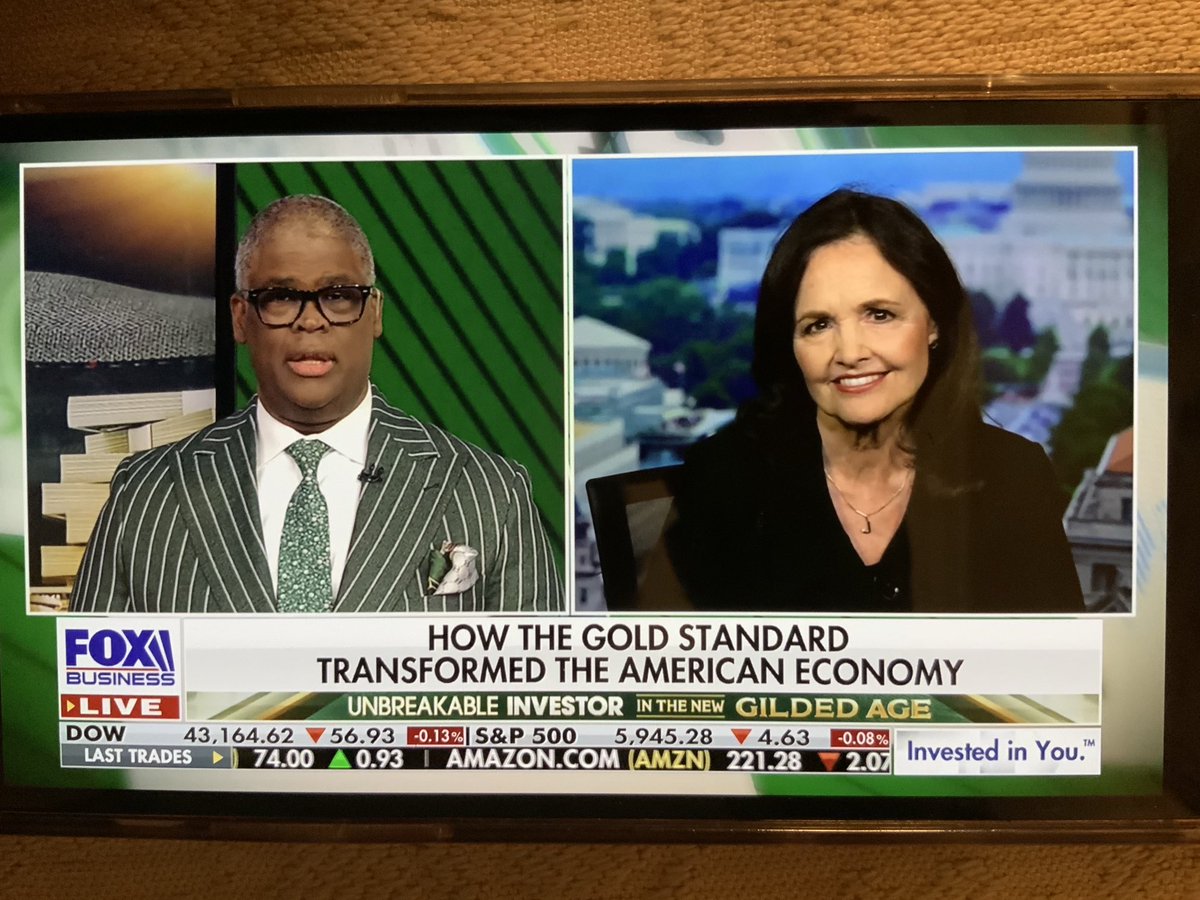
I like the caption for this segment with Charles Payne @cvpayne last week. A solid monetary foundation that delivers stable money (vs. government-induced inflation) provides optimal platform for productive economic growth—the kind that raises wages and living standards.

English
Jack Kemp Foundation retweetledi

In my conversation with Trump’s former economic advisor @judyshel, she emphasized the U.S. should NOT create a central bank digital currency.
It is now banned.
Judy is advocating for gold-backed treasury bonds and the further development of stablecoins.
The golden era...
English
Jack Kemp Foundation retweetledi

Todays' "Heard on the Street" Wall Street Journal column by Aaron Back says, "core CPI has now come in at either 3.2% or 3.3% [annualized] for seven straight months. This gives little comfort that inflation is still heading toward the Federal Reserve's 2% target."
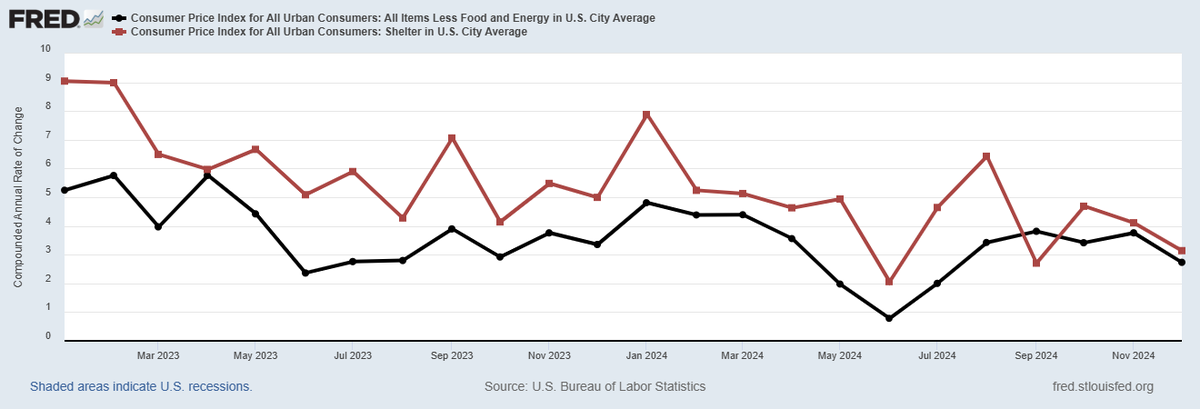
Actually, "core CPI" rose at a 2.7% annual rate in December after averaging 3.6% for the previous four months and 1.5% in the three months before that. But getting these facts right doesn't matter because Core CPI is a useless distraction. It ignores prices people care most about while magnifying the most delayed and unreliable estimates in the index.
The key problem is that 45% of the Core CPI consists of Shelter -- mostly dubious estimates of Owner's Equivalent Rent (OER) plus lagged surveys of old and new rents.
The graph on the left shows Core CPI as a black line and Shelter in red. If Mr. Back believes the Fed should pay more attention to OER --unlike any other central bank-- then it would make sense for him to use Core CPI to describe the Fed as too easy. But the Fed itself knows better, which is a big reason the FOMC targets overall PCE inflation rather than Core CPI inflation.
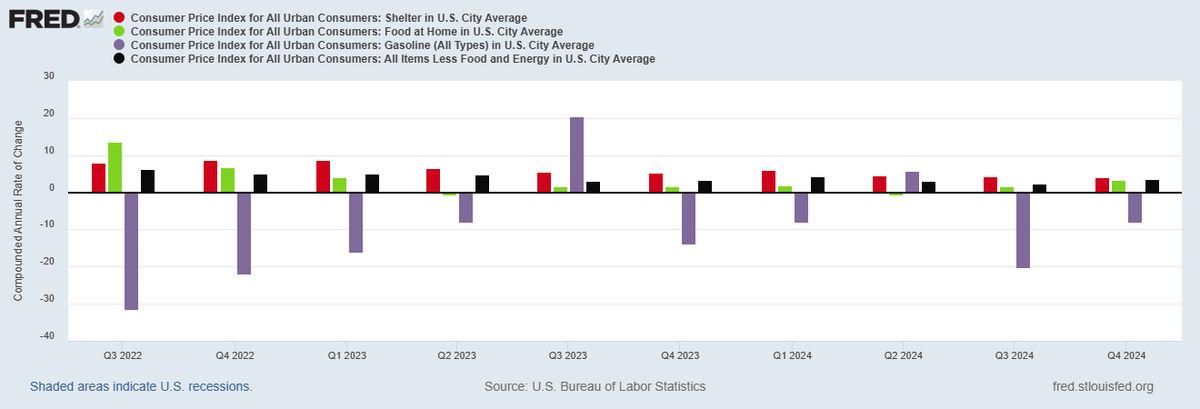
The graph on the right smooths out the first graph's wiggles in annualized monthly figures by using quarterly averages instead. Core CPI is still shown in black and Shelter in red. Once again, we see the reason the Core CPI appears "sticky" is because Shelter inflation is extremely sticky.
Some good news: even shelter inflation slowed a little last year -- from 6.1% in the first quarter to 4.1% by the fourth. That is the main reason Core CPI likewise slowed from 4.2% to 3.5% between the first and fourth quarters and rose only 2.2% in the third.
The usual excuse for focusing on Core CPI is not to puff up the weight given to OER and rent (as it does) but supposedly to avoid being misled by food or energy price swings. But less information is rarely better than more. The second graph on the right shows the quarterly annualized price changes for food at home in green and gasoline (a proxy for oil or energy) in purple.
Even though groceries and gasoline are the most talked-about examples of public irritation with inflation, Core CPI discards groceries and gas in favor of magnifying BLS estimates of OER.
The 0.25% rise in the December CPI was exaggerated by a bizarre 4.4% monthly jump in gasoline prices (a compound annual rate of 68.6%). Yet the quarter-to-quarter gasoline price change was negative (-7.8%) following a deeper drop in the third quarter. Beware of paying too much attention to annualized monthly gyrations, but also to 12-month year-to-year averages (which are slow to change and distorted by base effects when price changes were quirky one year ago).
The annual rate of food price inflation was high in the fourth quarter at 3.3%, but only 1.5% in the third quarter and even lower in the second. The trend is benign.
Core CPI inflation tells us a lot about sticky BLS estimates of OER and rent but it tells us nothing about trends in grocery or gasoline prices.
Core CPI also tells us nothing (comforting or otherwise) about whether total PCE inflation "is still heading toward the Federal Reserve's 2% target."
There is a word for journalists who promote the misuse of Core CPI as tool to predict total PCE inflation. That word is "wrong."


English

From @Comm4Prosperity:
"We keep getting asked by readers: if the dollar is being devalued (as measured by consumer inflation and the rising price of gold), why is the dollar soaring against other currencies?
The answer, as Unleash Prosperity Economic Advisory Council member, Judy Shelton (@judyshel) explains: while the dollar has lost half its value relative to the gold price over the past decade, most of our competitors have seen their currencies fall by almost twice as much in their value relative to gold.
This chart (the US dollar is in purple), shows that, as she puts it, 'we are the least dirty shirt in the laundry.' But the shirt is still dirty.
Anyone who looks at this chart and thinks that BRICs (the much-hyped new super currency created by Brazil, Russia, India, and China) will supplant dollar supremacy, is floating around in la la land."
committeetounleashprosperity.com/hotlines/the-d…
English

"The Reagan tax-rate cuts—Carter had them all heading to his desk in October 1978. A Rep. Jack Kemp-endorsed cut in tax rates of 30 percent across the board inclusive as well of a capital gains tax-rate cut had just passed both houses of Congress comfortably... 1/
Brian Domitrovic@BrianDomitrovic
Carter Almost Adopted The Reagan Revolution forbes.com/sites/briandom…
English

From the great @sfgrannis:
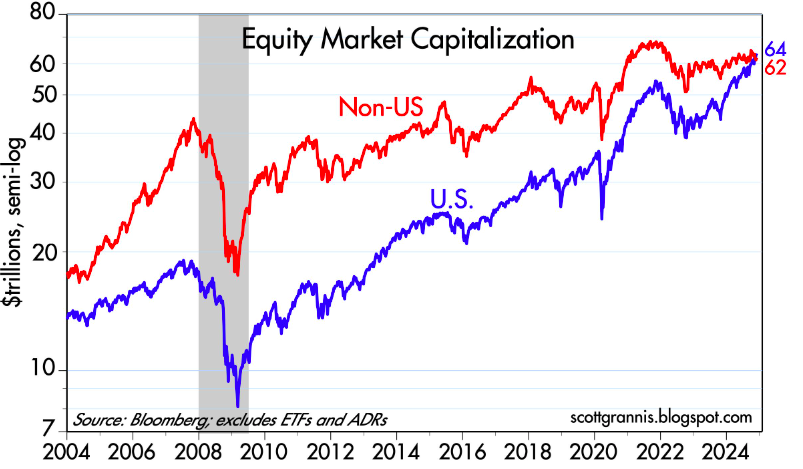
"The U.S. economy is the undisputed powerhouse of them all. Nothing says it better than the $170 trillion net worth of the U.S. private sector, & the fact that the market capitalization of U.S. equities is greater than the sum of all other global equity markets' market cap."
scottgrannis.blogspot.com/2024/12/the-us…

English

Our friends at @Comm4Prosperity are doing great work pressing the new Administration and Congress to prioritize tax cuts early in the new term.
committeetounleashprosperity.com/hotlines/one-b…
English

To re-incentivize American manufacturing (& STEM education), bring back the gold standard.
Eric Yeung 👍🚀🌕@KingKong9888
This guy got a good point. 🤣🔥
English

Statement on the passing of President Jimmy Carter:
“We're grateful for President Carter's service to our nation and his fellow Americans who sought a home and were willing to invest their sweat equity in the ownership. The Jack Kemp Foundation loves (as did our namesake) the Habitat for Humanity model that President Carter championed throughout his post-political career. We send our condolences and love to the Carter family.”
English
Jack Kemp Foundation retweetledi

A new study from @kempfoundation estimates energy prices in Northern Virginia will need to increase by 25 to 70 percent by the end of the decade to meet the growing demand for data centers. @7NewsDC
wjla.com/news/local/rep…
English