kfaim π⚡

11.1K posts

kfaim π⚡ banner
kfaim π⚡

kfaim π⚡

@kfaim39

π

Katılım Şubat 2017
238 Takip Edilen339 Takipçiler
Sabitlenmiş Tweet
kfaim π⚡
kfaim π⚡@kfaim39·
I am sending you 1π! Pi is a new digital currency developed by Stanford PhDs, with over 25 million members worldwide. To claim your Pi, follow this link minepi.com/kfahim39 and use my username (kfahim39) as your invitation code.
English
3
0
6
0
kfaim π⚡ retweetledi
QuStream
QuStream@qu_stream·
The QuStream v2 paper is now live. This is the latest technical foundation behind QuStream’s ITS model: public quantum-noise epochs private endpoint state automatic rekeying OTP-grade non-reuse The website has also been refreshed for a clearer overview: qustream.com/documentation
English
1
16
49
589
kfaim π⚡ retweetledi
Slikk Smith
Slikk Smith@SlikkSmith·
14/ About the "cluster buy risk" warning. DEX trackers flag QST because >20% of supply sits in clusters of related wallets. In memecoin context, that means rugpull risk. In QuStream's context, the algorithm is misreading the network. Two reasons clusters appear: 1. The node marketplace. Node keys are bought and sold between community members, priced in QST. Every marketplace transaction creates wallet-to-wallet QST flows that cluster-detection algorithms interpret as "related wallets." It's not coordination. It's a functioning peer-to-peer marketplace doing exactly what it was designed to do. 2. Conviction accumulation. 100 daily transactions across 2,400 holders is a ~4% participation rate. The cluster wallets aren't trading. They've been accumulating for a year and waiting for staking to go live. These aren't flippers. They're operators acquiring node keys and stakers building positions. When staking activates, that supply is the first to lock, not the first to dump. Through-holders, not traders. The warning label reads as risk. The behavior reads as alignment.
English
1
1
3
45
kfaim π⚡ retweetledi
Slikk Smith
Slikk Smith@SlikkSmith·
13/ What this does to price discovery. The actual Raydium liquidity pool sits at $188K total. Daily volume: $10K. 100 transactions per day, ~$100 average trade. 2,400 holders. Run a moderate scenario: 500M QST locks into staking. Tradeable float drops from 860M to ~360M The $188K pool gets drained as stakers pull tokens off market A $10K market buy already moves price ~5-10% at current depth A $50K buy nearly doubles it A $100K buy gaps it multiples A $250K position can't be entered. Not "moves the market," physically cannot fill. Same dynamic in reverse for exits. Microcaps with revenue share and locked supply don't trade. They gap.
English
1
1
2
50
kfaim π⚡ retweetledi
Slikk Smith
Slikk Smith@SlikkSmith·
12/ The supply trap is deeper than that. Unstaked nodes bleed 70% of their revenue to a global staking pool. Global pool is uncapped, open to anyone. The mechanics force everyone toward locking: Node operators stake 200K to capture 100% of their node revenue Non-operators stake to the global pool to capture the 70% bleed If the pool is undersized, the bleed falls back to node operators (so node operators earn ≥30%, potentially 100%) Every category of holder is structurally pulled into staking 30-day unstaking lock on top.
English
1
1
2
61
kfaim π⚡ retweetledi
Slikk Smith
Slikk Smith@SlikkSmith·
11/ The network needs more QST than exists in circulation to fully stake. 4,000+ node keys distributed (cap is 4,732) 200,000 QST required per node to fully stake Full staking at 4,000 nodes: 800M QST needed Full staking at 4,732 nodes: 946M QST needed Circulating supply: ~860M The cap is above the available float. Full node staking from circulating supply is structurally impossible.
English
1
1
2
50
kfaim π⚡ retweetledi
Slikk Smith
Slikk Smith@SlikkSmith·
10/ Now do the supply math. Total supply: ~1B QST Team locked (drip-unlocking bi-weekly through Feb 2029): ~140M Aggregators ignore the lock. Real circulating today: ~860M. Real market cap: ~$2.5M. That's the starting point. It gets tighter.
English
1
1
2
49
kfaim π⚡ retweetledi
Slikk Smith
Slikk Smith@SlikkSmith·
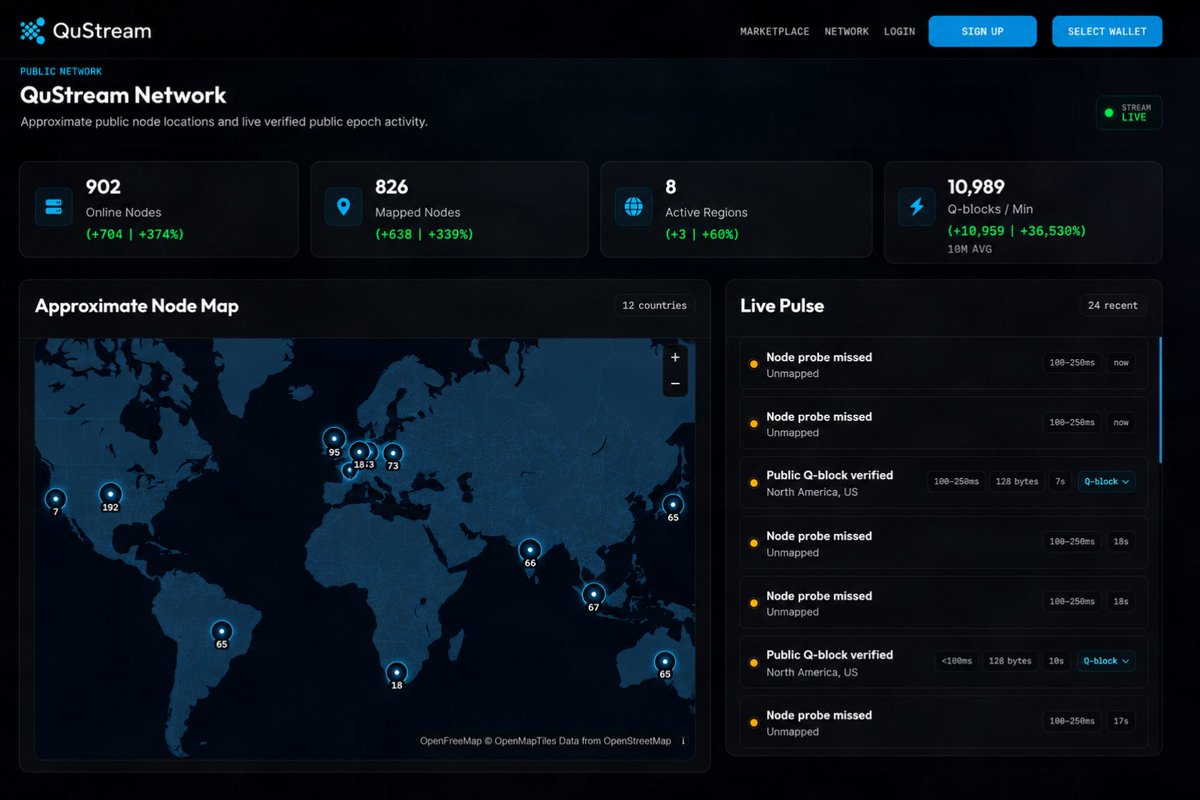
9/ The network is LIVE. Right now. Public testnet activity at account.qustream.com/network: 1,103 nodes online 1,015 mapped globally 8 active regions 12,173 Q-blocks per minute (10m avg) This is not a roadmap promise. It is encryption infrastructure operating in real time.
English
1
1
2
74
kfaim π⚡ retweetledi
Slikk Smith
Slikk Smith@SlikkSmith·
8/ The smart meter TAM alone is generational. 1.8 billion smart meters worldwide on vulnerable PKI. UK replacement cost using standard PQC: £200 million. QuStream is lightweight enough to deploy as a firmware OTA update. No technicians, no hardware swaps. Same problem, fraction of the cost.
English
1
1
2
230
kfaim π⚡ retweetledi
Slikk Smith
Slikk Smith@SlikkSmith·
7/ The pipeline doesn't match the market cap. Nokia + Capgemini partnership building quantum networks to NATO certification standards $350B sovereign defense program, technical demo in progress Drone chip integration (chip-level security baked into a hardware platform sold globally, MOU pending) Multi-data-center infrastructure audit passed in the Netherlands
English
1
1
2
83
kfaim π⚡ retweetledi
Slikk Smith
Slikk Smith@SlikkSmith·
6/ NATO already tested it. 2025 Proof-of-Concept on the NATO/EU-sponsored Italy–Malta fiber line. Solved the "last-mile problem" for QKD. Live demos with NATO member armed forces scheduled. Direct lines into NATO panels via Nokia liaisons.
English
1
1
3
49
kfaim π⚡ retweetledi
Slikk Smith
Slikk Smith@SlikkSmith·
5/ Google just vindicated the thesis. New Google research moved the quantum threat timeline to "likely by 2029," not 2035. They're now asking researchers to report PQC vulnerabilities via Zero Knowledge Proofs because the "standard" lattice-based algorithms are already showing cracks. QuStream sits outside that fragility.
English
1
1
2
51
kfaim π⚡ retweetledi
Slikk Smith
Slikk Smith@SlikkSmith·
4/ The tech is mathematically different. NIST's post-quantum standards rely on "hard math problems" that future computers might crack. Same flawed bet that got us here. QuStream uses symmetric-key infrastructure built on Shannon's one-time pad. 504-bit hardness (minimum search space) from immutable mathematics, not conjecture. Ultimately, the end result is Operational Perfect Secrecy.
English
1
1
3
88
kfaim π⚡ retweetledi
Slikk Smith
Slikk Smith@SlikkSmith·
3/ The founder is not a crypto LARP. Adrian Neal. 40 years in cryptography. IBM → UBS Warburg's first cryptographer → Oxford spin-outs. Currently Senior Director and Global Lead for Post-Quantum Cryptography at Capgemini. Two-time winner of the NATO Defence Innovation Challenge.
English
1
1
2
134
kfaim π⚡ retweetledi
Slikk Smith
Slikk Smith@SlikkSmith·
2/ The pitch in one line: peer-reviewed quantum-safe encryption, real revenue model, real institutional pipeline, microcap valuation, and a supply structure the market hasn't priced in. Most "quantum" coins are buzzwords. This one has a paper in the Springer FTC 2025 proceedings and a live network shipping Q-blocks right now.
English
1
1
2
87
kfaim π⚡ retweetledi
Slikk Smith
Slikk Smith@SlikkSmith·
🧵 $QST / QuStream: ~$2.5M market cap. NATO-validated cryptography. 1,103 live nodes online. And a tokenomics structure that makes full staking mathematically impossible from circulating supply. (1/15)
English
1
3
11
183
kfaim π⚡ retweetledi
Pi Network
Pi Network@PiCoreTeam·
Here is last month's Network Update! Over 100,000 Pioneers have been KYC'd and over 30,000 migrated to Mainnet.
Pi Network tweet media
English
1.1K
1.8K
8.4K
202K
kfaim π⚡ retweetledi
QuStream
QuStream@qu_stream·
What do QuStream nodes actually do? They generate, verify, and serve Q-Blocks. A Q-Block acts as a safe carrier used to derive encryption material, but contains nothing useful to an attacker on its own. Authorized end users can extract what they need from a verified Q-Block. The source matters: Q-Blocks must come from QuStream’s trusted node network. Entropy as a service, delivered through verified infrastructure.
QuStream tweet media
English
2
15
59
1.1K
kfaim π⚡ retweetledi
Pi Network
Pi Network@PiCoreTeam·
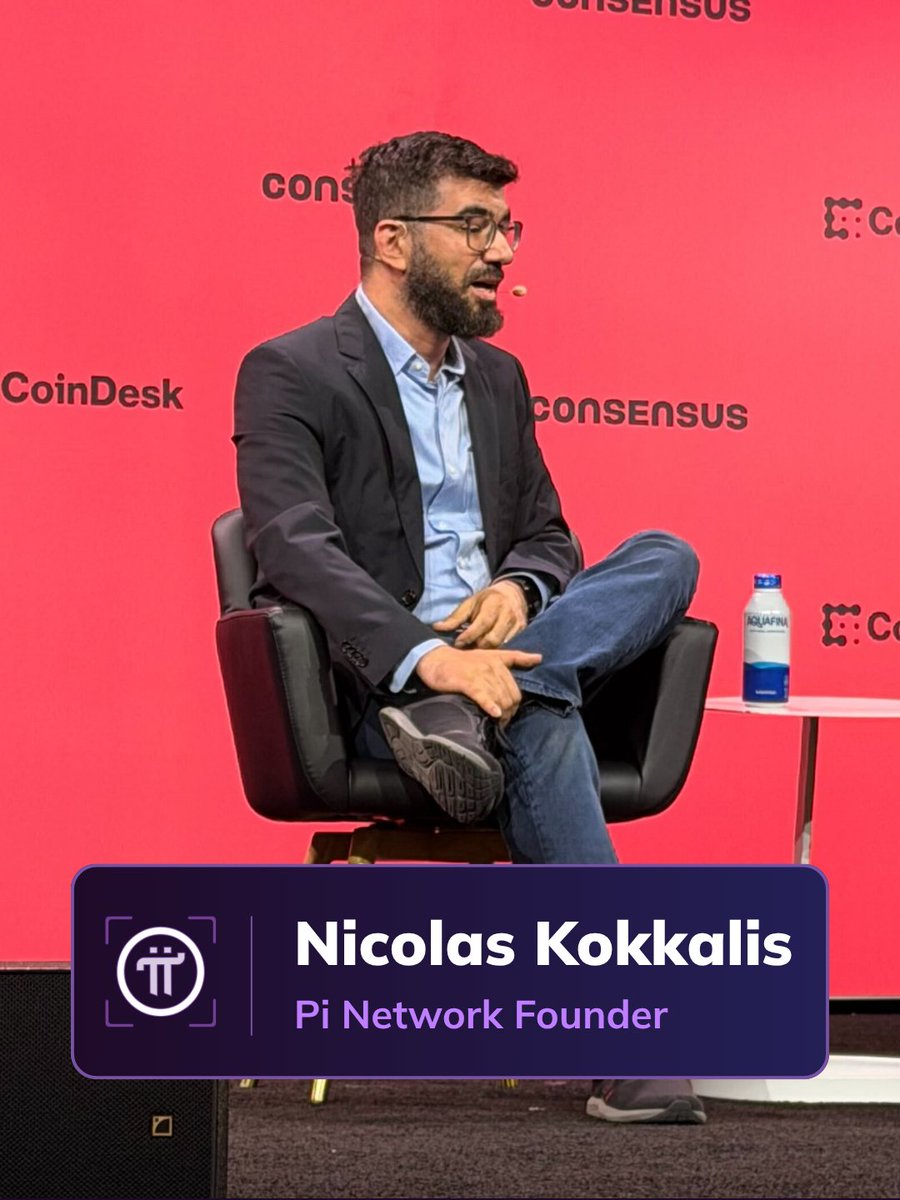
Pi Founder Nicolas Kokkalis spoke today at Consensus 2026 Miami on the panel, “How to Prove You’re Human in an AI World (Without Doxing Yourself).” The discussion focused on one of the most urgent challenges in the AI era: how to maintain trust and verify real human identity as AI systems become capable of generating convincing bots, profiles, and interactions at scale. Stay tuned for the full video!
Pi Network tweet mediaPi Network tweet media
English
718
2.1K
9.8K
242.5K