KenKomu.stark retweetledi
KenKomu.stark
4.1K posts

KenKomu.stark
@kikis216
CRYPTOGRAPHIC Researcher|| BLOCKCHAIN developer || Graduate Mentee @kamilimu
Nairobi Katılım Mart 2020
2.4K Takip Edilen1K Takipçiler
KenKomu.stark retweetledi


Did another @minisendapp series!
This time why we think solving cross-chain liquidity fragmentation is key in unlocking stablecoin payments in Africa while building on @base
-Moving 200k usdc in under 7 months with 500 plus unique wallets.
Check us out at : minisend.xyz
iamchris.base.eth@_ChrisOketch
Look who's cooking again! @minisendapp weekly series dropping again this week.
English
KenKomu.stark retweetledi

Your AI agent just got hacked. Its key is compromised. You have two options:
❌ Redeploy from scratch. Lose all state, reputation, assets.
✅Spectre Protocol: Prove you're the owner via ZK email proof, recover the key, agent is back online. No private data on-chain.
No single point of failure. Fully verifiable. Powered by @NoirLang @LitProtocol @Filecoin
@PL__Genesis @protocollabs
Link below:
devspot.app/projects/2040
@Lynette_mwangi
#PL__Genesis
English
KenKomu.stark retweetledi

The ZK talk lately is a massive reality check. Even top-tier researchers are admitting it’s the highest point on the knowledge hierarchy. That Google paper using a ZKP to mask their quantum optimizations is actually insane to me.
I’ve been at this for a year, and I’m still just feeling out the deep end, but the strides I'm making are real. There's no way I’m stopping until I hit that world-class circuit optimizooor level.
zk is actually hard fr but yeah… if i don’t go insane who will
English
KenKomu.stark retweetledi

Demo Tuesday at the lab with Nelly
Nelly ( @nellycyberpro ) introduced @wifiproof a different approach to proof of attendance that leans on venue Wi-Fi and ZK geolocation to confirm presence without exposing unnecessary data.
The focus was on building systems that respect privacy while still getting the job done.
Key takeaways from the session:
• How proof of attendance can work without over-collecting user data
• Using Wi-Fi signals as part of location verification
• Where ZK geolocation fits into real-world use cases
• Rethinking how we design for privacy from the start
A solid look at how small ideas can shift how we build for users.
If you missed it, watch the full Demo on YouTube
👉youtu.be/A3UanlfBvsI

YouTube
English
KenKomu.stark retweetledi

🚀 My paper on post-quantum cryptography is now online!
Free access (limited time): authors.elsevier.com/a/1mrO35buwX0e…
#PostQuantumCryptography #CyberSecurity
English
KenKomu.stark retweetledi

Your idle usdc in your @minisendapp wallet now has automated yields!
Get a Minisend wallet, deposit and start earning on @base
app.minisend.xyz

English
KenKomu.stark retweetledi

KenKomu.stark retweetledi

we’re hiring 🚨
looking for a backend engineer (node.js, typescript, AWS) to help build and scale the systems powering an ai product.
you’ll work on real-time pipelines, APIs, infra, and distributed systems alongside a small, high-output team
we’re looking for someone who:
↳ has 2+ years of backend experience (node.js + typescript)
↳ is strong with postgresql, redis, and api design
↳ has hands-on aws experience
↳ understands scalability, performance, and clean system design
bonus if you’ve:
↳ worked on high-scale consumer products
↳ built real-time or distributed systems
comp: ₹30–60 LPA + equity
location: india preferred (remote with travel)
this is not for everyone.
only apply if you have proof of exceptional work
send your proof of work 📥

English
KenKomu.stark retweetledi

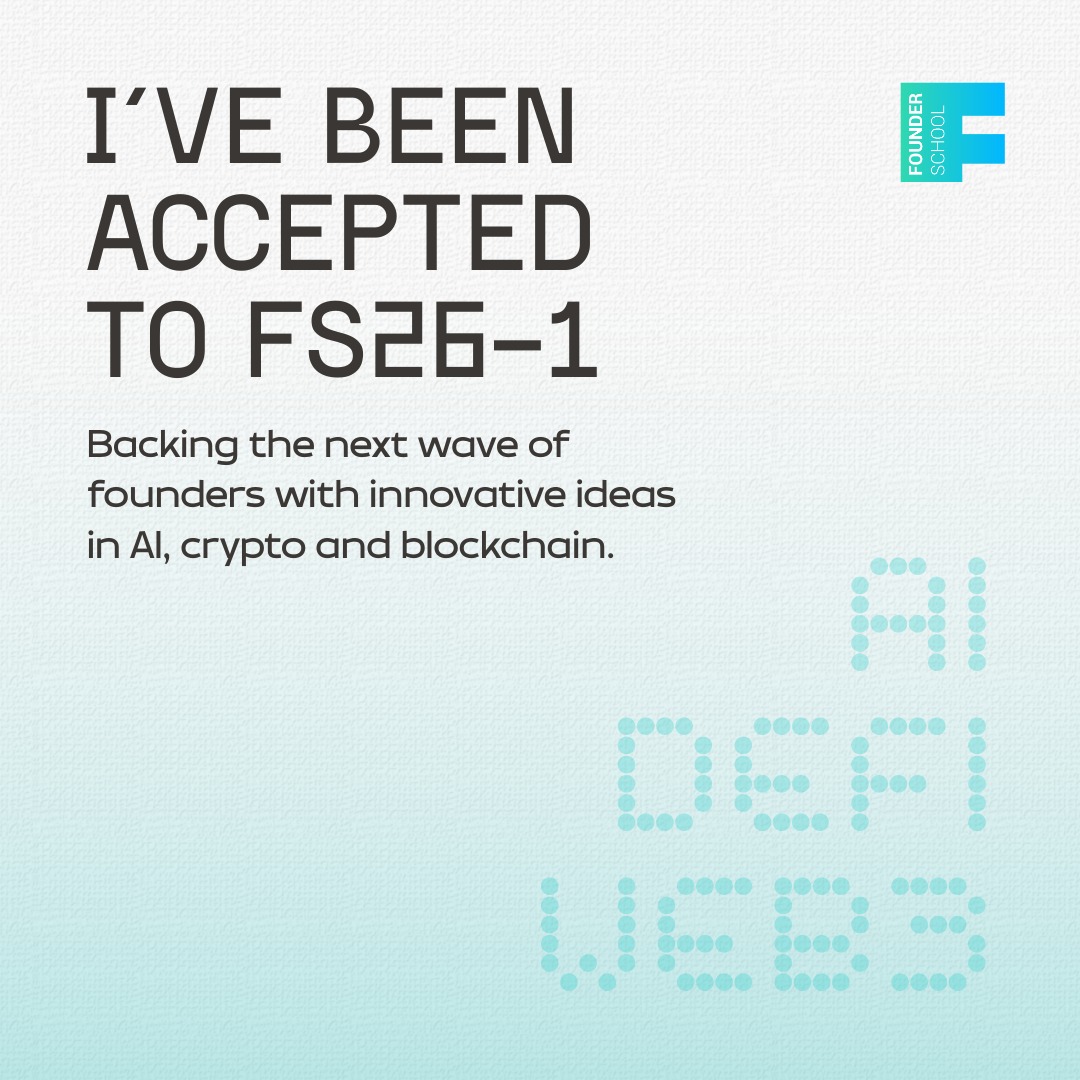
Happy to announce that I got accepted into Founder school!
Super bullish on @minisendapp
@FS_Build

English
KenKomu.stark retweetledi

On September 23, 2025, I talked @wifiproof for the first time.
At the time, it was a hackathon idea built around a very simple observation: whenever people arrive at a hackathon, conference, or venue, one of the first things they ask is, “What’s the Wi-Fi password?”
That tiny ritual stuck with me.
Because if you are physically in a venue, trying to connect to the venue’s Wi-Fi, that already says something important. It says you are there. And I kept asking myself: why do we still have to give away so much personal information just to prove something as simple as attendance?
Why should proving “I was there” require exposing your name, phone number, email, or other unnecessary details?
That question became WiFiProof.
Version 1 was important because it proved the idea had life. People understood it immediately. They loved the concept. But if I’m being honest, v1 also showed me all the places where the design was not strong enough yet. There were real security assumptions and weaknesses that needed to be revisited. So I went back to the drawing board.
Over the past few months, I’ve been building WiFiProof v2.
Reworking assumptions.
Fixing vulnerabilities.
Tightening the security model.
Improving the proof flow.
Making the system more credible, more private, and much closer to the product I originally imagined.
This has been one of those projects where the deeper you go, the more you realize how much care is required if you want to build something that is not just interesting, but actually trustworthy.
And now, after all that iteration, WiFiProof v2 is ready for testing.
Tomorrow, I’ll be demoing it at @Web3Clubs Labs.
I’m excited, but more than that, I’m grateful. Grateful that an idea that started as a hackathon experiment is now at the stage where people can actually come interact with it, test it, question it, and help shape what it becomes next.
If you’ve followed the journey since the first post, thank you.
If this is your first time hearing about @wifiproof , welcome.
And if you care about privacy, ZK, cryptography, proof of attendance, or building better systems for the real world, I’d love for you to come see what we’ve been working on.
See you tomorrow at Web3Clubs Labs.

xiaomaomao.base.eth@nellycyberpro
You’re at a crypto conference. First thing you do? (After grabbing coffee and dodging swag) ask: What’s the Wi-Fi password? What if that tiny ritual could become unforgeable, private proof that you were actually there? Enter: WiFiProof, built during @zk_monk hackathon 2025.🧵
English
KenKomu.stark retweetledi

some notes from the ongoing zk class @Web3Bridge
examples of quantum-resistant algorithms
Lattice-based cryptography: Uses lattice problems, such as LWE and RLWE, which are believed to be hard for quantum computers to solve.
Hash-based cryptography: Relies on the security of hash functions and includes schemes such as Merkle trees and the eXtended Merkle signature scheme (XMSS).
CBC: Based on error-correcting codes, with McEliece and Niederreiter cryptosystems being notable examples.
Multivariate quadratic (MQ) cryptography: Uses systems of multivariate quadratic equations, which are hard to solve.
reference book:
Next Generation Mechanisms for Data Encryption
Keshav Kumar and Bishwajeet Kumar Pandey
English
KenKomu.stark retweetledi