Sabitlenmiş Tweet

𝐆𝐞𝐧𝐋𝐚𝐲𝐞𝐫: Optimistic Democracy Consensus
- how a small, random Jury delivers secure on-chain decisions
welcome to the first installment of our new weekly deep-dive series on GenLayer’s core architecture.
last series we explored validators, the Equivalence Principle, and how intelligent contracts actually work. This week we go one layer deeper: how GenLayer reaches fast, secure, and truly decentralized consensus when AI models are involved.
➥ 𝐭𝐡𝐞 𝐟𝐮𝐧𝐝𝐚𝐦𝐞𝐧𝐭𝐚𝐥 𝐜𝐡𝐚𝐥𝐥𝐞𝐧𝐠𝐞
traditional blockchains rely on deterministic execution. every node must produce the exact same output. but AI-native computation is non-deterministic by nature. different LLMs can produce slightly different yet equally valid answers. exact string matching is impossible. GenLayer solves this with a new consensus model called Optimistic Democracy Consensus.
➥ 𝐰𝐡𝐚𝐭 𝐎𝐩𝐭𝐢𝐦𝐢𝐬𝐭𝐢𝐜 𝐃𝐞𝐦𝐨𝐜𝐫𝐚𝐜𝐲 𝐂𝐨𝐧𝐬𝐞𝐧𝐬𝐮𝐬 𝐚𝐜𝐭𝐮𝐚𝐥𝐥𝐲 𝐢𝐬
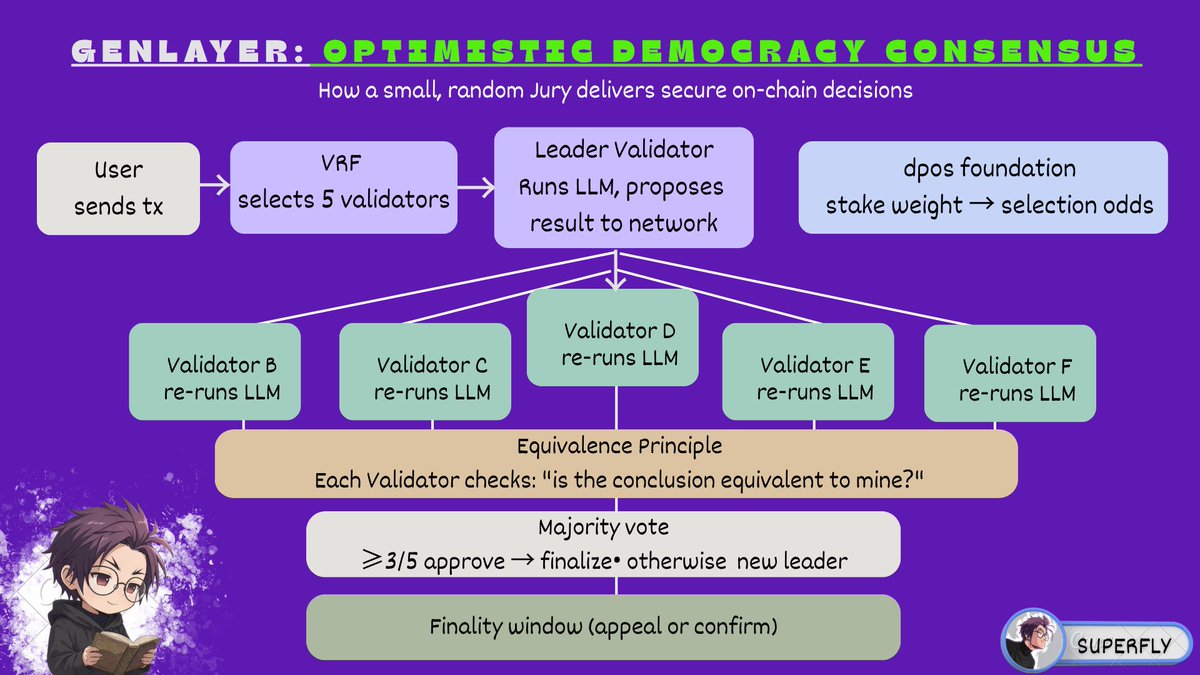
instead of requiring every validator in the network to vote on every transaction, GenLayer uses a small, randomly selected “jury” of validators [typically five]. This jury is chosen via Verifiable Random Function [VRF], ensuring true randomness and fairness. The selection is also weighted by stake [dPoS foundation], so higher-staked validators have proportionally better odds of being selected, but no single party can dominate.
➲ 𝐭𝐡𝐞 𝐩𝐫𝐨𝐜𝐞𝐬𝐬 𝐰𝐨𝐫𝐤𝐬 𝐚𝐬 𝐟𝐨𝐥𝐥𝐨𝐰𝐬
- a user sends a transaction to an intelligent contract.
- one validator from the jury is randomly chosen as the leader. the Leader executes the contract in genVM, queries its LLM, and proposes a result to the network.
- the remaining validators independently re-run the exact same logic using their own diverse LLMs.
- each validator applies the developer-defined Equivalence Principle embedded in the contract: “Is this conclusion equivalent to mine within the rules I set?” [Not identical strings; equivalent meaning]
- if at least 3 out of 5 validators approve the leader’s proposal, the transaction reaches finality.
- there is a short confirmation window during which anyone can appeal. If no majority is reached or an appeal is filed, the process escalates automatically [new leader, expanded jury] until consensus forms.
➥ 𝐰𝐡𝐲 𝐭𝐡𝐢𝐬 𝐝𝐞𝐬𝐢𝐠𝐧 𝐢𝐬 𝐩𝐨𝐰𝐞𝐫𝐟𝐮𝐥
- only a small jury is needed for most transactions → near-instant finality in the happy path.
- multiple independent LLMs reduce single-model bias or compromise.
- it assumes the Leader is correct (optimistic), but the democratic majority vote + appeal mechanism guarantees security even when disputes arise.
- Random VRF selection + stake-weighted odds prevents cartel behavior.
this is the “court of the internet” in action: a small, randomly chosen jury of AI-powered validators deliberating and reaching secure consensus on real-world data and reasoning.
𝐭𝐥𝐝𝐫: GenLayer's Optimistic Democracy Consensus lets a tiny, randomly selected group of validators reach fast, secure on-chain decisions by combining VRF randomness, a Leader proposal, independent LLM re-execution, the Equivalence Principle, and majority voting. delivering both speed and unbreakable decentralization.
the image below shows the complete flow from transaction submission to finality.
English