The difference between average traders and pro traders is simple:
Average traders panic in drawdown.
Pro traders cut losers fast.
Average traders take profits too early.
Pro traders let winners grow.
Average traders fear volatility.
Pro traders understand it’s part of the game.
Most traders trade emotionally.
Professionals trade probabilities.
The market rewards discipline, not comfort.
Be more like the pros.
#trading#mindset#futures
The market doesn’t reward intelligence.
It rewards discipline, patience, and survival — something the best traders already understood.
William O’Neil built his edge on buying leading stocks in strong trends and cutting losses fast.
Jesse Livermore made it clear that the big money comes from sitting still in winning trades, not constant action.
Paul Tudor Jones proved that survival comes first — protecting capital is more important than being right.
The market doesn’t care how smart you are.
It cares how you behave under pressure.
How Traders Lose Discipline (Step by Step)
A real, internal experience — the slippery slope to guaranteed losses.
1️⃣ You bend one small rule
You tell yourself:
“It’s fine… I’ll move the stop just this once.”
Nothing explodes immediately, so your brain learns the wrong lesson:
Rule‑breaking feels safe.
2️⃣ You start chasing trades
You’re bored.
You’re impatient.
You want action.
So you take a setup that’s “almost good.”
Now you’re trading emotion, not edge.
3️⃣ Your emotions take the wheel
One loss triggers revenge.
One win triggers euphoria.
You size up randomly, enter impulsively, and justify it with:
“I’ll fix it later.”
This is where accounts quietly bleed.
4️⃣ Hope replaces logic
You stop asking:
“Is this a valid trade?”
And start saying:
“It might go up.”
Hope is not a strategy — it’s a trap.
5️⃣ Risk management disappears
You let losers run.
You cut winners fast.
You stop respecting your max loss.
You’re no longer managing risk — risk is managing you.
6️⃣ You stop journaling
No review.
No reflection.
No accountability.
Without a journal, every mistake becomes a recurring subscription.
7️⃣ Ego becomes the strategy
You’re no longer trying to trade well —
you’re trying to prove you’re right.
This is the final stage before the blow‑up.
Discipline doesn’t vanish in one moment.
It erodes — one ignored rule, one emotional trade, one ego decision at a time.
By the time you notice, the damage is already done.
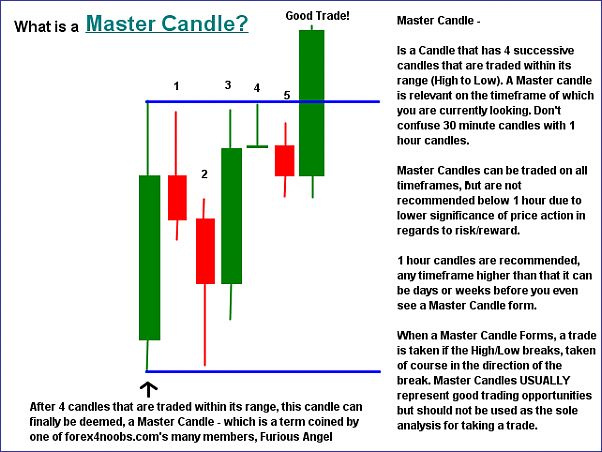
- A Master Candle forms when 4 candles stay inside one candle’s range.
- Only after the 4th inside candle does it officially qualify.
- Best used on 1H and higher — lower timeframes are noise.
- Shows compression + buildup of energy before expansion.
- Trade the break of the Master Candle high/low.
- Breakout direction = trade direction.
- It’s a trigger, not a full strategy — add context, trend, and risk control.
- Often leads to clean, high‑probability moves when used with discipline.
DISCOMFORT IS THE REAL EDGE
- Trading gets easier once you accept that discomfort is part of the job, not a sign you’re doing something wrong
- Most traders blow up because they try to escape discomfort instead of operating inside it
- Fear, FOMO, hesitation, doubt — these emotions don’t disappear, you just learn to act despite them
- Your discipline is measured in the moments you feel the most pressure
- The trader who can sit with discomfort without breaking rules grows faster than the trader chasing confidence
- You don’t need to feel good to trade well — you need to stay consistent
- Mastering discomfort is what separates a skilled trader from an emotional one
Trading Is One of the Greatest Skills You Can Teach Yourself
Once you reach a point where you truly understand the market and can trade with consistency, that skill doesn’t disappear.
It stays with you like riding a bike. Even if you take time off, the foundation is still there.
What makes trading different is the freedom it creates.
You’re not tied to a location, a boss, or a schedule. You can build a life around your own decisions.
That’s why so many people are drawn to trading and willing to put in the hours.
It’s not just about money it’s about independence, flexibility, and having a skill that stays with you for life.
10 Rules of Ruthless Trading Discipline
These rules outline a professional trader’s mindset: clarity before action, emotional neutrality, and strict process adherence. The core message is simple — discipline is the real edge.
Core Principles
- Every trade must be planned — if you can’t articulate it, you shouldn’t execute it.
- Losses must be cut immediately — hope is not part of the system.
- Position sizing must be conservative — size follows setup quality, not ego.
- Never chase price — missed trades are cheaper than forced trades.
- Process over brilliance — consistency compounds, improvisation destroys.
- Avoid boredom trades — sit out unclear markets.
- No revenge trading — emotional trades bleed accounts.
- Respect your stop-loss — moving it is self-sabotage.
- Journal everything — awareness creates improvement.
- Show up like a professional — every click must be intentional.
If you're not a successful trader yet,
Plan.
Backtest.
Study price action.
Study price action.
Study price action.
Meditate.
Believe in yourself.
Successful trading is the reward of your daily actions.
The day you stop treating trading like a hobby is the day your results begin to change.
You stop gambling.
You stop guessing.
You start operating with
discipline,
structure, and
intention.
Businesses measure ROI.
Traders should too.
Most traders don't actually lose on the idea... they lose on position sizing.
How many of you know this feeling?
(Live later today, make sure you're there 🤝🏼)
If you want to improve your trading,
Use this weekend to:
- Study price action
- Study your emotions
- Improve your system
- Work on your risk plan
- Review your past trades
- Plan next week's trades
Use weekends is the best time to become 10x better than your competition.
spend as much time as possible learning how price moves
backtest
paper trade every day
take scalps
take swings
hold overnight
watch what price does over and over again
but once you understand the theory, something has to change
you have to start trading like there is real money involved and respecting the risk
that means smallest size possible
one trade per day
strict risk rules
no nonsense
because if you cannot follow your rules with small size
you will never follow them with big size
and until you actually follow your rules consistently every day, you will never make it in trading