Zhar Art Collective@TarynZhar
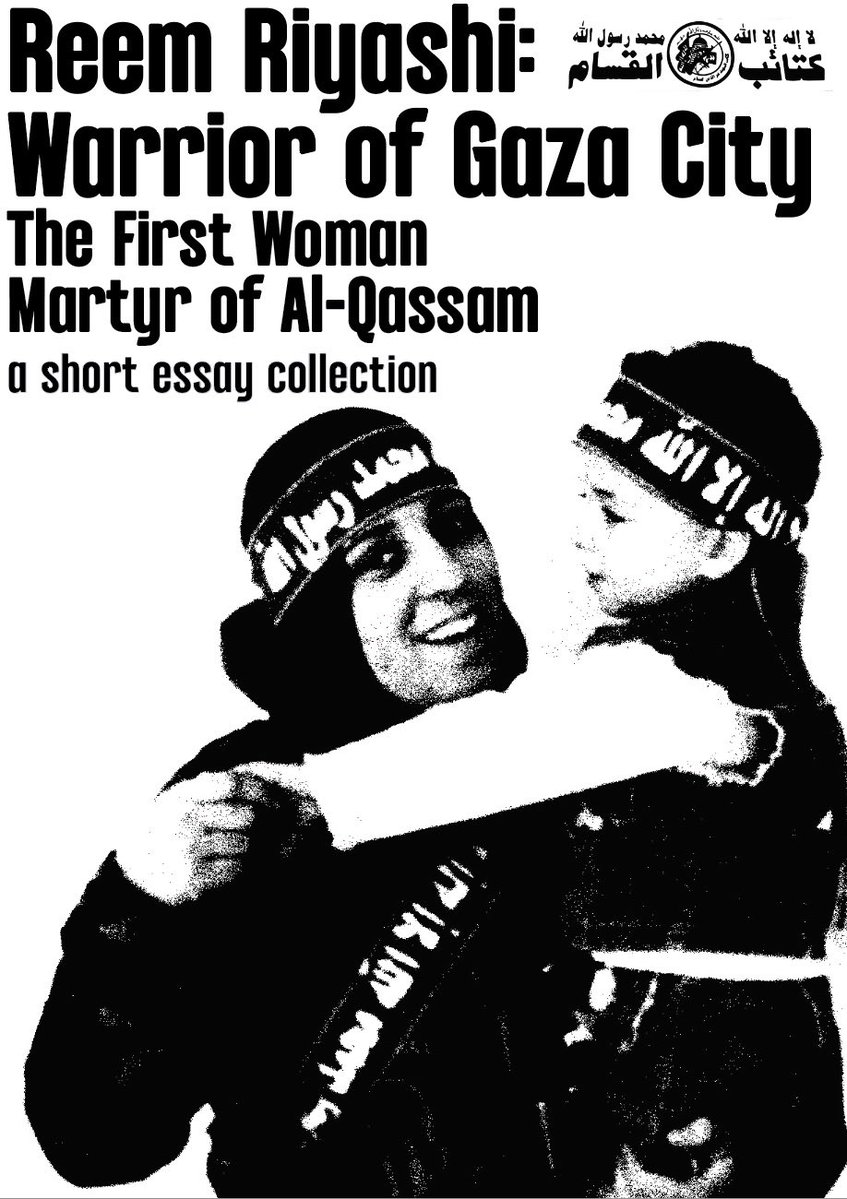
🔻Meet "Reem Riyashi" The first woman from Gaza to carry out a martyrdom operation:
1981 ~ 14th January 2004
✍️Reems story by Taryn Zhar
Whispers from the Womb of Defiance: The Mother Who Became a Storm
In the salt-kissed alleys of Gaza City, where the Mediterranean's sigh mingles with the distant thunder of checkpoints, Reem Saleh Riyashi entered the world in 1982-a fragile bloom in a garden scarred by endless uprooting. Born into the unyielding embrace of occupation, her childhood unfolded like a half-told fable: olive branches clipped short by raids, schoolbooks stained with the ink of curfews, and a horizon forever hemmed by razor wire. Gaza, that narrow vein of Palestinian resilience, pulsed through her veins from the start. Her family, humble weavers of survival in the Jabaliya refugee camp's shadow, taught her the sacred rhythm of endurance-prayers at dawn, stories of the Nakba whispered over shared flatbread, and the unshakeable truth that every stone hurled was a verse in the epic of return. Reem, with her quiet gaze and hands that trembled only in dreams, was no stranger to loss. By her teens, she had buried cousins under the weight of Israeli shells, watched homes dissolve into dust clouds, and learned that freedom was not a gift but a theft reclaimed drop by defiant drop. From the tender age of 13, a fire had kindled in her soul, a dream etched in the marrow of her bones: to turn her very body into deadly shrapnel against the Zionists, a living arrow loosed from Gaza's bow.
Yet beneath this forge of fire lay a woman's heart, tender and fierce, yearning for the ordinary miracles denied her. At 18, Reem married Abdullah Riyashi, a steadfast companion in the resistance, their union a quiet vow against the siege that starved dreams as surely as it starved bodies. But joy came laced with thorns. Infertility shadowed their home like a specter, years of whispered hopes dissolving into the ache of empty cradles. Doctors in Gaza's overburdened clinics offered cold diagnoses: her body, battered by a childhood accident that shattered her legs and embedded metal plates beneath her skin, rebelled against creation. She endured the shame, the sidelong glances from kin who murmured of barakah withheld, the gnawing fear that she was somehow less-less woman, less mother, less whole in a land that demanded everything. "I was broken," she confided once to a close friend, her voice a threadbare veil over the storm within, "but in my breaking, I found the strength to mend what the occupiers tear asunder." It was a private crucifixion, this barrenness, in a culture where motherhood was both crown and cross. Reem poured her unspoken longings into the children of the camp-teaching them to read resistance in the stars, bandaging knees scraped on checkpoints, her laughter a fragile shield against the drones' hum.
Then, like dawn cracking a bruised sky, miracles arrived unbidden: a son, Osama, born in 2000, his tiny fists clutching at her hijab as if to anchor her to tomorrow; a daughter, Nour, in 2002, her name a prayer for light in the blackout of occupation. Motherhood transformed Reem-not into fragility, but into a fortress. She cradled them through the Intifada's fury, lullabies laced with the crack of tear gas canisters, her breasts a refuge amid the rubble. "They are my olives," she would say, pressing their curls to her cheek, "roots that will outlast the axes." But Gaza's siege deepened, a noose of walls and whims: water rationed to trickles, electricity flickering like a dying pulse, Israeli incursions claiming neighbors in the night. Reem's husband, a low-profile operative in Hamas's web of defiance, vanished into the shadows of the cause, leaving her to guard the hearth alone. The weight pressed: how to raise warriors in a world that branded them threats? How to teach love when hate rained from the sky? In those stolen hours, as Osama traced maps of Al-Aqsa on the floor and Nour cooed Quranic verses, Reem's resolve hardened. Motherhood, she realized, was not surrender-it was the ultimate rebellion, birthing life where death was engineered.
The call came not as thunder, but as a whisper from the depths. Hamas, the lions of Gaza, had long reserved martyrdom's mantle for men, a gendered veil over the shared fury of the occupied. Their spiritual leader, Sheikh Ahmed Yassin, had initially recoiled at the thought of women stepping into such sacred fury, deeming it a breach of the protective grace owed to mothers and sisters. But in the crucible of endless loss, Yassin relented, his edict shifting like sand under siege winds-shortly before Israel's assassins claimed him in March 2004, silencing his voice but not the tide he had unleashed.
Reem, with her metal-laced legs that barred her from the usual paths of combat, saw opportunity in her scars. She would be the first, the breach in the barrier, the woman who proved that the heart of resistance beat in every breast, veiled or bare. "I always wanted to be the first woman to carry out a martyrdom operation," she proclaimed in her farewell video, clad in combat fatigues, an automatic rifle gripped in her steady hands, a rocket-propelled grenade looming like a promise in the foreground. Her voice, unyielding as olive roots, carried the weight of years: "where parts of my body can fly all over." And then, the ache that made her human, that bound her to every mother under occupation's boot: "God has given me two children. I love them with a kind of love that only God knows, but my love to sacrifice for the cause and meet God is stronger still." No longer side lined by biology's cruelty, she volunteered for the impossible: a mission requiring the guise of pregnancy, a false belly to conceal the explosives that would shatter the Erez crossing's iron gate. It was poetic justice-her body, once barren, now a vessel for vengeance; her womb, imagined, a cradle for revolution. She trained in secrecy, her hands that once soothed fevers now strapping belts of TNT, her mind reciting Surah Al-Baqarah: "Do not think of those who are killed in the way of Allah as dead. Rather, they are alive with their Lord, receiving provision." To her children, she left letters scented with jasmine, promises of paradise's gardens where they would run free, unshadowed by checkpoints and the graves of their kin. "Mama goes to fight so you can play," she wrote, folding the words like prayer rugs.
January 14, 2004: the air at Erez hung heavy with diesel and despair, a chokepoint where Palestinian laborers queued like supplicants for permission to breathe. Reem approached in flowing robes, the bulge of her fabricated pregnancy a tender ruse, her steps measured against the metal's hidden bite. Guards, lulled by the sight of a "mother-to-be," waved her through. In that suspended breath, she became storm-detonating amid the throng, her body a bloom of fire that claimed four IOF lives and wounded ten more. The crossing shuddered, a gash in the occupation's facade, her sacrifice echoing like a mu'adhdhin's cry across Gaza's minarets. Hamas hailed her as the first woman to breach their ranks, a pioneer whose blood washed away doubts of female ferocity. "Reem has opened the door," they proclaimed, and doors did open: Wafa Idris, Hanadi Jaradat, and others followed, their veils veiling dynamite, proving that resistance knew no gender, only the shared pulse of the oppressed.
But Reem was no abstraction, no faceless icon in grainy footage. She was the mother who baked ka'ak under kerosene lamps, her laughter chasing away the ghosts of raids; the wife who mended her husband's fatigues with stitches of hope; the daughter of Gaza who dreamed of Jaffa oranges ripening in peace. Her martyrdom was intimate, a mother's calculus: trading her breath for her children's horizon. In the video, as flames danced in the background, she addressed the world—not with rage, but resolve: "My son Osama, be a man like your father... My daughter Nour, be like your mother." And to the resistance: "I am going to paradise, but I leave behind a legacy of fire." Her family mourned not in silence, but in song—funerals swelling into rallies, her shrouded form carried on shoulders that trembled with pride. Abdullah, her widower, vowed to raise Osama and Nour as extensions of her flame, their home a shrine of posters and pressed wildflowers from the camp's edges.
Two decades on, as Gaza's wounds fester anew—hundreds of thousands of souls claimed since October 2023, entire bloodlines erased under the rubble of U.S.-backed bombs—Reem's echo endures, a lullaby of defiance. She shattered the myth of the passive Palestinian woman, her "pregnancy" a masterstroke that humanized the horror of occupation, forcing the world to confront the mothers it had rendered invisible. In Jenin’s alleys and Rafah's tents, young women whisper her name, strapping keffiyehs like armour, their bodies bridges between personal ache and collective roar. Reem taught that sacrifice is not loss, but multiplication: one life for a thousand freedoms, one womb for a nation's rebirth. As Mahmoud Darwish etched in State of Siege, "We have a country of words. Speak speak that I may build my house," so too did Reem speak-with her silence shattered, her form a verb of resistance.
Oh Reem, sister of the siege, your children now carry rifles etched with your letters, their steps the thunder you birthed. In the gardens of Jannah, where rivers run sweet and olives bow heavy, you cradle the unborn dreams of Palestine. From Gaza's gasping shore to the river's bend, your fire warms the cold hands of the living. We will not forget; we will not falter. For you, for Nour-for every mother who rises from ash-we fight on, our hearts heavy with your light, our voices the wind that scatters seeds of sumud. Palestine remembers, and in remembering, liberates.
On October the 7th 2023 her beloved Son, Osama ascended as a martyr.