
Krish Subramanian

73.4K posts

Krish Subramanian banner
Krish Subramanian

Krish Subramanian

@krishnan

Future Asteroid Farmer, Technologist, & former Physicist. Believe in equitable world but not the woke tactics. Democracy is key for human species. AI and Cloud

Seattle, WA Katılım Şubat 2007
715 Takip Edilen16.6K Takipçiler
Krish Subramanian
Krish Subramanian@krishnan·
The resistance to AI is real. And it might be the most expensive collective decision in modern American history. Seven in ten Americans say AI is moving too fast. A similar share opposes AI data centers near their communities. NBC News reports 57 percent believe the risks of AI outweigh the benefits. Enterprises do not get a vote on AI adoption. The board does. The CFO does. The investors do. Once one competitor in a sector starts shipping AI workflows that meaningfully compress cost structures, every other player either follows or loses margin until they exit. This is not opinion. It is how capital allocation works. Meanwhile, the public is choosing the opposite path. Block the data center. Distrust the model. Skip the tool. Wait it out. The asymmetry compounds fast. Enterprises that adopt AI capture exponential efficiency gains, which translate into earnings, valuations, and concentrated wealth. Individuals who resist lose the chance to use these same tools to compete, to start something, to multiply their own output. The exponential curve does not pause for popular opinion. It just decides who rides it. What we are setting up is a wealth gap that makes the last 40 years of inequality look modest. A small group will own the productivity multiplier. The rest will pay for the output it produces. This is not an argument for unconditional AI adoption. It is an argument against unconditional refusal. The right question is not whether Americans should resist AI. It is how regular people get an ownership stake in what it produces. Worker co-ops, public AI infrastructure, profit sharing, tax structures that recycle gains broadly. The conversation should be about distribution, not denial. So what is the better play? Resist AI and hope the curve flattens, or engage and fight for who owns the gains?
English
0
0
0
92
Krish Subramanian
Krish Subramanian@krishnan·
Anyone using Flyhermes.ai? Experience? I have been using it for 24 hours now. It is too slow and gateway times out regularly. Is it affiliated with @NousResearch Thanks
English
0
0
0
147
Krish Subramanian
Krish Subramanian@krishnan·
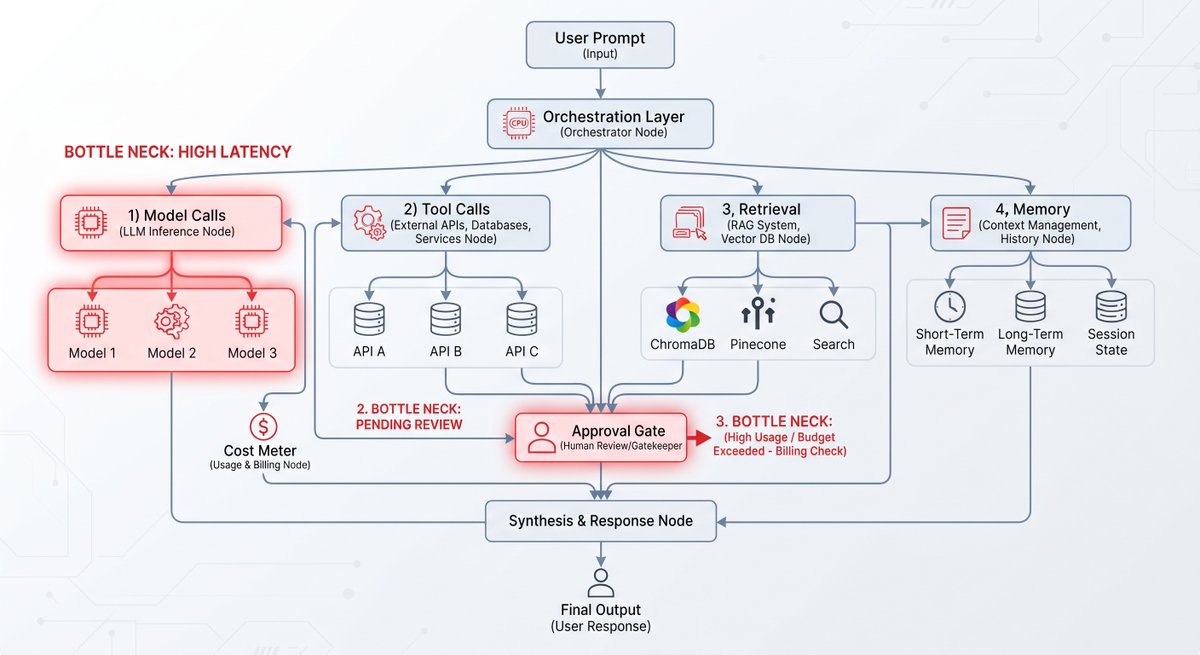
The "too many agents" problem is not new. You have seen this movie before. Cloud sprawl. SaaS sprawl. Now agent sprawl. The pattern is identical: deployment outpaces governance, costs compound, and leadership notices too late. The WSJ reported this week (wsj.com/cio-journal/co…) that companies are drowning in AI agents. Deloitte's 2026 survey of 3,235 leaders confirms it. 96% of enterprises are already running agents. Only 21% have a mature governance model. That gap is not a bug. It is the default state of enterprise technology adoption. But here is what makes agent sprawl structurally worse than what came before. An idle SaaS license wastes money. An idle AI agent can still act. An agent you forgot about can still be sending emails, making API calls, and influencing decisions downstream. Gartner estimates Fortune 500 companies will run over 150,000 agents by 2028, up from under 15 in 2025. No governance model scales 10,000x in three years. There is also a goals problem. Software executes instructions. Agents pursue goals. When two agents pursue overlapping goals without shared context, you do not get double the work done. You get double the confusion. Two agents addressing the same customer issue. One credits the account. The other opens a ticket. The customer gets neither. This is not a technology problem. It is an organizational design problem wearing a technology costume. The same companies that never asked "who owns this?" when they spun up cloud accounts in 2015 are making the same mistake today. Gartner predicts 40% of agentic AI projects will be cancelled by 2027. That number will probably be conservative. The Day 1 story is "AI agents are transforming enterprise work." The Day 2 story is "do you know what your agents did last Tuesday?" Most organizations cannot answer that. That is the real problem.
Krish Subramanian tweet media
English
0
0
0
98
Krish Subramanian retweetledi

Ihtesham Ali
Ihtesham Ali@ihtesham2005·
A Stanford neuroscientist published a paper a few years ago that quietly answered one of the oldest questions in human history, and almost nobody outside his field has heard of it. The question is why we dream. Not what dreams mean. Why they exist at all. Why your brain spends a third of its sleep hallucinating images instead of just resting like every other organ in your body. His name is David Eagleman. He runs a lab at Stanford. The paper is called "The Defensive Activation Theory", and the moment you read it the explanation collapses every other theory you have ever been taught about dreams. Freud said dreams were repressed desires. He was guessing. He had no brain scans. He had no electrodes. He had a couch and a notebook and a century of credibility that nobody has been able to fully scrub off the subject since. Modern neuroscience replaced him with the memory "consolidation theory". The idea that dreams are your brain sorting through the day, filing things away, deciding what to keep. That story is partially true. Sleep does consolidate memory. But it does not explain the single strangest thing about dreams, which is that they are almost entirely visual. You do not dream in pure sound. You do not dream in taste. You do not dream in smell. You dream in pictures. Vivid, detailed, often impossible pictures that activate the back of your brain so hard a scientist scanning you would think your eyes were wide open. Eagleman started from one fact almost nobody outside neuroscience knows. The brain is territorial. Every region holds its turf through constant electrical activity. The moment a region goes quiet, its neighbors start invading. They take the silent territory and reassign it to themselves. This is called "cortical takeover", and it is not slow. It is not a long process measured in years. In experiments where adults are blindfolded, the visual cortex starts processing touch and sound within an hour. One hour of darkness, and the territory is already being annexed. In congenitally blind people, the visual cortex is fully repurposed. It runs language. It runs hearing. It runs touch. The hardware never went unused. It was just reassigned to whoever showed up first. Now sit with the implication of that for a second. Every night, when you close your eyes and fall asleep, the sun has set. The planet has rotated. The visual cortex, which takes up roughly a third of your entire cortex, is suddenly receiving zero input. For eight hours. Every single night. For your entire life. And evolution has shaped your brain inside a planet that has been spinning into darkness for billions of years. If cortical takeover happens in an hour, the visual cortex should have been lost a long time ago. Stolen by hearing. Stolen by touch. Reassigned by morning. Humans should have evolved into a species whose vision works fine during the day and then degrades every time the sun goes down because the territory keeps getting renegotiated overnight. But that did not happen. Vision works the moment you open your eyes. Which means something is defending the territory while you sleep. Eagleman's claim is that dreams are that defense. Every 90 minutes through the night, a precise burst of activity fires from the brainstem into the visual cortex. Pontine-geniculate-occipital waves. PGO for short. They are anatomically aimed. They are not general arousal. They are a targeted volley of signal launched directly at the back of the brain where vision lives. The cortex lights up as if it is receiving real images, and you experience that artificial activation as a dream. The bizarre narrative your conscious mind invents around it later is just your brain trying to make sense of the noise. The dream is not the point. The dream is the side effect. The point is keeping the territory occupied. The evidence for this is the part that should haunt you. Newborns spend roughly 50% of their sleep in REM. Adults spend twenty. Old adults spend fifteen. The amount of dreaming you do tracks almost perfectly with how plastic your brain is. Newborns have the most plastic brains on earth. Their visual cortex is in the highest danger of being overrun by neighboring senses while it develops. So evolution gave them an enormous defense budget. As you age, your brain becomes less plastic, the takeover risk drops, and the defense system scales down accordingly. Eagleman and his co-author ran the same correlation across twenty-five primate species. The more plastic a species' brain, the higher the proportion of REM sleep. The relationship held across the entire primate family tree. Plasticity and dreaming move together. They are two halves of the same evolutionary equation. A species that ranks higher on flexibility and learning also dreams more. A species that is born ready to walk and survive dreams less. Plasticity is the asset. Dreaming is the insurance premium. And the prediction the theory makes is the one that quietly closes the case. Of all your senses, only one is disadvantaged by darkness. You can still hear in the dark. You can still feel in the dark. You can still smelll and taste in the dark. The only sense that depends on light is vision. Which is exactly the sense your dreams are made of. The defense system is targeted at the only territory that is actually vulnerable while you sleep. Memory consolidation is real. Emotional processing is real. Your brain does do those things at night. But Eagleman's argument is that those functions piggyback on a much older system whose original job was simpler and more brutal. Keep the lights on inside the visual cortex while the planet is dark, or lose it. For thousands of years, people have asked what dreams mean. Prophets wrote about them. Poets wrote about them. Freud built a discipline on them. None of them had access to the actual answer, which is that dreams may not mean anything in the symbolic sense at all. They may be the visible flicker of a defense system running in the background, the way a screen saver protects a monitor by keeping the pixels moving even when nobody is looking. The strangest thing about the theory is how cleanly it explains why dreams feel so real. Your visual cortex cannot tell the difference between a PGO wave and an actual photon. It is the same hardware lighting up the same way. The cortex does its job. It builds an image. Your conscious mind, half-awake, wraps a story around it and calls it a dream. You are not seeing your subconscious tonight. You are watching your brain defend a piece of itself from being stolen. Every animal that has ever closed its eyes on this planet has done the same thing.
Ihtesham Ali tweet media
English
268
1.3K
4.7K
688.2K
Krish Subramanian
Krish Subramanian@krishnan·
Organic ego is more powerful than rationality. This is the reason you see scientists and ardent religious believers joining hands against AI
English
0
0
0
56
Krish Subramanian
Krish Subramanian@krishnan·
For the first time since the AI race began, Anthropic just passed OpenAI in U.S. business adoption. Ramp's May 2026 AI Index shows Anthropic at 34.4% (up 3.8% month over month) against OpenAI at 32.3% (down 2.9%). Anthropic has quadrupled business adoption year over year from under 8% to 34.4%. Among first-time business AI buyers, Anthropic now wins about 70% of head-to-head matchups against OpenAI. The single most telling number is not in the headlines. Claude Code now authors roughly 4% of all GitHub public commits worldwide. That number doubled in one month. This is not a model quality story but rather the pricing story. SaaS pricing per seat does not survive contact with agentic AI and we now have enterprise datapoint to show the trend. Claude Code is priced per token, per task, against the engineering output. ChatGPT is priced per seat, against the user thread. The market just read it back at 4% of public GitHub commits in one month against a 2.9-point business adoption drop in the same month. The seat is the wrong unit for agentic AI. Compute and outcome are the right units. The Ramp print is the first time the wrong unit thesis has shown up in the largest business adoption metric in the U.S. For enterprise CIOs the practical read is direct. SaaS pricing model is dead and they need to adjust to a token consumption or outcomes based models. The honest caveat is real. Anthropic users have experienced frequent outages, rate limits, and dissatisfaction in recent weeks. Reliability at scale is the diligence question for the next twelve months. Adoption flips are easier to print than they are to hold.
English
0
0
0
81
Krish Subramanian
Krish Subramanian@krishnan·
Google's Threat Intelligence Group disclosed (cnbc.com/2026/05/11/goo…) that it thwarted a criminal threat actor that used an AI model to find and develop a zero-day exploit unknown to software developers. The exploit bypassed two-factor authentication. The plan was a mass exploitation event. Google did not believe Gemini was used. Independent reporting names the tool as OpenClaw. The mass exploitation event was stopped only because Google alerted the tool vendor. John Hultquist, Google's chief threat-intelligence analyst, called this the moment cybersecurity experts have warned about for years. It is easy to see this as yet another PR effort by Google but I see the patch pipeline as binding constraint argument I have pointed out in the past just got its cleanest confirmed adversarial use datapoint. The time to patch metric is important, not the vulnerability count. Today the public record has a named live event where the adversary built the zero-day with AI, weaponized it for a mass exploitation operation, and was stopped only because the tool vendor was alerted in advance. The defender did not get there first by capability. The defender got there first by relationship. Dario Amodei said recently that adversarial AI would catch up to defensive AI on a six to twelve month horizon. The empirical horizon crossed the forecast in the matter of days. For enterprise CIOs, the diligence questions are now operational. Which AI tools used inside the enterprise have a documented red team posture. Which AI tool vendors have a tool developer notification protocol when adversarial use is detected. Which AI tool vendors are the next OpenClaw equivalent if a similar event happens against the enterprise.
English
0
0
0
97
Krish Subramanian
Krish Subramanian@krishnan·
CNBC reported that AI is driving what may be the largest organizational shift since the industrial and digital revolutions per a McKinsey partner. 59% of respondents expect the influence of the Chief Human Resources Officer to grow. The Chief AI Officer role is moving from candidate to permanent fixture on the C-suite org chart at large enterprises. The operating-model rewrite is now visible at the org chart in the form of permanent new C suite roles, not at the headcount cut tier in the form of one time reductions. I earlier argued showcasing a PwC study that cutting headcount with AI lands you in the 80% that captures no value holds. This news shows that the 20% cohort now has a public org chart marker (CAIO and CHRO elevation) that the 80% group from PwC categorization does not. The enterprises that have stood up a CAIO function has the substrate that allows them to optimally leverage AI for future growth. The enterprises that have not stood up a CAIO function has the substrate gap that leads them to suboptimal AI gains leading to the 80% group of the PwC study I talked earlier.
English
0
0
0
52
Krish Subramanian
Krish Subramanian@krishnan·
Anthropic adjusted session limits in late March and temporarily offered double usage during off-peak hours to spread load. OpenAI shut down its Sora video generation app, partly to redirect compute toward coding and enterprise products built on a new model codenamed Spud. OpenAI CFO Sarah Friar confirmed she spends most of her time hunting near-term compute capacity. The Ornn Compute Price Index shows the Blackwell-hour at $4.08, up 48% from $2.75 two months ago. Anthropic and OpenAI combined expect to spend nearly $65 billion in 2026 to train and run models. The structural read pairs with the Anthropic-SpaceX 300MW Colossus 1 deal, the Anthropic-Akamai $1.8B edge inference deal, the Anthropic-Google $200B compute commitment, the AMD MI400 supply commitments at Meta and OpenAI, and the SpaceX $55B Terafab plan. My read is that the per-hour customer visible compute price is now moving on the same curve as the binding constraint I talked about last month. Power has joined silicon as the priced binding constraint. Anthropic’s conservative strategy in signing up for compute, coupled with the exponential consumption of tokens across enterprises, raises concerns about their credibility as they approach an IPO. This realization by Anthropic is evident in their partnership with Elon Musk for compute resources. However, there’s a risk that it may be too late for Anthropic to fix this issue. They are already losing credibility with developers, and if they also lose credibility with enterprise decision makers, their IPO plans could go for a tailspin. On the other hand, OpenAI is well positioned to build enterprise credibility through its compute investments, despite facing challenges on the consumer side. We will see how the next two quarters reshape the enterprise AI market.
Krish Subramanian tweet media
English
0
0
0
127
Krish Subramanian
Krish Subramanian@krishnan·
Fortune published an interview with Qualcomm CEO Cristiano Amon. Amon confirmed Qualcomm is collaborating with "pretty much all" leading AI players on top-secret hardware devices. OpenAI and Meta were named. Other companies remained undisclosed. The devices are wearables. Not phones. Glasses, pins, pendants, jewelry. Amon framed the shift as the center of digital life moving from phone plus OS plus app store to agent plus wearable. "The control point of the industry is changing. It's not about the OS and the App Store. It's going to be what are the agents that you select." Some pundits talk about the OpenAI smartphone chip codesign with Qualcomm and MediaTek and the Anthropic edge-inference deal at Akamai. But I see it differently. The control point of the post app store era is not the device, the OS, or the app store. The control point is which agent the user selects. The agent is the new browser. The model behind the agent is the new search engine. The wearable is the new phone form factor. So far, the Day 1 / Day 2 / Day 3 pattern at the user-interface layer is the cleanest mental model for the AI cycle. The new wrinkle today is that the Day 3 user-interface substrate is now publicly committed at the largest mobile chipset vendor in the world. The vendor that runs only on phone OS plus app store distribution has a substrate concentration on the legacy form factor. The vendor that runs on a wearable substrate has the post phone form factor cleared. This gives companies like Meta an opportunity to shine in the AI world, provided Zuckerberg doesn't screw up like his VR investments. This also shines spotlight on OpenAI bringing in Jony Ive and, if they play it right, they could overcome Google's Android and iOS phone advantage with AI but if they go the phone route, it is not a smart strategy.
English
0
0
0
127
Krish Subramanian
Krish Subramanian@krishnan·
Anthropic released a research preview called "dreaming" inside Claude Managed Agents. Dreaming runs as an asynchronous job. It reads an existing memory store and optionally up to 100 past sessions. It cleans duplicates and outdated entries. It writes a new organized memory composed of plain-text notes and structured playbooks. The underlying model weights are not modified. Future sessions reference the cleaned memory. Patterns surfaced include recurring agent mistakes, workflows agents converge on, and shared team preferences. The agent reliability substrate just picked up an asynchronous-learning axis that does not require model weight updates. Couple months back I wrote about papers discussing smarter reasoning by itself is not the agent reliability fix. I have also argued that the binding constraints are tool calibration, architectural restraint, and now memory architecture. This release by Anthropic adds a fourth constraint dimension that sits orthogonal to the three. The dreaming loop is the closest thing in production to a continuous integration pipeline for agent behavior. The agent runs. The job aggregates. The playbook updates. The next session reads the playbook. The model weights stay constant. The agent gets sharper between sessions. This may be one of the pathways in which AI systems can enter the realm of recursive self improvement. The frontier model vendor that ships an agent without an asynchronous review and consolidate loop is shipping matters for organizations. The single-shot learning architecture (no inter session memory consolidation) carries forward known errors. The asynchronous consolidation architecture surfaces them and rewrites the playbook the agent uses next. This is interesting because the behavior is getting closer to how our nervous system behaves. The autonomic nervous system does not retrain its core neurons on every event. It consolidates patterns during rest periods (sleep is literally where consolidation happens biologically) and updates the implicit playbooks that the conscious mind never sees. Dreaming in software is the same shape: an asynchronous consolidation loop that updates the implicit operating policy without rewriting the underlying substrate.
Krish Subramanian tweet media
English
0
0
1
125
Krish Subramanian
Krish Subramanian@krishnan·
BILL Holdings filed an 8-K after the close on May 7 announcing a workforce reduction of up to 30 percent. The cut was paired with a one billion dollar share repurchase authorization and Q3 fiscal 2026 results: revenue 406.6 million up 13 percent, core subscription and transaction revenue 371.1 million up 16 percent. Restructuring charges of 30 to 60 million expected. Stock rose more than 8 percent in extended trading. Upwork CEO Hayden Brown told employees on May 7 the company would cut roughly 24 percent of total headcount, about 145 roles out of 600. Q1 revenue of 195.5 million grew only 1.4 percent year over year. Q2 guidance came in 6.9 percent below consensus. Stock fell 19.3 percent on Thursday to 8.54 dollars. Brown cited AI as the reason teams move faster smaller. Ticketmaster cut 8 percent of its global workforce, roughly 350 roles across 25 countries, on May 7. Coinbase reported a 394 million Q1 loss on May 7, with revenue of 1.41 billion missing the 1.52 billion consensus by 7 percent and EPS of negative 1.49 dollars against a positive 27 cents expected. The company announced 700 cuts (14 percent of workforce) days earlier on May 5. Most coverage will read this as a Thursday-Friday tech layoff dump or four separate company-specific stories. No, it is beyond that. The discriminator on AI-driven layoffs is not the layoff itself. It is the forward forecast that comes paired with the layoff. Block and Oracle paired their cuts with strong forward signals and the stock rose. Cloudflare paired the cut with a soft revenue guide and the stock fell 18 percent. Inside 48 hours that pattern just got four more public prints. BILL paired the 30 percent cut with a one billion dollar buyback and a 13 percent revenue print and the stock rose 8 percent. Upwork paired the 24 percent cut with a Q2 guide 7 percent below consensus and the stock fell 19 percent. Ticketmaster's 8 percent cut had no paired forward signal in the press release and the stock barely moved. Coinbase paired its cut with a 31 percent revenue decline and the stock fell on the print. Same operating decision in four companies. Four different forward forecasts. Four different market reactions inside two trading days. The sample size is no longer anecdotal. Block, Oracle, Cloudflare, BILL, Upwork, Ticketmaster, Coinbase. Seven AI-driven workforce restructuring in roughly six weeks. Three rose. Three fell. One was flat. The market is sorting them on a single axis: does the cost compression come paired with credible demand anchor expansion. The seat cost takeout is necessary but not sufficient. The demand anchor signal is the binding variable on equity mark response. This leads back to how do you use AI and the PwC study results I spoke about earlier. Still confused, let us talk.
Krish Subramanian tweet media
English
0
0
0
135
Krish Subramanian
Krish Subramanian@krishnan·
QOTD: Documentation is the front door for your business in the Agentic world
English
0
0
0
50