Kate Sleeth, PhD

5.6K posts

Kate Sleeth, PhD banner
Kate Sleeth, PhD

Kate Sleeth, PhD

@ksleeth

Cancer researcher turned career adviser for academic and #altac #postac opportunities. Posts on careers, science, education, ethics and life! She/Her. 🇬🇧🇺🇸

LA Katılım Eylül 2009
1K Takip Edilen770 Takipçiler
Sabitlenmiş Tweet
Kate Sleeth, PhD
Kate Sleeth, PhD@ksleeth·
Yes, that is also me! I am starting EduKatedSTEM to help navigate #STEM #Careers, from applying to #gradschool to getting a job using the skillset that you enjoy. Follow me now at EduKatedSTEM on Twitter, Instagram, YouTube, Patreon, Facebook - and LinkedIn (soon!)
EduKatedSTEM@EduKatedSTEM

Yesterday was a big day. I finally published my website edukatedstem.com . Check it out for services provided, my resources, and blog posts covering #highered #highereducation #Career #careerdevelopment #careeradvice #AcademicTwitter #AcademicChatter

English
1
0
11
0
Kate Sleeth, PhD retweetledi
Sampson the Service Dog
Sampson the Service Dog@sampson_dog·
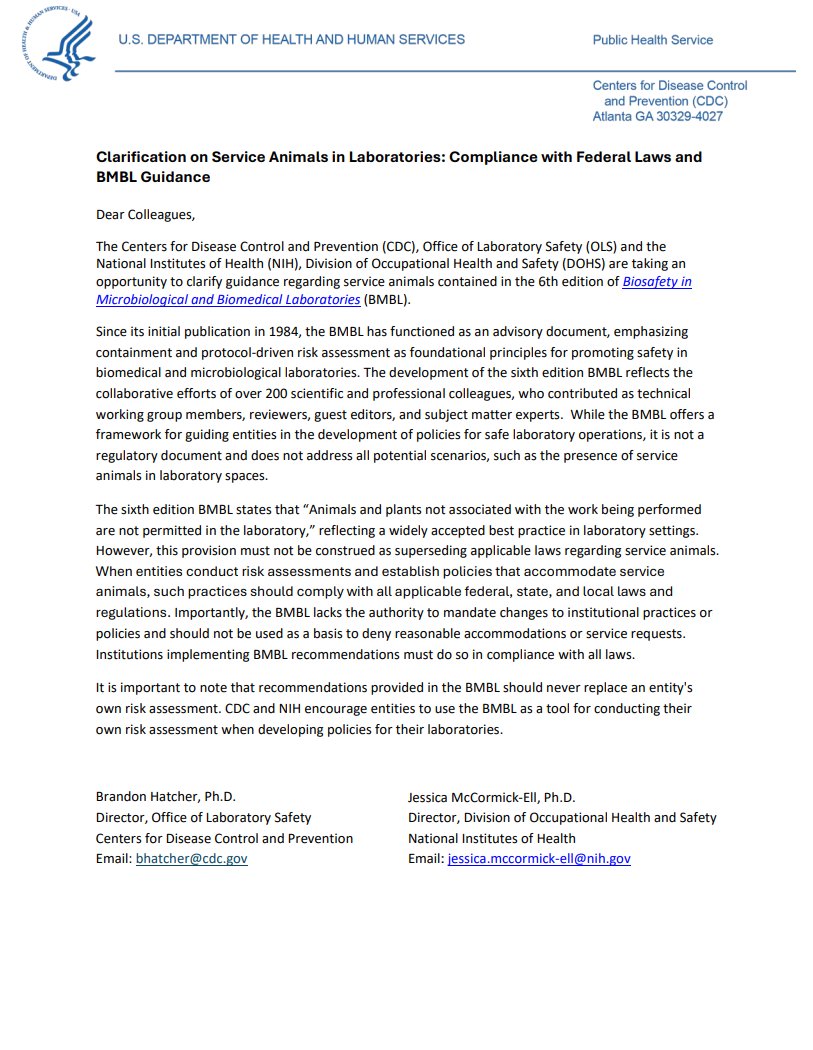
WE DID IT! Service animals have now been formally recognized by the CDC BMBL clarification, and it is the first time this has been explicitly stated in alignment with biosafety guidance at the federal level. URGENT UPDATE: Federal Clarification on Service Animal Access in Laboratories—Attention Safety and Compliance Personnel Nearly 3 years ago, a scientist lost their career over one sentence. They contacted me for help. They were highly qualified. They had an exemplary record. They were also disabled and relied on a trained service dog for independence. Then the newest edition of the CDC’s Biosafety in Microbiological and Biomedical Laboratories (BMBL) was released. One sentence changed everything: “Animals and plants not associated with the work being performed are not permitted in the laboratory.” That sentence—without context—was used to terminate them, and many others, as well as be used to deny students with disabilities utilizing a service dog for independnece access to labopratory experience. Not because of risk. Not because of performance. Not because of science. Because of interpretation. I took this on directly. I reached out to the authors and leadership behind the BMBL asking for one simple clarification: That service animals may be an exception based on individualized risk assessment. For months—nothing. So I escalated. I contacted Arizona Representative Juan Ciscomani and worked alongside his Legislative Director for over two and a half years. We engaged direct conversations with the CDC. We sent a letter signed by several others members of Congress and over a dozen biosafety organizations. We engaged in NIH modernization discussions. We spoke in open forums. We pushed—consistently, persistently, and with evidence. Today, there is a major step forward. CDC has issued a formal clarification: “Clarification on Service Animals in Laboratories: Compliance with Federal Laws and BMBL Guidance.” And it says what should have always been clear: • The BMBL does not override federal, state, or local law • It cannot be used to deny reasonable accommodations • It is guidance—not regulatory authority • Risk assessment—not blanket exclusion—must drive decisions Most importantly: Service animals must be considered within the framework of lawful accommodation and individualized risk assessment. This is more than a clarification. It is the first time this has been explicitly stated in alignment with biosafety guidance at the federal level. This is precedent setting. It closes a policy gap that has harmed careers, limited access, and forced talented scientists out of the field. To every Environmental Health & Safety office, compliance leader, biosafety professional, and institution: Please read this. Share this. Implement this. Because inclusion and biosafety are not in conflict—they were just never clearly aligned. Until now. I owe a great deal to Rep. Ciscomani and his Legislative Director for their trust, dedication, and commitment to making this possible! Direct link: lnkd.in/guhepBzG #CDC #NIH #ServiceAnimal #ServiceDog #Accessible #Science #Inclusion #BMBL #RepresentativeCiscomani #INSISTENT
Sampson the Service Dog tweet media
English
52
77
575
5K
Kate Sleeth, PhD
Kate Sleeth, PhD@ksleeth·
Have you ever wondered why is DEI relevant to science? Dr. Mahadeo Sukhai @ideastemcanada provides 3 examples of why DEI in scientific research actually makes the science better; by asking better questions, and improving data collection and analysis. youtu.be/LjTe0psyRdQ
YouTube video
YouTube
English
0
0
0
10
Kate Sleeth, PhD
Kate Sleeth, PhD@ksleeth·
At the end of the last video with Dr. Mahadeo Sukhai @ideastemcanada I mentioned that I didn't see why it was so hard to implement DEI accommodations/accessibility supports. Therefore this is an unexpected bonus video where he explains why that might be. youtu.be/zIQ0pLJvJI0
YouTube video
YouTube
English
0
0
0
7
Kate Sleeth, PhD
Kate Sleeth, PhD@ksleeth·
The series with Dr. Mahadeo Sukhai @ideastemcanada continues. This is an important one which I recommend everyone watch. You will probably be surprised at some of the information provided. youtu.be/AsxZ591XkTs
YouTube video
YouTube
English
0
0
0
8
Kate Sleeth, PhD
Kate Sleeth, PhD@ksleeth·
The next series of videos with Mahadeo Sukhai @ideastemcanada where I asked him all of my naive questions regarding DEI (Diversity, Equity and Inclusion). In this first video I ask him what DEI is and why I sometimes see the letters in a different order. youtu.be/ft_7ejSxxCM
YouTube video
YouTube
English
0
0
0
17
Kate Sleeth, PhD
Kate Sleeth, PhD@ksleeth·
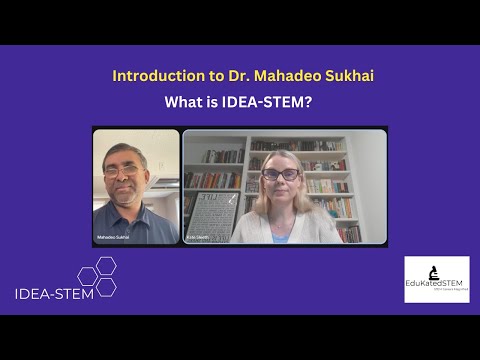
My friend and colleague Dr. Mahadeo Sukhai @ideastemcanada is the world’s first congenitally blind geneticist and I asked him to talk about his new initiative IDEA-STEM. He is proof that individuals who are differently abled can be successful in STEM. youtu.be/5ej9u9DUUjI
YouTube video
YouTube
English
0
0
0
13
Kate Sleeth, PhD
Kate Sleeth, PhD@ksleeth·
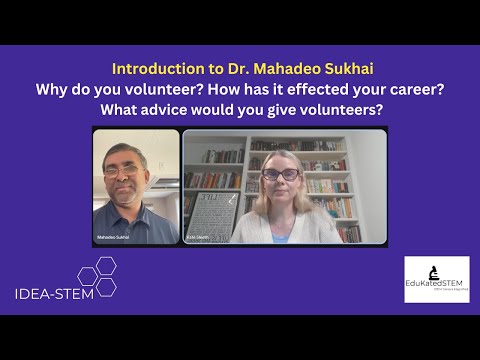
My colleague Dr. Mahadeo Sukhai @ideastemcanada is the world’s first congenitally blind geneticist and I asked him to talk about his extensive volunteering experience; why he does it and if he can give advice to those who wish to begin volunteering. youtu.be/OVffpP_9ttA
YouTube video
YouTube
English
0
0
0
40
Kate Sleeth, PhD
Kate Sleeth, PhD@ksleeth·
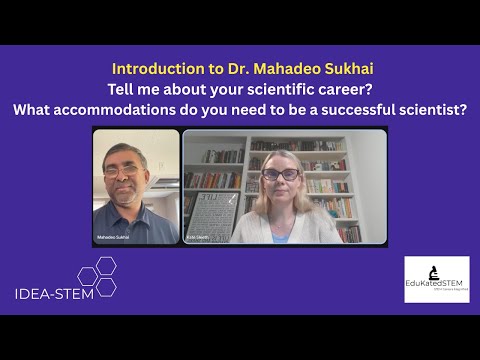
My colleague Dr. Mahadeo Sukhai @ideastemcanada is the world’s first congenitally blind geneticist and I asked him to talk about his scientific career and to explain his low vision accessibility supports. youtu.be/WtW8onO93mQ
YouTube video
YouTube
English
0
0
0
31
Kate Sleeth, PhD
Kate Sleeth, PhD@ksleeth·
My colleague Dr. Mahadeo Sukhai is the world’s first congenitally blind geneticist and I asked him to explain how his low vision has affected his education and career. He is proof that individuals who are differently abled can be successful in STEM. youtu.be/vfIOgaDJ1KQ
YouTube video
YouTube
English
0
0
0
49
Kate Sleeth, PhD
Kate Sleeth, PhD@ksleeth·
My friend and colleague Dr. Mahadeo Sukhai is the world’s first congenitally blind geneticist and I asked him to explain what low vision means. He takes me through a mini biology lesson before going into the details about his sight and experiences. youtu.be/HvemOL0OXIY
YouTube video
YouTube
English
0
0
0
39
Kate Sleeth, PhD
Kate Sleeth, PhD@ksleeth·
I am excited to be returning to the @nationalpostdoc annual conference, this time taking part in a panel for the plenary session. I will be joining Mark Moldwin, Heather Trepal, Rian Lund Dahlberg, Harry Sterling for a session moderated by Madhumita Joshi. tinyurl.com/mvaaeewe
Kate Sleeth, PhD tweet media
English
0
1
3
326
Kate Sleeth, PhD
Kate Sleeth, PhD@ksleeth·
I am speaking at 2026 National Postdoctoral Association Annual Conference. Please check out the details of my talk at: tinyurl.com/4rew7x38
English
0
0
0
15
Kate Sleeth, PhD
Kate Sleeth, PhD@ksleeth·
This is my most viewed video and it all concerns #GradSchool interview questions. Good luck if you are interviewing this year and please share widely. This is going to be a very competitive year and if this helps give someone the edge I will be very happy! youtu.be/rd3wS4Vkp1Y
YouTube video
YouTube
English
0
0
0
9
Kate Sleeth, PhD
Kate Sleeth, PhD@ksleeth·
Please share as with the reduced number of #GradSchool spots available, this year is going to be particularly challenging. You have been invited to participate in interviews for grad school. Here is some advice for before, during and after the interview. youtu.be/VM6t-z6w84c
YouTube video
YouTube
English
0
0
0
19
Kate Sleeth, PhD
Kate Sleeth, PhD@ksleeth·
It is the time of year for those in high school and undergrad to apply for summer internship programs. Having run one for many years and read thousands of applications, here is my advice. Please share the video as they are fiercely competitive. youtu.be/GSPYv04xPSw
YouTube video
YouTube
English
0
0
0
35
Kate Sleeth, PhD
Kate Sleeth, PhD@ksleeth·
Just spoke about an upcoming presentation in Feb. I will be tailoring my negotiation talk more than usual for this institution based on their feedback from last year. This is the real joy of being able to provide a service specifically for each population depending on their needs
English
0
0
0
14
Kate Sleeth, PhD
Kate Sleeth, PhD@ksleeth·
🚨 Application closes Dec 15 @awisnational The AWIS Bridge Grant program will offer microgrants to members who have lost federal research funding and who are: 🔵 assistant profs or nontenured faculty 🔵 tenured profs seeking to support their trainees awis.org/awis-bridge-gr…
English
0
0
1
19
Kate Sleeth, PhD
Kate Sleeth, PhD@ksleeth·
The final video in the series on starting a business is available. In this video, we'll answer some key questions about the realities of having a business: What are the pluses and minuses of having your own business? Would you do it again? youtu.be/_ILBQYqKW3Q
YouTube video
YouTube
English
0
0
0
9