

上田 欣也 (ウエダキンヤ)
54.3K posts
上田 欣也 (ウエダキンヤ)
@kuntakinya
熊本県合志市議会議員5期目。 保護司。合志の近代遺産を学ぶ会代表。 詩人。 くまもと戦争と平和のミュージアム設立準備会理事。 熊本県立大津高等学校卒、美術部。 青山学院大文学部英米文学科卒、ビートルズ訳詞研究会。 ザ・グレート・カントリー合志市!! 歴史と文化は、ここだけのもの
熊本県合志市 Katılım Haziran 2009
974 Takip Edilen785 Takipçiler
上田 欣也 (ウエダキンヤ) retweetledi


財務相が、通貨の投機的動きに注意するって、笑えるんですけど。
高市政権が最も投機的なのではないですか? #高市政権 #高市早苗
#円安
日本語
上田 欣也 (ウエダキンヤ) retweetledi

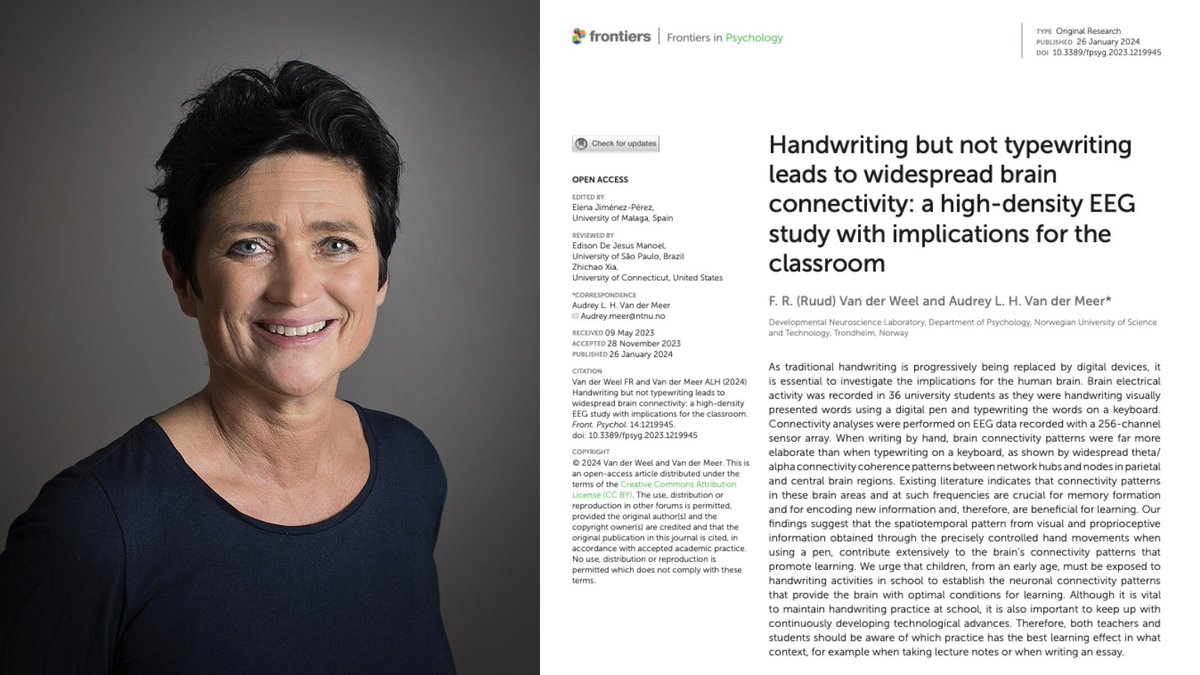
A Norwegian neuroscientist spent 20 years proving that the act of writing by hand changes the human brain in ways typing physically cannot, and almost nobody outside her field has read the paper.
Her name is Audrey van der Meer.
She runs a brain research lab in Trondheim, and the paper that closed the argument was published in 2024 in a journal called Frontiers in Psychology. The finding is brutal enough that it should have changed every classroom on Earth.
The experiment was simple. She recruited 36 university students and put each one in a cap with 256 sensors pressed against their scalp to record brain activity. Words flashed on a screen one at a time.
Sometimes the students wrote the word by hand on a touchscreen using a digital pen, and sometimes they typed the same word on a keyboard. Every neural response was recorded for the full five seconds the word stayed on screen.
Then her team looked at the part of the data most researchers had ignored for years, which is how different parts of the brain were communicating with each other during the task.
When the students wrote by hand, the brain lit up everywhere at once.
The regions responsible for memory, sensory integration, and the encoding of new information were all firing together in a coordinated pattern that spread across the entire cortex. The whole network was awake and connected.
When the same students typed the same word, that pattern collapsed almost completely.
Most of the brain went quiet, and the connections between regions that had been alive seconds earlier were nowhere to be found on the EEG.
Same word, same brain, same person, and two completely different neurological events.
The reason turned out to be something nobody had really paid attention to before her work. Writing by hand is not one motion but a sequence of thousands of tiny micro-movements coordinated with your eyes in real time, where each letter is a different shape that requires the brain to solve a slightly different spatial problem.
Your fingers, wrist, vision, and the parts of your brain that track position in space are all working together to produce one letter, then the next, then the next.
Typing throws all of that away. Every key on a keyboard requires the exact same finger motion regardless of which letter you are pressing, which means the brain has almost nothing to integrate and almost no problem to solve.
Van der Meer said it plainly in her interviews.
Pressing the same key with the same finger over and over does not stimulate the brain in any meaningful way, and she pointed out something that should scare every parent who handed their kid an iPad.
Children who learn to read and write on tablets often cannot tell letters like b and d apart, because they have never physically felt with their bodies what it takes to actually produce those letters on a page.
A decade before her, two researchers at Princeton ran the same fight using a completely different method and ended up at the same answer. Pam Mueller and Daniel Oppenheimer tested 327 students across three experiments, where half took notes on laptops with the internet disabled and half took notes by hand, before testing everyone on what they actually understood from the lectures they had watched.
The handwriting group won by a wide margin on every question that required real understanding rather than surface recall.
The reason was hiding in the transcripts of what the two groups had actually written down.
The laptop students typed almost word for word, capturing more total content but processing almost none of it as they went, while the handwriting students physically could not write fast enough to transcribe a lecture in real time, which forced them to listen carefully, decide what actually mattered, and put it in their own words on the page.
That single act of choosing what to keep was the learning itself, and the keyboard had quietly skipped the choosing and skipped the learning along with it.
Two studies. Two countries. Same answer.
Handwriting makes the brain work. Typing lets it coast.
Every note you have ever typed instead of written went into your brain through a thinner pipe. Every meeting, every book highlight, every idea you captured on your phone instead of on paper was processed at half depth.
You did not forget those things because your memory is bad. You forgot them because typing never woke the part of the brain that would have made them stick.
The fix is the thing your grandmother already knew.
Pick up a pen. Write the thing down. The slower road is the faster one.
English
上田 欣也 (ウエダキンヤ) retweetledi
トランプはあちこち電話している。飛行機から15分とかじゃなくてもっと。高市首相が喜色満面で「電話が…」と会見したためトランプが各国首脳に電話していることが日本のニュースになるように。
韓国の李大統領はトランプ氏と30分間電話会談、トランプ氏は習近平国家主席との会談に関して説明した。
時事ドットコム(時事通信ニュース)@jijicom
【速報】韓国大統領府によると、米韓首脳が電話会談した jiji.com/jc/article?k=2…
日本語
上田 欣也 (ウエダキンヤ) retweetledi
参政党の地方議員8人が「国保逃れ」をしていたとして、本日、離党勧告処分が下されました。
まずこの手法を平易に説明します。
地方議員は、個人事業主と同じ「国民健康保険」の加入者です。年収1,400万円規模の議員の場合、国保料は年間約110万円に達します。ところが、勤務実態がほぼない一般社団法人の役員に就任し、そこで「社会保険」に切り替えることで、年間の負担を約30万円まで圧縮できます。差額は年間約80万円です。
では、その「浮いた80万円」はどこから来るのでしょうか。
国民健康保険の財源は、皆さんと同じく保険料と税金で支えられています。本来負担すべき人が制度から抜け出すほど、残った加入者への負担が増す仕組みです。
神谷代表は「違法性の認識はなかった」と説明しました。しかし厚生労働省は今年3月、まさにこの手法について「勤務実態がない役員は社会保険の適用外」と明示する通知を発出しています。「知らなかった」で済む話では、もはやありません。
参政党は「国民とともに痛みを分かち合う」政治を訴えてきました。その党の議員たちが、一般市民が払い続ける保険料から意図的に離脱していた。これは違法か合法かという話の前に、政治家として何を体現していたのかという問題です。
処分は「離党勧告」にとどまり、議員辞職は個人の判断に委ねるとされました。
Yahoo!ニュース@YahooNewsTopics
【参政地方議員が国保逃れ 8人処分】 news.yahoo.co.jp/pickup/6580660
日本語
上田 欣也 (ウエダキンヤ) retweetledi


何で謝ってるんだろ?船の事故なのに。乗せたのは高校だしな。
共産・田村氏、辺野古事故でおわび 高校生を船に乗せたこと「重大な誤り」(沖縄タイムス) news.yahoo.co.jp/articles/16395…
日本語


@masa_yagami 談合排除のために作られたプロポーザル、総合評価方式の弱点とも言える部分なので、内部告発以外に表沙汰になることはないでしょう。
日本語
で、改憲急ごうなんて、国民投票が楽しみで仕方がない。
高市内閣「支持」下落 3月以来の60%台 物価高対策への不満6割近く 8割弱が「手取り増えた実感ない」 FNN世論調査を詳細分析(FNNプライムオンライン(フジテレビ系))
#Yahooニュース
news.yahoo.co.jp/articles/e3d73…
日本語
@masa_yagami 観測気球にしても、粗雑な記事ですね。何を言いたいのか、わかりません。萩生田の大臣答弁は誠実で好きだったんですけど。
日本語
萩生田氏 ガソリン補助見直し示唆
延々と続けるのも無理がある
2026年5月18日 news.yahoo.co.jp/pickup/6580663
日本語
上田 欣也 (ウエダキンヤ) retweetledi
トランプ訪中後の「米代表団が中国の支給品や土産をゴミ箱に投げ捨てた」というX(旧Twitter)のバズりネタ、海外メディアの検証で真相が判明。
結論から言うと「大げさに誇張されたデマ」です。
実際のところ:
ネットで言われているような「中国を公然と侮辱するための嫌がらせ(ゴミ箱への一斉廃棄)」を証明する公式な証拠、写真、動画は一切存在しません。
実際にあったのは、出入国の際にIDカードやバッジを返却し、サイバーセキュリティー(盗聴・マルウェア対策)の観点から一時的な端末の持ち込みを制限するという、国際外交における「ごく一般的な通常安全プロトコル」に過ぎません。
握手と笑顔の裏で行われる通常の防諜手続きが、ネットの「スカッとする話」を求める願望や、一部の政治家によって劇場型のドラマに歪められた典型例。
騙されないように要注意です。
news.meaww.com/fact-check-did…
日本語
確かに、門田はお目出度い。こういうことを言っておかないと、自分の立ち位置が危ういのだろうと私は思う。
有馬哲夫@TetsuoArima
ビジネス保守って現実が理解できないバカなのか。 お花畑もいいところ。 トランプは、台湾など守る気はない。 日本も守る気はない。 だから虎の子のトリポリを中東におくった。 トランプはイラン攻撃で泥沼化にはまって打つ手がないから習近平のポチになっている。 そのポチの抱きつきポチがサナエ。 日本の地位が地に堕ちた。 早く辞めてくれ。
日本語
九州南部の火山群、地下に巨大なマグマだまりか 九州大学など指摘 - 日本経済新聞 nikkei.com/article/DGXZQO…
日本語
なんでこの記事が今頃グーグルに上がってくるんじゃ!?
東京エレクトロン九州、新開発棟のしゅん工が25年夏に延期|熊本日日新聞
#熊本のニュース #熊本日日新聞 #熊日 #熊本
kumanichi.com/articles/10421…
日本語