Kyle J

19 posts

Kyle J banner
Kyle J

Kyle J

@kylejresearch

United States Katılım Nisan 2023
73 Takip Edilen20 Takipçiler
Kyle J
Kyle J@kylejresearch·
🚨 ELON JUST REVEALED WHICH JOBS AI WILL ELIMINATE FIRST It's not the labor jobs that disappear. IT'S THE DESK JOBS. Musk laid it out clearly: anything digital gets replaced first. If you're producing files, documents, spreadsheets, or code at a computer, you're in the direct line of fire. AI already operates in the digital world. It doesn't need a body or an office. Just access to the same software you're using. Faster output, zero fatigue, scales infinitely for free. Accountants? AI does it faster. Analysts? AI does it cheaper. Paralegals? AI works 24/7. Coders? AI is already writing half the internet. ALL DIGITAL OUTPUT. ALL IN AI'S LANE. Now look at the other side: Welding. Electrical work. Plumbing. HVAC. Jobs where you're physically moving materials in unpredictable environments. AI can't do that. Real-world physics. Tight spaces. Problem-solving on the fly. THAT'S FRICTION AI CAN'T BRUTE FORCE PAST. Digital work = maximum exposure. Physical work = maximum protection. The irony is brutal: Society spent decades pushing everyone toward office jobs and away from the trades. We told people desk work was the safe, respectable path. TURNS OUT WE HAD IT BACKWARDS. The people who became electricians, welders, and plumbers built the most automation-proof careers in existence. The work we looked down on survives. The work we put on a pedestal automates first. BUT HERE'S WHAT AI CAN'T REPLACE: Critical thinking in ambiguous situations. Strategic decision-making when there's no clear answer. Building relationships and trust. Creative problem-solving that requires intuition, not pattern recognition. AI executes. Humans decide what's worth executing. AI optimizes processes. Humans figure out which processes to build. THE PEOPLE WHO THRIVE WON'T BE THE ONES DOING REPETITIVE TASKS. They'll be the ones asking better questions, making judgment calls AI can't make, and connecting dots that don't exist in training data. If your job is purely execution, that's at risk. If your work requires creativity, strategy, or navigating complex human dynamics? THAT'S WHERE HUMANS STAY KING. The shift isn't "AI vs. humans." It's "AI + humans who leverage it" vs. "humans who get replaced by it." Position accordingly.
English
0
1
1
113
Kyle J
Kyle J@kylejresearch·
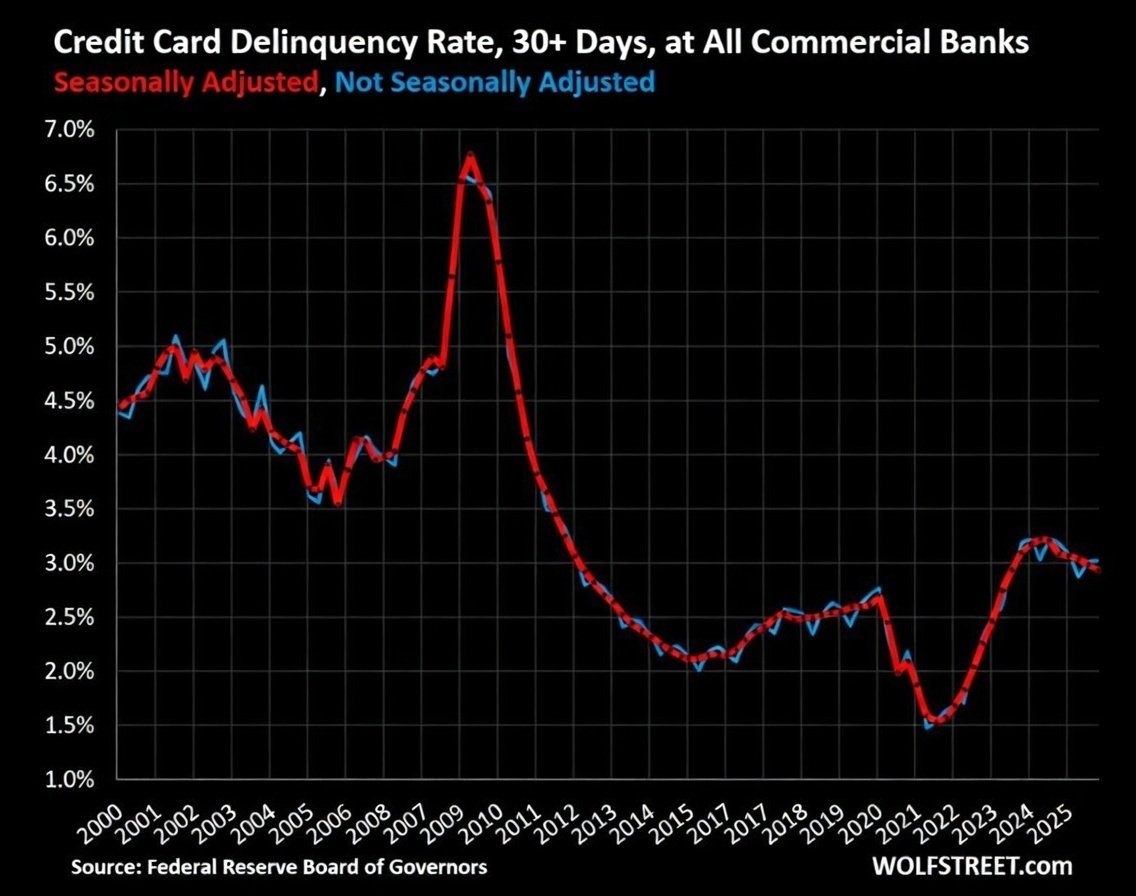
🚨 EVERYONE SAYS CONSUMERS ARE BROKE BUT THE DATA SAYS OTHERWISE The narrative right now is that Americans are tapped out, struggling, and about to crack. Credit card debt is "exploding." Delinquencies are "skyrocketing." EXCEPT TTHAT IS NOT ALL TRUE. Credit card delinquency rates just dropped to 2.94% in Q4 2025, the lowest level since Q3 2023. That's down from 3.08% a year ago and 3.10% two years ago. Third-party collections (where defaulted accounts end up) hit a record LOW of 4.6%. THINK ABOUT THAT. The media keeps screaming about a consumer crisis while delinquencies are literally falling. Here's what's actually happening: Credit card balances rose $69 billion year-over-year to $1.28 trillion. But those balances are STATEMENT balances, most get paid off every month and never accrue interest. Credit card balances aren't a measure of debt. They're a measure of SPENDING. And Americans are spending at record levels because they're earning record levels of income. THE CONSUMER BALANCE SHEET IS STRONG. 65% of Americans own their homes. 40% of homeowners have NO mortgage. Over 60% of households hold stocks. Many are sitting on record piles of interest-earning cash. The debt-to-disposable-income ratio for credit cards and consumer loans? 8.0%—the same as 2023 and 2024, and BELOW pre-pandemic levels. Meanwhile, available unused credit hit a record $4.15 trillion. CONSUMERS HAVE MORE ACCESS TO CREDIT THAN EVER AND AREN'T USING IT. So why does everyone think consumers are broke? Because the narrative drives clicks. "Americans drowning in debt" gets more engagement than "consumers managing finances well." But the actual data, delinquencies, collections, debt-to-income ratios, all point to a healthy consumer. Most people think rising credit card balances = rising defaults. What's actually happening? Rising balances reflect increased spending power while delinquencies DROP. That's not a crisis. That's a functioning economy.
Kyle J tweet media
English
0
1
1
107
Kyle J
Kyle J@kylejresearch·
🚨 RAY DALIO JUST ISSUED A WARNING The U.S. is entering a debt death spiral. National debt: $38 trillion and climbing. Annual interest payments now EXCEED the entire defense budget. WASHINGTON IS BORROWING NEW MONEY JUST TO PAY THE INTEREST ON OLD DEBT. That’s not fiscal policy. That’s a Ponzi scheme. And Ray Dalio says hyperinflation is the inevitable endgame. HERE’S WHY THERE’S NO EXIT: Dalio has studied every major empire collapse in history—Rome, Spain, Britain, the Dutch Empire. They all followed the same script: Massive debt accumulation. Currency debasement. Loss of institutional trust. Internal division. America is checking every single box. Right now, tax revenue doesn’t even cover mandatory spending. Social Security + Medicare + interest payments consume MORE than the government collects. EVERYTHING ELSE RUNS ON BORROWED MONEY. - Defense? Borrowed. - Infrastructure? Borrowed. - Education? Borrowed. And every dollar borrowed adds to the compounding interest burden. This is what a debt spiral looks like in slow motion. GOVERNMENTS IN THIS POSITION HAVE TWO CHOICES: - Option 1: Default on the debt (political suicide, will never happen). - Option 2: Print money and inflate the debt away (the slow, hidden tax on savers). Guess which one they ALWAYS choose? The playbook is simple: The Fed cuts rates to make the debt serviceable. The Treasury keeps issuing bonds. The money supply expands. Your dollars buy less every year. Most people think “inflation is under control” because headline CPI dropped. Meanwhile, REAL ASSETS keep grinding higher. THAT’S NOT GROWTH. THAT’S DEBASEMENT. The math is undeniable now. We’re past the point of “managing” this problem. The only question left is how fast it accelerates and who gets destroyed when it does.
English
0
1
1
74
Kyle J
Kyle J@kylejresearch·
🚨 PRIVATE EQUITY IS MORE STUCK THAN IT WAS IN 2008 Private equity just posted its fourth straight year of declining returns to investors. Distributions as a percentage of net asset value stayed at 14%, the second-lowest level since the depths of the 2008 financial crisis. BUT HERE'S THE DIFFERENCE: The 2008 drought lasted about two years. This one is now in year FOUR. THE INDUSTRY IS SITTING ON $3.8 TRILLION OF UNSOLD ASSETS. Think about that number. $3.8 trillion in companies they can't exit. They own roughly 32,000 portfolio companies and are holding them for an average of 7 years now, up from 5-6 years in 2021. Why can't they sell? Interest rates rose in 2022 and never came back down enough. Exit multiples compressed. Valuations dropped. The IPO market froze. So private equity is stuck holding companies they were supposed to flip years ago. AND IT'S GETTING WORSE. Deal activity looked "gangbusters" in January 2025. Then Trump's "Liberation Day" tariffs hit, and dealmaking slammed to a halt. Total deals in 2025: 3,018 (down -6% from 2024). Meanwhile, fundraising collapsed -16% to $395 billion in 2025. THAT'S FOUR STRAIGHT YEARS OF DECLINES. Here's why this matters: Private equity promised investors 20%+ IRRs. But to hit those returns in today's environment, firms need to grow EBITDA by 12% annually for five years. Previously, 5% growth was enough. "12 is the new 5," according to Bain's report. Most portfolio companies can't grow at 12% per year. Especially not the ones stuck in the back of the portfolio for 7+ years. So what happens? Firms sell their "gem" assets to meet distribution requirements and keep the struggling ones on the books. The longer they hold, the worse the IRRs look. THIS IS A LIQUIDITY CRISIS IN SLOW MOTION. Pensions and endowments are getting pickier. They're demanding proof of value creation BEFORE committing capital. That means fewer new funds. Less dry powder deployment. Longer hold periods. And $3.8 trillion still sitting there with no exit in sight. Most people think private equity is fine because deal values are "up." What's actually happening? The industry is stuck holding assets it can't sell in a market that won't cooperate.
Kyle J tweet media
English
0
4
5
86
Kyle J
Kyle J@kylejresearch·
🚨 ELON JUST TOLD YOU THE ENTIRE ECONOMY IS ABOUT TO BREAK And everyone's treating it like good news. He said nobody will need to work soon because AI and robotics will handle everything. Work becomes optional. Like a hobby you choose, not something you need to survive. SOUNDS GREAT, RIGHT? Now let me ask you a different question: What happens to your mortgage when your income goes to zero? What happens to rent? To food costs? To healthcare? Do those also become "optional" in Elon's robot paradise? OF COURSE NOT. Here's what he's actually describing: A world where production is infinite and cheap, but ownership is concentrated in about 50 companies. Everyone else becomes economically irrelevant. You don't have a job. You don't have bargaining power. You don't have leverage. But the people who OWN the AI? They have everything. THIS IS THE BIGGEST WEALTH TRANSFER IN HUMAN HISTORY. And it's being sold to you as "liberation from work." Think about what "not needing to work" actually means in a capitalist system where you still need money to survive. It means you're DEPENDENT. Completely dependent on whoever controls the resources. Whether that's UBI from the government or scraps from mega-corporations, you're no longer a participant in the economy. You're a liability being managed. THE AI REVOLUTION ISN'T A JOBS PROBLEM. It's a power consolidation problem. Elon and a handful of others are building the infrastructure that makes human labor obsolete. But they're not building the system that distributes the wealth that creates. That part? They're hoping you don't think about. So yeah, AI will replace your job. And unless there's a massive restructuring of who owns what, you're not going to be "free to pursue hobbies." You're going to be economically worthless in a system that still requires money to live. THAT'S the future we're walking into.
English
0
1
1
83