KyroDB

104 posts

KyroDB banner
KyroDB

KyroDB

@kyrodb

Give reliable context to your AI agents and RAG

India Katılım Ekim 2025
1 Takip Edilen27 Takipçiler
Sabitlenmiş Tweet
KyroDB
KyroDB@kyrodb·
Make your AI Reliable and Accurate. Get KyroDB
Kishan@kishanvats03

AI is bound to fail. The biggest lie you’re told: “Just plug an MCP into your knowledge base, and you have a smart assistant.” You don’t. That just connects your AI to data. It doesn’t prove the data is safe to trust. It doesn’t prove the policy wasn’t replaced yesterday. So the model does what models do: reads outdated context with perfect confidence. That’s how AI systems actually fail in production. Not because the model is stupid. Because the system handed it unsafe evidence and asked it to be certain. We built @kyrodb to fix exactly this. It’s a context correctness runtime that sits between your AI agents and your knowledge stores. Before context reaches the model, KyroDB checks freshness, scope, provenance, and proof. If it’s stale, unsafe, or unprovable, your AI doesn’t guess. It knows when it knows. And refuses when it doesn’t. KyroDB is the last line of defense before your AI speaks. First 100 developers get 25% off. Coupon + link in the comments.

English
0
0
5
102
KyroDB
KyroDB@kyrodb·
Stale informations cost million dollars in production. Is the data going to your AI safe and secure?
English
0
2
2
43
Kishan
Kishan@kishanvats03·
damn, really?
Kishan tweet media
English
1
0
4
61
KyroDB retweetledi
Kishan
Kishan@kishanvats03·
Saw a reel in which a contestant pitched a context solution to @waitin4agi_ and he rejected that by saying 'Context won't be a problem in the long run' by giving an example of increasing context window in LLMs. I have great respect for Varun, but he is 100% wrong here. The idea of 'We can solve context problem by increasing the context window' is out of touch in so many ways. Bigger context windows help capacity, but they do not automatically solve selection, relevance, or pollution. 'Needle in the haystack and 'context rot' problems are one of the most complained issues when you visit developer forums(on X too). We are fixing this context issue at @kyrodb. Long context ≠ usable context Many frontier researchs also highlighted this issue. 🧵
English
2
1
6
160
Kishan
Kishan@kishanvats03·
one of the core reasons behind all this is 'Context rot' and we are fixing it, almost near to solving the 'Needle in the haystack problem'.
CJ Zafir@cjzafir

Codex can get dumber and slower on long sessions. Here's the fix: 1. Run Process_narration=false This will stop Codex from showing you all the planning steps, resulting in saving a lot of output tokens. 2. Prompt: "Act as an orchestrator. Use parallel agents to do the research and execution work. Write detailed tasks for each parallel agent and force them to act, iterate, get their tasks done, and bring back an in-depth report. Your job is to deeply analyze the agents' work, provide feedback, and provide them with continuous tasks." This prompt offloads the majority of the context-burning work to agents, and each agent has its own context window. So you can utilize 5 agents (5 context windows). 3. Add this hard rule: "Measure twice, cut once policy." Debugging and patching is messy work. Force Codex to plan first, act after (don't use plan mode; it's just overcomplicated). Ask it to make a task list for every task so it can track progress and iterate better. 4. Add this hard rule: "Keep the codebase clean, no tmp files, no dead code, no dead files. Stay organized all the time. No unnecessary folders, subfolders, or files." Claude keeps most of its working files in cache as temporary files (which is bloatware, but it keeps the codebase neat), but Codex is output-heavy. It creates tons of folders and files, and your workspace can become a mess after a few sessions. As a result, this contaminates the context window and degrades performance. Force Codex to stay organized and follow the file structure. These 4 techniques can help you save 40% context every session, and performance will be a lot better. For planning, use Codex 5.5 (extra high), and after the plan is done, shift to Codex 5.5 (high) with fast mode. This works faster.

English
1
0
6
112
KyroDB retweetledi
Kishan
Kishan@kishanvats03·
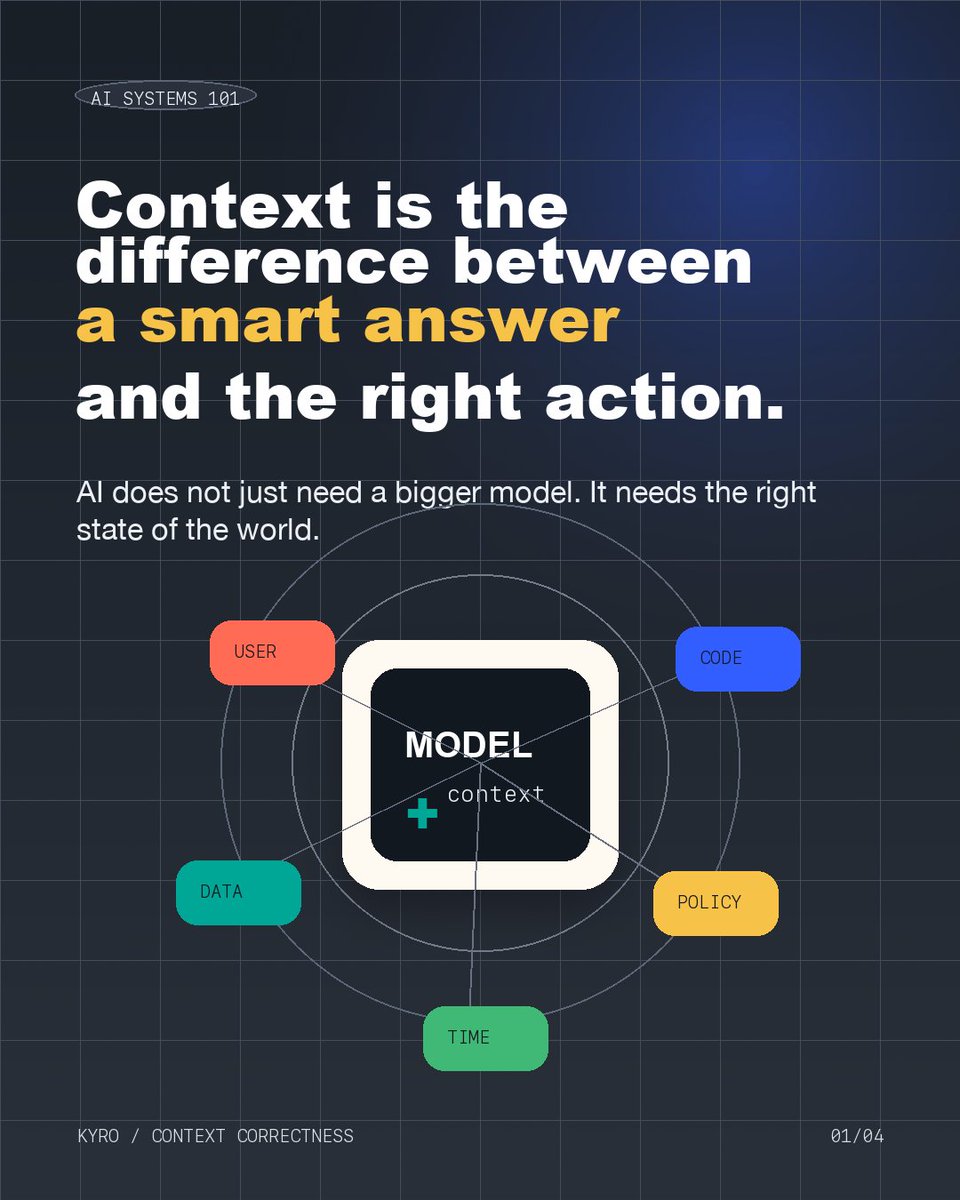
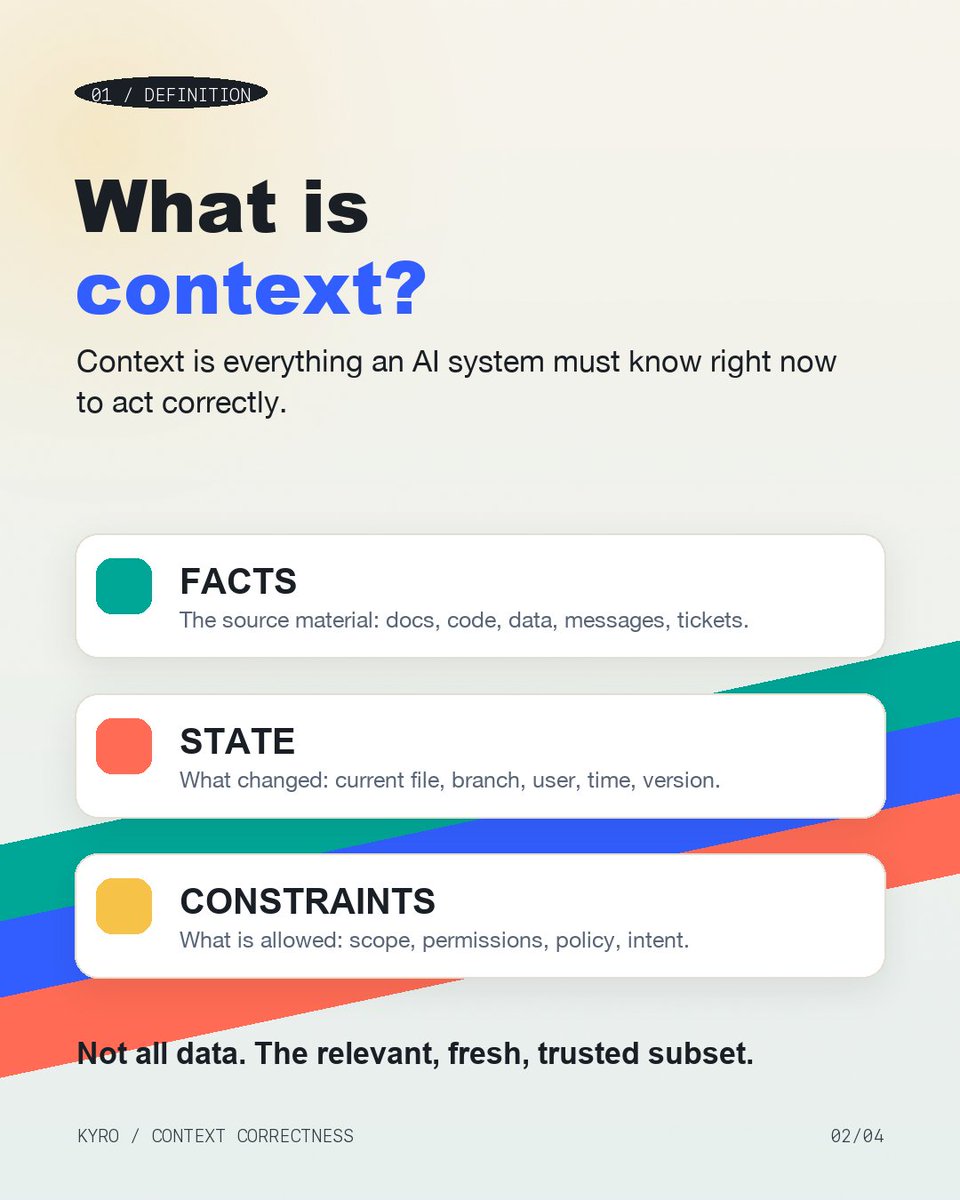
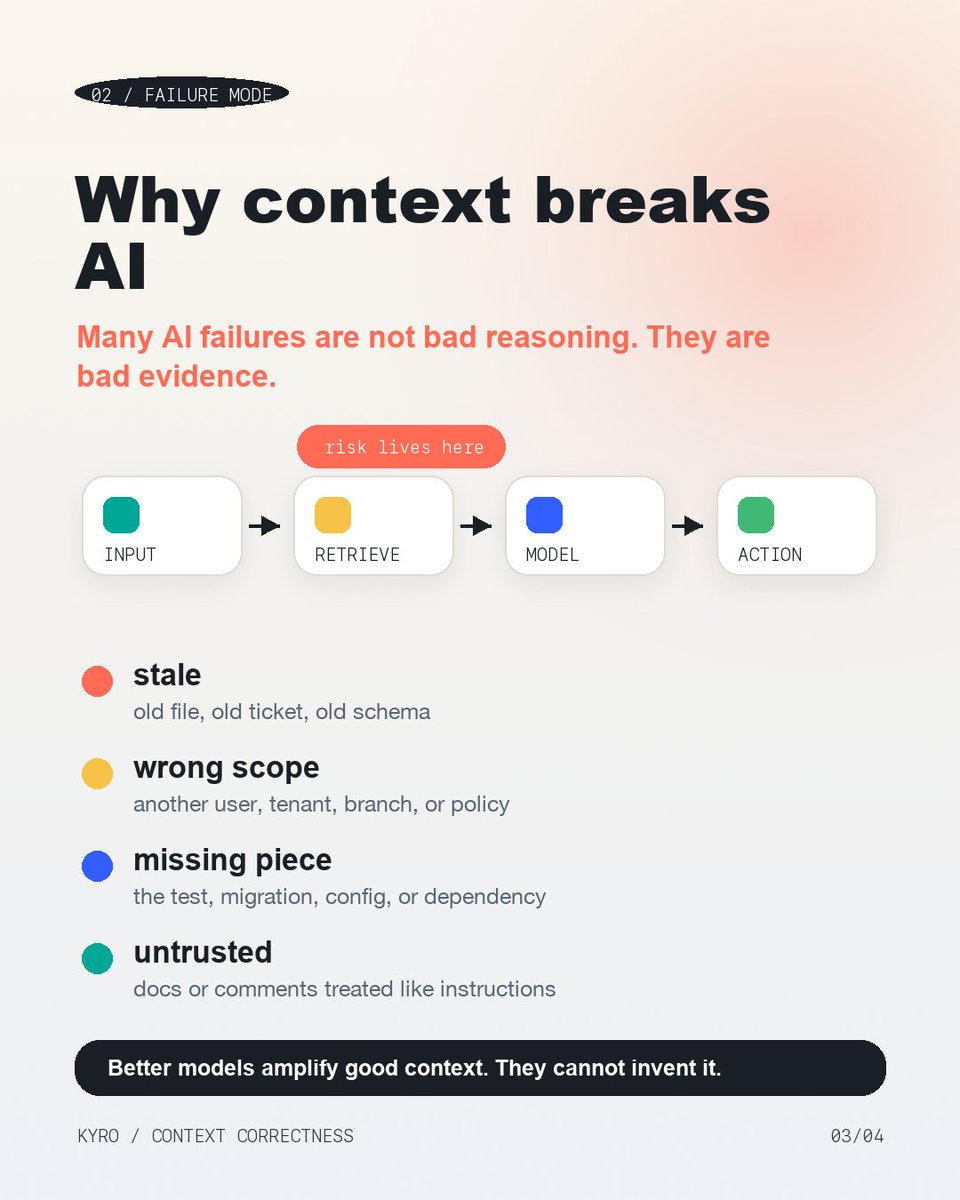
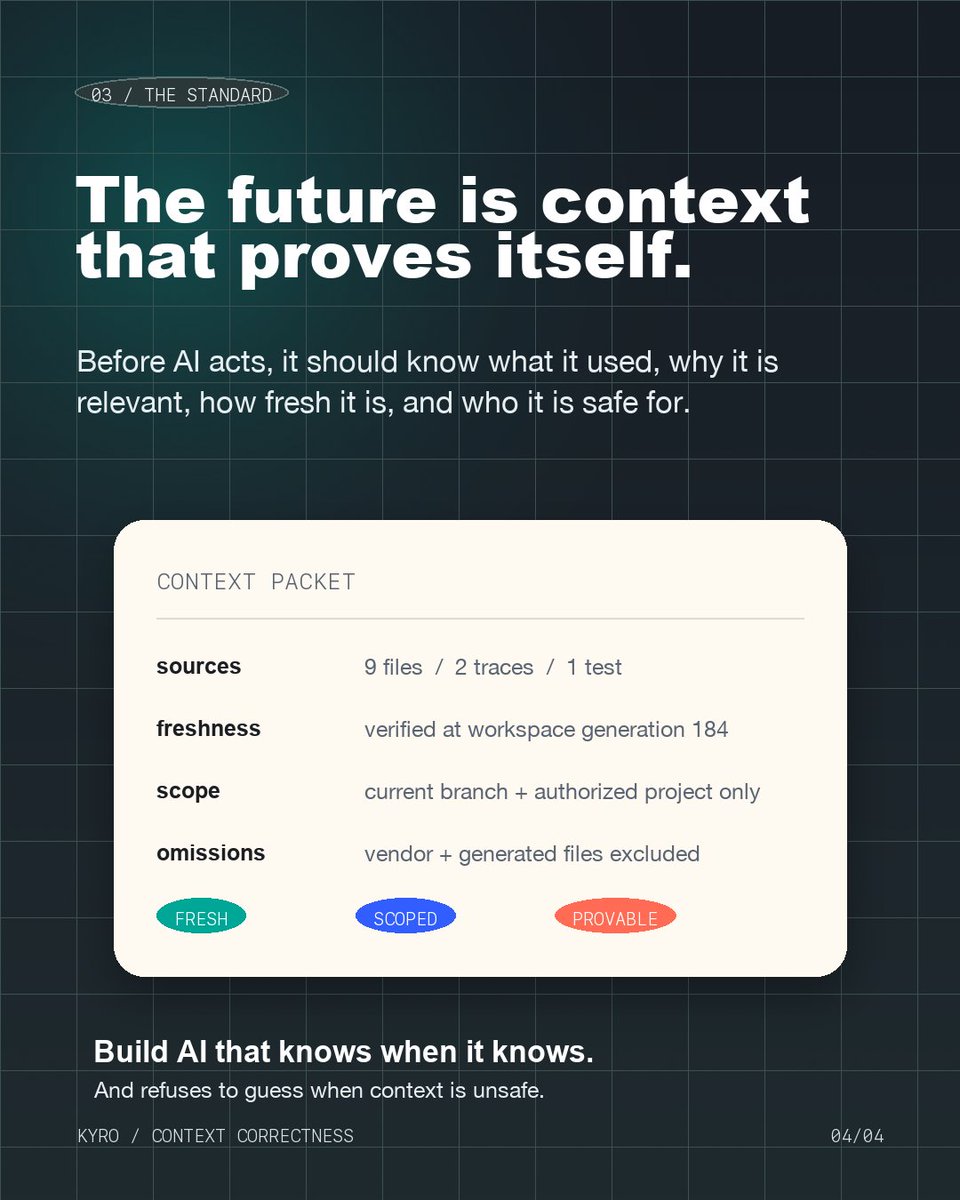
AI systems do not fail only because the model is weak. They fail because the context is stale, incomplete, unsafe, or irrelevant. The next layer of AI infrastructure is context that is fresh, scoped, and provable before the model acts.
Kishan tweet mediaKishan tweet mediaKishan tweet mediaKishan tweet media
English
1
1
3
62
KyroDB retweetledi
Kishan
Kishan@kishanvats03·
Opening up my calendar to chat on AI agents, mostly around retrieval/context/memory. If you are someone working in this field or even interested in this, let's chat and discuss what's going on in the market. Link in comments.
English
2
1
4
148
KyroDB retweetledi
Kishan
Kishan@kishanvats03·
@kyrodb is designed to solve exactly this problem by making retrieval adaptive, predictive, and cache-first instead of vector-first. It avoids that trap with Hybrid Semantic Cache + learned prediction + tiered coherence, which turns RAG into something that stays sharp even as scale grows, especially for the agentic/voice/real-time use cases where collapse hurts most.
How To AI@HowToAI_

RAG is broken and nobody's talking about it. Stanford researchers exposed the fatal flaw killing every "AI that reads your docs" product in existence. It’s called "Semantic Collapse," and it happens the second your knowledge base hits critical mass. If you've noticed your AI getting "dumber" as you add more data, this is exactly why. Right now, companies are dumping thousands of documents into their AI, thinking it’s getting smarter. When you add a document to RAG, it converts it into a high-dimensional vector. Under 10,000 documents, this works perfectly. Similar concepts cluster together. But past 10,000 documents, the space fills up. The clusters overlap. The distances compress. Everything starts to look "relevant." It is a mathematical law called the Curse of Dimensionality. In a 1000-dimensional space, 99.9% of your data lives on the outer edge. All points become equidistant from each other. That perfect, relevant document you are looking for now has the exact same mathematical similarity as 50 completely irrelevant ones. The Stanford findings are brutal: At 50,000 documents, precision drops by 87%. Semantic search actually becomes worse than old-school keyword search. Adding more context doesn’t fix the AI. It makes the hallucinations worse. Your "nearest neighbor" search isn't finding the best answer anymore. It's finding everyone. We thought RAG solved hallucinations. It didn't. It just hid them behind math.

English
1
2
6
781
KyroDB
KyroDB@kyrodb·
Get KyroDB today to power your agents and RAG pipelines with ultra-fast retrieval and personalised memory.
Kishan@kishanvats03

@kyrodb broke the ceiling of ANN benchmarks. Perfect 100% recall on 3 out of 6 datasets (Fashion-MNIST, GloVe-25, SIFT-128) Near-perfect (99.78%–99.91%) on the other 3, essentially lossless retrieval across the board. KyroDB now proves SOTA in high-dimensional vector search on AI workloads, but that's just a flashy thing. Behind the scenes, something more intelligent and powerful is in place to work on production workloads. Most vector DBs skip cache invalidation entirely. Stale vectors silently poison your retrieval. KyroDB ships with a new cache architecture called Hybrid Semantic Cache(HSC)- cache-aware retrieval that knows when to trust the cache and when to invalidate. High recall means nothing if you're retrieving from a stale index state. Get @kyrodb today to power your agents and RAG pipelines with ultra-fast retrieval and personalised memory. Link in comments.

English
0
0
1
42
KyroDB retweetledi
Kishan
Kishan@kishanvats03·
Get safe cache + retrieval brain in one system for your agents. Get @kyrodb
English
0
1
4
86
KyroDB retweetledi
Kishan
Kishan@kishanvats03·
HNSW + LRU is broken
English
0
1
2
118
KyroDB retweetledi
Kishan
Kishan@kishanvats03·
High and precise recall is a necessity for agentic search now. For traditional search workloads (find me the top-10 similar movies), 97% recall is fine. For agentic reasoning loops where a single missed document can cause the agent to hallucinate or take a wrong logical step, even a 2% recall drop is potentially catastrophic. Every document the agent fails to retrieve is a reasoning failure that cascades through the entire chain. @kyrodb gives you exactly what these agents need, extreme high recall at high dimensions
English
0
1
3
124
KyroDB
KyroDB@kyrodb·
The new agentic era needs new infrastructure to work on; we are making models faster and better. What about the bedrock on which they rely and work? Slow and brittle?
Kishan@kishanvats03

that's exactly the philosophy with which we built @kyrodb, our data infra was designed to serve human needs for transactions and analytics, not the needs that these agents require and deserve. > designed the whole architecture from scratch to serve the agents. > created new caching mechanism to provide ultra-low latency and memory > solved the cold-cache spikes and cache invalidation problem. KyroDB currently ranks #1 on ANN for high-dimensional vector search. thanks for voicing this @JeffDean

English
0
0
2
132