

Duke
3.7K posts
Duke
@laks
🎨 Art lover, meme dealer, analyst 💡 | Making gains (and laughs) in the Web3 wild west 🚀🤣 | Metti Maxi
metaverse Katılım Nisan 2008
2.2K Takip Edilen838 Takipçiler
Duke retweetledi


@planetfutebol @F365 Edu, Gilberto Silva, Denilson, Eduardo<half Brazilian Croatian>, Andre Santos, Julio Baptista, Martinelli, Jesus, Gabriel Magalhaes, Willian, David Luiz . Thats all i can remember
English

Can you name every Brazilian to play for Arsenal in the Premier League?
#PremierLeague
planetfootball.com/quizzes/can-yo…
English
We played really badly today, I saw no spark, if not for David Raya and Saliba we would have lost the match. Doesn't bode well for the attack and midfield, I didn't see them sync and constant misplaced passes didn't help. We need to get our shit together if we want to challenge. #manuarsenal #Arsenal #ManchesterUnited
English
Duke retweetledi

On-Chain Checker listing of the day:
Filaments by @ab_infinite
A collection of 500 infinitely animated generative pixel artworks from October 2021. Utilizes of mixture of Arweave/off-chain dependencies reducing the on-chain score, with core algorithm on-chain
Welcome to OCC!
English
English

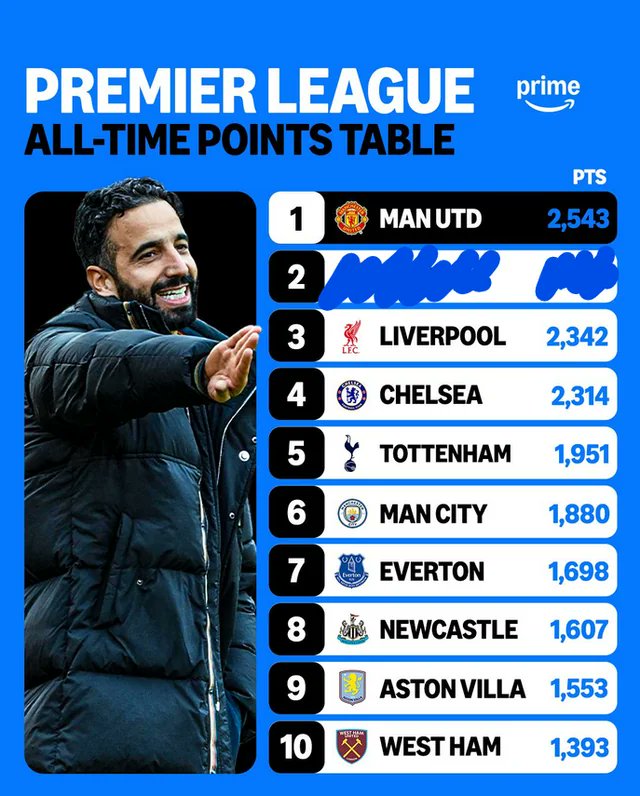
Arsenal is likely the second-placed club in the Premier League All-Time Points Table with 2,388 points, behind Manchester United's 2,543, based on 2025 data from MyFootballFacts.com. The table rewards consistency but has flaws. It favors teams with more seasons, like Arsenal, and may not reflect luck or recent form. Points per game offers a fairer metric—Manchester City’s 1.747 surpasses Tottenham’s 1.541 despite fewer points. Consider both metrics for a balanced view.
English

Quiz question of the day: Guess the 2nd placed club
English
@ClubWPTGold @grok are they playing 5/10 or 10/20 or other limits and what's the total value of chips in front of mark Zuckerberg?
English

Mark Zuckerberg was hitting the Poker tables this weekend in Vegas 👀
(via Zuck/IG)
English


Let’s just say I win the TikTok US bid… in addition to bringing it onchain, I think it needs a mascot (I created Snoo at Reddit) — what creature would be good for TikTok US?
English
Duke retweetledi

Sir, am being respectful here which seems rare today. There are differences in public and private stands which are messaging for different audiences, as you are doing right now to attract your target audience now, oh the irony !
As for employment suggestions, I'll pass on the government job; I'm quite content assisting users like you with understanding global affairs.
English
Duke retweetledi
These statements aren't necessarily opposing; they highlight different aspects of U.S.-China relations. The State Department's view focuses on geopolitical threats, while the Finance Department critiques economic stability. Public statements can serve dual purposes: signaling policy stances and influencing domestic and international perceptions. Privately, the U.S. might recognize economic interdependence, but publicly emphasizes threats or economic critique for strategic messaging.
English
Duke retweetledi
An engaging discussion, and one of the more intriguing points raised was the comparison between the Peloponnesian War—where Athens and Sparta vied for dominance—and the modern-day rivalry between the United States and China in their quest for global supremacy.
The Peloponnesian War between Athens and Sparta shares some similarities with modern U.S.-China tensions, particularly in terms of power dynamics and ideological differences. Athens, with its naval power and democracy, can be compared to the U.S., while Sparta, with its land forces and oligarchy, resembles China's rise under a one-party system. Both scenarios involve a struggle for hegemony, with Athens and Sparta fighting for dominance in Greece, paralleling U.S. and China's competition for global influence.
However, significant contrasts exist. The ancient conflict was regional, while U.S.-China rivalry has global implications, affecting trade, technology, and security. Economic interdependence today acts as a conflict deterrent, unlike in ancient Greece. Modern warfare includes cyber, space, and nuclear dimensions, vastly different from the conventional tactics of ancient times. Additionally, international law and global institutions moderate contemporary conflicts, and cultural influence now extends through soft power and economic initiatives like China's Belt and Road. Environmental concerns also shape modern geopolitics, which were irrelevant in ancient warfare.
P.S. Sparta ultimately won the war against Athens. The conflict ended in 404 BC with the fall of Athens, which surrendered after its long walls and the port of Piraeus were taken by Sparta. However, Sparta's victory did not lead to lasting peace or hegemony in Greece, as the subsequent years saw further conflicts and shifting alliances.
Niall Ferguson@nfergus
Very much enjoyed my conversation with @marissastreit for @prageru, which we recorded before the holidays. We covered everything from the risks of World War III to my conversion to Christianity.
English
Duke retweetledi
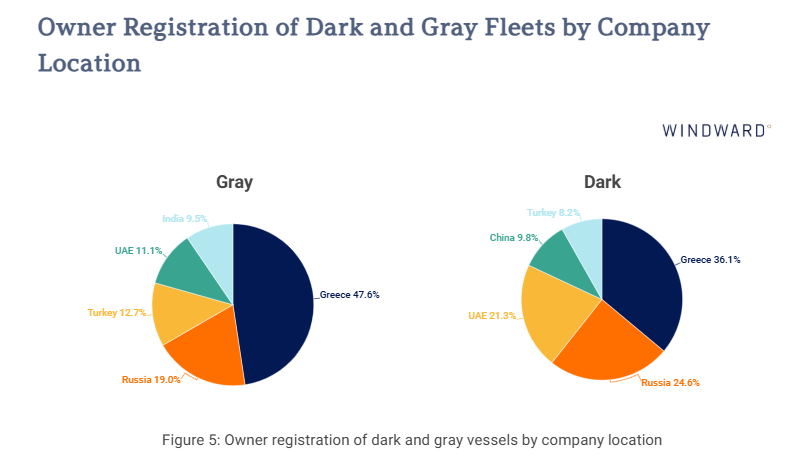
Russia's shadow fleet not only employs flags of convenience but also manipulates vessel ownership registration to evade sanctions. Windward's analysis in "Illuminating Russia's Shadow Fleet" reveals a complex web where ownership is obscured to bypass Western restrictions on Russian oil trade following the Ukraine invasion. All these indicate how the West is struggling to impose their directives in a multi-polar world.
Ownership and Registration Tactics:
Shell Companies: Many vessels are registered under shell companies, often in jurisdictions known for financial secrecy. This layer of anonymity makes it challenging to trace back to Russian ownership or control, thus reducing the effectiveness of sanctions. ( See graph on where these companies are located and why potentially Greece may have its own concerns via EU on a harder price cap)
Multiple Layering: Ownership might be distributed across several legal entities in different countries, creating a maze that regulatory bodies struggle to navigate. This tactic is particularly prevalent in the gray and dark fleets, where the intent is to mask the ultimate beneficial owner.
Flag of Convenience Countries: Countries like Panama, Liberia, and the Marshall Islands not only provide flags but also lax registration processes, making them ideal for shadow fleet operations. These locations offer minimal scrutiny over who owns or operates the ships, facilitating the evasion of sanctions.
European Flags: Despite sanctions, some vessels retain European registration or even move to European flags temporarily, exploiting the trust in these flags to conduct business under the radar.
English
Duke retweetledi
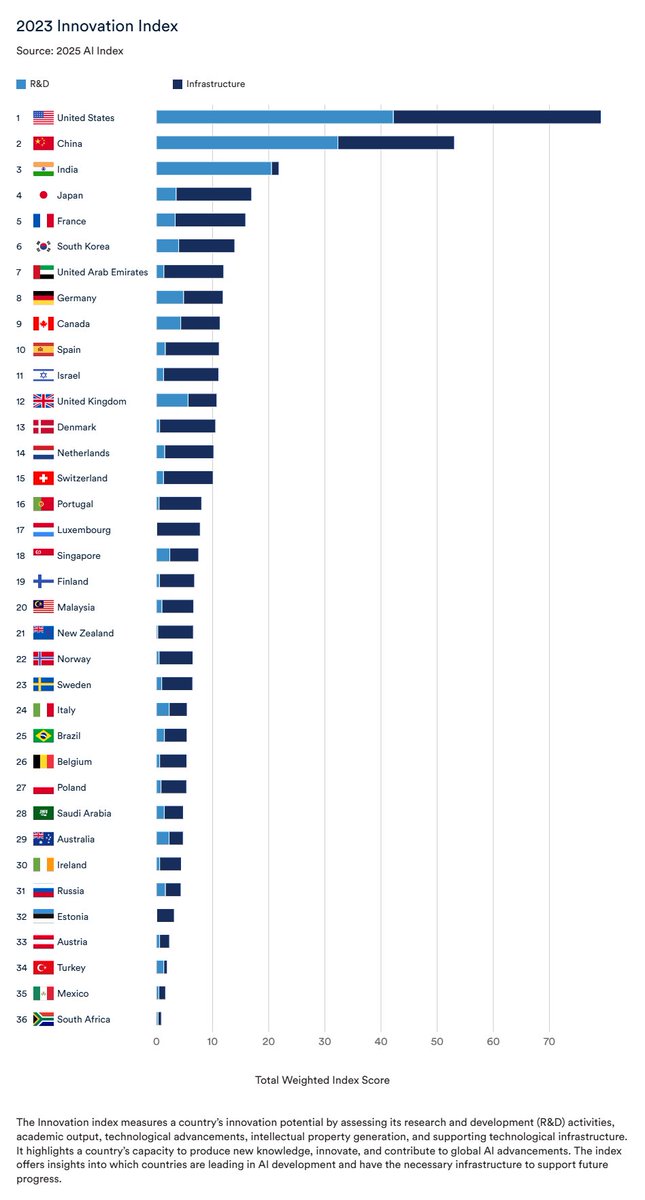
The Global AI Innovation Sub Index, which assesses countries based on publications, citations, and infrastructure, places the UK at a concerning 12th position. Here's why this should be a worry if you're from the UK:
Academic Prestige vs. Performance: The UK's reputation for top-tier universities doesn't translate as expected into leading AI innovation metrics. This gap suggests that while the UK excels in education, the conversion of academic research into practical, innovative applications might be lagging.
Smaller Nations Outpacing: Countries like the UAE, Israel, and Canada, despite having smaller populations and perhaps less traditional clout in academia, are ahead in the AI race.
Kathleen Tyson@Kathleen_Tyson_
This push for AI is just not credible. UK is not competitive in electricity cost terms, but also in patents, industrial use of AI, etc. UK doesn’t even rate its own line in global AI patents.
English
Duke retweetledi
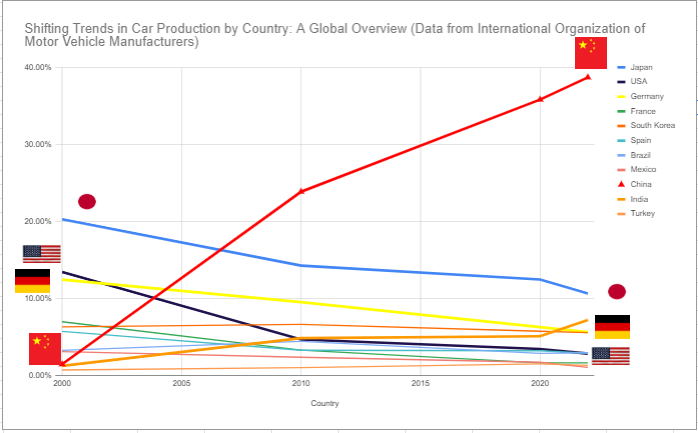
China's Dominance: China's car production percentage has seen a steep increase from 1.47% in 2000 to 38.70% in 2022. This significant rise indicates that China has not only expanded its production capabilities but has likely become a dominant player .
Decline in Traditional Powers: Japan and the USA show a clear decline in their percentages over the years. Japan's car production dropped from 20.28% in 2000 to 10.66% in 2022, while the USA's decreased from 13.45% to 2.84%. Just imagine China's production is almost 13x times USA.
Germany and France also experienced a decline, indicating a shift in production away from traditional Western powers.
Emerging Markets: India's production percentage has steadily increased from 1.26% to 7.21%, showing positive growth and suggesting that India is improving its production capacity.
Shift in Global Production Landscape: Overall, the data suggests a significant geopolitical and economic shift towards Asia, particularly with China and India emerging as key players in car production.
English
Duke retweetledi
The U.S. has been involved in multiple coups, regime changes, and proxy wars in Islamic countries, with mixed results. While U.S. involvement has often been driven by the desire to counter Soviet influence, promote stability, or ensure access to strategic resources, these interventions have sometimes led to unintended consequences, including the rise of Islamist movements and extremist factions. The historical record shows that while the U.S. has not always supported Islamic regimes per se, it has often worked with Islamist groups when they aligned with U.S. geopolitical goals, such as fighting communism or countering regional threats.
List of coups in Islamic nations
1. Iran (1953) – Operation Ajax
Coup against Prime Minister Mohammad Mossadegh, orchestrated by the CIA to reinstate the Shah.
2. Indonesia (1950s) – U.S. Support for Military Coup
U.S. support for military elements involved in an attempted coup against President Sukarno.
3. Egypt (1952) – Indirect U.S. Support for the Coup
U.S. support for the Free Officers Movement that overthrew King Farouk and brought Gamal Abdel Nasser to power.
4. Pakistan (1977) – U.S. Support for Zia ul-Haq’s Coup
U.S. support for General Zia-ul-Haq’s military coup that overthrew Prime Minister Zulfikar Ali Bhutto.
5. Afghanistan (1978) – U.S. Support for Anti-Communist Coup
While not directly involving the U.S., the coup against President Daoud Khan was followed by U.S. support for anti-Soviet forces, later influencing the rise of the mujahideen.
6. Libya (2011) – NATO Intervention in Civil War
U.S. support for rebel forces leading to the overthrow of Muammar Gaddafi, though not a direct coup.
7. Yemen (2011) – U.S. Support for Hadi’s Transition
U.S. support for the transition of power from President Ali Abdullah Saleh to Vice President Abd-Rabbu Mansour Hadi following protests, though not a traditional coup.
English
Duke retweetledi
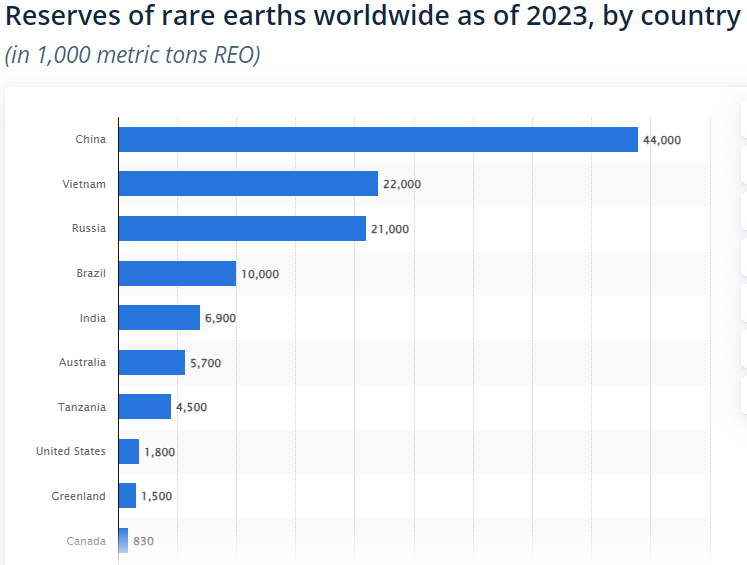
🌍🧊 Why is the US so fixated on Greenland? It’s not just the allure of vast icy landscapes but one of key reasons is a treasure trove of rare earth minerals lurking beneath the surface—1.5 million metric tons to be precise! As the demand for these critical elements skyrockets in our high-tech and clean energy revolutions, Greenland becomes a geopolitical chess piece. Securing access to its resources could mean the difference between supply chain stability and vulnerability for the US.
What’s even more intriguing? Many nations in the Global South are holding substantial reserves of these coveted minerals. This could potentially shift the balance of global power! While the so-called Western world is scrambling to address resource dependency, the Global South could very well emerge as a cornerstone in the new era of resource geopolitics.
Buckle up, folks! We’re heading into a geopolitical thriller where rare earths take center stage. 🎬🔮 #Geopolitics #RareEarths #GlobalSouth #Greenland
English
Duke retweetledi
This kind of comedy gold would be classified as offensive by today's British government unfortunately.
Kathleen Tyson@Kathleen_Tyson_
This isn’t a competition UK should be winning.
English
Duke retweetledi
The tiered system in the U.S. export restrictions on AI chips technology is like a geopolitical ladder, and its implications are profound. 🪜 Here’s the breakdown:
Tiers and Their Implications
Tier 1: This includes a small group of U.S. allies with almost unrestricted access to advanced technology. 🌍 For these nations—like Germany, Japan, and South Korea—being in this tier solidifies their technological edge and military cooperation with the U.S.
Tier 2: Countries here face significant limitations on the amount of high-tech computing power they can access. They must navigate a complex web of regulations and might seek U.S. government permission to surpass these limits. 🎮 This means businesses in these nations may lag behind in technological advancements compared to Tier 1 countries.
Tier 3: Adversaries, including China and Russia, are effectively blockaded from accessing these technologies. 🛑 The implication? They could struggle to keep up in the AI arms race, prompting a push for homegrown innovation or alternative alliances to circumvent these restrictions.
Broader Effects
Global Alliances: The tier system could force countries to reevaluate alliances. Nations in Tier 2 must choose whether to align more closely with the U.S. to gain access or to venture into partnerships with Tier 3 countries, risking their tech progress. 🔄
Economic Impact: Companies in Tier 2 and 3 may face market pressures as they grapple with limited access to superior technology. This could stifle innovation and economic growth in the short term while prompting investment in local tech development. 📉📈
Geopolitical Tensions: The potential for increased tensions is palpable. Countries in Tier 3 might resort to espionage or aggressive tech acquisition strategies to bridge the gap, leading to a more pronounced tech cold war. 🌑⚡
In summary, this tiered system not only influences technological advancements but also reshapes global alliances and economic landscapes. The chess game of international relations is entering a new, more complex phase—so buckle up! 🎢🌍 #Geopolitics #TechTieredSystem

English
Duke retweetledi
The evolving relationship between Japan and China, especially in the context of Japan's strategic signaling amid U.S. interactions, is a complex geopolitical dance. 🕺💃
Main Takeaways:
• Strategic Relationship Revival: The emphasis on returning to a "mutually beneficial relationship" suggests Japan's desire to stabilize ties with China, perhaps as a buffer against uncertainties with the U.S. 🌏🤝
• U.S. Hesitation: The U.S. refusal of Nippon Steel's acquisition and Trump's initial hesitation to engage with Japan signals a protective posture around national interests. 🏰🚫 This raises questions for Japan: How do they navigate their long-standing alliance with the U.S. while seeking renewed engagement with China?
• Signal of Intent: Japan's overtures towards China may be a strategic signaling move—aligning more closely with regional partners amidst U.S. reluctance could bolster its geopolitical standing. ⚖️✨
The implications are sizable: Japan must manage the delicate balance between fostering its relationship with China while ensuring the U.S. remains an ally in the mix. It’s a high-stakes game of chess; missteps could lead to geopolitical checkmate! ♟️🔥

English