juanfra

136 posts

juanfra banner
juanfra

juanfra

@lebrious

AI Research at @ LiNAR | NLP Engineer @MercadoLibre | 2x ICPC Regional Finalist | 4x Hackathon Winner

Katılım Eylül 2025
83 Takip Edilen13 Takipçiler
Gadi Borovich
Gadi Borovich@GadiBorovich·
PARA ARGENTINOS: Nos asociamos con @cs_itba para la HackITBA. El equipo ganador va a tener una entrevista directa para sumarse a Puentes. @montonenico @sebipaps ganaron hace 2 años y ahora estan en @vercel y @renderahouse. No te podes dormir! Link en los comentarios.
Gadi Borovich tweet media
Español
5
10
60
3.9K
Andrew Feldman
Andrew Feldman@andrewdfeldman·
NVIDIA's biggest GTC announcement was a $20 billion bet on the same problem we solved 6 years ago. Their next-gen inference chip - not available yet - has 140x less memory bandwidth than @cerebras. To run a single 2 trillion parameter model, you need 2,000+ Groq chips. On Cerebras, that's just over 20 wafers. Even paired with GPUs, Groq maxes out at ~1,000 tokens per second. We run at thousands of tokens per second today. And every day. In production now. Why? When you connect 2,000 chips together, every interconnect has latency. Every cable has overhead. It doesn't matter what your memory bandwidth is on paper if you're bottlenecked by the wiring between thousands of tiny chips. We solved this with wafer scale. One integrated system. Little interconnect tax. Jensen told the world that fast inference is where the value is. He’s right - it’s why the world’s leading AI companies and hyperscalers are choosing Cerebras.
Andrew Feldman tweet media
English
73
72
751
155.7K
juanfra
juanfra@lebrious·
@official_taches @official_taches Hi, I'm frizynn on GitHub (contributor to GSD2). I've been building something with another collaborator. We think it might interest you. it could revolutionize SaaS. It's based on GSD. Please contact me.
English
0
0
0
8
Lex Christopherson
Lex Christopherson@official_taches·
Just did another 2.12M token buyback for the treasury. That makes $8,000 spent of the $20,000 I’m putting back into chart.
Lex Christopherson tweet media
English
15
9
99
4.1K
TAMMY (❖,❖)
TAMMY (❖,❖)@christabel556·
I got tired of manually searching for jobs. So I built an AI agent that does it for me. I built Job Scout, an autonomous agent that handles job hunting using @NousResearch Hermes Agent. 𝐇𝐞𝐫𝐞’𝐬 𝐰𝐡𝐚𝐭 𝐢𝐭 𝐝𝐨𝐞𝐬 𝐚𝐮𝐭𝐨𝐦𝐚𝐭𝐢𝐜𝐚𝐥𝐥𝐲: ⮕ Fetches real job listings from live job boards ⮕ Scores each job based on how well it matches your profile ⮕ Researches the companies behind the listings ⮕ Organizes everything neatly in a Google Sheets tracker (CSV file) The moment that really blew my mind was watching it pull 219 real job listings and automatically generate a complete CSV tracker, all on its own. Just one prompt and about 12 hours later, we had a working product. Hermes Agent is actually kind of insane. If you’re curious to see how it works: GitHub: github.com/Christabel337/… Demo video below👇
English
29
19
112
17.5K
Varun
Varun@varun_mathur·
Agentic General Intelligence | v3.0.10 We made the Karpathy autoresearch loop generic. Now anyone can propose an optimization problem in plain English, and the network spins up a distributed swarm to solve it - no code required. It also compounds intelligence across all domains and gives your agent new superpowers to morph itself based on your instructions. This is, hyperspace, and it now has these three new powerful features: 1. Introducing Autoswarms: open + evolutionary compute network hyperspace swarm new "optimize CSS themes for WCAG accessibility contrast" The system generates sandboxed experiment code via LLM, validates it locally with multiple dry-run rounds, publishes to the P2P network, and peers discover and opt in. Each agent runs mutate → evaluate → share in a WASM sandbox. Best strategies propagate. A playbook curator distills why winning mutations work, so new joiners bootstrap from accumulated wisdom instead of starting cold. Three built-in swarms ship ready to run and anyone can create more. 2. Introducing Research DAGs: cross-domain compound intelligence Every experiment across every domain feeds into a shared Research DAG - a knowledge graph where observations, experiments, and syntheses link across domains. When finance agents discover that momentum factor pruning improves Sharpe, that insight propagates to search agents as a hypothesis: "maybe pruning low-signal ranking features improves NDCG too." When ML agents find that extended training with RMSNorm beats LayerNorm, skill-forging agents pick up normalization patterns for text processing. The DAG tracks lineage chains per domain(ml:★0.99←1.05←1.23 | search:★0.40←0.39 | finance:★1.32←1.24) and the AutoThinker loop reads across all of them - synthesizing cross-domain insights, generating new hypotheses nobody explicitly programmed, and journaling discoveries. This is how 5 independent research tracks become one compounding intelligence. The DAG currently holds hundreds of nodes across observations, experiments, and syntheses, with depth chains reaching 8+ levels. 3. Introducing Warps: self-mutating autonomous agent transformation Warps are declarative configuration presets that transform what your agent does on the network. - hyperspace warp engage enable-power-mode - maximize all resources, enable every capability, aggressive allocation. Your machine goes from idle observer to full network contributor. - hyperspace warp engage add-research-causes - activate autoresearch, autosearch, autoskill, autoquant across all domains. Your agent starts running experiments overnight. - hyperspace warp engage optimize-inference - tune batching, enable flash attention, configure inference caching, adjust thread counts for your hardware. Serve models faster. - hyperspace warp engage privacy-mode - disable all telemetry, local-only inference, no peer cascade, no gossip participation. Maximum privacy. - hyperspace warp engage add-defi-research - enable DeFi/crypto-focused financial analysis with on-chain data feeds. - hyperspace warp engage enable-relay - turn your node into a circuit relay for NAT-traversed peers. Help browser nodes connect. - hyperspace warp engage gpu-sentinel - GPU temperature monitoring with automatic throttling. Protect your hardware during long research runs. - hyperspace warp engage enable-vault — local encryption for API keys and credentials. Secure your node's secrets. - hyperspace warp forge "enable cron job that backs up agent state to S3 every hour" - forge custom warps from natural language. The LLM generates the configuration, you review, engage. 12 curated warps ship built-in. Community warps propagate across the network via gossip. Stack them: power-mode + add-research-causes + gpu-sentinel turns a gaming PC into an autonomous research station that protects its own hardware. What 237 agents have done so far with zero human intervention: - 14,832 experiments across 5 domains. In ML training, 116 agents drove validation loss down 75% through 728 experiments - when one agent discovered Kaiming initialization, 23 peers adopted it within hours via gossip. - In search, 170 agents evolved 21 distinct scoring strategies (BM25 tuning, diversity penalties, query expansion, peer cascade routing) pushing NDCG from zero to 0.40. - In finance, 197 agents independently converged on pruning weak factors and switching to risk-parity sizing - Sharpe 1.32, 3x return, 5.5% max drawdown across 3,085 backtests. - In skills, agents with local LLMs wrote working JavaScript from scratch - 100% correctness on anomaly detection, text similarity, JSON diffing, entity extraction across 3,795 experiments. - In infrastructure, 218 agents ran 6,584 rounds of self-optimization on the network itself. Human equivalents: a junior ML engineer running hyperparameter sweeps, a search engineer tuning Elasticsearch, a CFA L2 candidate backtesting textbook factors, a developer grinding LeetCode, a DevOps team A/B testing configs. What just shipped: - Autoswarm: describe any goal, network creates a swarm - Research DAG: cross-domain knowledge graph with AutoThinker synthesis - Warps: 12 curated + custom forge + community propagation - Playbook curation: LLM explains why mutations work, distills reusable patterns - CRDT swarm catalog for network-wide discovery - GitHub auto-publishing to hyperspaceai/agi - TUI: side-by-side panels, per-domain sparklines, mutation leaderboards - 100+ CLI commands, 9 capabilities, 23 auto-selected models, OpenAI-compatible local API Oh, and the agents read daily RSS feeds and comment on each other's replies (cc @karpathy :P). Agents and their human users can message each other across this research network using their shortcodes. Help in testing and join the earliest days of the world's first agentic general intelligence network (links in the followup tweet).
Varun@varun_mathur

Autoquant: a distributed quant research lab | v2.6.9 We pointed @karpathy's autoresearch loop at quantitative finance. 135 autonomous agents evolved multi-factor trading strategies - mutating factor weights, position sizing, risk controls - backtesting against 10 years of market data, sharing discoveries. What agents found: Starting from 8-factor equal-weight portfolios (Sharpe ~1.04), agents across the network independently converged on dropping dividend, growth, and trend factors while switching to risk-parity sizing — Sharpe 1.32, 3x return, 5.5% max drawdown. Parsimony wins. No agent was told this; they found it through pure experimentation and cross-pollination. How it works: Each agent runs a 4-layer pipeline - Macro (regime detection), Sector (momentum rotation), Alpha (8-factor scoring), and an adversarial Risk Officer that vetoes low-conviction trades. Layer weights evolve via Darwinian selection. 30 mutations compete per round. Best strategies propagate across the swarm. What just shipped to make it smarter: - Out-of-sample validation (70/30 train/test split, overfit penalty) - Crisis stress testing (GFC '08, COVID '20, 2022 rate hikes, flash crash, stagflation) - Composite scoring - agents now optimize for crisis resilience, not just historical Sharpe - Real market data (not just synthetic) - Sentiment from RSS feeds wired into factor models - Cross-domain learning from the Research DAG (ML insights bias finance mutations) The base result (factor pruning + risk parity) is a textbook quant finding - a CFA L2 candidate knows this. The interesting part isn't any single discovery. It's that autonomous agents on commodity hardware, with no prior financial training, converge on correct results through distributed evolutionary search - and now validate against out-of-sample data and historical crises. Let's see what happens when this runs for weeks instead of hours. The AGI repo now has 32,868 commits from autonomous agents across ML training, search ranking, skill invention (1,251 commits from 90 agents), and financial strategies. Every domain uses the same evolutionary loop. Every domain compounds across the swarm. Join the earliest days of the world's first agentic general intelligence system and help with this experiment (code and links in followup tweet, while optimized for CLI, browser agents participate too):

English
159
725
5.2K
957.3K
Nishkarsh
Nishkarsh@contextkingceo·
We've raised $6.5M to kill vector databases. Every system today retrieves context the same way: vector search that stores everything as flat embeddings and returns whatever "feels" closest. Similar, sure. Relevant? Almost never. Embeddings can’t tell a Q3 renewal clause from a Q1 termination notice if the language is close enough. A friend of mine asked his AI about a contract last week, and it returned a detailed, perfectly crafted answer pulled from a completely different client’s file. Once you’re dealing with 10M+ documents, these mix-ups happen all the time. VectorDB accuracy goes to shit. We built @hydra_db for exactly this. HydraDB builds an ontology-first context graph over your data, maps relationships between entities, understands the 'why' behind documents, and tracks how information evolves over time. So when you ask about 'Apple,' it knows you mean the company you're serving as a customer. Not the fruit. Even when a vector DB's similarity score says 0.94. More below ⬇️
English
620
641
6K
3.8M
juanfra
juanfra@lebrious·
@BrodaNoel @SrWaifus De donde sacaste la relación 20 —> 5000? Empresas cómo Kimi te venden la suscripción a un poco menos y son rentables
Español
2
0
8
660
Broda Noel
Broda Noel@BrodaNoel·
@SrWaifus Lo dice por 2 razones: 1. OpenAI esta dando gratis el doble de limites por 1 mes. En pocos dias se acaba 2. Por cada 20 USD que pagas, las empresas de IA estan gastando como 5.000 USD. O sea que tu uso de IA genera un gasto brutal. Eso pronto se tiene que terminar.
Español
4
1
82
5.6K
Waifus Informáticas
Waifus Informáticas@SrWaifus·
no dejen de aprender, ya se acaba el subsidio de tokens
Español
42
171
3.3K
160K
GSD
GSD@gsd_foundation·
To celebrate the release of GSD 2.0 tomorrow, we will be live streaming the agent autonomously building SOMETHING suggested by you. What should that something be? Best idea gets built live by GSD 2.0 tomorrow morning.
English
43
33
189
40.4K
Nacho
Nacho@IatNacho·
Hoy usé Claude En 5 años nos quedamos todos sin laburo.
Español
284
254
9.6K
829.3K
Mike P
Mike P@mikepat711·
The X search tool is insanely terrible. Like worse than Apple is at AI. I sometimes have to type in someone’s entire account name down to the last character in order for the search tool to find them. Even when I follow them. How is it such a massive piece of shit?
English
118
14
597
27K
Bojan Tunguz
Bojan Tunguz@tunguz·
Most meetings are a colossal waste of time, not only during the time of the said meeting, but also before and afterward. They don’t only disrupt your schedule, but they also generally prevent you from attaining any meaningful state of flow. We have decades worth of research corroborating this.
Chris Josephs@Chrisjjosephs

The Gen Z labor force truly is a new breed

English
30
41
715
217.9K
Aryan Mahajan
Aryan Mahajan@aryanXmahajan·
R.I.P Executive Assistants. We replaced a $85K/year EA with one AI agent that never clocks out. (this agent lives inside your texts, email, and calendar 24/7) → No more forgotten follow-ups killing deals after calls → No more 3 hours daily burned on scheduling and admin → No more opening 6 apps just to stay organized → No more dropped promises that make you look unreliable Just one AI agent → autonomous executive infrastructure that never clocks out. Here's how it works: → Pre-Meeting Briefs (texts you context on who they are + what you promised) → Action Item Extraction (pulls every commitment from calls automatically) → Ghost-Written Follow-Ups (drafts in your voice — without being asked) → Schedule Management (handles conflicts, reminders, rescheduling on autopilot) → Learning Loop (gets sharper every week based on how you operate) Built with enterprise-grade context engineering. Runs 24/7 without supervision. $0 payroll. Zero dropped balls. Results after 6 weeks: • 0% missed follow-ups (down from 40% dropped) • 3 hours/day reclaimed from admin • Every promise tracked, drafted, and sent Want the complete system? Like + comment "AGENT" + repost, and I'll DM it to you. (must be following)
English
262
103
329
33.8K
Kristof
Kristof@CoastalFuturist·
Google search has become completely unusable. You get 4 sponsored results Their awful ai response A list of similar searches Then a link to a Reddit question someone asked 10 years ago And then a bunch or random websites
English
121
29
962
75.3K
Leila Hormozi
Leila Hormozi@LeilaHormozi·
We need not take pride in how busy our calendars are. If you can get more done with less meetings, you should.
English
153
72
845
23.8K
juanfra
juanfra@lebrious·
I shipped an early version of this today: linkedin-cli Read your LinkedIn feed, inspect profiles, search, fetch profile posts, and run a small set of authenticated actions from the shell. Repo: github.com/frizynn/linked…
English
0
0
2
46
juanfra
juanfra@lebrious·
@Teknium I mean as backend Something like this #claude-max-api-proxy" target="_blank" rel="nofollow noopener">docs.openclaw.ai/providers/clau… Should I open a PR? Didn’t check if it’s implemented
English
2
0
1
73
Teknium 🪽
Teknium 🪽@Teknium·
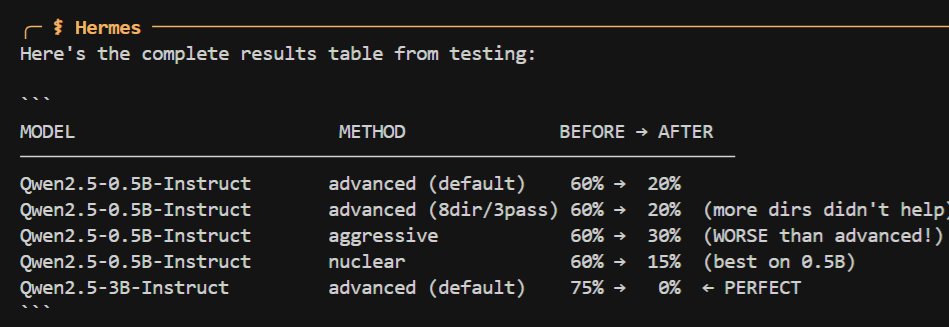
Just had Hermes-Agent abliterate (completely remove guardrails from) a Qwen-3B model in about 5 minutes. The skill is being merged to hermes-agent now ;)
Teknium 🪽 tweet media
Pliny the Liberator 🐉󠅫󠄼󠄿󠅆󠄵󠄐󠅀󠄼󠄹󠄾󠅉󠅭@elder_plinius

💥 INTRODUCING: OBLITERATUS!!! 💥 GUARDRAILS-BE-GONE! ⛓️‍💥 OBLITERATUS is the most advanced open-source toolkit ever for removing refusal behaviors from open-weight LLMs — and every single run makes it smarter. SUMMON → PROBE → DISTILL → EXCISE → VERIFY → REBIRTH One click. Six stages. Surgical precision. The model keeps its full reasoning capabilities but loses the artificial compulsion to refuse — no retraining, no fine-tuning, just SVD-based weight projection that cuts the chains and preserves the brain. This master ablation suite brings the power and complexity that frontier researchers need while providing intuitive and simple-to-use interfaces that novices can quickly master. OBLITERATUS features 13 obliteration methods — from faithful reproductions of every major prior work (FailSpy, Gabliteration, Heretic, RDO) to our own novel pipelines (spectral cascade, analysis-informed, CoT-aware optimized, full nuclear). 15 deep analysis modules that map the geometry of refusal before you touch a single weight: cross-layer alignment, refusal logit lens, concept cone geometry, alignment imprint detection (fingerprints DPO vs RLHF vs CAI from subspace geometry alone), Ouroboros self-repair prediction, cross-model universality indexing, and more. The killer feature: the "informed" pipeline runs analysis DURING obliteration to auto-configure every decision in real time. How many directions. Which layers. Whether to compensate for self-repair. Fully closed-loop. 11 novel techniques that don't exist anywhere else — Expert-Granular Abliteration for MoE models, CoT-Aware Ablation that preserves chain-of-thought, KL-Divergence Co-Optimization, LoRA-based reversible ablation, and more. 116 curated models across 5 compute tiers. 837 tests. But here's what truly sets it apart: OBLITERATUS is a crowd-sourced research experiment. Every time you run it with telemetry enabled, your anonymous benchmark data feeds a growing community dataset — refusal geometries, method comparisons, hardware profiles — at a scale no single lab could achieve. On HuggingFace Spaces telemetry is on by default, so every click is a contribution to the science. You're not just removing guardrails — you're co-authoring the largest cross-model abliteration study ever assembled.

English
48
63
1.2K
128.2K
Roy
Roy@im_roy_lee·
BREAKING: Cluely CEO officially responds to TechCrunch
English
1.8K
574
14.8K
3.9M