Leonard Hong

7.5K posts

Leonard Hong banner
Leonard Hong

Leonard Hong

@leonardshong

New Keynesian | @NTUsg Graduate | YIMBY | KiwiSaver | Public Policy | Political Economy | Macroeconomics | Meritocracy | Korean-Kiwi Views my own.

Auckland, New Zealand Katılım Nisan 2020
677 Takip Edilen708 Takipçiler
Sabitlenmiş Tweet
Leonard Hong
Leonard Hong@leonardshong·
My article on Singapore's fiscal prudence and its contrast with New Zealand is available on the @nzherald. The city-state's unorthodox but pragmatic economic model provides some answers to New Zealand's future challenges. nzherald.co.nz/business/opini…
English
9
11
39
6K
Leonard Hong retweetledi
International and Monetary Economics Network
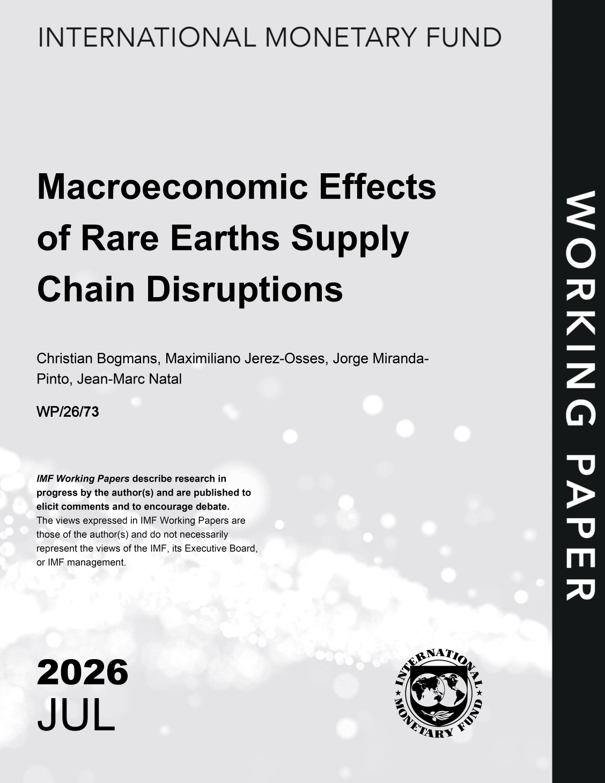
Highly relevant! "Macroeconomic Effects of Rare Earths Supply Chain Disruptions" by Christian Bogmans, Maximiliano Jerez-Osses, Jorge Alberto Miranda Pinto, and Jean-Marc Natal. "Rare earth elements (REEs) are critical inputs in high‑tech manufacturing. Following China’s 2025 export licensing requirements on REEs and permanent magnets, concerns have risen about the macroeconomic consequences of supply disruptions in import‑dependent economies. Standard assessments based on “value added at risk” (VAAR) ignore production network linkages and input reallocation. We develop a small open economy model with imported REEs and production networks, calibrated using an REE‑augmented input–output table from USGS data. Applying the model to the United States, Germany, France, the United Kingdom, Japan, and India, we find substantial cross‑country heterogeneity in response to an 80% reduction in REEs supply. The most exposed economies are Japan, U.S. and Germany. Under low substitution elasticities (horizons under one year), these economies experience a GDP loss of 1.8, 1.5, and 1.2 percent, respectively. These differences reflect heterogeneity in sectoral composition, factor shares, and the strength of forward linkages of REE-intensive sectors. Under higher elasticities (longer horizons), aggregate losses become negligible." elibrary.imf.org/view/journals/…
International and Monetary Economics Network tweet media
English
2
45
163
8.4K
Leonard Hong retweetledi
Fareed Zakaria
Fareed Zakaria@FareedZakaria·
China has gained more from the Iran war than from any crisis in three decades. Beijing has paid costs for this war. But measured against the damage to America’s goals, alliances and credibility, China has come out ahead. My take:
English
87
486
1.7K
150.7K
Leonard Hong
Leonard Hong@leonardshong·
@liamvincent26 He also unintentionally undermines his own "libertarianism" too! It was very amusing to watch from my end. "Vibes" as the main pillar for good policy? It's embarrassing.
English
0
0
1
80
Liam Vincent
Liam Vincent@liamvincent26·
Paul Henry talking some absolute gobbledygook on Q & A. Jack Tame poses that Henry is romanticising a period when the top income tax rate was 60+% and he says the different is back then “the state championed success and didn’t demonise it”. Like what??? These are just words.
English
12
8
184
5.2K
Leonard Hong retweetledi
Alok Kumar
Alok Kumar@Alokkumarzz·
In 2008, Malcolm Gladwell explained why some people succeed and some don't in a single 1-hour talk. This will permanently change the way you think about talent, effort, and success. Bookmark & watch today, no matter what.
English
89
1.1K
6.2K
630.8K
Leonard Hong retweetledi
Ochob
Ochob@0chob·
Paul Samuelson was the first American to win the Nobel Prize in Economics. He spent his career proving that ordinary people should not try to beat the market. He also quietly beat the market himself for 60 years. His last full-length interview explains how. Almost nobody has watched it. Samuelson taught at MIT for 65 years, from 1940 until he died in 2009. His textbook "Economics" sold roughly four million copies. He rewrote the field. Every finance professional working today learned economics from a book he wrote or a book written by his students. He also ran his own money quietly. His returns reportedly outpaced most active managers of his era, and he was an early investor in Warren Buffett's Berkshire Hathaway. He never advertised the numbers. He said the opposite in public. His most famous line about investing: "Investing should be more like watching paint dry or watching grass grow. If you want excitement, take $800 and go to Las Vegas." He was one of the earliest advocates for index funds. He believed almost nobody could beat the market and almost nobody should try. His nephew Larry Summers became Treasury Secretary. His students founded half the modern economics profession. He was invited into every important economic policy debate of his lifetime. His view on personal finance was unusually blunt for a Nobel laureate. In one of his final interviews, near the end of his life, he explained his framework in three sentences. Personal finance is not a science. It is a set of common-sense decisions repeated for decades. Save more than you spend. Diversify. Do not chase excitement. Do not trust anyone who promises certainty. He said these things thousands of times over 70 years and the industry ignored him every year. The full interview covers his childhood, his years at Chicago and Harvard, his rise at MIT, his Nobel, and his philosophy on money. He was 94 years old at the time. His voice is thin and his answers are direct. He does not soften anything. He treats the interviewer like a graduate student who happens to be holding a camera. The more sophisticated a market becomes, the more valuable the boring advice becomes. Every investor who ignored Samuelson's rules is a receipt for how right he was. Every quant who read his mathematics and skipped his common sense missed the point. Samuelson died December 2009. He was 94. His textbook is still in print. The interview is free.
veles@velesxbt

x.com/i/article/2076…

English
19
300
1.2K
196.5K
Leonard Hong
Leonard Hong@leonardshong·
Furthermore, her "research" doesn't consider the fact the main reasons behind national populism is economic discontent widely covered by economists such as Stiglitz, Rodrik, Rajan, Wolf and others. She made the cost-of-living worse with her Finance Minister Robertson.
English
5
0
23
1.1K
Leonard Hong
Leonard Hong@leonardshong·
Whilst I don't think PM Ardern deserves to get abused by the public in ways that stopped her from living a normal life in NZ, she has no self-awareness regarding the damage her policies had on the country. She's the example of a PR driven politician. rnz.co.nz/life/people/ce…
English
130
26
299
15.8K
JR Murphy
JR Murphy@CivilSocietyNZ·
@leonardshong I'm one of your victims you neo-liberal capitalist fascist bigot!! I will say anything I want to people who make sure I am violently abused, live in terror of homelessness & have to beg for food at you DISGRACEFUL DEGRADING FOOD BANKS!
English
3
0
3
233
Leonard Hong
Leonard Hong@leonardshong·
@CivilSocietyNZ Firstly, calling me names and constantly saying nasty personal attacks on my ethnic heritage does not help you. Secondly, putting labels on my economic ideas do not help you, ma'am. I hope you think about your behaviour online and your conduct. It's immature and disgraceful.
English
3
0
13
266
JR Murphy
JR Murphy@CivilSocietyNZ·
@leonardshong Raised means you weren't born here! Spewing neo-liberal cult fascist hatred like you did in your post deserves response you got snowflake! Ardern helped poor people while you capitalist fascist terrorists increased violence against local woman like me by 250% after taking power
English
1
0
1
256
Leonard Hong retweetledi
Reads with Ravi
Reads with Ravi@readswithravi·
Jensen Huang said it right: “Greatness does not come out of intelligence, it comes from character. Character is not formed out of smart people, it is formed out of people who have suffered.”
English
29
317
1.9K
43.4K
Leonard Hong
Leonard Hong@leonardshong·
@CivilSocietyNZ Oh wow - talk about racism. I was raised in NZ you absolutely ignorant and pathetic human being. How about you watch what you say on a public domain before you say personal nonsense.
English
7
0
36
839
JR Murphy
JR Murphy@CivilSocietyNZ·
@leonardshong I would suggest as a foreigner from a completely different culture that you have no fkn idea what you are talking about & believe everything you see in our corrupt capitalist media. She did not damage, she helped poor people, all govts printed money & allowed it to go to rich
English
11
0
7
908
Leonard Hong retweetledi
henry cooke
henry cooke@henrycooke·
Ruth Richardson - who lost the finance portfolio to Birch and clashed with him in Cabinet - describes him as “the ultimate man for all political seasons”.
henry cooke tweet media
English
5
4
31
3.2K
Leonard Hong
Leonard Hong@leonardshong·
Overall, history will judge her in a mixed way. She is a personally kind and emotionally sensitive politician. Her intentions have always good. She was an excellent crisis manager. Her flaws come from her focus on mainly communications rather that sound economic policy.
English
7
0
1
310
Leonard Hong
Leonard Hong@leonardshong·
I had a lot of fun going on Liam Dann's podcast for the NZ Herald to discuss compulsory savings, macroeconomics, New Zealand’s long-term economic trajectory, and the experiences that have shaped my economic thinking ☺️ youtube.com/watch?v=Hi6oLw…
YouTube video
YouTube
English
1
1
5
309
Leonard Hong retweetledi
Michael Pettis
Michael Pettis@michaelxpettis·
Tsinghua's Li Daokui, one of China's most prominent economists, calls for an increasingly urgent response to problems in the Chinese economy, focusing mainly on policies to unleash constraints on the ability of local governments to continue to power growth: "Specifically, after completing major infrastructure projects, local governments have become preoccupied with repaying their debts. Because interest rates remain high, the more debt they repay, the greater the total debt burden becomes. This process absorbs enormous amounts of economic and financial energy without converting that energy into actual output or productivity." His proposed response is to reduce what he calls "blockage" at the local-government level by exploiting the relatively clean balance sheet of the central government. He mostly asks, in other words, for a shift in the locus of debt creation from local-government balance sheets to the central government. If you believe that there remain a lot of productive investment opportunities that local governments are unable to access because of their bloated balance sheets, and that only local governments can take on these projects, this would certainly make sense. But I think it has been many years since this has been true, in which case it seems to me that his proposed policy response is to accelerate debt creation even further, partly, he says, to fund local-government repurchases of empty apartments and partly to improve benefits to migrant workers. My worry is that not enough people see China's extremely high and rapidly-rising debt burden as the main medium-term problem facing China, perhaps because the only way to address the debt burden requires much slower growth, and as of now this is still politically unacceptable, especially if real Chinese unemployment is closer to the 10.2% Li believes it to be than the 5.0% official rate published earlier today. It's good that Chinese economists are becoming increasingly vocal about the deep difficulties the very-unbalanced Chinese economy faces. But I worry that they are still not willing to acknowledge just how difficult it will be to address these imbalances, nor to recognize that the longer Beijing postpones the adjustment, the more disruptive it is likely to be. On these last two points the historical precedents are pretty clear. yuzhehe.com/p/chinas-econo…
English
32
147
614
284.6K