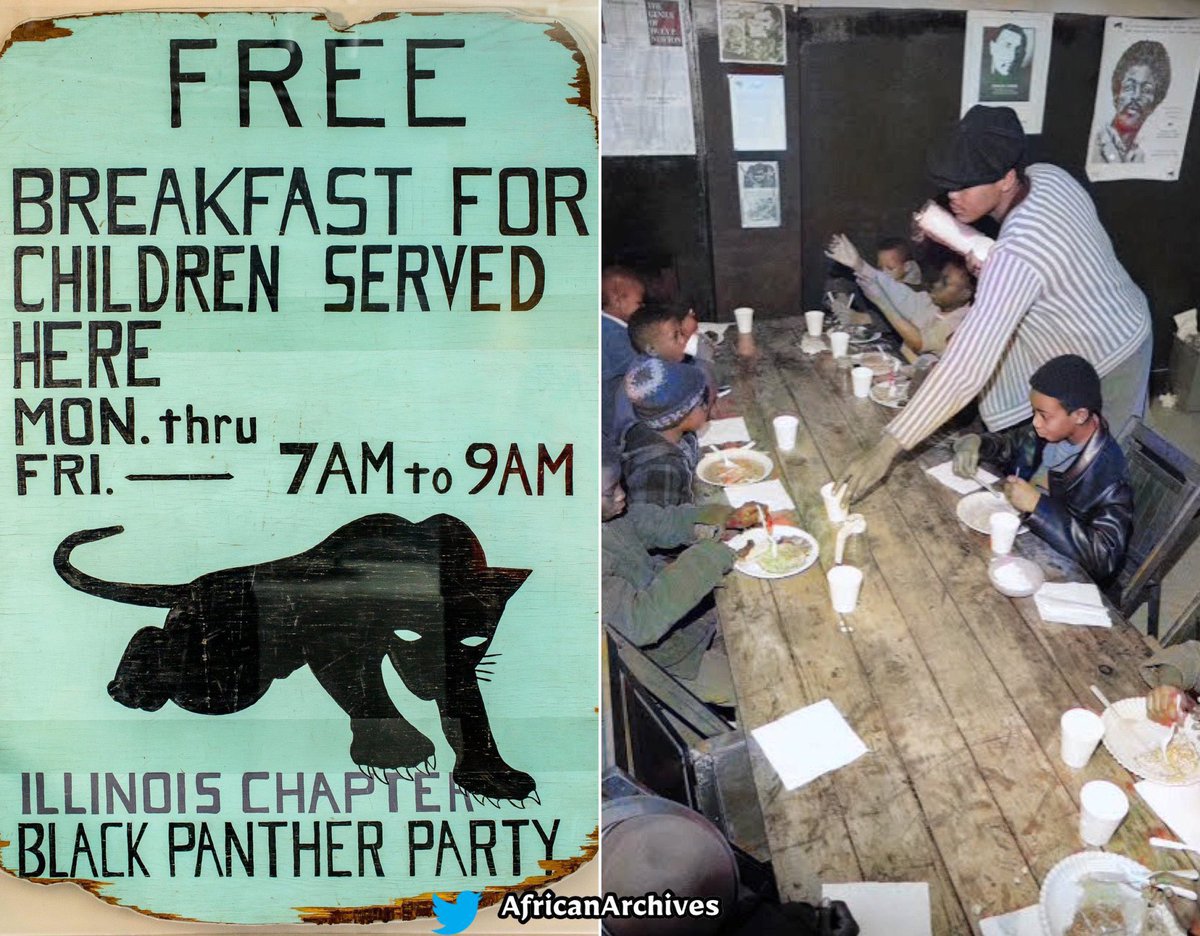
The Black Panther Party first & most notable community program was the Free Breakfast for Children Program.
The program began in January 1969 because poverty forced families to send their children to school hungry.
—By the end of 1969, the Black Panthers were serving full free breakfasts (including milk, bacon, eggs, grits, and toast) to 20,000 school aged children in 19 cities around the country, and in 23 local affiliates every school day. The breakfast program was just one of many programs the Panthers ran to address the needs of the poor. In fact, they developed more that 60 Serve the People programs, including efforts to provide free clothing and shoes, medical services —including drug and alcohol awareness, —legal aid education, and what was thought to be some of the first true early childhood education programs in the nation, preceding Head Start. But the Panthers’ image and focus on self-determination drew the attention of then FBI chief, J. Edgar Hoover. He singled out the Black Panthers as national hate group, and the breakfast program as an act of subversion. Once Hoover went after the Breakfast Program, the handwriting was on the wall. Even though the organizers were careful to consult with nutritionists to make sure the children got high quality, balanced meals, and made sure they had the necessary permits from the health and fire departments for the kitchens and halls where they served meals, they became regular targets of local officials. The children they served were caught in the middle.—
Lots of #Illini content coming up tonight on 5 On Your Sideline at 10:15 on @ksdknews.
And it's not just hoops...
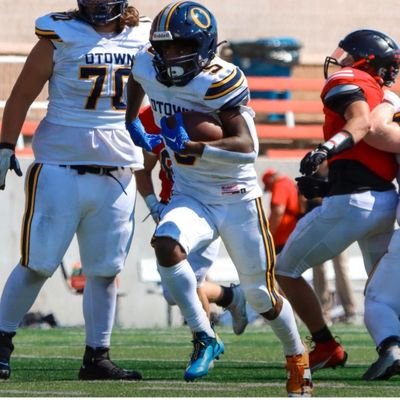
I sit down with @Randolph_22 as he prepares for the NFL Draft... and to join childhood friend @EasyE2432 as a pro athlete.
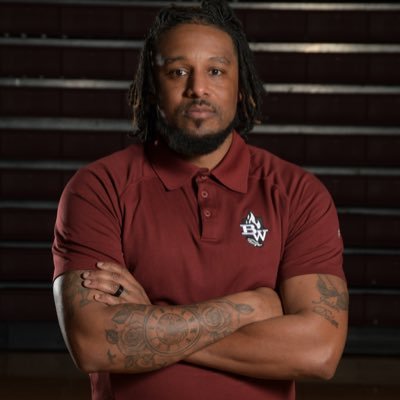
@BWestAthletics@MaroonsHoops
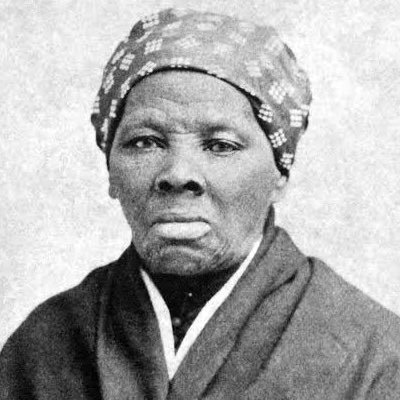
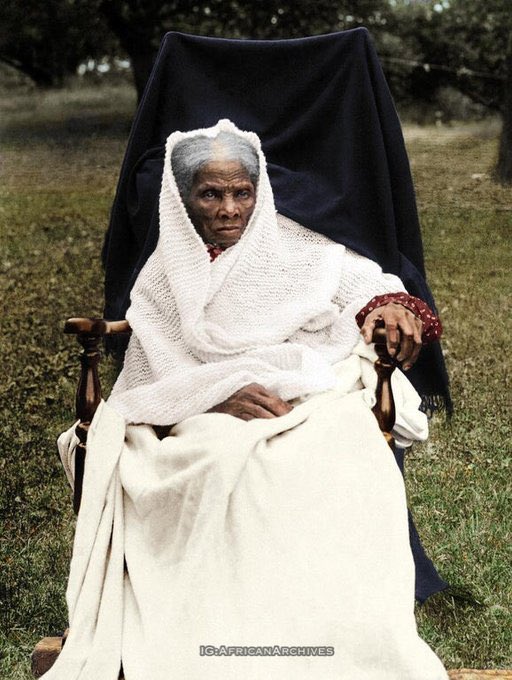
Harriet Tubman's Last Portrait, 1911.
—Harriet Tubman (born Araminta "Minty" Ross) was an African-American abolitionist, humanitarian, and Union spy during the American Civil War. Born into slavery, Tubman escaped and subsequently made more than 19 missions to rescue more than 300 slaves using the network of antislavery activists and safe houses known as the Underground Railroad.
She later helped John Brown recruit men for his raid on Harpers Ferry, and in the post-war era struggled for women's suffrage.
As a child in Dorchester County, Maryland, Tubman was beaten by masters to whom she was hired out. Early in her life, she suffered a severe head wound when hit by a heavy metal weight. The injury caused disabling seizures, narcoleptic attacks, headaches, and powerful visionary and dream experiences, which occurred throughout her life. A devout Christian, Tubman ascribed the visions and vivid dreams to revelations from God.
BACKGROUND:
In 1849, Tubman became ill again, and her value as a slave was diminished as a result. Edward Brodess tried to sell her, but could not find a buyer. Angry at his action and the unjust hold he kept on her relatives, Tubman began to pray for her owner, asking God to make him change his ways:
"I prayed all night long for my master," she said later, "till the first of March; and all the time he was bringing people to look at me, and trying to sell me." When it appeared as though a sale was being concluded, she switched tactics. "I changed my prayer," she said. "First of March I began to pray, 'Oh Lord, if you ain't never going to change that man's heart, kill him, Lord, and take him out of the way."
A week later, Brodess died, and Tubman expressed regret for her earlier sentiments.
Brodess' death increased the likelihood that Tubman would be sold and her family would be broken apart, as frequently happened in the settlement of an estate. His widow, Eliza, began working to sell the family's slaves. Tubman refused to wait for the Brodess family to decide her fate, despite her husband's efforts to dissuade her."[T]here was one of two things I had a right to," she explained later, "liberty or death; if I could not have one, I would have the other."
ESCAPE FROM SLAVERY:
Tubman and her brothers, Ben and Henry, escaped from slavery on September 17, 1849. Tubman had been hired out to Dr. Anthony Thompson, who owned a large plantation in an area called Poplar Neck in neighboring Caroline County; it is likely her brothers labored for Thompson as well.
Because the slaves were hired out to another household, Eliza Brodess probably did not recognize their absence as an escape attempt for some time. Two weeks later, she posted a runaway notice in the Cambridge Democrat, offering a reward of up to 100 dollars for each slave returned. Once they had left, Tubman's brothers had second thoughts. Ben may have just become a father. The two men went back, forcing Tubman to return with them.
Soon afterward, Tubman escaped again, this time without her brothers and successfully.