Here are some movies along with which Lovecraftian entity they best exemplify.
Underwater 2020: Cthulhu
The Void 2016: Shub-Niggurath
Hereditary 2018: Nyarlathotep
Terrified 2017: Yog-Sothoth
Mercy 2014: Hastur
City of the Living Dead 1980: Azathoth
Add your own or suggest alternates!
Like everyone else, I’ve been spending the weekend reading all about this alleged Minnesota fraud and wanted to use the tools that we have at @MiddeskHQ to see what we could learn.
Verifying a business is a challenge but not an unsolved problem. There is a difference between a business that is real on paper (i.e. they have registered with the Secretary of State) and one that has legitimate business operations.
This evaluation is contextual, so you wouldn’t automatically decide that a business that has only formed last week and doesn't have a credible office location is illegitimate. When we started Middesk, we didn’t really have a business for at least 6 months and were running the company out of my apartment.
But there are signals that we can look at to build a more complete picture of a company, even if they are just getting their business off the ground.
I pulled 2,000 child care and home health care companies formed in Minnesota with a registered operating address in Minneapolis. To build the list, I focused on companies that mentioned child care or home care in their entity name to expand the scope beyond what we might have found if we only looked at industry specific licenses.
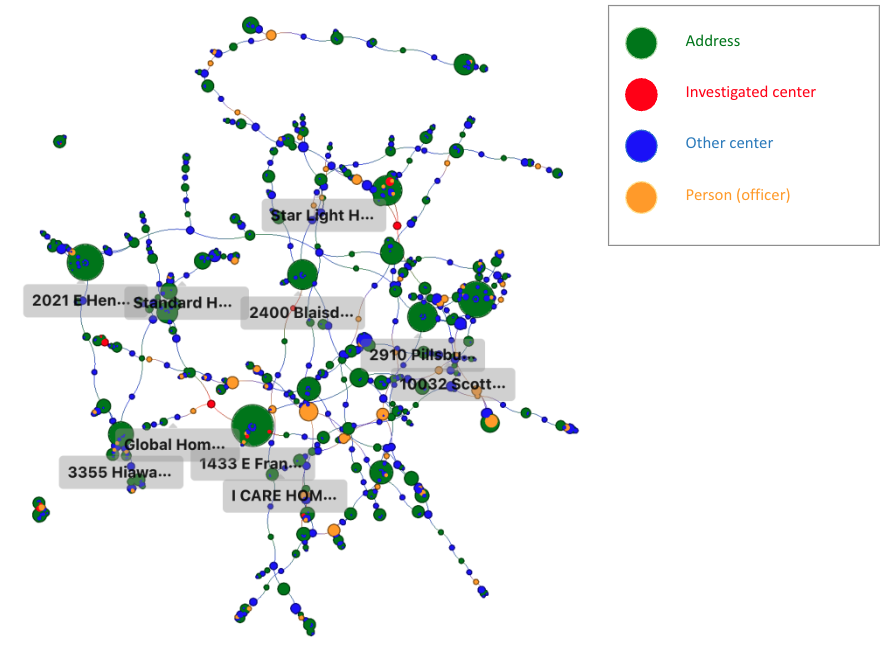
I placed the businesses on a graph to show the relationships, which looked like this:
Then I looked at clusters of businesses that were using the same or similar addresses as their operating location.
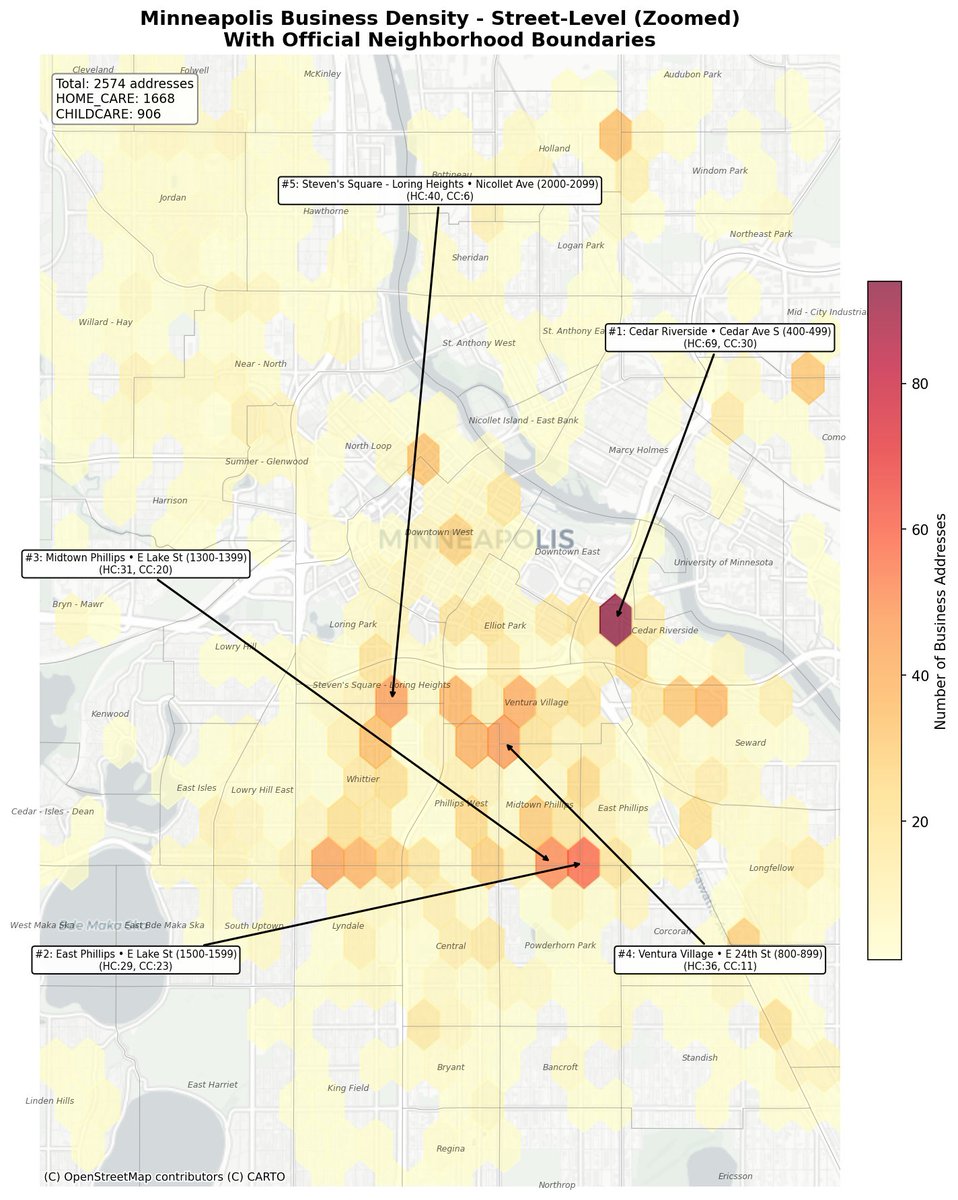
You can see the heatmap of address density below, but consider that a single block in MN has more than 100 companies from the sample of businesses that we used for this dive.
We can also see some of the businesses visited in the @nickshirleyy video within that block, along with other high density blocks.
Next, I looked at the connections between companies, since businesses are easy to shut down and re-open on paper. Connections were based on shared addresses, individuals, and ownership structures.
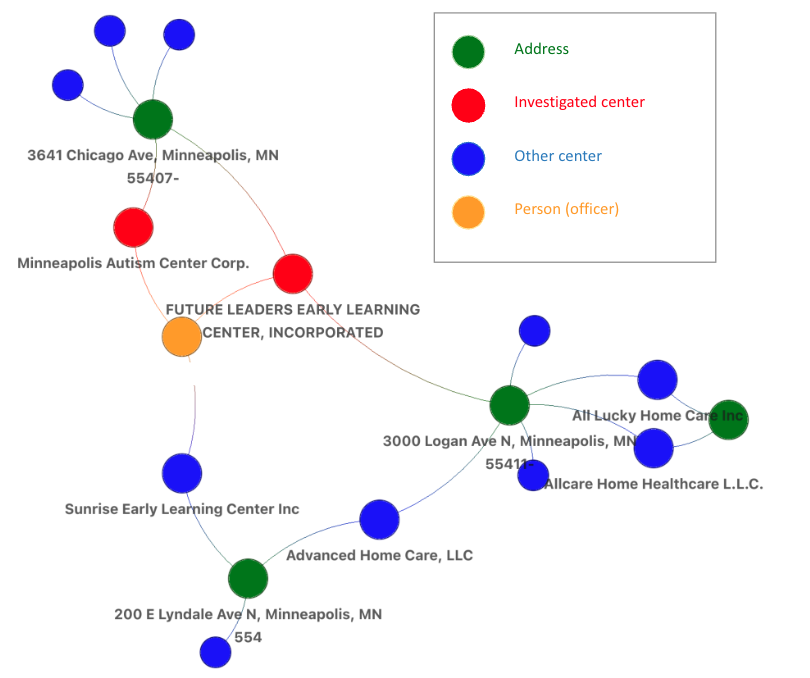
For example consider this cluster of related businesses:
12 companies connected through 3 shared addresses and a shared officer. 2 of the companies in this cluster are visited in the video. These businesses are the red ones.
And TBC, it doesn't mean that all businesses in the cluster are fraudulent, just an example of higher risk.
To go a bit further, I looked at the online web presence of the entities in the cluster above and found that of the 12 companies, all have no credible online web presence (Google Places page, recent reviews, online/available website, etc.).
When you consider that the average age of these 12 businesses is 8 years, this increases the risk of the cluster further. You would expect businesses formed in the last 8 years to have some meaningful online presence.
Next step would be expanding beyond Minneapolis and layering in funding data like grants, PPP loans, etc. But the clustering patterns alone tell you a lot.