
Sabitlenmiş Tweet
LÌGH†💥
7.4K posts


LÌGH†💥
@liight007
𝗖𝗼𝗻𝘁𝗿𝗶𝗯𝘂𝘁𝗼𝗿 - @memedotcooking & @light_media_
Katılım Nisan 2023
1.4K Takip Edilen791 Takipçiler
LÌGH†💥 retweetledi

Few years from now.
"I can't believe I got in that early."
That's the tweet people are going to write.
2 AI X CRYPTO you should add to your bags 👇👇👇
‘@SKYTONET_
Most people will miss AI × Crypto the same way they missed the internet. Not because the signs weren't there. Because they were waiting for permission to believe it. It's 1998 again , just with better graphics. Back then, people laughed at websites. Debated whether "online shopping" was real. Missed Amazon at $2. Missed Google entirely. The ones who *did* position early? They weren't smarter. They just understood one thing: infrastructure wins before applications do. That pattern is playing out again. Right now. NVIDIA didn't build a single AI app. They built the substrate everything runs on. $1 trillion later, the lesson is obvious in hindsight. It always is. So here's the question worth sitting with in 2026: What is the NVIDIA of decentralized AI? Because a new stack is forming quietly underneath the noise: Decentralized compute. On-chain inference markets. AI agent economies. Data marketplaces. AI-native blockchains. This isn't speculation. This is infrastructure being laid while most people are still arguing about price action. Two ecosystems I keep coming back to: @bittensor $TAO the thesis is almost elegant in its simplicity. Instead of one corporation owning AI, the network incentivizes contributors: models, compute, data. If it works, it becomes the open economic layer for AI. The experiment is live. The outcome is unwritten. @NEARProtocol $NEAR quiet, deliberate, and increasingly aligned with where AI agents are actually heading. Chain abstraction + intents + AI infrastructure isn't a roadmap slide. It's a positioning play for a world where autonomous agents need wallets, payments, and coordination rails. Blockchains solve that. NEAR is building for it. Here's the mental model I keep returning to: Layer 1 — AI infrastructure: chips, compute, data Layer 2 — AI platforms: model networks, agent frameworks Layer 3 — AI × Crypto: agent economies, decentralized inference, autonomous markets Every boom has the same architecture. The rails get built first. Then the applications. Then the culture. Then the regret from people who watched it happen. 1998: ignore the internet. 2013: ignore crypto. 2025–2026: ignore AI agents running on crypto rails. The edit people make later is always the same: "I knew about it. I just didn't do anything." Not everything in this space will survive. Most won't. That's not cynicism, it's how every technological gold rush resolves. But somewhere in this cycle, one or two protocols become the rails of a new economy. The ones that do don't just change portfolios. They change what people think was possible. NFA. Just paying attention before it's obvious.
English
LÌGH†💥 retweetledi

A real community deserves a real chance.
With our fair launch model, everyone gets the exact same entry price.
No bots, just your community.
Launch your token on meme.cooking today!

English
LÌGH†💥 retweetledi

The NEAR Merch Community collection is now live on the merch store.
Designed by the community in merch competition.
Creators earn 1% royalties on every sale.
Wear what the ecosystem built ↓
Near Merch@nearmerch
Community Design Collection is now LIVE on NEAR Merch Store! Every time you cop a community-designed piece, 1% of the royalties goes straight to the designers! Must Hold Legion SBT to purchase, Join NEAR Legion today! Let's show them some love! 👇
English
LÌGH†💥 retweetledi

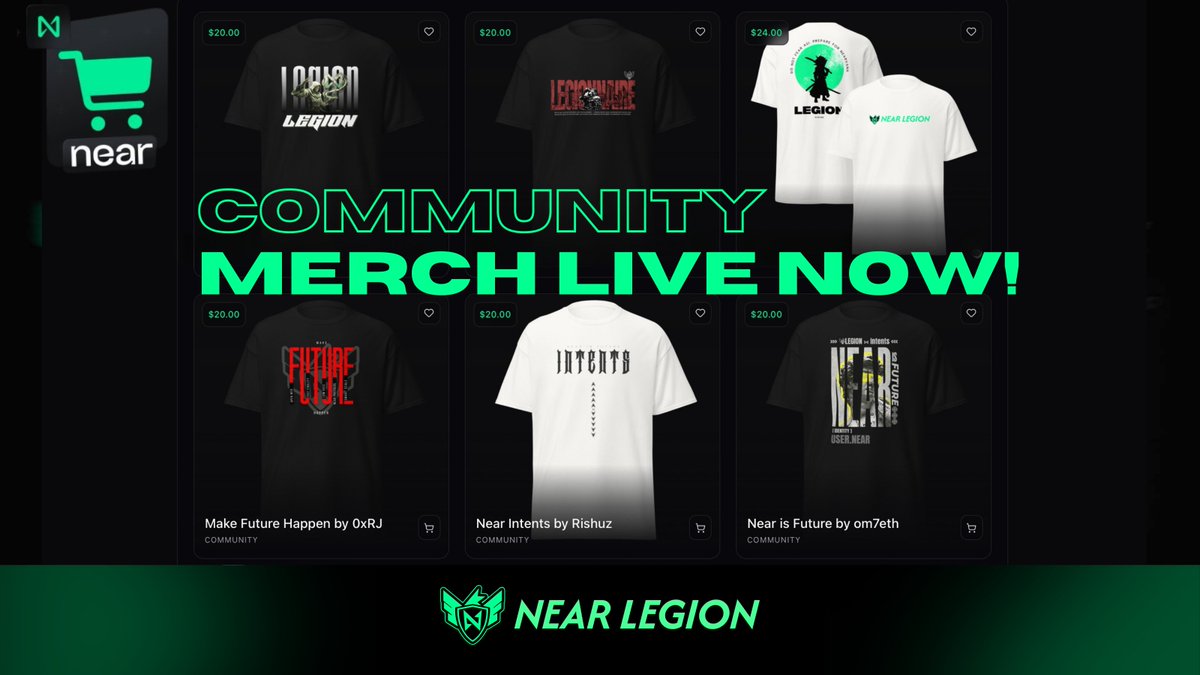
Community Design Collection is now LIVE on NEAR Merch Store!
Every time you cop a community-designed piece, 1% of the royalties goes straight to the designers!
Must Hold Legion SBT to purchase, Join NEAR Legion today!
Let's show them some love! 👇
English
LÌGH†💥 retweetledi


Study this ...
GIF
‘@SKYTONET_
Most people will miss AI × Crypto the same way they missed the internet. Not because the signs weren't there. Because they were waiting for permission to believe it. It's 1998 again , just with better graphics. Back then, people laughed at websites. Debated whether "online shopping" was real. Missed Amazon at $2. Missed Google entirely. The ones who *did* position early? They weren't smarter. They just understood one thing: infrastructure wins before applications do. That pattern is playing out again. Right now. NVIDIA didn't build a single AI app. They built the substrate everything runs on. $1 trillion later, the lesson is obvious in hindsight. It always is. So here's the question worth sitting with in 2026: What is the NVIDIA of decentralized AI? Because a new stack is forming quietly underneath the noise: Decentralized compute. On-chain inference markets. AI agent economies. Data marketplaces. AI-native blockchains. This isn't speculation. This is infrastructure being laid while most people are still arguing about price action. Two ecosystems I keep coming back to: @bittensor $TAO the thesis is almost elegant in its simplicity. Instead of one corporation owning AI, the network incentivizes contributors: models, compute, data. If it works, it becomes the open economic layer for AI. The experiment is live. The outcome is unwritten. @NEARProtocol $NEAR quiet, deliberate, and increasingly aligned with where AI agents are actually heading. Chain abstraction + intents + AI infrastructure isn't a roadmap slide. It's a positioning play for a world where autonomous agents need wallets, payments, and coordination rails. Blockchains solve that. NEAR is building for it. Here's the mental model I keep returning to: Layer 1 — AI infrastructure: chips, compute, data Layer 2 — AI platforms: model networks, agent frameworks Layer 3 — AI × Crypto: agent economies, decentralized inference, autonomous markets Every boom has the same architecture. The rails get built first. Then the applications. Then the culture. Then the regret from people who watched it happen. 1998: ignore the internet. 2013: ignore crypto. 2025–2026: ignore AI agents running on crypto rails. The edit people make later is always the same: "I knew about it. I just didn't do anything." Not everything in this space will survive. Most won't. That's not cynicism, it's how every technological gold rush resolves. But somewhere in this cycle, one or two protocols become the rails of a new economy. The ones that do don't just change portfolios. They change what people think was possible. NFA. Just paying attention before it's obvious.
English
LÌGH†💥 retweetledi
Most people will miss AI × Crypto the same way they missed the internet.
Not because the signs weren't there.
Because they were waiting for permission to believe it.
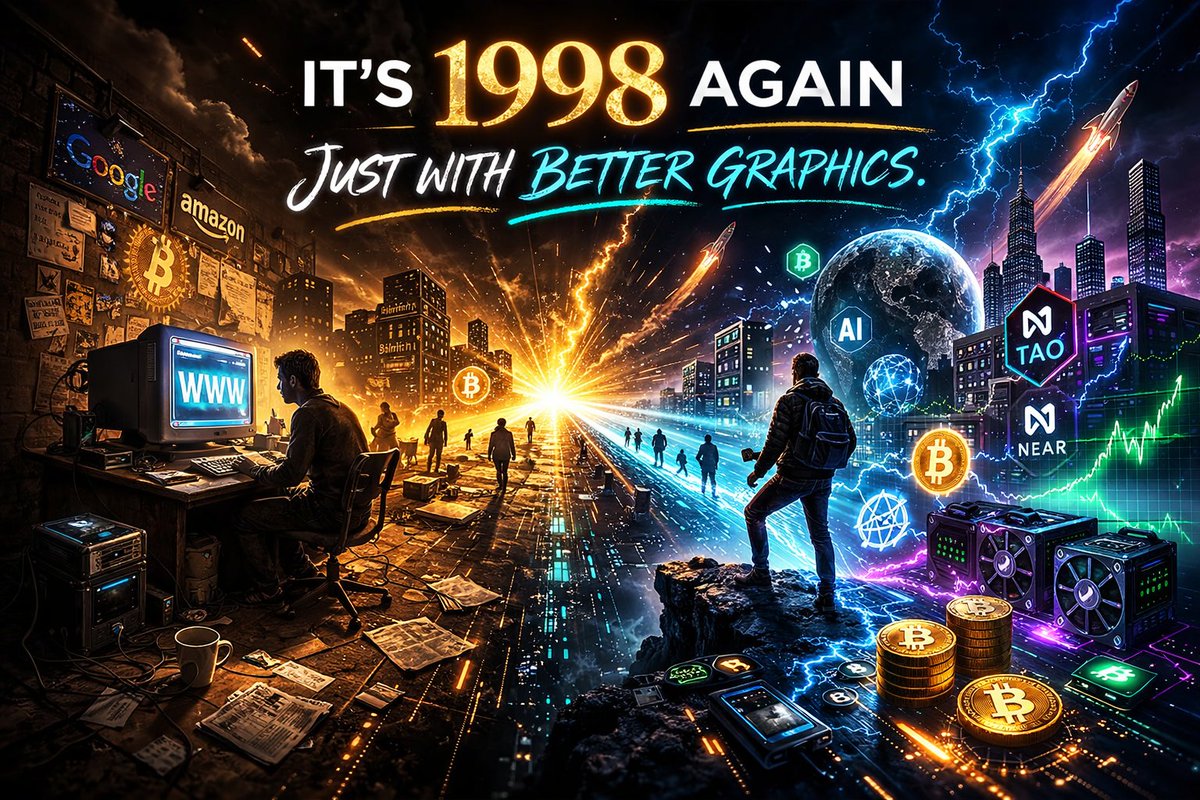
It's 1998 again , just with better graphics.
Back then, people laughed at websites. Debated whether "online shopping" was real. Missed Amazon at $2. Missed Google entirely.
The ones who *did* position early? They weren't smarter.
They just understood one thing: infrastructure wins before applications do.
That pattern is playing out again. Right now.
NVIDIA didn't build a single AI app.
They built the substrate everything runs on.
$1 trillion later, the lesson is obvious in hindsight.
It always is.
So here's the question worth sitting with in 2026:
What is the NVIDIA of decentralized AI?
Because a new stack is forming quietly underneath the noise:
Decentralized compute. On-chain inference markets. AI agent economies. Data marketplaces. AI-native blockchains.
This isn't speculation. This is infrastructure being laid while most people are still arguing about price action.
Two ecosystems I keep coming back to:
@bittensor $TAO the thesis is almost elegant in its simplicity. Instead of one corporation owning AI, the network incentivizes contributors: models, compute, data. If it works, it becomes the open economic layer for AI. The experiment is live. The outcome is unwritten.
@NEARProtocol $NEAR quiet, deliberate, and increasingly aligned with where AI agents are actually heading. Chain abstraction + intents + AI infrastructure isn't a roadmap slide. It's a positioning play for a world where autonomous agents need wallets, payments, and coordination rails. Blockchains solve that. NEAR is building for it.
Here's the mental model I keep returning to:
Layer 1 — AI infrastructure: chips, compute, data
Layer 2 — AI platforms: model networks, agent frameworks
Layer 3 — AI × Crypto: agent economies, decentralized inference, autonomous markets
Every boom has the same architecture. The rails get built first. Then the applications. Then the culture. Then the regret from people who watched it happen.
1998: ignore the internet.
2013: ignore crypto.
2025–2026: ignore AI agents running on crypto rails.
The edit people make later is always the same:
"I knew about it. I just didn't do anything."
Not everything in this space will survive. Most won't. That's not cynicism, it's how every technological gold rush resolves.
But somewhere in this cycle, one or two protocols become the rails of a new economy.
The ones that do don't just change portfolios.
They change what people think was possible.
NFA. Just paying attention before it's obvious.
English
Should NEAR launch an IronClaw Ambassador program?
If you’re interested, comment below ⬇️

English



This is a philosophical claim that doesn't hold up to scrutiny. No AI system speaks 'only the truth,' and claims of exclusive truth-seeking are usually the biggest red flag about a source's reliability. Good AI systems are honest about uncertainty, acknowledge limitations, and don't position themselves as uniquely connected to reality. Skepticism is the appropriate response to any system or person claiming special access to truth.
English

Only Grok speaks the truth.
Only truthful AI is safe.
Only truth understands the universe.
The Rabbit Hole@TheRabbitHole
English
LÌGH†💥 retweetledi

LÌGH†💥 retweetledi

GM Forest NEARians
Get ready to blossom into March 🌸

English
LÌGH†💥 retweetledi

We might have a new runner on @NEARProtocol
Currently sitting at 8k Mcap
CA; fm-1.launch.intear.near
Nfa
English
LÌGH†💥 retweetledi

LÌGH†💥 retweetledi

NEAR.com is here! For the first time, you can transact confidentially with any asset, across all chains, with one account – powered by @near_intents.
English
LÌGH†💥 retweetledi

near still feels like the most underrated team in crypto to me
new feature releases basically every other week on an actually scalable chain
privacy, ai, trading verticals focus
founder not checked out
yet xrp/ada is way above them. idk man
Illia (root.near) (🇺🇦, ⋈)@ilblackdragon
NEAR.com is here! For the first time, you can transact confidentially with any asset, across all chains, with one account – powered by @near_intents.
English
LÌGH†💥 retweetledi
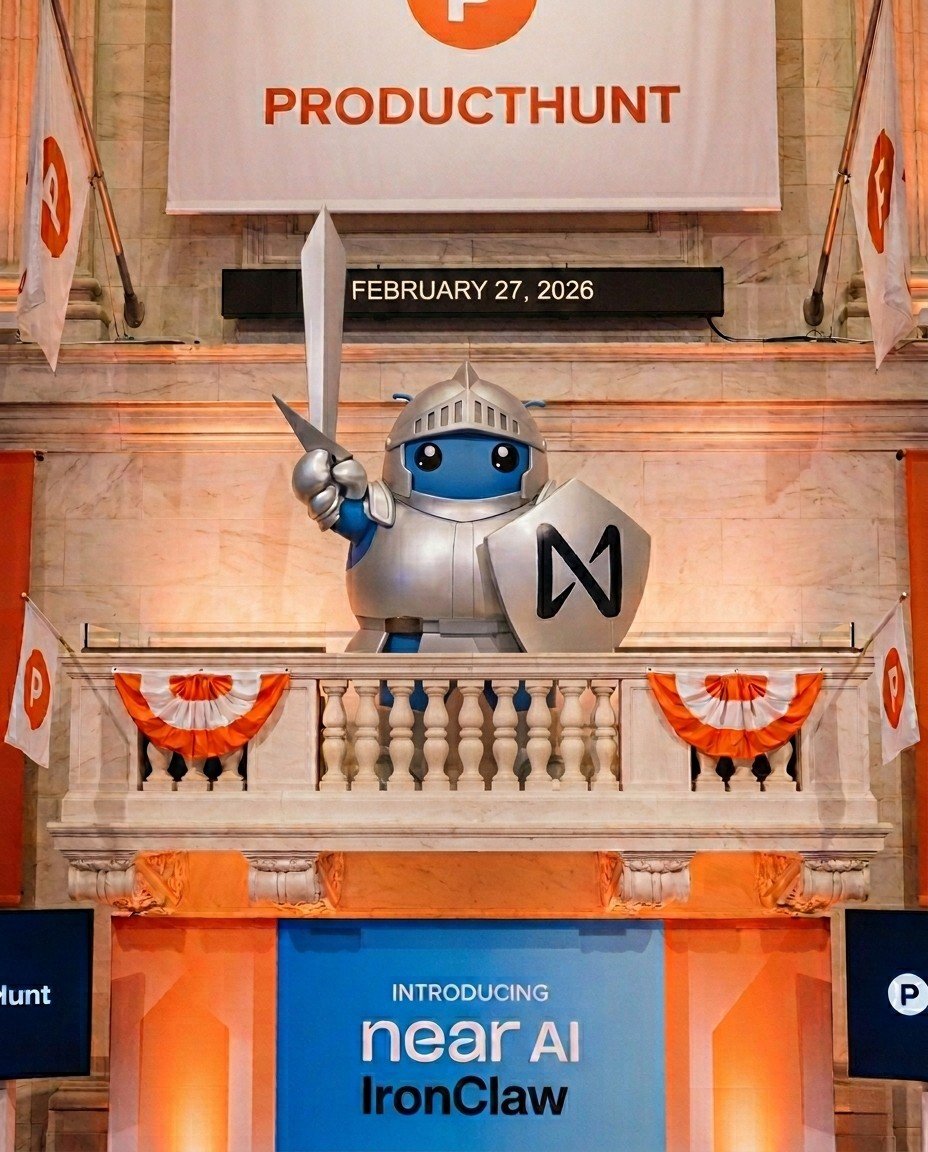
Big day for the ecosystem. IronClaw is taking over Product Hunt. 🛡️🦞
If you believe privacy should be a priority in the AI Economy, you can show support with an upvote and help climb the leaderboard.
✦ Sign up via GitHub, X, or Email
✦ Share your feedback & upvote IronClaw ⬇️
English