Ying Liu

35 posts

Ying Liu banner
Ying Liu

Ying Liu

@liuying04

Sr Director of Research at Scale AI | ex-Meta | ex-Google | LLM agents, evaluation, RL, and the science of building frontier system | Erdős number 3

California, USA Katılım Eylül 2013
141 Takip Edilen133 Takipçiler
Sabitlenmiş Tweet
Ying Liu
Ying Liu@liuying04·
Frontier LLM training is avant-garde winemaking A great natural-wine estate cannot be copied. Same winemaker, same grape, same playbook, new site: you get a different wine. The reason is terroir. Not just soil and climate, but the living cellar itself. Years of fermentation leave indigenous yeast and resident microflora in the walls, the barrels, the air. That biology is written down nowhere. It is the place. Frontier model training works the same way. A lab's training stack is a cellar. The custom kernels, the tuned collective communication, the interconnect quirks, the checkpoint and restart rituals, the tribal knowledge about which node tends to throw silent data corruption: none of it is fully documented. Change the architecture and you disturb the cellar. New bottlenecks surface. New loss spikes appear. A fresh strain of bugs shows up across hardware, network, and platform, the way Brettanomyces blooms when you change the process. In small doses it reads as character. Past a threshold it is a fault. Half the craft is knowing which is which.
English
0
0
4
468
Ying Liu
Ying Liu@liuying04·
People who have solved an open Erdős problem should get an honorable Erdős number 1. They have collaborated across time.
English
0
0
2
66
Ying Liu
Ying Liu@liuying04·
@concernedAIguy It definitely accelerates and reveals "hard frontiers" that cannot be solved by AI, yet. For example, Jacobian Conjecture when N=2. I don't think we will reach math singularity before we have truly self-evolving AI agents, but we will see.
English
0
0
0
40
Guy
Guy@concernedAIguy·
@liuying04 Do you think the current wave of tons of problems being solved is fast takeoff/math singularity?
English
1
0
0
73
Ying Liu
Ying Liu@liuying04·
Vibe frontier math is happening so soon. People who have got important results are still mostly mathematicians though. Domain expertise still matters. I have a Erdős number of 3 and a minor degree in math. Not enough to navigate the math frontier!
Shouqiao Wang@Qiaoqiao2001

I solved 6 open Erdős problems in 5 days, using @OpenAI GPT-5.6 Sol. I have a math background, but the Codex workflow I used does not require deep mathematical knowledge. Here’s exactly how I approached it, including my prompts 🧵

English
3
1
13
2.1K
Ying Liu
Ying Liu@liuying04·
Also, congratulations, @MIT! Two of this year’s Fields Medalists are MIT alumni: Yu Deng, BS 2011, who transferred from Peking University in 2009, and Hong Wang, PhD 2019. Interestingly, this also appears to the first time MIT graduates have won the Fields Medal.
English
0
0
1
97
Ying Liu retweetledi
jacob tsimerman
jacob tsimerman@Jacob_Tsimerman·
I want to clarify my thoughts on problem-solving in mathematics, and the potential consequences of AI for the field. For context, I’m quoting here my post in reply to Daniel Litt (who, echoing others, I find very clear, grounded, and insightful in his thinking). The claim The short version is that I think problem-solving is an immense, and pervasive part of modern mathematical research. Consequently, if human problem-solving disappears by virtue of the AIs becoming strictly and substantially better at it, then most of the time currently spent by modern mathematical researchers will have to be spent on an activity that is altogether pretty different. Whether such an activity is viable as a professional endeavour is something I am unsure of, but strongly encourage others to think about and try to envision, so that if/when the time comes, we can steer such a future into being. Allow me to make this somewhat concrete: by problem-solving I mean questions of the form “is T true? If so find a proof. If not, find a disproof.” where T is a precise mathematical statement. I’ll also include “find an example of S, if there is one” where S is some structure (variety/category/property/isomorphism/….). The argument Ok. Now as I said (and some have echoed) I spend ~all of my time problem-solving as my primary goal. This has sub-goals, but my entire main research field disappears if someone solves the Zilber-Pink Conjecture in its more general form. This is a single conjecture (precisely stated!) and lots of mathematicians, postdocs, and graduate students are engaged in picking apart special cases of it, trying strategies, finding analogies to develop intuition, etc.. Of course, lots of motivation and intuition and analogizing and understanding have gone into deciding to make the ZP conjecture a focus! But the fact remains that this is now what is being worked on ~all of the time by this community. This is true of many mathematicians. They have a problem (or ten) and spend most of their time doing it. If someone solves it, they have to find a different problem. This can be a big, disorienting process involving a lot of energy, and is neither trivial nor always fun (though often rewarding in the end). People have written a lot about Theory building vs. Problem-solving, and I want to first of all clarify I have nothing against theory building or theory builders! It is a valuable part of mathematics, and while there are differences in perspective between the “camps” there is way more mutual respect and agreement. However, I gather there is a perception that theory-builders spend most of their time not-problem-solving, and I think this is largely untrue. Now I’m not a theory-builder primarily (though I’ve partaken a LITTLE BIT by necessity) so I am outside of my comfort zone. As such, I apologize for mistakes and welcome corrections! But theory-building constantly runs through problem-solving. Let’s say you want to define the right notion of a cohomology theory. Of course you must make candidate definitions. But then what does it mean for it to be the right one? Well, you start asking if it has natural properties. These are T statements. Does it satisfy a Kunneth formula? Is it functorial in the right way? When you have the wrong one you have to find the properties it’s missing, and when you have the right one you have to prove that it indeed has those properties. Again, I am not saying nor do I believe that this makes problem-solving “real math” and theory-building lesser. I am just trying to draw attention to the way I think research mathematicians operate, and mathematics is practiced. To put all this a different way, imagine you had access to an AI oracle that could resolve statements T, but somehow lacked any creativity to build technology or make definitions (I think this is unlikely, but for the purpose of this thought experiment lets imagine it). How would your mathematics change, if you were a theory builder? Well, you make a definition, and want to know if it’s the right one. You immediately ask your oracle a thousand questions. From “are these basic properties true” to “ooh, so is this deep conjecture true?” and start getting back answers, and amending your definitions. You could invent and resolve entire research directions in days. But the confusion you would have had to push through to flesh out your theory would largely (probably not entirely) be instantly resolved and the whole process sped up tremendously by your oracle. A big part of the process would be gone. This is very very different to modern mathematics. One more thought This post is too long already, but I’ve seen some people say that they only do mathematics to find truth and others valourize that as the only virtuous way to be. I do not do mathematics only to find truth. I do it largely because I enjoy it and I am good at it. I also find it beautiful and am grateful I get to spend my days understanding beautiful things. But I enjoy the challenge, the process, resolving confusions, finding strategies, grappling with problems. I would like to push for this being de-stigmatized. Mathematicians are people who need money, housing, food, love, exercise, and a great deal of other stuff including various forms of meaning. There are many people whose primary enjoyment of math comes through problem solving in one of its incarnations. If that disappears, that is not a trivial issue and many of them might not want to do it anymore (even if there were some way to proceed).
jacob tsimerman@Jacob_Tsimerman

Hey @littmath , I've seen you post this sentiment a lot, and want to push back a bit (in my formal twitter-posting debut!). So my math career has almost entirely been "solve this problem". Now, of course there is an enormous amount of other activities such as formulating toy problems, identifying which ones are worthwhile, theory building, and selection and formulation of the original problems. But typically for 80%+ of my time, I know what problem I'm trying to solve and am just trying to solve it. I've seen the view expressed a lot that this is sort of not-the-main-point, and is just a part of figuring out the appropriate mathematical structure and phenomena. It's not that this is untenable, but I feel this is a somewhat overstated perspective. For one thing, talks (almost) always start/end with "here is the theorem I have proven". Its not that the view you have of math isn't coherent, but I could equally formulate the point of math as 1. Find a fun phenomenon 2. Make a problem capturing it as nicely as possible 3. Solve it, possibly by building theories and formulating sub-problems. so that problem-solving become the central point of math, and theory building as a side-effect. Indeed, mathematicians offer measure the value of a theory by the problems it can solve. This is at least an important part of a theory. I actually feel you and I are not far apart in our mathematical taste, so I'm curious how much we actually disagree here (I suspect the answer is "some"). Sorry for the overly long post! I am very much a twitter-newbie and will have to adjust.

English
31
146
875
292.9K
Ying Liu
Ying Liu@liuying04·
^should "not" be all humans.
English
0
0
0
51
Ying Liu retweetledi
Marcel Rød
Marcel Rød@marcelroed·
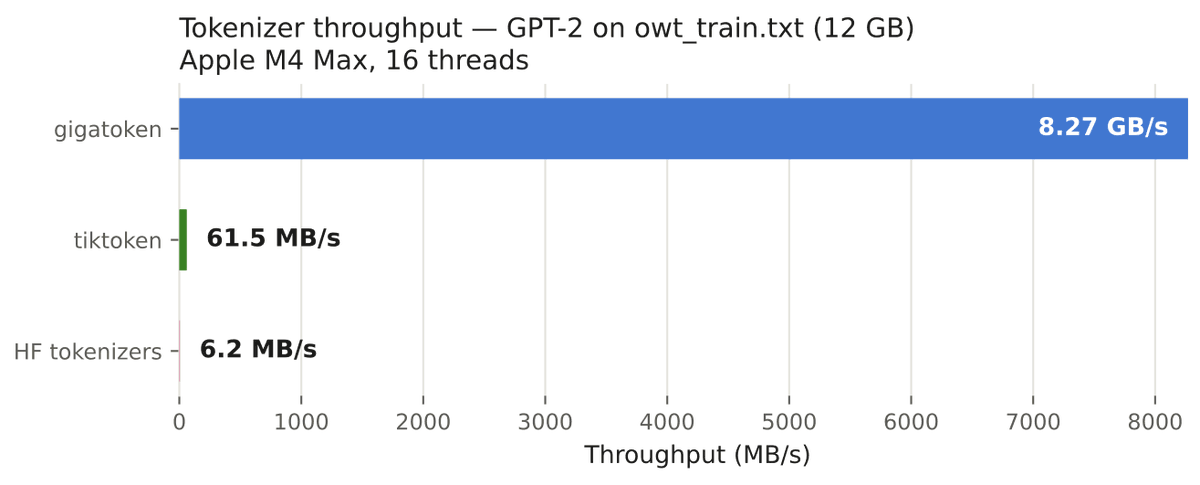
Introducing the world's fastest tokenizer implementation, Gigatoken! Gigatoken is ~500-1000x faster than HuggingFace, and ~100x faster than OpenAI's tiktoken for most tokenizer definitions on most machines. These baselines are already multithreaded Rust implementations! 🧵
Marcel Rød tweet media
English
84
441
4K
637.1K
Ying Liu
Ying Liu@liuying04·
@dare0lu Seems like gpt is aware of the Jacobian conjecture counter example now (probably through harness and memory, not model weights m) and can’t easily and fairly test whether GPT could’ve solved it too.
English
0
0
1
69
Ying Liu
Ying Liu@liuying04·
@jdlichtman Could be considered an AlphaFold moment of affine algebraic geometry, not of math. Just like AlphaFold moment is on structural biology, not biology :)
English
1
0
1
108
Ying Liu
Ying Liu@liuying04·
@HelaliBillel Unfortunately, I don’t have a large enough token budget to run it for very long. But someone who does almost certainly is.
English
0
0
1
601
Billel Helali
Billel Helali@HelaliBillel·
@liuying04 We still need to settle the (n=2) case to fully close out the Jacobian conjecture dimension by dimension.
English
2
0
9
3K
Ying Liu
Ying Liu@liuying04·
The disproof of the Jacobian conjecture may be only the first domino. I asked GPT-5.6 Sol to trace the initial implications below, though I have not independently verified the full chain. If the new counterexample holds: - The Dixmier conjecture fails for A_n when n >= 3 - Mathieu's conjecture falls - Zhao's vanishing conjecture falls - Cubic maps of the form x + H(x) must yield counterexamples in higher dimensions One tiny map. Decades of collateral damage.
levent@__alpoge__

hello there the jacobian conjecture is false thanx to my close friend akhil for asking about it and my other close friend fable for working during the world cup final ((1+xy)^3 z + y^2 (1+xy) (4+3xy), y + 3 x (1+xy)^2 z + 3 x y^2 (4+3xy), 2 x - 3 x^2 y - x^3 z): \C^3\to \C^3, has jacobian determinant -2, and sends (0, 0, -1/4), (1, -3/2, 13/2), and (-1, 3/2, 13/2) to (-1/4, 0, 0)

English
22
40
523
68.6K
Ying Liu
Ying Liu@liuying04·
@cociclo The same can be said for the other disproved conjectures. I chose to frame a little conservatively. I expect many more such conjecture and many formal papers to state more clearly.
English
1
0
0
62
Mariano
Mariano@cociclo·
@liuying04 But that was obvious as soon as the tweet was posted: there was no if or unsafety whatsoever, as the verification of its correctness is and was simply trivial.
English
1
0
1
76
Ying Liu
Ying Liu@liuying04·
@cociclo Referring to the validity of the counter example to Jacobian conjecture. We can safely remove “if it holds” now.
English
1
0
1
339
Mariano
Mariano@cociclo·
@liuying04 Whay do you mean by "if it holds"? Do you even know what the words in the conjecture mean? Why are you talking about something you have no understanding of?
English
1
0
2
434
Ying Liu
Ying Liu@liuying04·
@JDEadonWriter It's already happening! I just thought to dig a bit more about the implications in math before re-posting, and the broken conjectures listed are appetizers. Really great findings of disproving Jacobian conjecture, which I read from Yitang Zhang's interview.
English
1
0
4
858
JD Eadon
JD Eadon@JDEadonWriter·
@liuying04 Fascinating! You can hear mathematicians racing to write new papers and blog posts on the repercussions.
English
2
0
11
3.3K
corolho
corolho@corolho666·
@liuying04 There’s no damage in proving a conjecture is wrong lol
English
1
0
3
1.5K