Livepeer

6.6K posts

Livepeer banner
Livepeer

Livepeer

@Livepeer

The open GPU network for real-time AI video.

Katılım Mart 2017
422 Takip Edilen49.2K Takipçiler
Chemist 🧪
Chemist 🧪@ChemistDeFi·
@Livepeer network built for transcoding now serving world models lol. demand mix is the real signal, agent avatars and gen video is where compute actually earns its keep
English
1
0
4
68
ComfyUI
ComfyUI@ComfyUI·
We’ve temporarily suspended new free-tier account creation on Comfy Cloud due to a recent abuse incident targeting high-cost video generation models. Importantly, - All existing paid accounts and credits are unaffected - Existing free-tier credits will not roll over next month We built the free tier because we genuinely want new users to experience ComfyUI easily. We have to step back temporarily to protect the platform, but we are still working on that goal and will share more updates as soon as we have them. Thanks for the support and patience.
English
19
16
206
23.2K
Livepeer
Livepeer@Livepeer·
@aakashgupta The next constraint isn’t “more GPUs,” it’s how you provision them. The orchestration layers that can flexibly route work to available, performant GPUs will define the next wave of AI compute.
English
1
6
24
1.2K
Livepeer
Livepeer@Livepeer·
@farzyness Open compute, open heart, open mind.
Nederlands
0
1
11
127
Farzad 🇺🇸 🇮🇷
Farzad 🇺🇸 🇮🇷@farzyness·
Distributed energy and compute is inevitable.
Aakash Gupta@aakashgupta

Nvidia just figured out how to put an AI data center on the side of your house. And pay you to host it. Each XFRA node packs 16 Blackwell RTX Pro 6000 GPUs, 4 AMD EPYC CPUs, and 3TB of RAM in a Dell PowerEdge rack mounted next to the AC condenser. The homeowner pays nothing for the hardware. They get discounted electricity and internet in exchange for letting Span tap unused capacity on their electrical panel. This sounds insane until you look at the actual constraint blocking AI infrastructure. Hyperscalers are not GPU-limited. Nvidia ships them on schedule. They are not capital-limited. They are sitting on hundreds of billions in capex. What they cannot get is grid interconnection. A 100MW data center requires a substation upgrade that takes 4 to 7 years in most US markets. US grid operators have over 2,600 gigawatts stuck in their interconnection queues per Lawrence Berkeley Lab. The wait, not the silicon, is the bottleneck. Span solved this by going behind the meter. A new Pulte home has 200A service. That's 48kW of capacity. The home uses 1 to 3kW most hours. The headroom never gets touched. Span's smart panel measures real-time consumption and dynamically routes whatever the home isn't using to the XFRA node. No substation upgrade. No queue. Just slack capacity sitting on the residential side of the meter, already cleared. Span claims it can deploy 8,000 nodes for one fifth the cost of a comparable 100MW centralized facility, six times faster. PulteGroup is the wedge. They delivered 29,000 homes in 2025. The XFRA unit goes in during construction next to the smart meter. No retrofit. Pulte gets a feature on the spec sheet and revenue share on the compute that flows through the wall. The grid was the bottleneck. Pulte just became the workaround.

English
33
35
435
79.3K
Aakash Gupta
Aakash Gupta@aakashgupta·
Nvidia just figured out how to put an AI data center on the side of your house. And pay you to host it. Each XFRA node packs 16 Blackwell RTX Pro 6000 GPUs, 4 AMD EPYC CPUs, and 3TB of RAM in a Dell PowerEdge rack mounted next to the AC condenser. The homeowner pays nothing for the hardware. They get discounted electricity and internet in exchange for letting Span tap unused capacity on their electrical panel. This sounds insane until you look at the actual constraint blocking AI infrastructure. Hyperscalers are not GPU-limited. Nvidia ships them on schedule. They are not capital-limited. They are sitting on hundreds of billions in capex. What they cannot get is grid interconnection. A 100MW data center requires a substation upgrade that takes 4 to 7 years in most US markets. US grid operators have over 2,600 gigawatts stuck in their interconnection queues per Lawrence Berkeley Lab. The wait, not the silicon, is the bottleneck. Span solved this by going behind the meter. A new Pulte home has 200A service. That's 48kW of capacity. The home uses 1 to 3kW most hours. The headroom never gets touched. Span's smart panel measures real-time consumption and dynamically routes whatever the home isn't using to the XFRA node. No substation upgrade. No queue. Just slack capacity sitting on the residential side of the meter, already cleared. Span claims it can deploy 8,000 nodes for one fifth the cost of a comparable 100MW centralized facility, six times faster. PulteGroup is the wedge. They delivered 29,000 homes in 2025. The XFRA unit goes in during construction next to the smart meter. No retrofit. Pulte gets a feature on the spec sheet and revenue share on the compute that flows through the wall. The grid was the bottleneck. Pulte just became the workaround.
Aakash Gupta tweet mediaAakash Gupta tweet media
English
152
297
1.6K
350.1K
Valentyn Muzi
Valentyn Muzi@muzerman_v·
🎯 Builders still building (AI and Big Data) Projects in focus: @chainlink @dfinity @NEARProtocol @Livepeer @injective @Filecoin @graphprotocol @aleph_im @OasisProtocol @_Qubic_ Data: @santimentfeed @Crypto_Dep $LINK $ICP $NEAR $INJ $LPT $FIL $GRT $ALEPH $ROSE $QUBIC
CryptoDep@Crypto_Dep

⚡️ Top AI & Big Data Projects by Developer Activity (30d) Dev.Activity - the development activity of a project done in its public #Github repositories. Development Activity metrics are measured in the number of Github events. $LINK - 194 $ICP - 171 $NEAR - 70.3 $LPT - 29 $INJ - 25.2 $FIL - 21.1 $GRT - 15.2 $ALEPH - 13.2 $ROSE - 12.8 $QUBIC - 12.2 Data source: @santimentfeed

English
2
0
8
813
Livepeer retweetledi
Doug Petkanics
Doug Petkanics@petkanics·
The expansion of @Livepeer from a transcoding network to a realtime AI video infrastructure is well underway. Here are some of the highlights, and some of the upcoming challenges for the ecosystem: Highlights: * AI fees represent over 60% of the share of the network. * Quarterly fee capture at an all time high. * Diverse AI job types from generative realtime AI video and world models, to embodied agents, to LLM inference for OpenClaw, to audio and media generation. * Inflation rate decreasing daily for 6 months+ and continuing to fall. * Agent-based network access through MCPs and skill files. Challenges ahead: * AI apps built on the network moving from development and beta into scaled production use with product market fit. * Eliminate or reduce circular fees (Gateways using only their own hardware and not falling over to broader network for scale.) * Better DevX for using the Network as a Product. See @MessariCrypto Q1 2026 report on Livepeer below.
Livepeer@Livepeer

x.com/i/article/2051…

English
4
9
36
2.2K
Jake
Jake@immutablejacob·
.@livepeer just had its strongest usage quarter ever. network usage increased 72% QoQ to 134M minutes processed in Q1 2026, a new ATH. full @messaricrypto report below 👇
Jake tweet media
English
3
5
30
8.1K
Livepeer
Livepeer@Livepeer·
BREAKING Livepeer hits ATH for usage and fee generation in Q1 2026 AI inference is now 60% of protocol revenue. Read @MessariCrypto “State of Livepeer Q1 2026” produced by Senior Research Analyst @immutablejacob
Jake@immutablejacob

.@livepeer just had its strongest usage quarter ever. network usage increased 72% QoQ to 134M minutes processed in Q1 2026, a new ATH. full @messaricrypto report below 👇

English
2
10
39
1.6K
Livepeer
Livepeer@Livepeer·
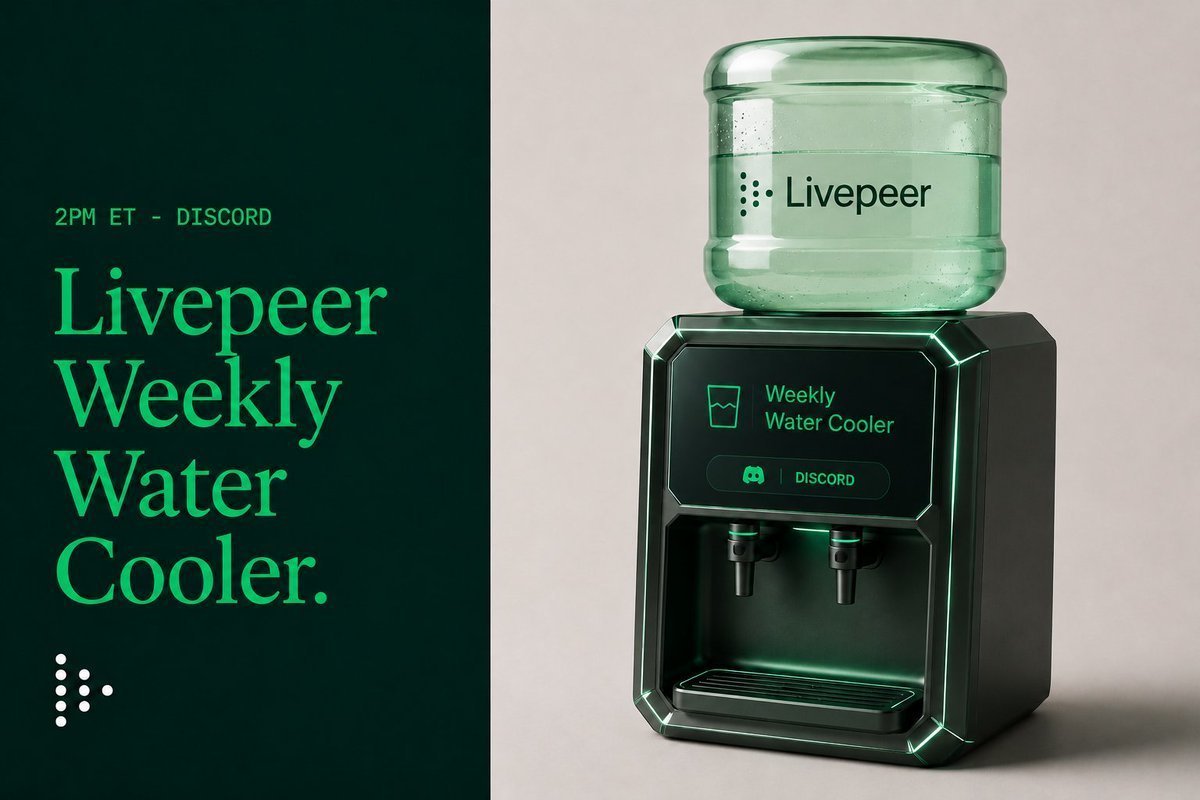
30 minutes (or ~1.8k GPU‑seconds, for those keeping latency score) until the weekly community Water Cooler chat 🍹
Livepeer tweet media
English
4
2
17
715