Li Ying

34 posts

Li Ying banner
Li Ying

Li Ying

@liying_n

Researcher in Max Planck Institute, Berlin. Language, Emotion, History. Check out my website for historical meaning of words: https://t.co/kgxEcQZZJr

Berlin, Germany Katılım Kasım 2014
116 Takip Edilen104 Takipçiler
Sabitlenmiş Tweet
Li Ying
Li Ying@liying_n·
My new paper with @thomhills in Cognition analyzed newspaper language referring to 60 U.S ethnic and cultural minority groups. Our research shows linguistic patterns underlying both the degree and content of outgroup prejudice. doi.org/10.1016/j.cogn…
English
0
3
13
0
Li Ying retweetledi
Devin Robert Wright
Devin Robert Wright@Devin_R_Wright·
‼️Paper alert‼️ Our paper "Humans create more novelty than ChatGPT when asked to retell a story" has been published in Nature Scientific Reports. We compare various differences between humans and ChatGPT when they serially reproduce 116 stories in chains. nature.com/articles/s4159…
English
1
8
22
12.5K
Li Ying retweetledi
Penny Pexman
Penny Pexman@PennyPexman·
We've been working on a lot of semantic norming projects over the last 2 years, but this one is the biggest: Now published in #psynomBRM: Concreteness ratings for 62000 multiword expressions, with @ejmuraki @summerabdalla and Marc Brysbaert. rdcu.be/cSlzz
Penny Pexman tweet media
English
1
19
69
0
Li Ying retweetledi
Dirk Wulff
Dirk Wulff@dirkuwulff·
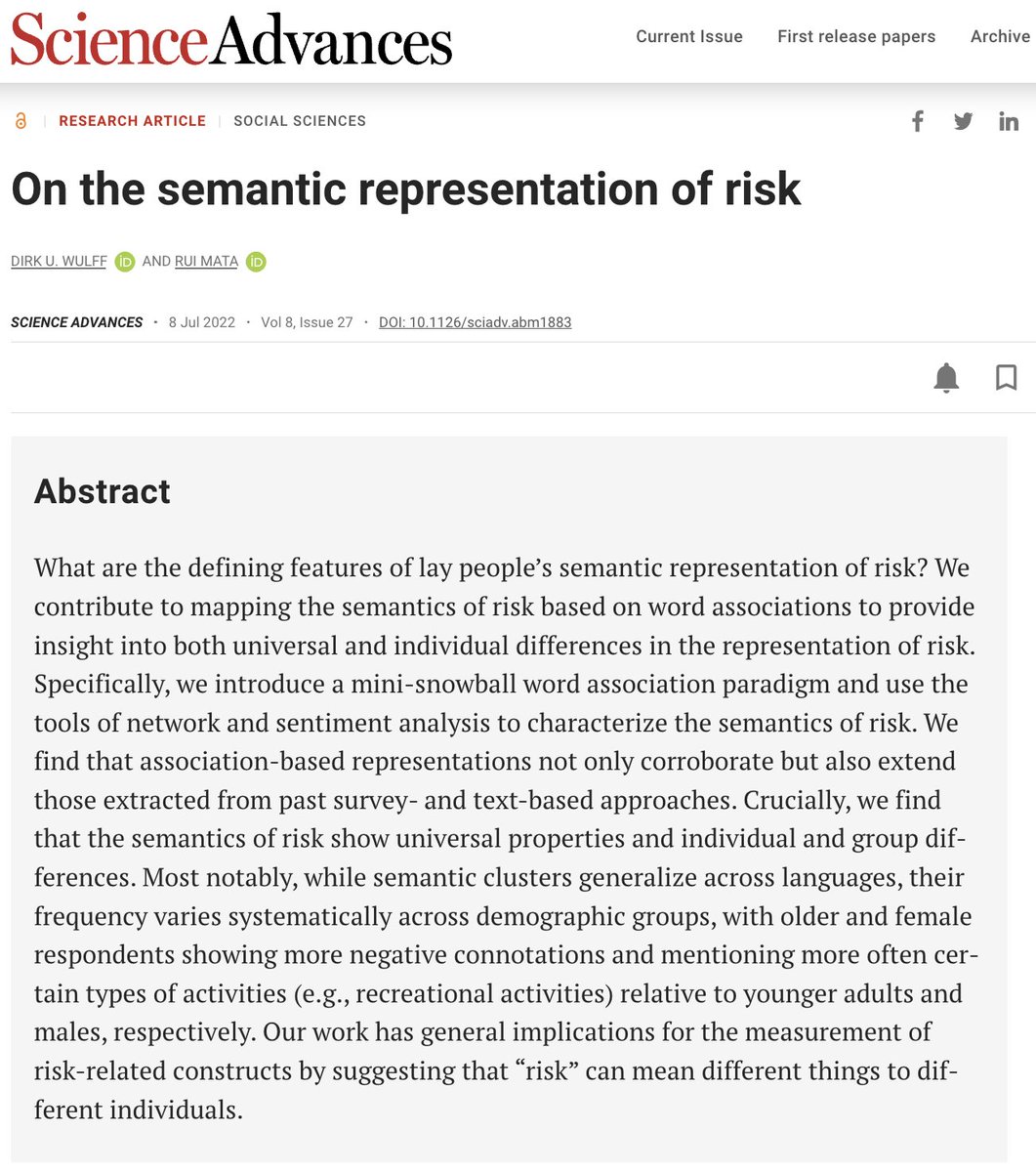
How does society think about #risk? In our 🚨 new article 🚨 in @ScienceAdvances, we use free associations and #network analysis to map people's multi-facetted representation of risk and show commonalities and differences across languages, age, and gender. With @rui__mata
Dirk Wulff tweet media
English
2
23
87
0
Li Ying
Li Ying@liying_n·
Taken together, our research demonstrates that semantic change is shaped by processing and acquisition patterns across generations of language users.
English
0
0
0
0
Li Ying
Li Ying@liying_n·
This hampering effect may have, in turn, curbed the rate of semantic change so that language does not change too fast for the human mind to catch up.
English
1
0
0
0
Li Ying
Li Ying@liying_n·
Why have some words changed their meanings more than others? My article with @csqsiew suggests that the rate of semantic change is constrained by how people use and learn language. link.springer.com/article/10.375…
English
1
2
5
0
Michael Geers
Michael Geers@michael_geers_·
Psychologists are increasingly sharing their code and data. Why not share their entire surveys too (instead of just screenshots)? Some immediate benefits for other researchers would be (1) better understanding of the exp. paradigm and (2) ease of reuse. Anything I’m missing?
English
4
2
14
0
Li Ying retweetledi
Ryan P. Badman
Ryan P. Badman@RyanPaulBadman1·
"rats.. can switch to a “stochastic” mode when challenged with a competitor that they cannot defeat by counterprediction... switching between strategic and stochastic behavioral modes is controlled by locus coeruleus input into ACC" cell.com/fulltext/S0092…
English
0
1
3
0
Li Ying retweetledi
Society for Affective Science
Society for Affective Science@affectScience·
🗓️REMINDER 🗓️Abstract submissions for #2022SAS are due November 22nd! The all-virtual conference will be held March 30-April 2, 2022! society-for-affective-science.org/conferences/20…
Society for Affective Science@affectScience

Hooray! 🎉 The #SAS2022 abstract portal is NOW OPEN! Abstracts are due 22nd November 2021. Please RT. Learn more about abstract submission formats & guidelines here: society-for-affective-science.org/conferences/20…

English
0
3
6
0
Li Ying retweetledi
Massimo Stella PhD
Massimo Stella PhD@MassimoSt·
🙏Grateful about this first student-led work by Asra Fatima at @CognoscoL with @liying_n, @thomhills and I. Started as a final project @exetercompsci , we produced an #AI using cognitive data and networks to predict & understand #stress, #anxiety and #depression levels in texts.
NetScience@net_science

DASentimental: Detecting depression, anxiety and stress in texts via emotional recall, cognitive networks and machine learning. (arXiv:2110.13710v1 [cs.CY]) arxiv.org/abs/2110.13710

English
1
5
15
0