Laura Jayes

20.2K posts

Laura Jayes banner
Laura Jayes

Laura Jayes

@ljayes

Host #AmAgenda 9-11am weekdays @skynewsaust

Australia Katılım Aralık 2008
4K Takip Edilen43.3K Takipçiler
Laura Jayes retweetledi
Receipt-Books/Business Angel
@ljayes Matt Cunningham is a class act and you can clearly see his love and frustrations with the NT. No other journo reporting on the NT like him. @SkyNewsAust
English
1
3
10
1.1K
Laura Jayes retweetledi
Jacinta Nampijinpa
Jacinta Nampijinpa@JNampijinpa·
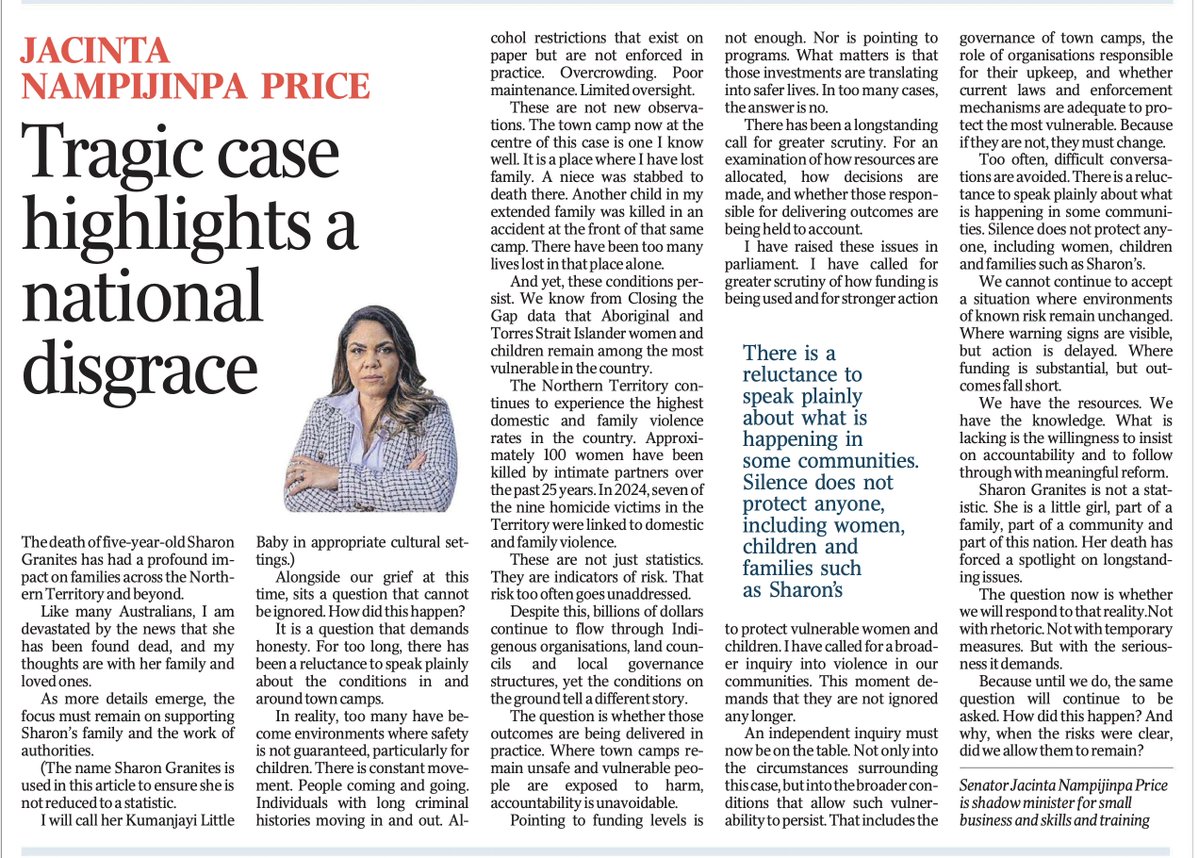
TRAGIC CASE HIGHLIGHTS A NATIONAL DISGRACE The death of five-year-old Sharon Granites has had a profound impact on families across the Northern Territory and beyond. Like many Australians, I am devastated by the news that she has been found dead, and my thoughts are with her family and loved ones. As more details emerge, the focus must remain on supporting Sharon’s family and the work of authorities. (The name Sharon Granites is used in this article to ensure she is not reduced to a statistic. When speaking of her, I will call her Kumanjayi Little Baby in appropriate cultural settings.) Alongside that grief sits a question that cannot be ignored. How did this happen? It is a question that demands honesty. For too long, there has been a reluctance to speak plainly about the conditions in and around town camps. In reality, too many have become environments where safety is not guaranteed, particularly for children. There is constant movement. People coming and going. Individuals with long criminal histories moving in and out. Alcohol restrictions that exist on paper but are not enforced in practice. Overcrowding. Poor maintenance. Limited oversight. These are not new observations. The town camp now at the centre of this case is one I know well. It is a place where I have lost family. A niece was stabbed to death there. Another child in my extended family was killed in an accident at the front of that same camp. There have been too many lives lost in that place alone. And yet, these conditions persist. We know from Closing the Gap data that Aboriginal and Torres Strait Islander women and children remain among the most vulnerable in the country. The Northern Territory continues to experience the highest domestic and family violence rates in the country. Approximately 100 women have been killed by intimate partners over the past 25 years. In 2024, seven of the nine homicide victims in the Territory were linked to domestic and family violence. These are not just statistics. They are indicators of risk. That risk too often goes unaddressed. Despite this, billions of dollars continue to flow through Indigenous organisations, land councils and local governance structures, yet the conditions on the ground tell a different story. The question is whether those outcomes are being delivered in practice. Where town camps remain unsafe and vulnerable people are exposed to harm, accountability is unavoidable. Pointing to funding levels is not enough. Nor is pointing to programs. What matters is that those investments are translating into safer lives. In too many cases, the answer is no. There has been a longstanding call for greater scrutiny. For an examination of how resources are allocated, how decisions are made, and whether those responsible for delivering outcomes are being held to account. I have raised these issues in Parliament. I have called for greater scrutiny of how funding is being used and for stronger action to protect vulnerable women and children. I have called for a broader inquiry into violence in our communities. This moment demands that they are not ignored any longer. An independent inquiry must now be on the table. Not only into the circumstances surrounding this case, but into the broader conditions that allow such vulnerability to persist. That includes the governance of town camps, the role of organisations responsible for their upkeep, and whether current laws and enforcement mechanisms are adequate to protect the most vulnerable. Because if they are not, they must change. Too often, difficult conversations are avoided. There is a reluctance to speak plainly about what is happening in some communities. Silence does not protect anyone, including women, children and families such as Sharon’s. We cannot continue to accept a situation where environments of known risk remain unchanged. Where warning signs are visible, but action is delayed. Where funding is substantial, but outcomes fall short. We have the resources. We have the knowledge. What is lacking is the willingness to insist on accountability and to follow through with meaningful reform. Sharon Granites is not a statistic. She is a little girl, part of a family, part of a community and part of this nation. Her death has forced a spotlight onto long-standing issues. The question now is whether we will respond to that reality. Not with rhetoric. Not with temporary measures. But with the seriousness it demands. Because until we do, the same question will continue to be asked. How did this happen? And why, when the risks were clear, did we allow them to remain?
Jacinta Nampijinpa tweet media
English
207
346
1.5K
38.6K
Laura Jayes retweetledi
The Other Side (Australian Vodcast)
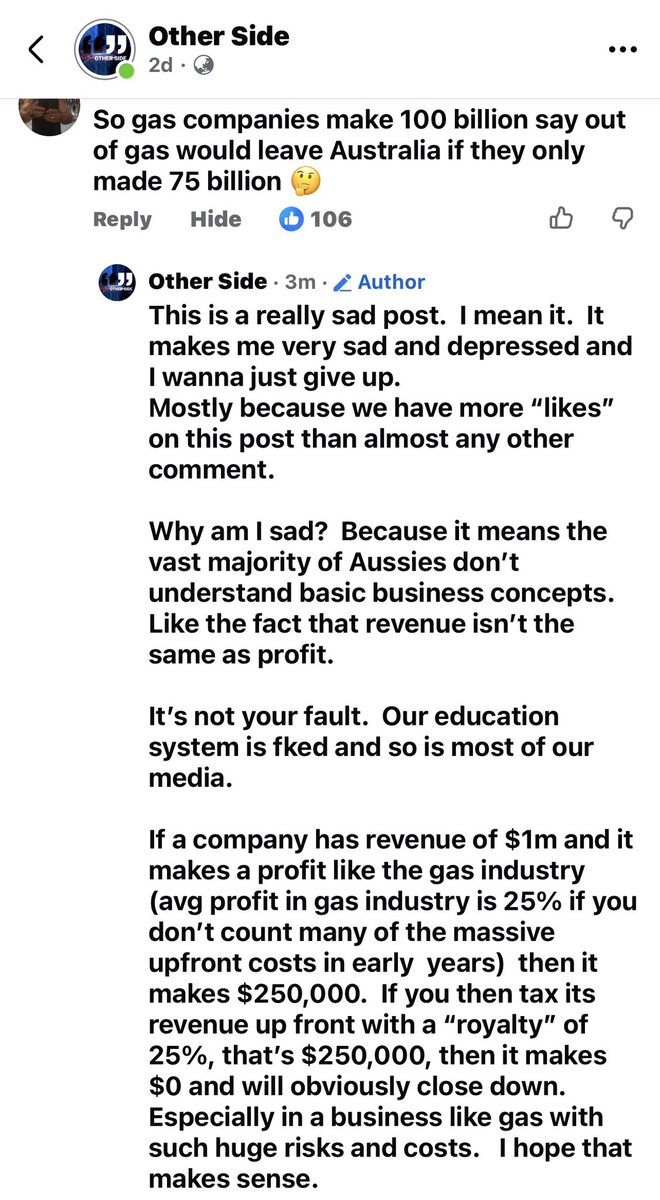
What’s really sad is Punters Politics and the Greens KNOW FULL WELL most people don’t understand basic business stuff like this. And this is how leftists take over countries with easy slogans and cool sounding populist PR campaigns like “the rich gas corporations are stealing from us!” For once I think we can applaud the major parties for not caving-in to the populism. But it probably won’t last. @ljayes @ellymelly @OzInstProgress @AusPoll6 @DrewPavlou @TopherField @OzraeliAvi @EnergyWrapAU
The Other Side (Australian Vodcast) tweet media
English
10
23
74
2.2K
Laura Jayes retweetledi
Hoops
Hoops@Hoopss·
Absolutely outrageous from Gout Gout. 10.04 at the age of 16. Speechless.
English
420
1.5K
23K
9M
Laura Jayes retweetledi
The Spectator Index
The Spectator Index@spectatorindex·
International Energy Agency chief says that Europe has 'maybe six weeks' of jet fuel left, says current shock is 'the largest energy crisis we have ever faced', according to AP report.
English
204
1.2K
5.8K
531.9K
Laura Jayes retweetledi
Peter Baker
Peter Baker@peterbakernyt·
A series of disjointed, hard-to-follow and sometimes-profane comments capped by threatening to wipe out Iran and attacking the pope have left many with the impression of a deranged autocrat mad with power and revived the debate about Trump's mental health. nytimes.com/2026/04/13/us/…
English
558
2.8K
7.5K
1M
Laura Jayes retweetledi
Track & Field Gazette
Track & Field Gazette@TrackGazette·
18-year-old GOUT GOUT 🇦🇺 19.67s (1.7) over 200m at Australian Championships in Sydney!!🤯🤯 A new U20 World Record ☑️ National Record ☑️ First Australian man under 20 seconds ☑️ A star is born!
English
1.1K
4.8K
43K
6.3M
Laura Jayes retweetledi
Christophe Ginisty
Christophe Ginisty@cginisty·
🔴 Le New York Times vient de publier le récit le plus accablant sur Trump depuis le début de la guerre. Et c'est une bombe. Jonathan Swan et Maggie Haberman, deux journalistes de la Maison Blanche, révèlent comment Trump a pris la décision d'entrer en guerre contre l'Iran. Ce qu'ils décrivent est exactement ce que j'analyse dans Le Pantin de la Maison Blanche. Voici les faits. Netanyahu a vendu un rêve. Le 11 février, dans la Situation Room, le Premier ministre israélien a présenté un scénario en quatre actes : tuer le Guide Suprême, détruire l'armée iranienne, déclencher une révolution populaire, installer un nouveau régime. Il a même montré une vidéo de montage avec les "futurs dirigeants" de l'Iran. Trump a répondu : "Sounds good to me." En une phrase, il venait de sceller le destin de la région. Le lendemain, la CIA a dit que c'était du vent. Les parties 3 et 4 du pitch de Netanyahu, la révolution populaire et le changement de régime, ont été qualifiées de "farce" par Ratcliffe lui-même. Rubio a traduit : "In other words, it's bullshit." Le général Caine a ajouté : "C'est la procédure standard des Israéliens. Ils survendent, et leurs plans ne sont pas toujours bien développés." Trump a entendu. Et il a quand même dit oui. Vance a tout vu. Le vice-président était le seul dans la pièce à s'opposer frontalement, avertissant que la guerre pourrait "détruire la coalition politique de Trump", que le Détroit d'Ormuz était le vrai point de vulnérabilité, que personne ne pouvait prédire les représailles iraniennes quand la survie d'un régime était en jeu. Il a dit : "Tu sais que je pense que c'est une mauvaise idée. Mais si tu veux le faire, je te soutiendrai." Ce n'est pas du courage politique. C'est de la déférence. Susie Wiles a regardé. La cheffe de cabinet, qui avait des inquiétudes, a estimé que ce n'était "pas son rôle" de s'exprimer sur une décision militaire devant les autres. Elle a "encouragé les conseillers à partager leurs vues." Elle s'est tue. Le général Caine n'a jamais dit non. Il a exposé les risques : diminution des stocks de munitions, Détroit d'Ormuz, pas de voie claire vers la victoire. Puis il a dit : "Si vous ordonnez l'opération, l'armée exécutera." Trump, lui, "entendait seulement ce qu'il voulait entendre." Et Trump a signé à bord d'Air Force One, 22 minutes avant la deadline fixée par son propre général : "Operation Epic Fury is approved. No aborts. Good luck." Voilà comment on entre en guerre au XXIe siècle. Pas avec une délibération solennelle. Pas avec un vote du Congrès. Pas avec une stratégie de sortie. Avec un slide show de Netanyahu, un "sounds good to me", et une note envoyée depuis un avion. Dans Le Pantin de la Maison Blanche, j'écris que les vrais décideurs sont ceux qui préparent les présentations que Trump regarde. Netanyahu l'a compris mieux que quiconque. Il a mis en scène une heure de spectacle visuel dans la Situation Room avec Mossad en fond d'écran, des vidéos de "futurs dirigeants", une promesse de victoire rapide et propre. Et Trump a dit oui. Pendant que Vance, Rubio, Wiles et Caine regardaient. Voici l'article du New-York Times : nytimes.com/2026/04/07/us/… 📖 Le Pantin de la Maison Blanche → amazon.fr/dp/B0GPCCMS68/
Christophe Ginisty tweet media
Français
649
16.7K
35.7K
3.1M
Laura Jayes retweetledi
Richard Fontaine
Richard Fontaine@RHFontaine·
There is a fog in diplomacy as of war, but a few things stand out after the ceasefire announcement: 1. This may not be the end but it’s at least the beginning of the end. Trump’s bluster might have opened the Strait of Hormuz and ultimately avoided catastrophic attacks on Iran’s civilian infrastructure. Two weeks give the sides a chance to lock in a peace deal. But it may not be a good agreement. 2. Already, Iran says that ships can pass the Strait “via coordination with Iran’s Armed Forces.” That means that Tehran controls access, which was not the case before the war. It’s hard to see how the United States – or the world – can accept indefinite Iranian control of such a key energy chokepoint. 3. Trump says Iran’s 10 point plan is a workable basis for negotiation. But that plan includes Iranian control of the Strait, accepting Iran’s right to enrich uranium, lifting all sanctions, no attacks on proxies like Hezbollah, paying reparations, and the withdrawal of US combat forces from the Middle East. It's a regime wishlist. 4. Iran remains in possession of its stock of highly enriched uranium, which the President says can be monitored effectively by satellite. If that was sufficient to prevent its misuse, however, it’s not clear why attacking Iran was necessary in the first place. 5. The real threat was Iran’s growing stockpile of missiles and drones, which it would eventually have in such quantities as to overwhelm any reasonable regional defenses. Behind that umbrella, Tehran could pursued its malign aims, including on the nuclear front. So if there was a casus belli, it was to degrade those programs. 6. But the administration’s war aims were broader: no nuclear Iran, no missiles or drones, no navy, no blocking the Strait of Hormuz, no support to proxies, decapitating the leadership and, depending on the day, overthrowing the regime. 7. Instead the regime remains in place, with nuclear material, and with degraded forces that still allow it to menace neighbors and block the Strait. If Tehran gets a decent proportion of its desired 10 points, we may face a materially worse situation than when this all started. 8. That's not inevitable, and hopefully that outcome can be avoided. But the negotiators now have tremendous work before them.
English
47
265
885
533.2K
Laura Jayes retweetledi
Physics & Astronomy Zone
Physics & Astronomy Zone@zone_astronomy·
The highest quality video of the moon was just released… this is so beautiful.
English
5.2K
65.1K
332.8K
11.3M
Laura Jayes retweetledi
Piers Morgan
Piers Morgan@piersmorgan·
If this is ‘3-D Chess’, I’m an Aardvark.
Abier@abierkhatib

Trump’s “victory timeline” claims. Mar 3: "We won the war." Mar 7: "We defeated Iran." Mar 9: "We must attack Iran." Mar 9: "The war is ending almost completely, and very beautifully." Mar 11: “You never like to say too ⁠early you won. We won. In ​the first hour it was over.” Mar 12: "We did win, but we haven't won completely yet." Mar 13: "We won the war." Mar 14: "Please help us." Mar 15: "If you don't help us, I will certainly remember it." Mar 16: "Actually, we don't need any help at all." Mar 16: "I was just testing to see who's listening to me." Mar 16: "If NATO doesn't help, they will suffer something very bad." Mar 17: "We neither need nor want NATO's help." Mar 17: "I don't need Congressional approval to withdraw from NATO." Mar 18: "Our allies must cooperate in reopening the Strait of Hormuz." Mar 19: "US allies need to get a grip - step up and help open the Strait of Hormuz." Mar 20: "NATO are cowards." Mar 21: "The Strait of Hormuz must be protected by the countries that use it. We don't use it, we don't need to open it." Mar 22: "This is the last time. I will give Iran 48 hours. Open the strait" Mar 22: "Iran is Dead" Mar 23: "We had very good and productive talks with Iran." Mar 24: "We’re making progress." Mar 25: “They gave us a present and the present arrived today. And it was a very big present worth a tremendous amount of money. I’m not going to tell you what that present is, but it was a very significant prize.” Mar 26: "Make a deal, or we’ll just keep blowing them away." Mar 27: "We don’t have to be there for NATO." Mar 28: No major quote Mar 29: Claimed talks were progressing Mar 30: "Open the Strait of Hormuz immediately, or face devastating consequences." Mar 31: Claimed a deal was "very close" and that Iran would "do the right thing" Apr 1: "We’ll see what happens very soon." Apr 2: Repeated that a deal was likely, while warning of continued strikes if not Apr 3: "Something big is going to happen." Apr 4: Said Iran must comply "immediately" or face further consequences. Apr 5: "Open the fuckin' Strait, you crazy bastards, or you'll be living in Hell - JUST WATCH! Praise be to Allah." 😂

English
305
305
2.9K
736K
Laura Jayes
Laura Jayes@ljayes·
I did not know it was $1.7B! Wild
Huge@Huge_Wildlife

@ljayes Love your work on Skynews, here is details from Grok on the $1.7b to Iran: es, Trump's reference to the Obama administration flying $1.7 billion in cash to Iran is essentially accurate in its core details, though the full $1.7 billion figure combines multiple transfers and the payments were in foreign currencies (euros, Swiss francs, and others), not U.S. dollars. Background and Details This was not a direct "gift" under the 2015 Iran nuclear deal (JCPOA). It settled a decades-old legal claim at the Iran-U.S. Claims Tribunal in The Hague. Before the 1979 Iranian Revolution, Iran paid the U.S. about $400 million for military equipment that was never delivered after the Shah was overthrown. Iran pursued the claim (principal plus interest) for years. The Obama administration negotiated a settlement for $1.7 billion total: the original ~$400 million principal plus ~$1.3 billion in negotiated interest (far less than what a full tribunal ruling might have awarded). Timing: The first installment of $400 million (in foreign cash on wooden pallets) was delivered on January 17, 2016—the same day Iran released four American prisoners (including journalist Jason Rezaian) as part of a separate prisoner swap. The Obama administration initially described the events as coincidental but later acknowledged using the payment timing as "leverage" to ensure the prisoners' safe release. Subsequent payments: The remaining $1.3 billion was sent in additional cash installments in late January and early February 2016. Why cash? U.S. sanctions isolated Iran from the international banking system, making wire transfers difficult or unreliable. Officials said cash (procured via central banks in Switzerland and the Netherlands, then converted) ensured immediate, guaranteed delivery as required by the settlement. No U.S. dollars were used, to comply with sanctions rules.
English
10
1
6
5.1K
Laura Jayes retweetledi
David Axelrod
David Axelrod@davidaxelrod·
I do not believe for a second that our military targeted an elementary school. But if an errant American missile accidentally killed a building filled with children, we should take responsibility for it, not sweep it under the rug. nytimes.com/2026/03/08/wor… via @NYTimes
English
2.7K
619
3.9K
578.2K
Laura Jayes retweetledi
Laura Ingraham
Laura Ingraham@IngrahamAngle·
If true, this is horrific news--and the U.S. military will have to address this publicly. Proximity of military compound obviously a factor, but our weapons also have pinpoint accuracy. NEW: Investigators think American forces were likely responsible for an airstrike on a girls’ elementary school that killed dozens of children in Iran, a U.S. official said wsj.com/world/middle-e… via @WSJ
English
4.4K
1.6K
8.5K
1.9M
Laura Jayes retweetledi
Kim Ghattas
Kim Ghattas@KimGhattas·
A rather scary read... and a repeat of what we saw in Gaza. "As planning for a potential strike in Iran was underway, Maven, powered by Claude, suggested hundreds of targets, issued precise location coordinates, and prioritized those targets according to importance, said two of the people. The pairing of Maven and Claude has created a tool that is speeding the pace of the campaign, reducing Iran’s ability to counterstrike and turning weeks-long battle planning into real-time operations, said one of the people. The AI tools also evaluate a strike after it is initiated, the person said." washingtonpost.com/technology/202…
English
46
645
1.2K
208.3K