Louis McKeeve

1.3K posts

Louis McKeeve banner
Louis McKeeve

Louis McKeeve

@lmkeev

💼 Building Upwork for UGC @ https://t.co/NLtYDgputQ 🔎 Acquiring digital businesses @ https://t.co/z3wVjmLXbZ

🇻🇳HCMC / 🇬🇧London Katılım Haziran 2022
966 Takip Edilen892 Takipçiler
Louis McKeeve
Louis McKeeve@lmkeev·
Good content only costs $150. 3 UGC creators. $50 each. On-demand content in 48 hours. No salaries. No benefits. Just content that converts. The system: 1. Post a job (can use @Pitchlo_ cos its free ...yes plugging my platform also) 2. Test 3-5 creators with small projects 3. Scale the winners, drop the rest 4. Build relationships with your top 3 Why this beats a marketing hire: → 10x cheaper → 10x faster → You test multiple styles, not one person's taste The creator who knows your brand after 10 videos will outperform any marketer on day 1.
English
1
0
1
206
Louis McKeeve
Louis McKeeve@lmkeev·
Stop using AI ads, start getting a Iphone 14 and knocking out low quality videos. This is the whole point of UGC. But most founders miss it. And people are fed up off AI Ads. What brands do wrong: → Add logos in the first 3 seconds → Use "ad voice" (overly enthusiastic, salesy) → Over-produce (lighting, editing, music) → Script every word What actually converts: → Shot on iPhone → Natural lighting → Real language ("this thing is actually insane" not "this product revolutionizes") → Feels like a recommendation, not a pitch The mindset: You're not making an ad. You're making a video that happens to sell something. When we hire creators on @pitchlo_ , the brief is simple: "Make it look like a story you'd post for your friends." That's it. The less it looks like an ad, the better it performs.
English
0
0
3
179
Louis McKeeve
Louis McKeeve@lmkeev·
2026 is the year of Paid "Thurst Trap" Ads.The data is clear. In our Facebook ad tests, female creators consistently outperform male creators on CTR. Not always. But often enough to be a pattern. Why I think this happens: → More expressive delivery → Better on-camera energy → Audience trusts recommendations more (parasocial psychology) → Stands out in feeds dominated by male founders → "Thurst" trends When we post a job on Pitchlo, we usually get 60%+ female applicants. We test both. We scale what works. The lesson: Don't assume you know what converts. Test everything. Creator style, age, energy, setting, hook , all variables. Your audience will tell you what they respond to. Listen.
English
0
0
3
173
Louis McKeeve
Louis McKeeve@lmkeev·
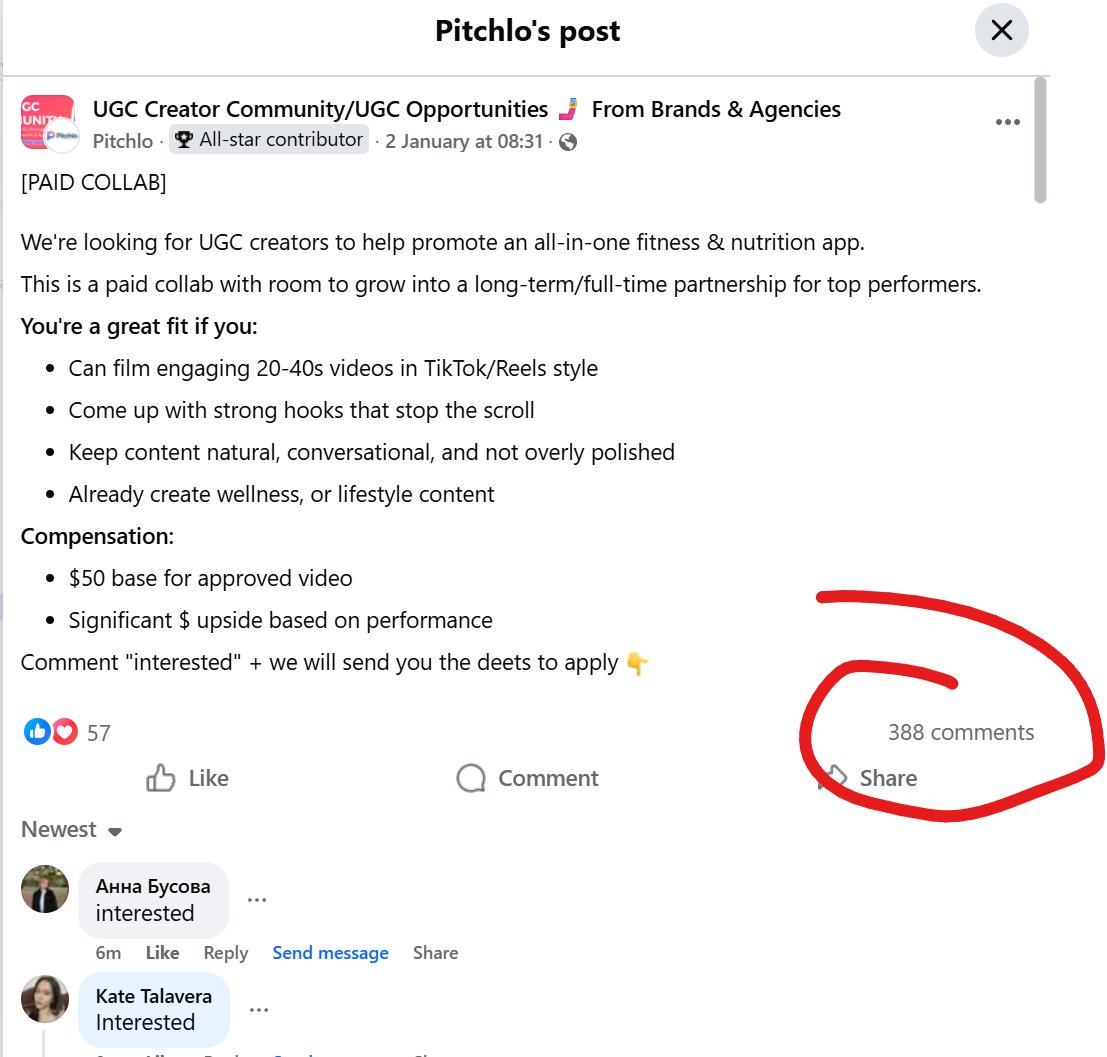
We keep going viral on Facebook Groups and yet no one is talking about this marketing channel. It is probably the least competitive and lowest effort channel to be marketing your start up right now. We are even of celebrity status with our "All Star Contributor" within at least 2 groups now. That's nearly 400 responses to a job post we did for a client....yet others are posting on Reddit to get UGC creators and miserably failing. Companies are paying just $50-$100 dollar for high quality human UGC Ads from creators. Human led UGC is not as expensive as it is made to be. I am yet to see many examples of AI UGC doing 4-6x ROAS on Facebook Ad campaigns, but we are betting on unpolished, "rougher looking" UGC videos becoming a trend this year and more trusted by consumers. If everyone is publishing the same AI perfection in UGC distribution, then how can you stand out?
Louis McKeeve tweet media
English
0
0
2
131
Louis McKeeve
Louis McKeeve@lmkeev·
Facebook ads are IMO the greatest invention of the 21st century. Just click some buttons and an algorithm finds customers that will buy your product.
English
1
0
3
100
Louis McKeeve
Louis McKeeve@lmkeev·
Your UGC can be perfect. Doesn't matter if no one watches past second 2. The hook is everything. Here's what I've learned testing dozens of creatives: Hooks that work: → Pattern interrupt: Start mid-action, mid-sentence, or with something visually unexpected → Direct callout: "If you're a startup founder..." (person thinks "that's me") → Controversial claim: "UGC agencies are a scam" (person thinks "wait what") → Specific number: "I spent $50 on this" (specificity = curiosity) → Transformation: Before/after in first 3 seconds Hooks that fail: → "Hey guys!" (instant scroll) → Slow intros or logos → Generic claims ("This product is amazing") → Starting with context instead of payoff The test: Watch your video on mute. First 2 seconds only. Would you stop scrolling? If not, re-shoot the hook. Everything else can stay. We've had the same script perform 3x better just by changing the opening line.
English
0
0
2
75
Louis McKeeve
Louis McKeeve@lmkeev·
Anyone else seeing increase in users paying with Klarna for subscriptions? Pretty worrying levels of consumer debt in US...
English
0
0
8
119
Louis McKeeve
Louis McKeeve@lmkeev·
claude being down should be everyones reminder to do more marketing
English
7
0
18
1.5K
Louis McKeeve
Louis McKeeve@lmkeev·
90% of bad UGC comes from bad briefs. Founders send creators a 3-page doc with brand guidelines, messaging pillars, and "key differentiators." The creator gets overwhelmed. Makes something generic. Everyone's disappointed. Here's the brief template that actually works: The 5-line brief: Hook: "Start by saying [X] or showing [Y]" Problem: "Talk about [pain point your audience has]" Solution: "Show how [product] fixes it" Proof: "Mention [specific result or feeling]" CTA: "End with [what you want viewers to do]" That's it. Example: Hook: "I was mass DMing brands for 2 hours a day" Problem: "Getting partnerships was exhausting and random" Solution: "Then I found this platform that sends me opportunities" Proof: "Got 3 brand deals in my first week" CTA: "Link in bio if you want to try it" Why simple briefs win: Creators aren't actors reading scripts. They're real people sharing experiences. Give them the skeleton. Let them add the personality. The best UGC feels unscripted because it mostly is.
English
0
0
3
76
Louis McKeeve
Louis McKeeve@lmkeev·
I have been looking a lot at viral loop marketing strategies - ie building products that have network effects implicitly built in that compound over time. Uber, Tinder, Wise all do this well in that sharing functions are part of the product experience...network value compounds. The only moat or value worth building for (long term) I can see is network as the product is getting easier and easier to build.
English
0
0
0
71
Minh-Phuc Tran
Minh-Phuc Tran@phuctm97·
The biggest mistake I made is building without compounding value. If every minute I spend building is adding a lil value to a compounding product. I’d be creating so much value in the span of a few months. How do you make sure you’re creating compounding value when building?
English
20
0
22
2.8K
Louis McKeeve
Louis McKeeve@lmkeev·
"Just give it to me". That's a prompt I tell Claude when I'm feeling lazy designing new features. Then you find what Cursor produces is a complete mess or breaks some sort of code. Here's a great prompt I have found as a lifesaver before Cursor / Claude does a recommendation: "Do not assume anything or make any assumptions about what is in my codebase. Ask questions of things you are unsure of before making recommendations". Especially helpful when strategizing Code design with Claude and saves a lot of headaches.
Louis McKeeve tweet media
English
1
0
4
159
Louis McKeeve
Louis McKeeve@lmkeev·
If I only had $500/month to grow my startup, here's exactly what I'd do:$150 → 3 UGC videos Find 3 creators. Pay $50 each. Give them a simple brief: → Hook in first 2 seconds → Show the problem → Show your product solving it → Call to action Don't overthink it. Raw beats polished. Authentic beats scripted. I find creators on @pitchlo_ in about 10 minutes. (yes i just plugged my own platform) Post a job (for free), get 20+ applications, pick the best fit. $350 → Facebook ads Run all 3 videos as separate ads. Same audience. Same budget. After 48-72 hours, you'll know: → Which creator style works → Which hook grabs attention → Which offer converts Kill the losers. Put remaining budget into the winner. The math: If your product is decent, expect 3-4x ROAS. $350 in → $1,000+ out. Now your $500 budget becomes $800. Then $1,200. Compounds fast. The mindset shift: Stop thinking of creators as vendors They're your part-time marketing team. The $50 creator who makes your winning ad? Put them on retainer. Build a relationship. They learn your brand, your audience, what converts. That's how you turn $500/month into a growth engine.
English
0
0
3
76
Louis McKeeve
Louis McKeeve@lmkeev·
If you've thought about using AI avatars for UGC, you've already lost. The whole point of UGC is that it's real. And people are becoming so savvy to this. A real human smile saying "I tried this and loved it" hits different than a deepfake reading a script.
English
0
0
2
77
Louis McKeeve
Louis McKeeve@lmkeev·
All you need for a great UGC video is $50. Like a proper real person. Found the creator on our own platform. First video she ever made for us. 8% CTR. Beating everything else we've tested. UGC reels paid reels ads are powerful. UGC isn't expensive. In fact at Pitchlo, we have a free tier for companies to post their jobs. It is never been easier to use UGC to scale your start ups.
English
0
0
4
124
Louis McKeeve
Louis McKeeve@lmkeev·
@alexcooldev looks cool. how are these vids performing vs. your other content on tiktok?
English
0
0
0
136
Alex Nguyen
Alex Nguyen@alexcooldev·
This AI influencer I built will helping me grow on Tiktok, YT and IG 100% organically. My 3-step system: Step 1: Create an avatar with nano banana Step 2: Generate the script with ChatGPT Step 3: Turn the script + avatar into UGC with Arcads Instead of paying $1,000 per video, I built my own AI UGC factory.
English
82
62
1K
153.6K
Louis McKeeve
Louis McKeeve@lmkeev·
Easiest way to reduce churn rate: Stop doing monthly subscriptions.
English
3
0
11
172
Louis McKeeve
Louis McKeeve@lmkeev·
Running an army of UGC "baddies" and "thurst traps" on Tikok could be the biggest growth hack to market your tech start up in 2026
English
2
0
3
908
Louis McKeeve
Louis McKeeve@lmkeev·
Most bootstrapped founders are allergic to paid ads. "Too expensive." "Not ready yet." "I'll do organic first." I used to think this too. Spent months doing manual outreach, posting content, waiting for traction. Then I ran my first $200 Facebook test. 48 hours later I knew exactly what was wrong with my offer. Here's what changed my mind: Organic is slow feedback. You post, wait, tweak, wait. Months pass. You're still guessing. Ads are fast feedback. $200 tells you: → Does anyone click? → Does anyone buy? → What copy resonates? → What audience responds? At Pitchlo we tested two audiences. Same budget. Same creative. Content Creator interest: $3.41 per signup Broad targeting: $10.68 per signup That's 3x difference. Found in 48 hours. No amount of organic posting would've revealed that. Now I keep an "experiment fund" every month. $200-500 just for testing random business ideas. If it doesn't convert with ads, I kill it fast and move on. The catch , and this is important: Ads are a double-edged sword. Don't drink from the well too much. We got comfortable with 4-5x ROAS. Started depending on it. Then we realized: if our ads break, our business breaks. So we use ad revenue to fund organic. Hire content creators. Build brand. Create assets that compound. Ads should accelerate learning and fund growth. Not replace your entire strategy. The founders winning in 2026 will be the ones who test fast, learn cheap, and reinvest into things that compound. $200 is a small price for clarity.
English
4
0
6
141
Louis McKeeve
Louis McKeeve@lmkeev·
Facebook Groups is the most slept-on channel in marketing your startup. We post jobs on FB Groups that get 100+ creator applications for our UGC platform @pitchlo_ The trick is to get one of these sleek badges to amplify reach "Top Contributor:" Cost: $0. Just commenting gets you points. While everyone's fighting for attention on LinkedIn and Twitter, we're farming leads in social medias probs biggest channels.
Louis McKeeve tweet media
English
1
0
6
211