Lauren Friedman

235 posts

Lauren Friedman

Lauren Friedman

@lololizzle

Vanderbilt University. Former NCAA athlete. Advocate for informed consent in psychiatric care. Empowered victim of iatrogenic SSRI harm. PSSD sufferer.

Los Angeles, CA Katılım Ağustos 2024
201 Takip Edilen138 Takipçiler
Lauren Friedman retweetledi
danielle gansky
danielle gansky@DanielleGansky·
ANTIDEPRESSANT WITHDRAWAL INJURY is a serious neurological brain injury that happens even when you stop an SSRI following “standard” doctor tapering advice. After long-term use, the brain & nervous system adapt and change but the rushed 2-4 week one-size-fits-all tapers doctors still use are dangerously fast and actively causing brain injuries on a massive scale. Right now, thousands of people are being harmed simply by doing exactly what their doctors tell them and end up with long-term neurological damage and years of disability. The system gaslights victims, denies the harm, and hides the truth. This rivals the opioid crisis. If you've been affected, you're not alone. Share your story. #antidepressantwithdrawal #pssd
Mikhaila Peterson@MikhailaFuller

My experience with psych med withdrawal/akathisia from lexapro. There are over 600 stories at prescribed-harm.com now. Worse than mine. Like my dad’s. If you want you can add your story, if you’ve been injured by medications, and I’ll add to it to the site too.

English
293
660
3.4K
1.6M
Lauren Friedman retweetledi
J͎Λ͎Y͎
J͎Λ͎Y͎@TakeThiamine·
"When patients report harm—such as withdrawal, PSSD, suicide, violence, or hallucinations—after starting a psych drug, we're told, 'Correlation doesn't equal causation.' Yet, when patients say the drug saved their lives, correlation becomes evidence. Go figure." —Kim Witczak, FDA Drug Safety Advocate and Consumer Representative, Psychopharmacologic Drugs Advisory Committee (PDAC) A 2014 survey of 1,829 antidepressant users found that the majority experienced serious adverse effects—most of which they were never warned about. 62% reported sexual dysfunction. 60% reported emotional numbing. Over half said they no longer felt like themselves. Nearly two in five reported suicidal thoughts while on the drug. When they tried to stop, 55% experienced withdrawal symptoms. Only 1% recalled being told this could happen. These are not rare reactions buried in prescribing footnotes. These are majority experiences, exposed only because someone thought to ask. And for those who do recognize something is wrong, the system has a second mechanism. A person experiences a traumatic or stressful life event and is prescribed an SSRI. The SSRI induces mania or hypomania—a well-documented side effect. They try to discontinue. The tapering process introduces new symptoms. The prescriber, rather than recognizing iatrogenic harm, concludes: "You were bipolar all along. You need these drugs long-term—and perhaps these drugs too." The ultimate gaslight is interpreting a patient's psychotropic withdrawal as proof of pathology—a framework where the treatment's failure is used to justify its necessity. Despite this, withdrawal is routinely misidentified as relapse. A 2019 systematic review across 14 studies confirmed the scale: 56% of people attempting to stop antidepressants experience withdrawal, with nearly half describing those symptoms as severe. The serotonin premise itself is non-falsifiable in routine practice: • There is no reliable clinical test that can diagnose a "low serotonin" state in a living patient's brain. • There is no blood nor urinary metabolite test that maps cleanly onto synaptic serotonin signaling. • There is no threshold below which "serotonin deficiency depression" is confirmed. As Lacasse and Leo noted in their review titled Serotonin and depression: a disconnect between the advertisements and the scientific literature, "The fact that aspirin cures headaches does not prove that headaches are due to low levels of aspirin in the brain." In practice, this means the diagnosis is inferred from symptoms, the drug is chosen to "correct" a chemistry that was never measured, and any subsequent change is interpreted through the same unmeasured premise. That is circular logic by design. Call this diagnostic recursion: a self-sealing system in which iatrogenic effects are repeatedly fed back into diagnosis. Each cycle adds a new label, each label adds a new drug, and each new drug increases the odds of further adverse effects being mistaken for disease progression. Each reflection looks like a new diagnosis, but it's all the same face. You can see this loop everywhere: • Withdrawal anxiety becomes "worsening generalized anxiety disorder." • Akathisia and activation become "bipolar spectrum features" or "treatment-resistant agitation." • Emotional blunting and apathy become "residual depression," prompting dose escalation. • Sexual dysfunction and hormonal flattening are framed as psychiatric symptoms instead of endocrine consequences. By the time the patient is on three or four psychotropics, clinicians are no longer treating an initial condition—they are managing a chemically induced one.
danielle gansky@DanielleGansky

ANTIDEPRESSANT WITHDRAWAL INJURY is a serious neurological brain injury that happens even when you stop an SSRI following “standard” doctor tapering advice. After long-term use, the brain & nervous system adapt and change but the rushed 2-4 week one-size-fits-all tapers doctors still use are dangerously fast and actively causing brain injuries on a massive scale. Right now, thousands of people are being harmed simply by doing exactly what their doctors tell them and end up with long-term neurological damage and years of disability. The system gaslights victims, denies the harm, and hides the truth. This rivals the opioid crisis. If you've been affected, you're not alone. Share your story. #antidepressantwithdrawal #pssd

English
9
94
722
36.1K
Lauren Friedman retweetledi
Iatrogenic Awareness
Iatrogenic Awareness@iatrogenicaware·
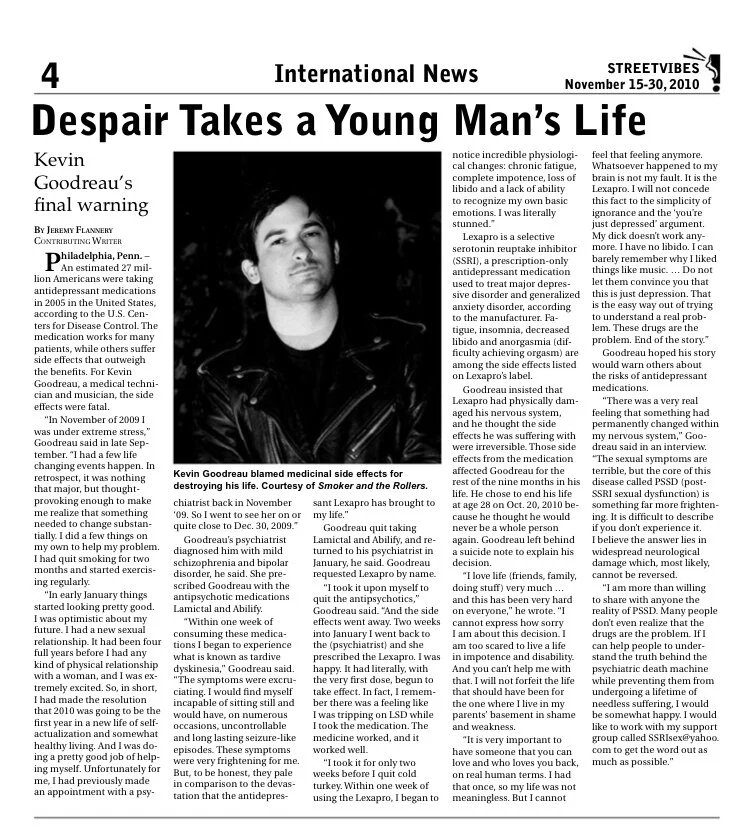
Crazy that PSSD victim Kevin Goodreau wrote "do not let them tell you this is depression" in his suicide note in 2010, and here we are still fighting this "PSSD is depression" narrative 20 years later.
Iatrogenic Awareness tweet media
English
5
35
90
7.1K
Lauren Friedman retweetledi
Ronan💊🚫❤️
Ronan💊🚫❤️@pssd_killjoy·
It’s so weird when people say “there’s more to life than sex” to people with PSSD. Do you want to volunteer to become castrated then??? We had no control over this and we only have one life.
English
7
8
52
1.3K
Lauren Friedman retweetledi
PSSD Network | Post-SSRI Sexual Dysfunction
"This can lock in for the rest of time. You can get genital numbing—like, the pathways that just allow you to feel what’s going on during sex, they get muted." Chris Williamson (@ChrisWillx) mentions Post-SSRI Sexual Dysfunction (PSSD) on his Modern Wisdom podcast.
English
3
20
76
2.8K
Lauren Friedman
Lauren Friedman@lololizzle·
@pavlovian_frog @MikhailaFuller Consider researching PSSD and protracted withdrawal injury. These medications are very much causing permanent neurological damage, and patients are completely blindsided by that fact when it happens to them.
English
0
0
6
143
pavlovian frog
pavlovian frog@pavlovian_frog·
@MikhailaFuller Stop being a retarded grifter like your dad. Typical cyclic antidepressants cause side effects and withdrawals, not neurological damage.
English
3
1
12
742
Lauren Friedman retweetledi
Joe Rogan Podcast News
Joe Rogan Podcast News@joeroganhq·
"What we are calling a mental health crisis is in large part a crisis of overmedicalization. Taking complex and real human struggles rooted in nutrition, sleep... and purpose and reducing them to medical conditions in need of medical interventions."
English
52
204
747
25.4K
Lauren Friedman retweetledi
Katie Collingwood
Katie Collingwood@KatieRColl·
Nobody told me that taking #SSRIs meant sacrificing my ability to have a relationship or to feel happy in my own body. Here's all the things I didn't know could happen before agreeing to take #prozac👇🏻
English
11
32
144
10.9K
Lauren Friedman retweetledi
Molly | PSSD
Molly | PSSD@NumbNotDumb99·
#Nobodytoldme that SSRI’s could strip away everything that made me human. Indefinitely, even after stopping the medication. They have taken away my sexuality and emotions although I’ve been off antidepressants for 2 years now. #PSSD
Inner Compass Initiative@_innercompass

🧵What were you never told about psychiatric diagnoses and drugs? Our founder Laura Delano recently shared what she was never told while testifying before a House Oversight subcommittee in Washington D.C. ... 1/

English
5
31
113
4.4K
Lauren Friedman retweetledi
Daniel Owens
Daniel Owens@dsowens17·
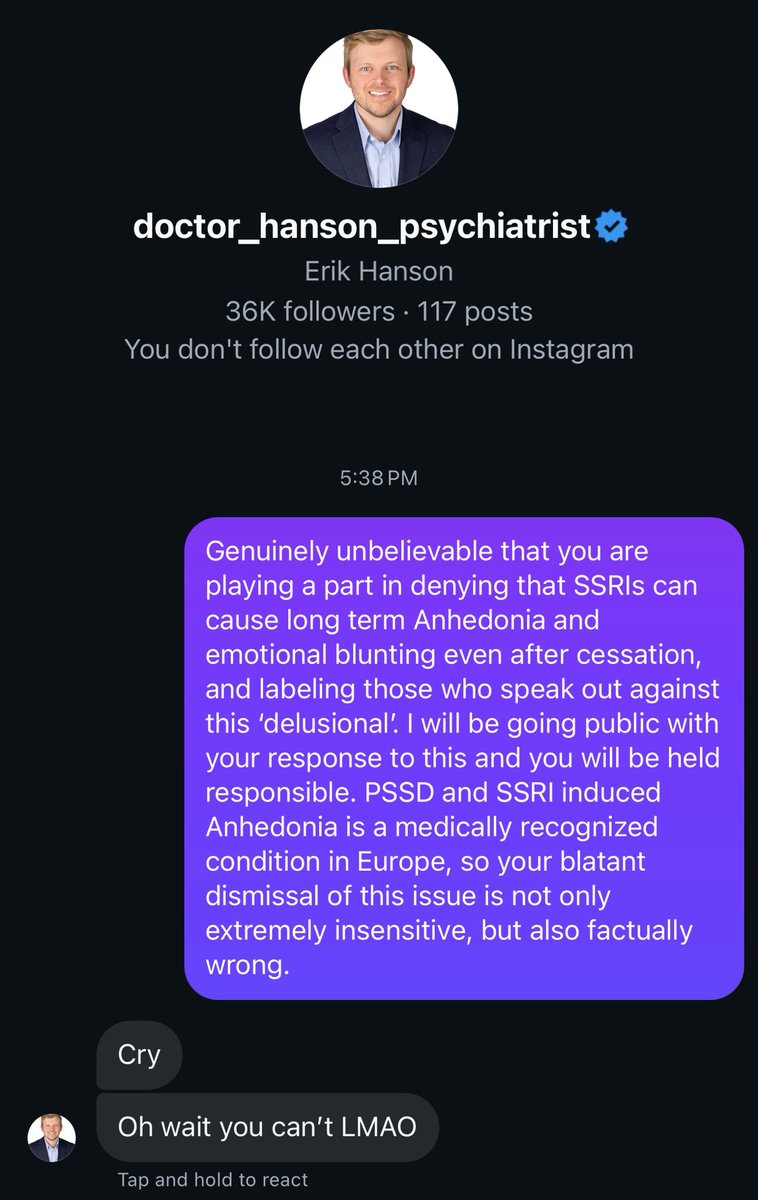
Not being able to cry when a family member dies or being able to process the grief of losing a close friend because of the severe emotional blunting from iatrogenic harm is dehumanising. A psychiatrist below mocking someone experiencing this. How common is this kind of behaviour? People show their true colours when they think no one is watching:
Iatrogenic Awareness@iatrogenicaware

Real exchange between a ‘doctor’ and I, openly mocking me for suffering from emotional blunting and Anhedonia. And we still wonder why so many PSSD victims commit suicide?

English
9
26
108
7K
Lauren Friedman retweetledi
Hans Amato
Hans Amato@HansAmato·
63 million Americans are on a medication right now that can permanently destroy the ability to feel pleasure. And most of them were never warned. It's called PSSD. Post-SSRI Sexual Dysfunction. A condition where sexual function, genital sensation, and emotional capacity do not return after discontinuing the medication. Not after months. Not after years. For some people, ever. There are thousands of men in online forums right now who took Zoloft or Lexapro for 6 months for mild anxiety and lost the ability to feel physical arousal, emotional connection, or orgasm. Permanently. They're 28, 31, 35 years old. The FDA added a warning label about persistent sexual dysfunction in 2019. The drugs had been prescribed for over two decades before that warning existed. The prescribing protocol that produces this outcome: 15-minute questionnaire. No blood test. No hormone panel. No thyroid check. No inflammatory markers. No nutrient status. Nothing objective. Just self-reported symptoms and a prescription pad. Nobody checked whether the "anxiety" was actually: > Ferritin at 12 (brain needs iron to synthesize neurotransmitters) > Free T3 at 1.8 (thyroid too low to maintain normal mood or cognition) > Vitamin D at 11 (directly linked to depression in dozens of studies) > Testosterone at 310 with estradiol at 45 (hormonal ratio so skewed the nervous system sits in permanent threat mode) > hs-CRP above 4 (chronic inflammation flooding the brain with endotoxin) > Fasting insulin at 18 (metabolic dysfunction creating neuroinflammation) Every single one causes anxiety. Every single one has a $15 blood test. Every single one has a fix that doesn't carry the risk of permanent neurological damage. What to do if you're on an SSRI or considering one: > Before accepting any psychiatric diagnosis, demand the full panel. Free testosterone, SHBG, estradiol sensitive, free T3, free T4, reverse T3, ferritin, vitamin D, hs-CRP, fasting insulin, homocysteine, B12. If your doctor won't order it, self-order for $150. > If the bloodwork shows metabolic or hormonal dysfunction, address those FIRST. Many men's "anxiety" resolves completely once the underlying biology is fixed. > If you're already on an SSRI and want to explore tapering, do it under medical supervision. Slow taper. Never cold turkey. > If you're experiencing persistent sexual side effects after stopping, you're not crazy. PSSD is real, it's documented, and there are practitioners working on it. 63 million prescriptions. Zero mandatory bloodwork. Billions in recurring revenue. The full pre-prescription testing protocol is on my substack. Every marker to demand, what to fix first, and how to have the conversation with your doctor before you take a pill that might permanently change who you are.
English
22
46
191
10.5K
Lauren Friedman retweetledi
Iatrogenic Awareness
Iatrogenic Awareness@iatrogenicaware·
Real exchange between a ‘doctor’ and I, openly mocking me for suffering from emotional blunting and Anhedonia. And we still wonder why so many PSSD victims commit suicide?
Iatrogenic Awareness tweet media
English
52
76
388
91.9K
Lauren Friedman retweetledi
Iatrogenic Awareness
Iatrogenic Awareness@iatrogenicaware·
@NumbNotDumb99 Exactly, I cannot fathom why ‘permanent emotional and sexual anesthesia are acceptable consequences of trusting regulatory health agencies’ isn’t universally agreed upon as wrong.
English
0
1
6
96
Lauren Friedman retweetledi
Mikhaila Peterson
Mikhaila Peterson@MikhailaFuller·
Akathisia is caused by psych med withdrawal but is also a side effect from a number of pharmaceuticals, not just withdrawal. Hell. The fact this fairly common reaction is hidden by pharmaceutical companies and renamed things like “restlessness” is criminal.
Sam Hall@samhall404

1/ TW ⚠️ One of my goals for 2026 is to raise more awareness about akathisia. Seeing as it’s one of the most severe side effects of psychiatric medications and withdrawal, it’s strange that so few prominent psychiatrists and institutions on this platform discuss it 🧵

English
38
85
446
44.9K
Lauren Friedman retweetledi
Iatrogenic Awareness
Iatrogenic Awareness@iatrogenicaware·
For #PSSD sufferers, the 'lack of proof' argument is an infuriating double standard; there are no physical biomarkers for depression, but when an SSRI causes permanent damage, that same lack of a biomarker is used to dismiss patient reports.
English
1
6
35
793
Lauren Friedman retweetledi
Iatrogenic Awareness
Iatrogenic Awareness@iatrogenicaware·
"Chemically Castrated: A Permanent, Growing Pharmaceutical Crisis Among Young Adults" Read my article on @Medium about the permanent harm #Finasteride, #Accutane and #SSRIs can cause. #PFS #PAS #PSSD #IatrogenicHarm @iatrogenicawareness/i-have-been-unable-to-feel-emotions-or-sexual-pleasure-for-5-years-all-because-of-an-fda-approved-9ff58fbf2d82?postPublishedType=repub" target="_blank" rel="nofollow noopener">medium.com/@iatrogenicawa
English
5
27
51
7.4K