

Longman
9.8K posts

Longman
@longmaaaa
It's better to be a warrior in garden than gardener on a war
Forest Katılım Ağustos 2011
1.6K Takip Edilen773 Takipçiler

1,5 млн просмотров, почти 100 тыс. лайков. я в шоке 😭
аля-ля@alyaalyaalyal
ну раз твиттер теперь интернациональный, настало время показать мои картины маслом
Русский
Longman retweetledi


Longman retweetledi

Alexander Solzhenitsyn gave the most controversial speech *against* Western Civilization at Harvard in 1978.
As a survivor of the Russian Gulags, they expected him to praise the West. Instead, he made a jarring accusation:
The West is a dying civilization. If it doesn't change its ways, it is doomed to collapse.
In fact, he said this has been the case for 500 years, when the West made a crucial mistake:
"How did the West decline from its triumphal march to its present debility?
...the mistake must be at the root, at the very foundation of thought in modern times. I refer to the prevailing Western view of the world which was born in the Renaissance…
I refer to humanism — the proclaimed autonomy of man from any higher force above him."
Solzhenitsyn said humanism made man autonomous from God, Truth, and objective morality.
If all morality is subjective, then man has nothing to live nor die for. Naturally, he loses his courage, embraces materialism, and grows effeminate to modern evils.
So, what is the solution?
A return to belief in a transcendental morality under God:
"If, as claimed by humanism, man were born only to be happy, he would not be born to die. Since his body is doomed to death, his task on earth evidently must be more spiritual…
The fulfillment of a permanent, earnest duty so that one’s life journey may become above all an experience of moral growth: to leave life a better human being than one started it."
All cultures live, or die, based on their respect of the True, Good, and Beautiful.
To save the West, Solzhenitsyn says start with beautifying your soul, for that is both how you live well, and begin to make civilization itself beautiful again.

English
@mexxanick @growing_daniel Два вопроса - были ли вы в Сербии и спрашивали ли как сербы относятся к русским, и при чем тут вообще Вучич?
Русский

@longmaaaa @growing_daniel Ну какая пропаганда, друг?
Русская пропаганда заставила Вучича оружие продавать на Украину?
Русский

I've seen like three Russian tweets like this, whats been going on with the Russian self esteem all this time
настя@_arzhevitinaa
я реально думала что большинство иностранцев ненавидят русских
English
Longman retweetledi

Дом тред, котятки. Как обещал, отвечаю на основные вопросы, параллельно рассказывая подробнее про дом и его хозяина (меня). С меня инфа, с вас лайк-ретвит, летс гоу

Русский
Longman retweetledi


Longman retweetledi

Do not use your energy to worry. Use your energy to believe, to create, to learn, to think and to grow.
- Richard Feynman
English
Longman retweetledi

Here is an almost 2-hour long documentary, filmed, edited & narrated by me.
ZERO STOCK FOOTAGE.
I literally went to these places to show you the mainstream historical narrative in Peru doesn't make sense.
If this work matters to you support it with a like/comment/repost
English
Longman retweetledi

A Soviet psychologist walked into a café in 1927 and watched a waiter do something impossible.
He remembered every open order at every table. Perfectly. Without notes. Without effort.
Then a table paid their bill. She asked him to repeat the order.
He couldn't remember a single item.
She spent the next two years figuring out why. What she found is now the operating system underneath every platform fighting for your attention.
Her name was Bluma Zeigarnik, and she was a graduate student at the time, sitting with her professor Kurt Lewin, watching the waiters work the room. What caught her attention was something so ordinary that it had been happening in restaurants for centuries without anyone asking why.
The waiters could remember every open order with perfect accuracy. Table four wanted the schnitzel with no sauce. Table seven had changed their wine twice. Table twelve owed for three coffees and a dessert. Every detail, held without effort, without notes, without any visible system at all.
But the moment a table paid their bill, the information vanished. Completely. Lewin tested it on the spot. He called a waiter back minutes after a table had settled up and asked him to recite the order. The waiter could not do it. Not partially. Not approximately. The information was simply gone.
Zeigarnik went back to her lab and spent the next two years turning that observation into one of the most replicated findings in the history of psychology.
Here is what she proved, and why it changes how you think about attention, memory, and almost every piece of media you have ever consumed.
She gave participants a series of tasks. Some tasks they were allowed to finish. Others were interrupted before completion. Then she tested recall across both groups.
The unfinished tasks were remembered at nearly twice the rate of the completed ones.
Not slightly better. Nearly twice. The brain was holding the incomplete work in a state of active tension, returning to it, keeping it warm, refusing to file it away. The finished tasks were closed, archived, released. The unfinished ones were still running.
She called it the resumption goal. When the brain commits to a task and cannot complete it, it opens a file that stays open until resolution arrives. That open file consumes a portion of your cognitive bandwidth whether you are thinking about it consciously or not. It surfaces in idle moments. It pulls at the edge of your attention during other work. It is the thing you find yourself thinking about in the shower when you were not trying to think about anything at all.
This is not a flaw in human cognition. It is a feature. The brain evolved to finish things. An open loop is a signal that something important is unresolved. Keeping that signal active increases the probability that you will return to it and complete it. In an environment where most tasks had real survival stakes, this was an extraordinarily useful mechanism.
In the modern world, it is the most exploited vulnerability in human attention.
Netflix did not invent the cliffhanger. But it industrialized it in a way no medium before it ever had. When a show ends on an unresolved question, it does not just create curiosity. It opens a file in your brain that stays active until the next episode closes it. The autoplay countdown that begins at 15 seconds is not a convenience feature. It is a precise calculation about how long the average person can tolerate an open loop before the discomfort of not knowing overrides every other intention they had for the evening. One more episode is not a choice. It is your brain doing exactly what it was designed to do: return to what is unfinished.
The writers who built Lost, Breaking Bad, and Succession understood this intuitively without ever reading a psychology paper. Every episode ended on an open question. Every season finale answered three things and opened five more. The entire architecture of prestige television is a Zeigarnik machine running at industrial scale.
But television is not where this gets dangerous.
Every notification on your phone is an open loop. Every unread email is an open loop. Every task you wrote on a list and have not yet crossed off is an open loop. Each one is consuming a small but real portion of your available attention, pulling fractionally at your focus, degrading your capacity to be fully present in whatever you are actually doing right now. TikTok's algorithm does not just serve you content you like. It serves you content that ends one loop and immediately opens another, keeping the resumption system permanently activated so the cost of stopping always feels higher than the cost of continuing.
The research on this accumulation effect is striking. Psychologists studying cognitive load have found that unfinished tasks do not sit passively in memory. They actively interrupt. They surface at the wrong moments. They are the reason you are reading something and suddenly remember an email you forgot to send. The brain is not malfunctioning. It is running its resumption system exactly as designed. It is just running it across forty open loops simultaneously, in an environment that generates new ones faster than any human nervous system was built to process.
The most important practical implication Zeigarnik's research produced is one that most people use backwards.
David Allen built his entire Getting Things Done system on the insight that the only way to close a cognitive open loop is to either complete the task or make a trusted commitment to complete it later. Writing something down in a system you actually trust has the same effect on the brain as finishing it. The file closes. The bandwidth is released. This is why writing a task down feels like relief even before you have done anything about it. You have not solved the problem. You have simply told your brain that the loop is registered and will be returned to, which is enough for the resumption system to stand down.
The inverse is equally true and far more destructive. Every task that lives only in your head, unwritten and unscheduled, is an open loop burning cognitive resources around the clock. The mental cost is not proportional to the size of the task. A tiny nagging obligation consumes the same active tension as a major project. Your brain does not discriminate by importance. It discriminates by completion.
Zeigarnik published her findings in 1927. The paper sat in academic literature for decades before anyone outside psychology paid attention to it.
Then television got good. Then the smartphone arrived. Then the entire attention economy was engineered, largely by people who understood intuitively what she had proven scientifically: an open loop is the most powerful hook available to anyone who wants to hold human attention.
Netflix knew it. Instagram knew it. Every designer who ever made a notification badge red instead of grey knew it.
The café in Vienna is long gone.
The mechanism she discovered there is now the operating system underneath every platform fighting for your time.
Every "to be continued."
Every unread notification.
Every thread that ends with "part 2 tomorrow."
All of it is the same waiter, the same unpaid bill, the same brain refusing to let go of what it has not yet finished.
Zeigarnik noticed it over coffee in 1927.
A century later, it is the most valuable insight in the history of media.
And nobody taught it to you in school.

English
Longman retweetledi

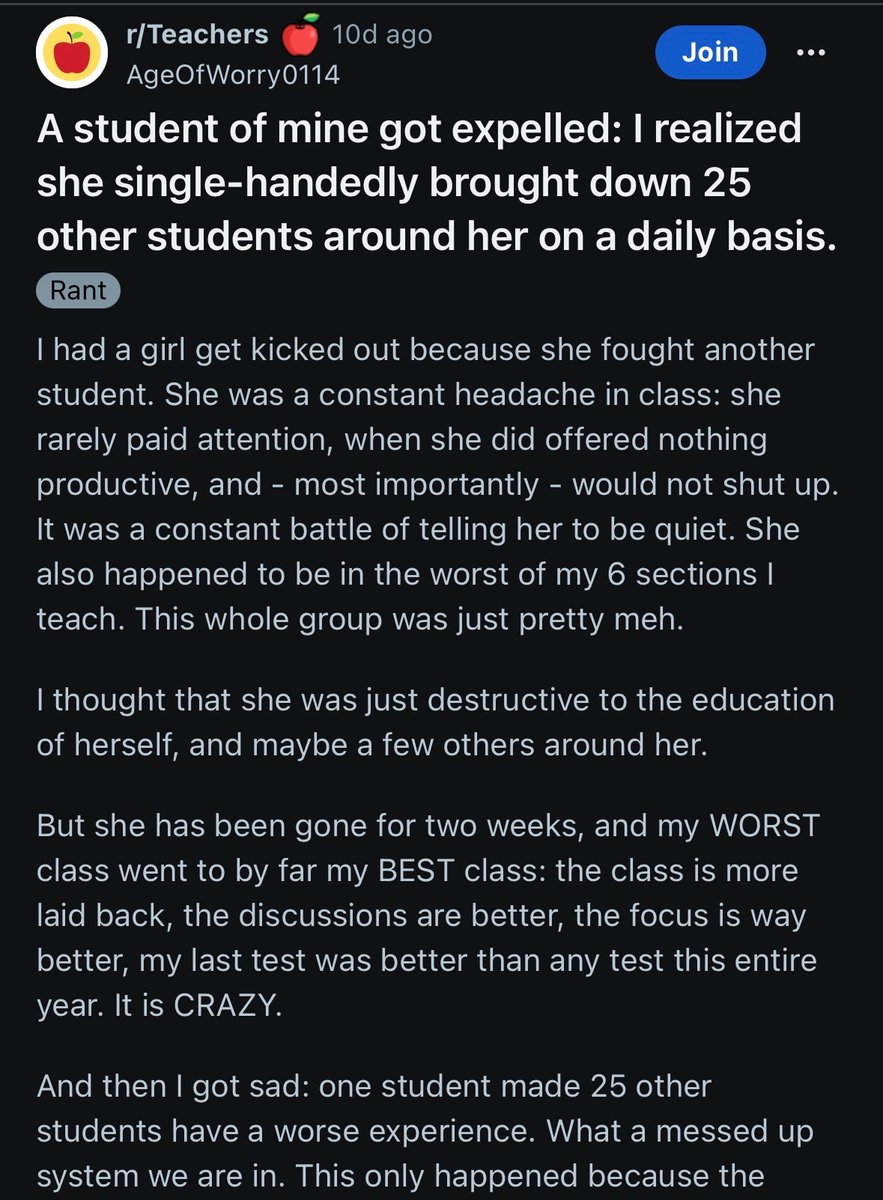
“One student made 25 other students have a worse experience”
Mercy to the cruel is cruelty to the innocent
English
Longman retweetledi

what will you do when there’s nowhere left to run
Radical Living@RadicalFalk
I'm leaving Germany | Brutally Honest Review
English
Longman retweetledi

Longman retweetledi

Только в условиях свободы ассоциации, где несогласных подвергают остракизму вместо попыток их переделать и заточать в ненавистной ими среде (это учит их маскироваться и мотивирует разрушать среду изнутри), возможно поддерживать долгосрочный положительный отбор и здоровье общества
можем не повторить@mojemnemojem
@msvetov а можно по подробнее о "либертарианском системном решении проблемы вырождения общества"?
Русский
Longman retweetledi

somehow a lot of people have missed the point when eff transformed from building hardware to hack government encryption and force it to adapt a better standard into a generic progressive nonprofit that cares about “tiktok abortion funds” (real example from their x goodbye).
the reason for that is the org has been hollowed out, still wearing the skin reminiscent of its former glory, but stuffed with nondescript activist bureaucrats that share none of the original values.
English
Longman retweetledi

The Electronic Frontier Foundation (@EFF) is, top to bottom, a Leftist Activism organization.
Take a quick look at the EFF Staff page. It is littered with:
- Reproductive Rights
- Equality
- Dismantle Systems of Oppression
- Marginalized Communities
- Sex Worker Rights
- Abortion Access
- Transgender Liberation
And on and on and on.
The EFF, originally created specifically to educate lawmakers and law enforcement on computers, is now entirely about extreme Leftist politics.
Their recent virtue signal about leaving @X is simply the latest in a long line of Leftist Virtue Signals.
eff.org/about/staff



English
Longman retweetledi

@Temptranquil @hytopia Rpg as a system, proof of concept as a single level/dungeon
English

@longmaaaa @hytopia Be careful making rpgs because they are super content heavy! Small addictive games with short game loops are the best fit!
English
The #1 thing you can do to help @hytopia right now, is to start playing around with the new hytopia-neo framework, and posting content around it.
We need a second wave of creators for this new more performant framework. I know we ask the community a lot, but if you have been or are now interested in creating games on hytopia, now is the most critical time, and it would be incredibly appreciated.
If you're not interested, or don't have time to create a full game on neo, you can still help us by making cool or useful plugins, and sharing those with other developers or just using them to create content and build awareness.
We're pumping out platform improvements, chat/social system has been updated and is continuing to get refactored, microtransactions are LIVE in Neo, and we have a ton more coming soon, and coming FAST.
Thanks Hytopians, I believe we're nearing a breakthrough! ❤️
English

🔌 Plugins are the heart of Neo.
The core stays lean: plugin scheduling, lifecycle management, and networking. That's it. Everything else lives in plugins.
And plugins control BOTH the client and server:
- Tick/frame systems
- React UI overlays
- Rendering hooks
- Movement & physics
- Skyboxes & weather
- Replace built-in features entirely
English
🚨 HYTOPIA-NEO, the next generation of the HYTOPIA framework, is live for testing.
Neo will quickly replace our old "HYTOPIA SDK" as the final generation of the HYTOPIA game client/server.
We'll be releasing a full announcement, overview & demo video soon, but if you're ambitious, here's how to get set up! 🧵👇
English